An ‘Invisible Brake’ on AI? New Research Suggests Content Debt is a $4.63 Trillion Liability

AI is growing explosively, but it’s also revealing the hidden cost of outdated and unmanaged enterprise content – and the number is bigger than the GDP of Japan. That stat might stop you dead in your tracks, but brands and organizations have an urgent need to address this problem. Here's why.
Content debt isn’t like other kinds of debt. It’s quiet, sneaky, and compounds exponentially in the shadows – where no one’s the wiser. It often accrues on your website, but it can spread across your organization’s entire content ecosystem like a virus.
We’ve known about content debt for a long time, lingering in the dark corners of Google where it can be conveniently ignored. Over time, it’s become a snowballing backlog of duplicated content, outdated topics, poorly structured text and terminology, and undocumented features.
Like technical debt in software development, content debt charges you interest. And that hefty bill pumps an invisible brake on your operations, wasting your team’s resources and hurting both your search engine rankings and AI search visibility. And at a moment when traffic is dying on the vine – and more customers are turning to answer engines like Google AI Overviews and ChatGPT – it’s become a critical liability.
But exactly how big is this problem? That’s what new research from Storyblok endeavored to find out. The CMS vendor collaborated with FT Longitude (an arm of The Financial Times) to shed some light on this question. And what they found ain’t pretty.
According to a survey of 550 senior executives at organizations with at least $1 billion in annual global revenue, content debt is costing enterprises $4.63 trillion worldwide.
You read that right: $4.63 trillion. That's bigger than Japan's GDP. A jaw-dropping stat by any measure.
The question is: how do we even begin to pay down this debt?
AI search exposed the problem – and made it worse
Prior to the modern AI explosion, content debt was out of sight and out of mind. Businesses could bury their old or low-quality content simply by de-indexing it, removing it from their navigation, or allowing only their most optimized pages to appear in search. So it persisted – but there were fewer routes to access it.
But AI has, for all intents and purposes, blown this up. LLMs are like bloodhounds, sniffing their way to inaccurate information that’s often obscured or even forgotten. This could be old product data or misrepresented pricing that could surface in an AI search, resulting in poor customer experiences. And because organizations can’t directly control what an LLM surfaces, this content is proving to be a liability.
As noted, this financial impact is harrowing. But the report also revealed some other compelling metrics. For example, 67% of executives say that poor content quality or structure is reducing their visibility in search and AI-driven discovery. A clear sign that enterprise leaders understand what’s happening and what’s at stake.
Respondents also indicate that there's an average of $663.4 million in content debt per company, and they’re spending roughly $4.8 million fixing the problems – and that’s 34% of the total content spend.
Source: “Content Debt: A $4.63 Trillion Business Liability” report
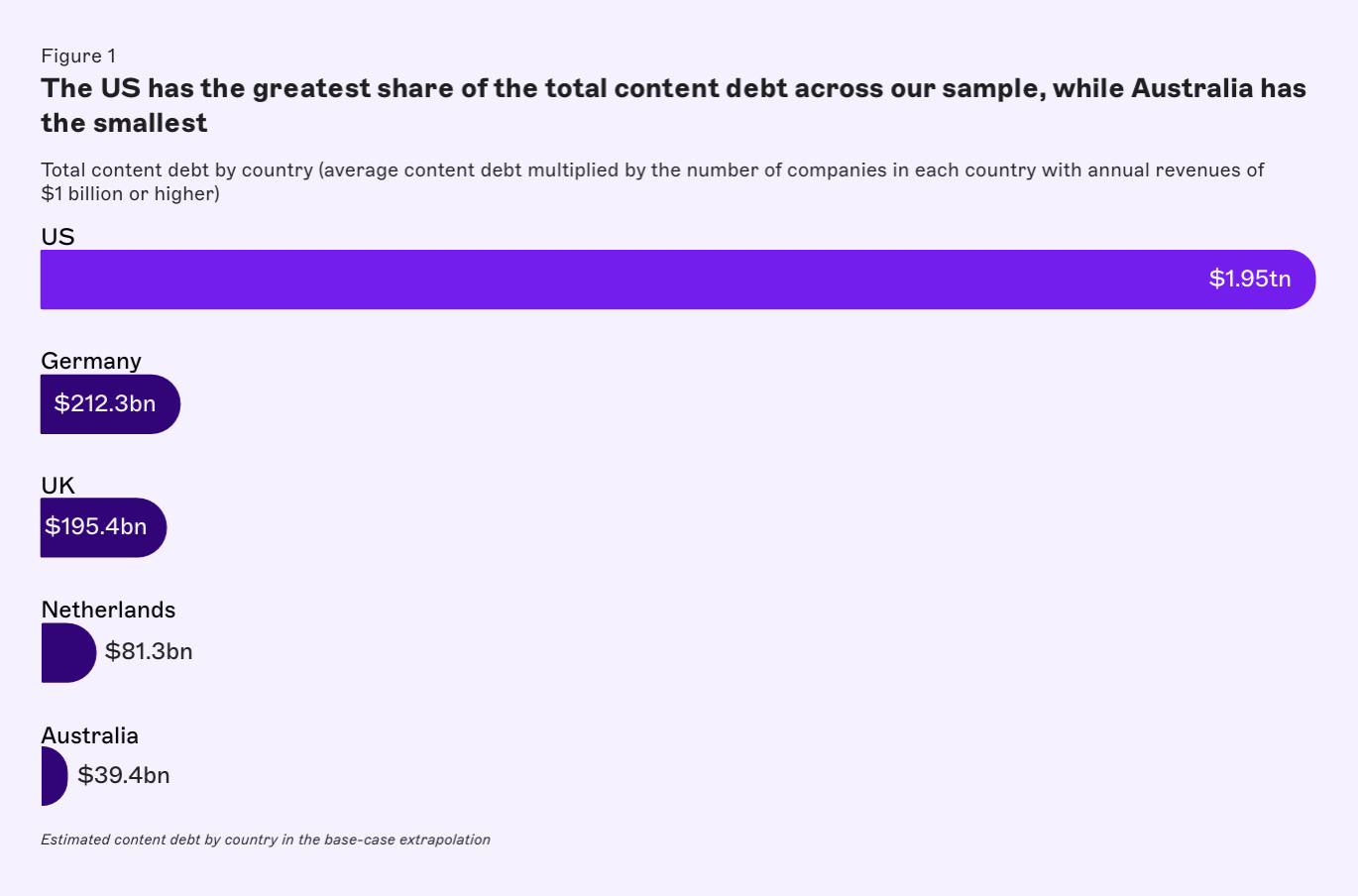
While the data includes a global sample, the U.S. dwarfs the rest of the world in its share of content debt. That’s not surprising given the density of companies in the region. But most large enterprises have multinational interests, and content debt is likely being amplified globally from the source.
Source: “Content Debt: A $4.63 Trillion Business Liability” report
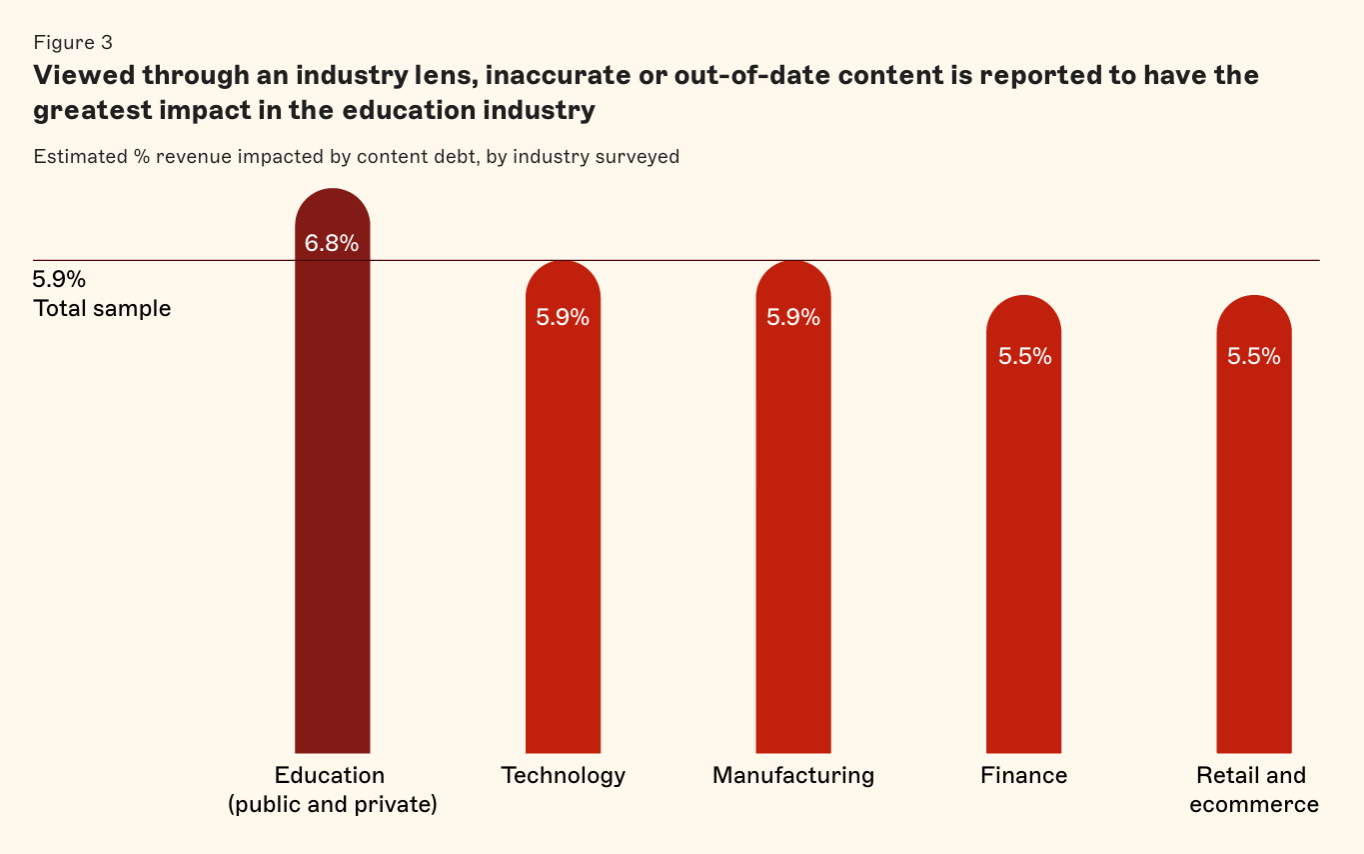
There’s also some interesting data on a granular level. For example, executives in the Netherlands report the highest revenue impact from inaccurate or out-of-date content. Meanwhile, when viewed through an industry lens, this same problem disproportionately impacts the education industry.
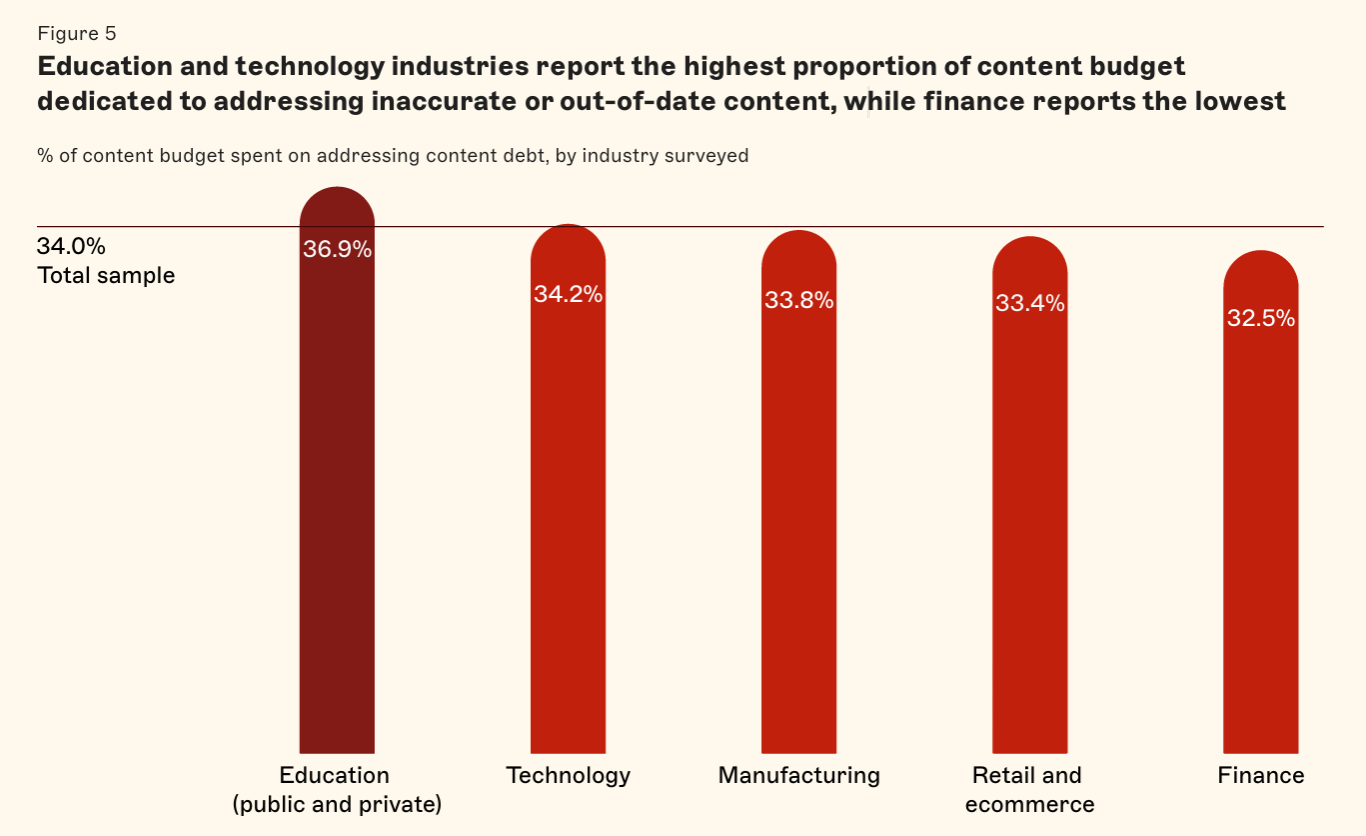
A likely conclusion? Many higher ed websites offer course materials or curriculum details that change frequently, and there’s likely a glut of digital residue left behind. As a result, education organizations report the highest proportion of content budget dedicated to addressing inaccurate or out-of-date content – and you can see below how this stacks up to other industries.
Source: “Content Debt: A $4.63 Trillion Business Liability” report
Enterprise leaders are finally addressing the content problem
So who’s responsible for this crushing, out-of-control content debt? There’s plenty of blame to go around, but the bottom line is that brands weren’t motivated to solve the problem because they simply didn’t feel it.
Now, after decades of letting it metastasize, enterprise leaders and executives are finally seeing the light. According to the research, 69% say outdated or inconsistent content is making it harder for customers to find, trust, or act on their information.
It gets worse. The same number say that the lack of visibility into their content is creating a compliance risk for their organization, while 67% say poor content quality or structure is weakening their discoverability in AI search. This tracks with my own coverage of AEO (Answer Engine Optimization) becoming a boardroom mandate, and how enterprise leaders are demanding enhanced content strategies as part of the new marketing playbook.
Additionally, 89% of respondents say that improving the quality, structure, and governance of their content would deliver measurable business value for their organization. They’re already trying to do this, with organizations spending (on average) 105.4 hours each week maintaining existing content.
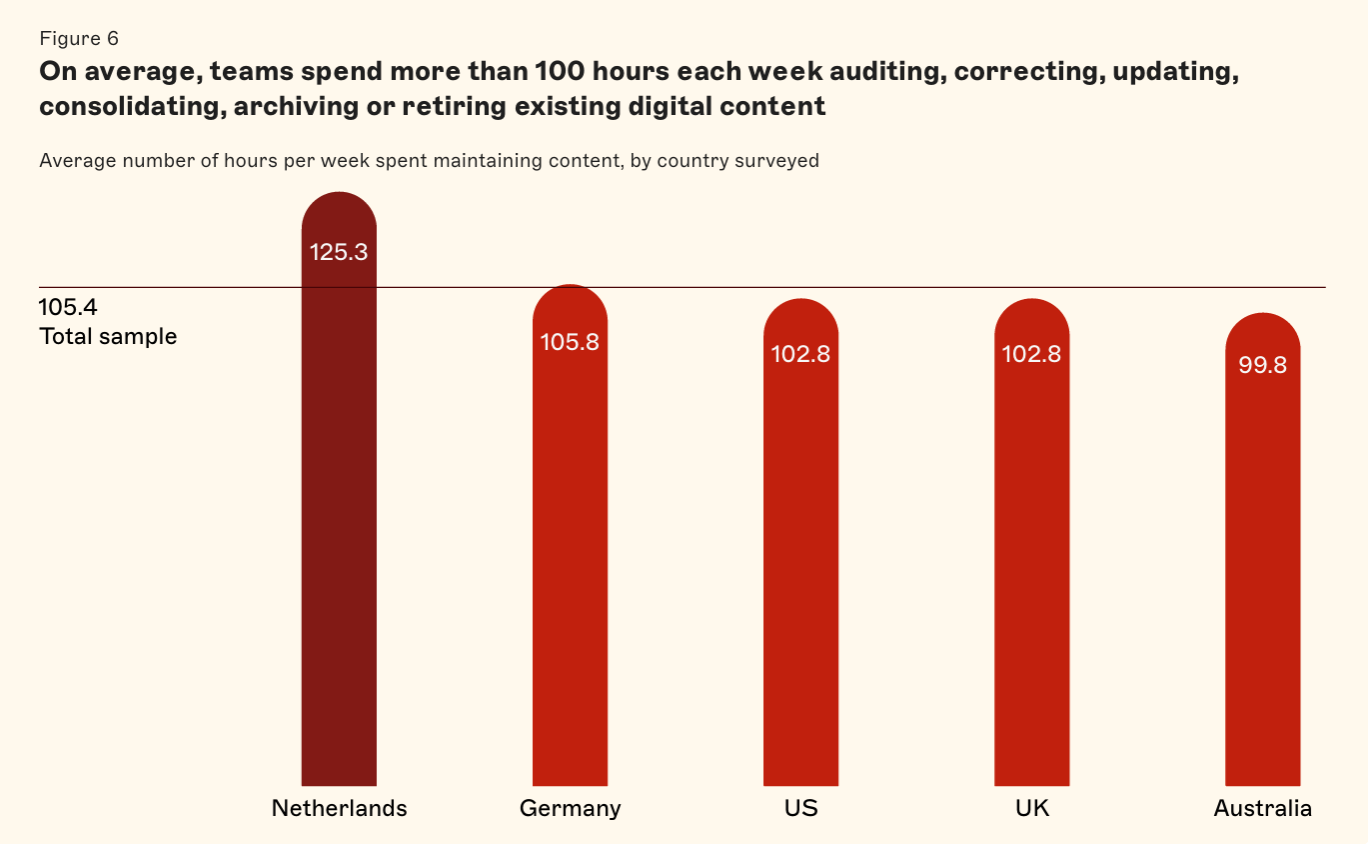
Source: “Content Debt: A $4.63 Trillion Business Liability” report
Perhaps the most troubling data point concerns the sheer volume of content that most enterprises are grappling with. According to the data, 78% of respondents say their organization has more digital content than it can realistically maintain as accurate, relevant, and up-to-date. That’s scary.
Can the content debt crisis be solved?
In the report, there’s a question posed to a C-level technology executive, asking what they would do if they had an extra $1 million per year to spend on content. Their answer: “The first investment would be AI tools that update outdated content automatically, so customers always receive fresh and correct information.”
This crystallizes the urgency and friction that leaders face when coping with the content debt crisis. But spending more on technology and remediation may not be the answer. Instead, enterprises should prioritize efficiency over reactive buying or strategies.
Further, 69% of executives agree that improving their content strategy is more of a technical challenge than a creative one, suggesting that teams are being held back by their CMS and tech stack, not by a skills gap.
Governance is also a critical part of the solution, and it helps reinforce the idea of “content confidence.” According to the research, organizations that are less affected by content debt have a higher degree of control over their enterprise content operations, from publishing to managing. Those with the highest confidence are less likely to have their systems and workflows limit their responsiveness, and more likely to exceed their financial targets than those with lower confidence.
Why it matters
As I heard repeatedly at the Boye & Company CMS Connect 26 conference in Montreal, the answer to our marketing woes isn’t more content – it’s better content.
“For decades, publishing as much content as possible, hoping it ranks in search, and letting the content and platforms decay has been a business strategy,” said Dominik Angerer, CEO of Storyblok. “It felt good at the time, just like loading up a credit card with a bunch of impulsive purchases and not thinking about the true cost of the debt. But now AI has exposed the scope of the problem, and it can’t be ignored anymore. The bill is past due.”
AI has indeed exposed and exacerbated this problem. But how can brands make a dent in a debt the size of Japan’s GDP? As Dominik said, just as consumers need to develop a plan to pay off debt, brands need a “content debt recovery plan” to eliminate the burden.
“The fact that they’re already spending so much time and money maintaining content and it isn’t decreasing the overall effects of content debt in a meaningful way proves that what they’re doing isn’t working,” he added. “The companies that audit all of their content, implement new ways of managing it, and measure the results will have confidence that their content is accurate, optimized, visible, and driving revenue in AI and every channel that’s important to them.”
In the age of AI, brands are fighting for more than visibility. They're fighting for their lives. Having your content ready to serve an audience of machines is the new imperative, and this data reinforces the scope of the problem we face.
Now, we need to take action. And that starts by removing the invisible brake – and hitting the accelerator.
Upcoming Events
Open Source CMS 26
October 20–21, 2026 – Utrecht, Netherlands
Join us for the first annual edition of our prestigious international conference dedicated to making open source CMS better. This event is already being called the “missing gathering place” for the open source CMS community – an international conference with confirmed participants from Europe and North America. Be part of a friendly mix of digital leaders from notable open source CMS projects, agencies, even a few industry analysts who get together to learn, network, and talk about what really matters when it comes to creating better open source CMS projects right now and for the foreseeable future. Book your tickets today.

Storyblok JoyConf 2026
October 28 - 29, Rheingoldhalle, Mainz (Frankfurt)
JoyConf 2026 is where developers, marketers, and digital innovators come together from all around the world, united by one powerful idea: great content isn’t built by tools alone – it’s built by people who rely on systems to deliver their best work to the world. In an era where technology is increasingly shaped by AI, Content Confidence becomes your competitive advantage. When you can create, manage, and scale content that performs seamlessly across channels, platforms, and AI, you don’t just keep up – you win. Book your seats today.
Sitecore Symposium 2026
November 10 - 12, Orlando, Florida
Welcome to “Marketing Rewired” at Sitecore Symposium 2026! Sitecore's annual flagship global conference brings together customers, partners, developers, marketers, and digital experience leaders to explore the latest innovations in digital experience, content management, AI, personalization, and customer engagement. This year's event features keynote presentations from Sitecore executives and industry experts, product announcements, hands-on learning, technical sessions, customer success stories, and networking opportunities focused on helping organizations build more intelligent, connected, and AI-powered digital experiences. Book your seats today.