Press ‘Play’ on the Future: Vimeo Delivers AI, Data, and Genuine Creativity for Video

The iconic SaaS-based video platform is writing a new script in the AI era, one that enriches the agentic frontier with data and context while enabling creators with enterprise-grade tools. Interview with Vimeo’s Head of Strategic Partnerships, Sara Benkov.
If you were a child of the 1980s, you probably remember your family’s first camcorder. It was a marvel of modern technology, a movie studio on your shoulder that turned moments into memories.
My dad documented everything in those days, filling countless VHS cassettes with hours of grainy, low-fidelity content from soccer tournaments in Massapequa and long lines at Disney’s Space Mountain. Our neighbors appreciated every excruciating moment of our watch parties.
I had different ambitions, hijacking our Sony monstrosity to create short “art films.” I vividly remember one called The Quick Draw Outlaw. It starred my youngest brother as an odious, Eastwoodian anti-hero hunting Billy the Kid through the wooded outskirts of our neighborhood.
Here’s the plot twist: At some point in the last half (the run time was a measly 10 minutes), our protagonist stumbles upon a UFO. Using the start/stop features of the camcorder, I magically beamed him up to an off-camera saucer.
It was a stupid analog trick, but it seemed downright magical at the time.
A few weeks ago, when I was at Vimeo's Manhattan offices for a Boye & Company CMS Experts meetup, I was thinking a lot about my own journey with moving pictures. Back in my agency days, I developed an integrated campaign for a very large pharmaceutical brand. I worked with the talented folks at Otherland to produce imaginative storytelling through video, which provided sales lift across our product categories.
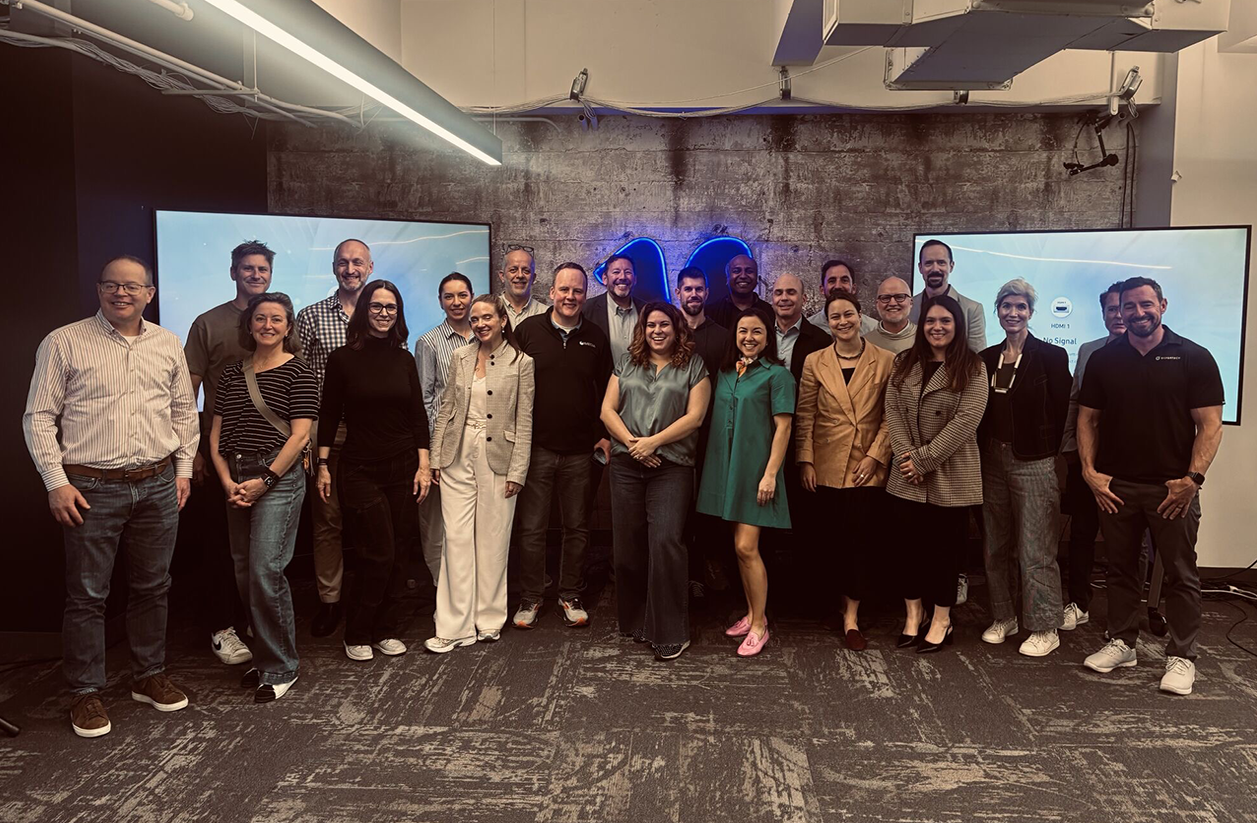
The Boye & Company CMS Experts/Digital Leaders Group meeting at Vimeo, May 2026
That’s when I learned just how powerful video can be. It’s a multisensory experience that makes content easier to digest – and according to some studies, it’s far more memorable than plain text. As humans, we retain 95% of messages through watching video, as opposed to just 10% from reading it. Why? Because our brains process visuals so much faster.
From a marketing perspective, the outcomes are even more compelling. For example, adding video to a product landing page can boost conversion rates by as much as 80%. It’s also been a game-changer for improving learning outcomes with module-based content.
Text, of course, is still incredibly important, particularly when it comes to SEO. In that sense, video has long been a “locked box” of context. But AI is beginning to shift that perception, and as Vimeo’s Sara Benkov told me, video is now emerging as more than just content – it’s another form of data. And that data can be harnessed to enrich search, learning, and a wide range of applications that are beginning to unfold.

Vimeo’s Head of Strategic Partnerships, Sara Benkov. Source: LinkedIn
Founded in 2004, Vimeo is one of the internet’s earliest video players, and has long been regarded as the “creator’s choice” – a professional-grade hosting ecosystem that focuses on high-quality playback, in-app editing tools, and collaborative workflows.
A lot has changed over the years, from storage to bandwidth to delivery. And what started as a haven for pure filmmakers evolved. Yes, there are more choices for hosting these days, but Vimeo has the distinction of being an ad-free environment that offers advanced piracy controls – giving it a real edge when it comes to trust and privacy.
Vimeo is often compared to the 500-pound video gorilla that is YouTube, which focuses on ad revenue and social reach (it’s also the second largest search engine on the web). Contrarily, Vimeo offers subscription-based hosting that isn’t focused on audience growth and discovery, or forcing ads down your throat. In fact, most Vimeo traffic comes from embedded players or links, where it aligns with CMSes and the websites they power.
Vimeo might be smaller than YouTube, but it’s mighty. With nearly 300 million registered users, almost 2 million paying subscribers, and over 6,000 enterprise clients, it’s a force in the video landscape – one that’s been amplified by its recent acquisition by Bending Spoons for $1.38 billion. The Italy-based consortium owns a portfolio of video vendors, including Brightcove and Streamyard, as well as productivity tools like Evernote (among others).
It’s fair to say that Vimeo’s audience skews more sophisticated, where people are making films that far surpass the quality of The Quick Draw Outlaw. In my conversation with Sara, we dug into Vimeo’s creative legacy and modern intention to treat video as a data multiplier. We also explored how the platform is using AI to help users scale their video production while maintaining safe and transparent AI development.
But the true superpower she revealed is Vimeo’s arc towards “genuineness,” something that’s in short supply in our increasingly synthetic world. AI is transforming what we create and how we create it, and video is perhaps the most visible channel being impacted by the glut of AI slop. TikTok alone has detected and labeled over 1.3 billion AI-generated videos, and that number is growing.
AI has an important role in the script. For creators, that means leveraging it to scale and streamline production. This is where Vimeo is helping users and enterprises take greater control of their output without losing the human thread – and pressing “play” on the future.
Can video be ‘genuine’ in the age of AI?
Video has become an ambient current. It’s everywhere, in the foreground and the background, from the social atmosphere to the enterprise and B2B ecosystem. In that sense, it can feel overwhelming – which is why quality has been such a decisive factor.
“We interact with video way more in our daily lives than we ever have,” Sara said. “TikTok, Instagram. The amount of video that’s now being pushed at us is staggering.”
She’s right. According to Searchlab, the average internet user in 2026 consumes 118 minutes of online video per day. This metric has been steadily increasing year over year, and now represents 82.5% of all global internet traffic.
Man, that’s a lot of content. And as I already noted, increasingly more of it is AI-generated garbage. That’s why the theme of “genuineness” has resonated so strongly in Vimeo’s positioning.
But what does it mean to be genuine? It’s a great question – and answering it begins with establishing a clear distinction between “genuineness” and “authenticity.” As Sara explained, the latter is about verifying truth and trust. Genuineness is softer, more the domain of intent and empathy.
“I feel like there’s a very big difference between the two,” she said. “You can be authentic in that what you’re telling me is true. But believing in what you’re talking about? That’s being genuine. Your video content doesn’t have to be commercial. It can be educational. It can be anything that humanizes your brand. Even if it’s part of the sales process, being genuine feels less salesy.”
These days, AI can fabricate just about anything, and with astounding results. But what’s often missing is the palpable human connection, and this is where Vimeo has always excelled. Video may be easy to synthesize technically, but the perceived intent behind it – what audiences experience as genuine – could be the meaningful differentiator in a sea of sameness.
Source: Vimeo
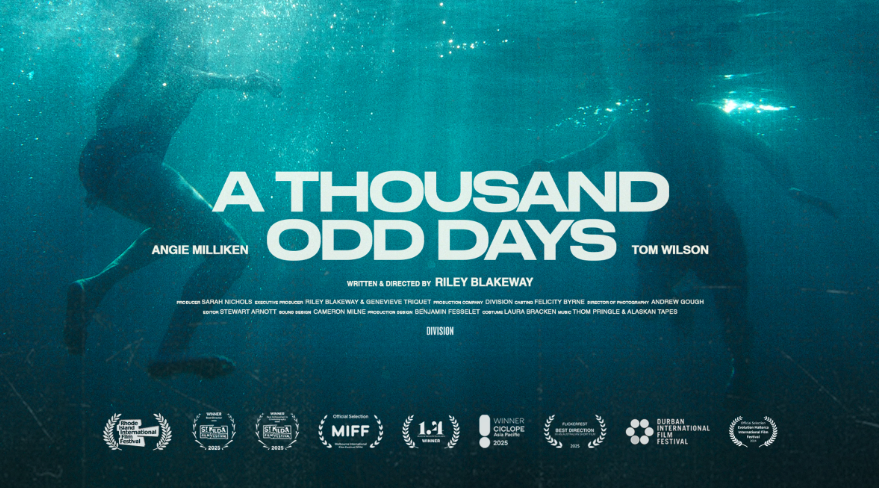
How does this surface? Look no further than Vimeo’s Best of the Year 2025 collection. It’s a patina for genuinely-crafted, human-produced short films that focus on powerful storytelling.
My suggestion: Take 15 minutes and watch A Thousand Odd Days, and you’ll understand just how core the idea of “genuineness” is to Vimeo’s mission. It’s exquisitely shot, beautifully narrated, and will knock the wind out of you.
Video as a new interface for B2B experiences
The consumer and social consumption of video is obvious. What’s less so is how video has become the most important format in B2B marketing, onboarding, and internal enablement. According to the MX Group, over 91% of businesses utilize video in their strategies, and it typically accounts for 25% to 35% of their total content marketing budgets.
What’s driving this? Audience behavior and expectations. B2B buyers now demand visual resources to explain complex products, and companies that use video realize almost 50% faster revenue growth than those that don't. It’s even permeating our communications, creating more personalized connections.
“Think about conference calls these days,” Sara said. “We used to have a seven-digit bridge line, and almost none of the calls were on video. Now, video is the go-to. No one just picks up the phone.”
For enterprises, video has fundamentally changed how employees learn and how culture is transmitted. Many corporate “day one” programs leverage video-based learning modules to streamline employee onboarding, as well as other facets of internal HR training. As Sara explained, this is an area where Vimeo crushes it.
“One of our other biggest use cases for companies is learning and development,” she said. “People engage more with video. We’re seeing quicker onboarding and people are more engaged in the overall training.”
Source: Vimeo documentation
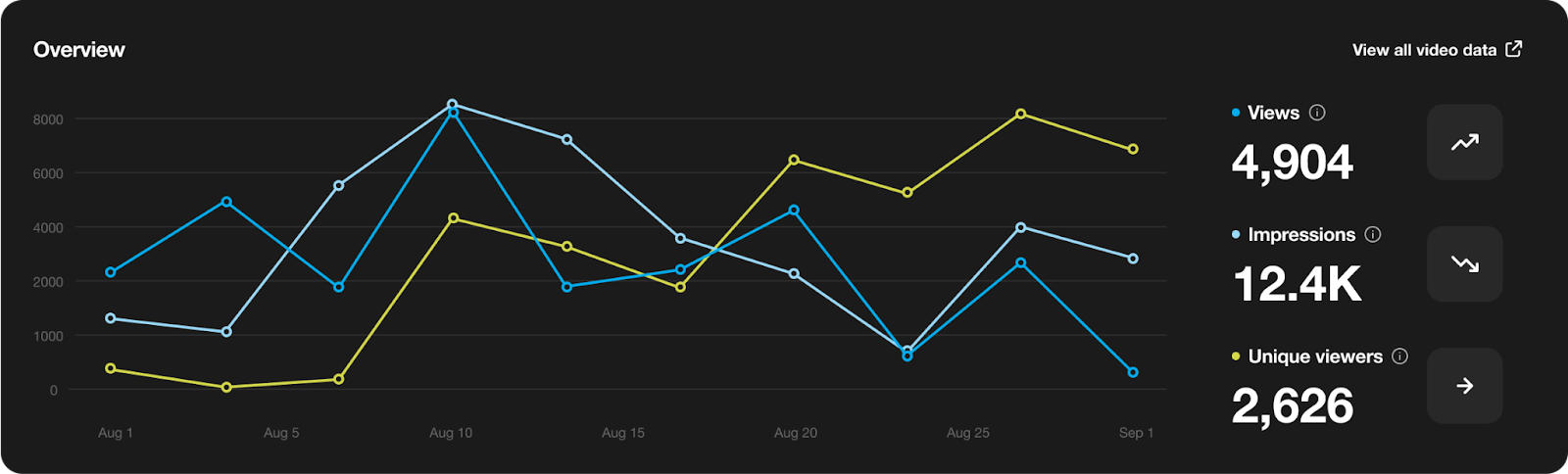
Because Vimeo’s player is interactive and well-instrumented, it’s not just delivering content, it’s providing measurable data on user behavior and juicing the feedback loop. To that end, there’s a dynamite set of onboard tools, including an advanced analytics dashboard that provides granular insights on views and impressions.
“We can make videos interactive, so you can ask questions, get live feedback, and track the analytics of what’s actually happening, so you can see those engagement numbers go up.”
Video, in this model, becomes a primary interface layer for B2B. It’s more than just a marketing channel tacked onto a website or into a CMS, but a central surface where employees, partners, and customers can experience your brand.
Beyond the player to enterprise-grade video
Use Vimeo for just a few minutes, and you’ll experience what makes it as beautiful as the work it supports. The UX is clean, modern, and minimalistic – making it incredibly easy to navigate.
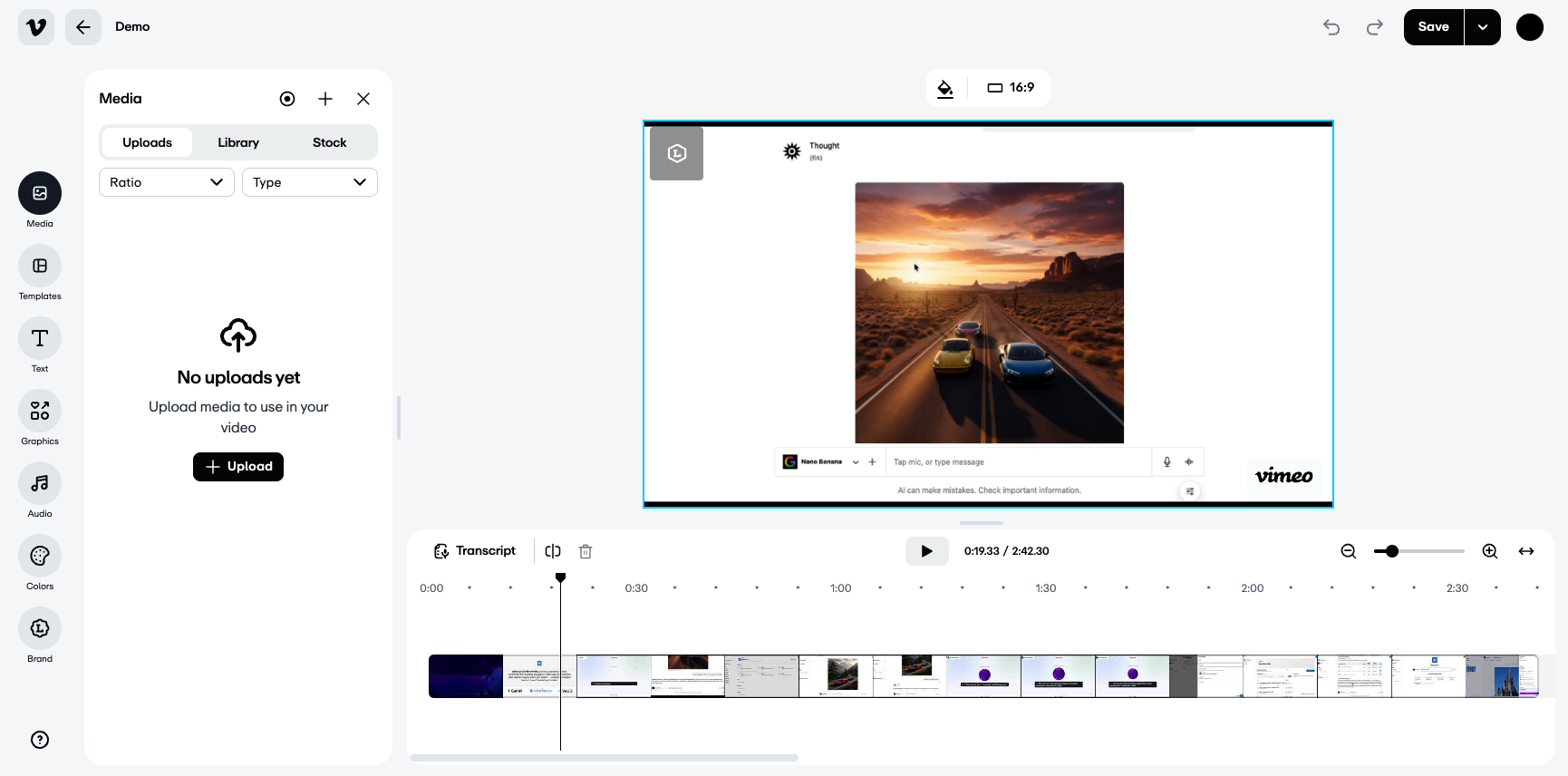
What draws filmmakers to the platform is its onboard video editing capabilities and its fierce commitment to maintaining quality by not applying hard compression to its output. Users can trim, transcribe, and add footage, music, graphics, and text to their timelines. They can effectively run their editing operations in a single, cohesive online studio. But the visual output is never compromised.
Source: Vimeo
That creator legacy still matters. But Vimeo’s focus on enterprise-grade video infrastructure is taking center stage, and Sara was candid about the gap between perception and reality.
“We built our reputation in the creative market, and that foundation is what makes everything we've built for the enterprise so powerful,” she punctuated. “We have engineers who have spent a lot of time building out the accouterments for making your video strategy successful.”
As part of that strategy, content management systems can access Vimeo's publishing, hosting, and tracking tools – all without a user ever leaving their CMS dashboard. Whether you’re deploying on Acquia, HubSpot, WordPress, or Wix, Vimeo's integrations can streamline video workflows and boost on-site engagement.
For the enterprise, security, compliance, and governance are becoming paramount considerations. This is where Vimeo establishes its credibility as more than just a fancy player – it’s a business powerhouse that fits marketing-centric workflows.
“We can be HIPAA compliant completely in terms of analytics and security, and we have a very robust API," Sara added. "If you want to embed a video onto your website and include a form, we can integrate that into your Salesforce or your HubSpot, and you have actionable leads sent right to your marketing platform.”
As part of that focus on security, both identity and access control are top of mind. Sara explained how Vimeo offers SSO and gated access to video content for authenticated users. Layer on geo-fencing and standards-based certifications – as well as a security team that’s focused on maintaining ISO certifications for ISMS and PII – and Vimeo is signaling that it belongs in regulated and highly-sensitive environments.
This is the language of enterprise procurement, not just creator communities. And it matters in a software landscape where compliance and governance have become key buying considerations.
AI as an assistant, not an auteur
Let's face it: AI is a prickly topic when it comes to content creators. As I’ve said in recent talks, there’s a “walled garden” around the creative product, and video is no exception.
What I appreciated about Sara’s perspective is that she avoided both extremes: AI as an existential threat or AI as a magic wand. Instead, she framed it as a powerful instrument for tooling and workflow, not as a source for wholesale video generation.
On the practical side, Vimeo is already using AI for the kinds of repetitive tasks that zap human energy. This includes a handy script generation tool, allowing users to prompt first drafts of video scripts based on specified topics, tones, and runtimes.
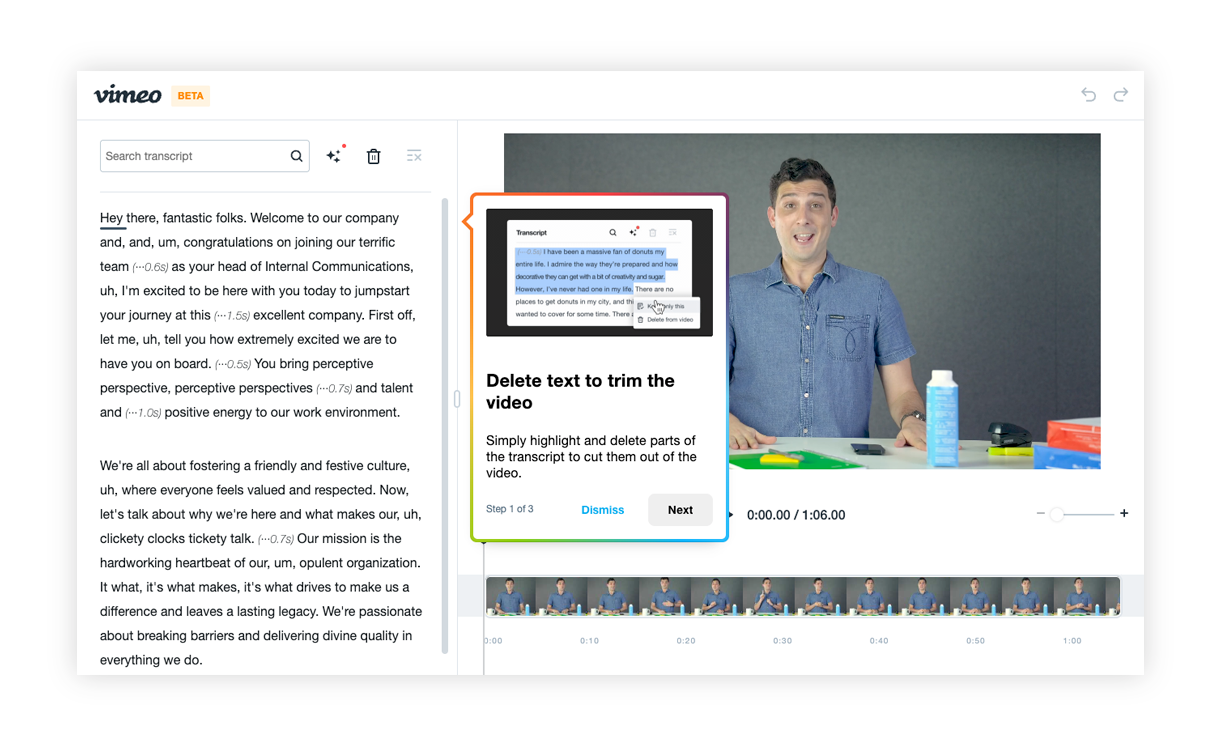
There’s also a text-based editor that removes filler words (“ums” and “uhs”) as well as awkward pauses and disfluencies. You can also cut out unwanted scenes just by editing the text in your transcript. It’s incredibly powerful and turns what was once a cumbersome activity into something that feels like a snap.
Source: Vimeo Documentation
There’s also video translation, voice cloning, interactive summaries, and a multi-modal search utility for locating scenes with specific visual elements. This has been a huge timesaver for creators, who no longer have to hunt for logos or other elements locked inside video content. Now, AI can help lighten the load.
Underscoring it all is a clear emphasis on enhancing accessibility and reach by automating critical layers like transcription generation, which enriches the audience experience.
“With AI, we automate a lot of the workflows, making sure videos go through the right approval process,” she said. “With language and dubbing and accessibility, I think AI comes in very strongly. It can help with generating the right thumbnails, the right elements to emphasize, and the right timing briefs. For example, some things need a five-minute video, some need a 30-second video. AI can help you pick where you should be.”
At the same time, Sara drew a firm line around creative intent. As she underscored, AI has purpose, value, and a clear time and a place as an assistive technology. For Vimeo’s community of creators, there’s a sacred trust around maintaining this divide.
That’s reflected in the company’s firm, two-pronged commitment to AI transparency, which is aimed at both protecting creators' rights and helping viewers identify synthetic or altered media. That means no unauthorized model training, clear human oversight within any AI tooling (like script generation), a strong commitment to data privacy, and restrictions on how voice cloning tools can be used.
These policies are the foundation. But for Sara, Vimeo’s commitment goes beyond the firmament and permeates the culture of the company. She offered a poetic observation.
“True creative value comes from humanity,” she said. “When you look historically at the art that was created in tough times, it really speaks to us. There’s a reason why we look at paintings that are 300 years old. There’s emotion. Feeling. And I think video conveys that now.”
At the CMS and digital experience layer, having these fierce commitments can perhaps strengthen the value of video across websites and applications – especially for brands that care about quality and defending the space where human creativity can thrive.
Expanding the value of an integrated video stack
The embrace of “video as data” is a clear power position, and one that opens up the potential field of applications. As Sara noted, the company has over two decades of historical data behind the scenes, and the trends have already provided meaningful insights.
Now, with the advent of AI, there’s the potential to glean even deeper knowledge from a host of data points like longitudinal records, engagement signals, and more. This curated wisdom is a key asset that can feed search, enhance personalization, and fuel other AI-powered experiences in the future.
Part of that roadmap is being written within the Bending Spoons family of products, where other video platforms like Brightcove live alongside Vimeo. While the tools differ, there’s a possibility for overlap – and I asked Sara if this creates any potential for channel conflict.
“At the end of the day, the best video for me is just genuine. It humanizes your company to make people feel like they're actually getting something out of it.”
As it turns out, the interplay is already highly collaborative and complementary. Rather than forcing a single product into every scenario, the strategy is to optimize for fit and reduce the friction for partners.
“Bending Spoons has a real vision around video,” she explained. “We’ve been integrated not product-wise but company-wise, and we’re working very well with Brightcove and StreamYard to make sure that we’re presenting the right solution to the customer. I was talking to a partner who mainly does podcasting. To be honest, Vimeo was a good fit, but StreamYard was a better one. So we’re just making it as easy as possible to work with all of us.”
Lights, camera, satisfaction
Vimeo has come a long way over the last 20 years. It started with filmmakers storing large-format files, but has evolved into an enterprise powerhouse that’s leveraging AI in useful ways.
If one theme hasn’t changed, it’s trust. That’s reinforced by the platform’s commitment to transparency, privacy, and compliance. But the idea of video as a rich data source is unlocking huge potential – and enabling AI to make a meaningful impact beyond generating slop.
One thing that stands out for me is Vimeo’s operational and augmentative approach to AI, focusing on workflow automation, accessibility, performance analytics, and editorial assistance – all while preserving a human center of gravity around creativity and intent. And under Bending Spoons, Vimeo is part of a broader ecosystem, guided by a culture that favors “best fit” solutions for customers and partners. That could be a net benefit for enterprises that are shopping for solutions in a crowded and more competitive marketplace.
Video is still content. It’s an experience designed for humans. But as a cache of data, it's being reinvented – even reimagined – for the AI era. As the intelligent web grows, CMSes and the experiences they power need smarter solutions for video, the kind that are searchable and well-structured for AI. This is where Vimeo’s enterprise readiness and “video-as-data” positioning start to feel like a strategic pillar in the AI-first stack.
Still, I keep coming back to the short films I made on my camcorder. It wasn’t about the technology – it was about the story. And appealing to that inner creator is something that Vimeo continues to champion for both individuals and enterprises.
“At the end of the day, the best video for me is just genuine,” Sara said. “It humanizes your company to make people feel like they're actually getting something out of it.”
My Recommendation: I've used Vimeo for years, and what continues to attract me is the quality. It sets the standard for the rest of the web, and if you're a stickler about compression artifacting, look no further. The in-app editing tools provide some nice alternatives to design apps like Canva. It's free to sign up, and the starter package is only $12/month – and it gives you access to collaboration tools and analytics. You can jump to Standard for $25 and Advanced for $75, and talk to sales for bigger enterprise terms. The current crop of AI tools signals a strong roadmap for where Vimeo's assistive automation is heading, and that makes it a solid bet. If you're looking to integrate with CMS, they have several pre-built options in their integration marketplace. It's a top-tier choice for almost any video strategy.
Upcoming Events

Umbraco Codegarden 2026
June 10–11, 2026 – Copenhagen, DK
Join us in Copenhagen (or online) for the biggest Umbraco conference in the world – two full days of learning, genuine conversations, and the kind of inspiration that brings business leaders, developers, and digital creators together. Codegarden 2026 is packed with both business and tech content, from deep-dive workshops and advanced sessions to real-world case studies and strategy talks. You’ll leave with ideas, strategies, and knowledge you can put into practice immediately. Book your tickets today.
CMS Connect 26
August 5-6, 2026 – Montreal, Canada
The best conferences create space for honest, experience-based conversations. Not sales pitches. Not hype. Just thoughtful exchanges between people who spend their days designing, building, running, and evolving digital experiences. CMS Connect brings together people who share real stories from their work and platforms and who are interested in learning from each other on how to make things better. Over two days in Montreal, you can expect practitioner-led talks grounded in experience, conversations about trade-offs, constraints, and decisions, and time to compare notes with peers facing similar challenges. Space is limited for this exclusive event, so book your seats today.
Open Source CMS 26
October 20–21, 2026 – Utrecht, Netherlands
Join us for the first annual edition of our prestigious international conference dedicated to making open source CMS better. This event is already being called the “missing gathering place” for the open source CMS community – an international conference with confirmed participants from Europe and North America. Be part of a friendly mix of digital leaders from notable open source CMS projects, agencies, even a few industry analysts who get together to learn, network, and talk about what really matters when it comes to creating better open source CMS projects right now and for the foreseeable future. Book your tickets today.
Contentstack ContentCon 2026
September 30 - October 1, Amsterdam / October 27-28, 2026 – Chicago
Contentstack’s annual customer conference is the premier event for executives, marketing leaders, and developers to redefine their digital experience strategy. This is your opportunity to step out of the "status quo" and into "elite" status, learning exactly how the world’s most successful brands are using the technology you already own to do the impossible. Enjoy a full day of interactive workshops, certifications, and inspirational on-stage sessions designed to help you become an expert on cutting-edge digital strategies and how to turn Contentstack's CMS and adaptive personalization tools into your greatest competitive advantage. Book your seats today.