Axe the ‘Coordination Tax’: New data says CX teams are struggling – and AI isn’t helping

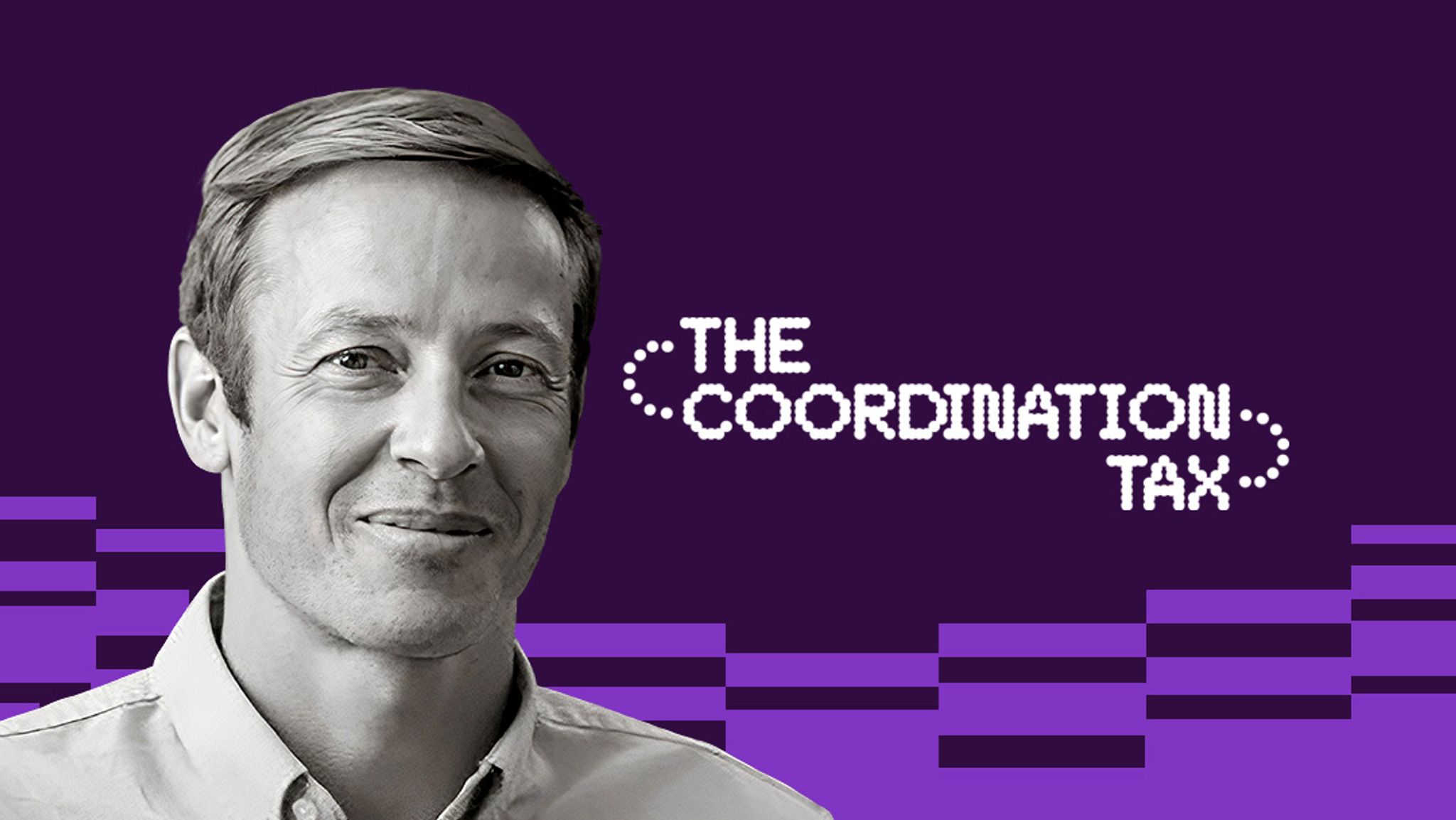
Remember how AI promised to make customer experience faster, easier, and more efficient? According to a recent study of B2B teams, the opposite is happening. Here’s what you can do to stick it to the tax man. Interview with Front CEO Dan O’Connell.
As they say, there are only two guarantees in life: death and taxes.
Let’s avoid any talk of the former and instead discuss our universal anathema towards the latter. That feels especially poignant in April, when “the taxman cometh” here in the U.S.
Yes, taxes are (often) essential. At the civic level, they provide the foundation for schools, roads, and vital services. But sometimes, the word “tax” materializes as friction within a system – an unintended consequence that results in all kinds of bad stuff.
There’s a term for this: “Coordination Tax.” It’s the hidden cost of time, effort, and productivity lost to a range of activities, typically when organizations attempt to synchronize their efforts. The impacts include everything from the hard increases in costs and labor to the soft trauma of emotional burden.
In many of the cited use cases, this “Coordination Tax” is a reflection of the energy wasted on resolving logistical tension rather than doing actual work. It’s squishy things like scheduling meetings, aligning tasks, and other stuff that falls into the “distraction” category.
And then there’s the intersection of CX and customer support. Every ticket that enters a system brings all kinds of uncertainty with it, especially in large organizations where help desk staff and engineers might not be getting the full picture as a problem works its way through the system.
We’ve been battling this in the CMS world for years, both with internal and external customers. Of course, when we started to inject AI into our workflows, there was hope that we might “axe the tax” and minimize the grief.
It did. Or at least it looks that way.
On the surface, support and ops leaders see positive results from their investments in new platforms and smarter AI. They’re automating simple tasks like resetting passwords. They’ve accelerated resolution times. Customers registered as being pretty satisfied.
But according to fresh research conducted by Front – a customer operations platform built explicitly for the kind of wiry, hairy complexities of B2B – this “Coordination Tax” is hammering CX teams, and they’re still paying the piper.
The report, The Coordination Tax: The Invisible Line Item in B2B Customer Operations, just dropped today. After reading it (front to back), I’m feeling overwhelmed – but hopeful that we can do something about it.
By conducting this research, Front is doing its part to keep the train rolling with a deeper understanding of where practitioners are colliding with challenges. As part of its research, the company surveyed almost 700 B2B customer service, operations, and account management leaders to uncover more of the minutiae.
So why isn’t AI turning frowns upside down or calming the chaos?
The data points to an opaque failure in modern customer support: the systems most companies rely on weren’t built for how B2B work is actually done – and layering AI on top hasn’t solved the problem. If anything, it’s exposing the issues.
Here’s the reality check: the core work didn’t get easier. Resolution times improved on paper, but the work required to solve complex issues stayed the same or even increased. Systems multiplied, and so did the need to jump between them, pushing more work into the “Black Holes” of email, Slack, and meetings – where critical context gets fragmented and lost.

Front CEO Dan O’Connell. Source: Front website
For a deeper dive into this research, I caught up with Front CEO Dan O’Connell, who’s been around the CX block. I wanted more perspective, because this idea of a “Coordination Tax” lurking in our processes can impact customer experience across a range of categories. But it’s also haranguing the soft tissue of loyalty, especially in industries like retail.
As economic headwinds pick up speed, enterprises can really benefit from tightening their CX bolts and cutting the fat. And when there’s less of an axe to grind – both with customers and employees – you’re in a better tax bracket.
Finding the hidden ‘Coordination Tax’
While this notion has permeated the industry lexicon, Dan has given the “Coordination Tax” a more focused lens in the AI era. He developed his own sensitivity to its impacts after years of sitting in the middle of messy B2B customer operations.
Dan’s tech pedigree covers the gamut, including a long tenure in Google’s AdWords (now Google Ads) practice, where he led West Coast sales of search, display, mobile, and YouTube advertising products. Leveraging his experience in the corridors of digital sales, he went on to command startups like TalkIQ and Dialpad – all before joining Front as CEO two years ago.
That arc, he told me, was really about the persistent theme of B2B complexity, where the real productivity problems are often elusive.
“We uncovered the ‘Coordination Tax’ just by looking at the actual work,” he said. “And in B2B, the hard part is coordinating everything.”
That’s the crux. Most organizations think in terms of tickets, cases, or conversations. But what actually consumes the hours – and the emotional stamina of CX teams – is the orchestration behind the scenes: tracking down the right account manager, pulling in product, escalating to legal, getting approvals, reconciling what’s in your CRM versus what’s in the billing system.
There are some golden nuggets in this research report, which is dense but easy to digest. It’s more like an e-book than a dull white paper (the online version even features a handy coordination tax calculator).
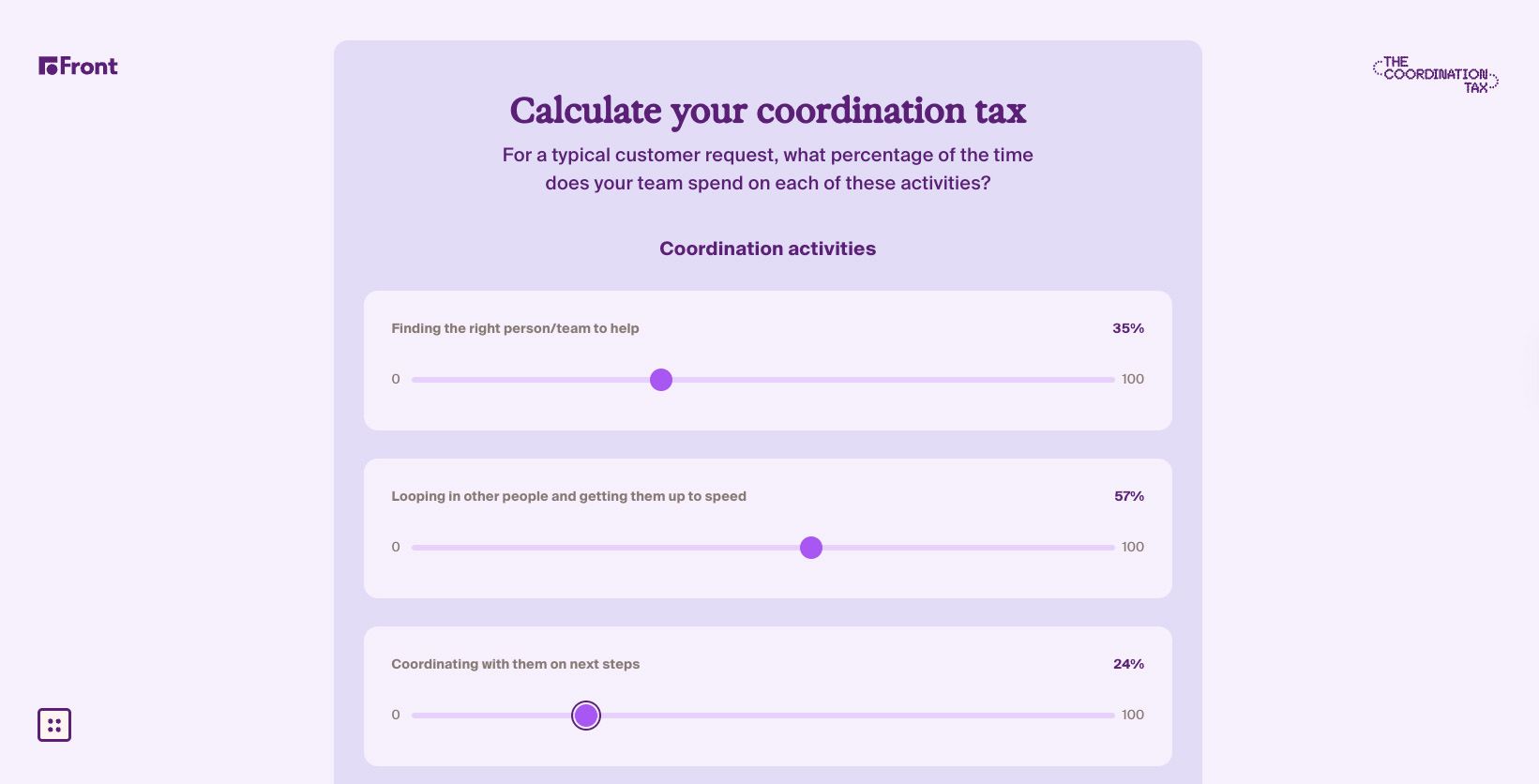
Source: Front’s “The Coordination Tax” report
For example, 93% of companies are now using AI in customer ops. Impressive adoption, to be sure. But at the same time, B2B organizations are spending three hours coordinating work for every hour spent resolving customer problems.
One of the biggest takeaways for me was the “AI irony” in full effect, where it breaks down spectacularly – and hands teams even bigger headaches. Case in point: Almost a quarter of respondents said that AI created more coordination work, while 22% reported lost context during handoffs. 20% saw requests routed incorrectly, adding to the woes.
And these issues occur more frequently than you might guess. According to the report, nearly three‑quarters of companies experienced at least one significant AI‑related issue in the past three months. As failure rates go, it’s uncomfortably high for a technology that promised to make everything better.
“There’s such a focus on deflection and automation rates,” Dan noted, pointing to the misalignment in AI’s projected value. “We’re not focusing on all of the time that it takes to coordinate and provide the best experience for a customer.”
There’s another devil in the details: invisibility. Based on the data, 42% of respondents aren’t even tracking the time lost to coordination, leaving the biggest source of inefficiency completely obscured.
If you're in the CX field, that’s probably not a shocker. According to Front, the typical company only tracks four metrics: CSAT, customer complaints or escalations, resolution time, and first response time. This squares with my own experience in the CX trenches, where I had to move tickets through a CMS help desk with Zendesk or Intercom. We simply didn't account for this.
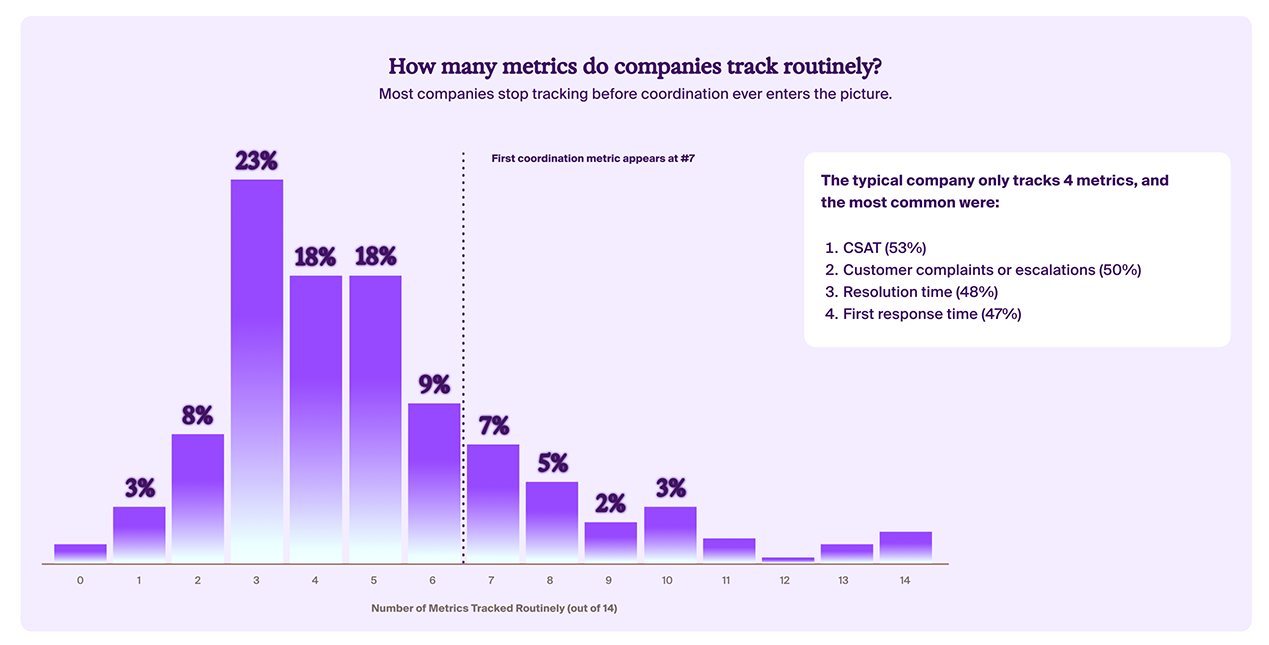
Source: Front’s “The Coordination Tax” report
Perhaps one of the thorniest revelations is the human toll: the “Coordination Tax” is costing B2B companies their best people. As the research highlights, over a third of companies lost a top performer to coordination burnout in the last year – not because they couldn’t handle customers, but because the job kept getting harder in ways that no one was measuring.
But here’s the good news: According to Front, one in seven companies in the study discovered the elusive “tax break.” They did it by treating coordination as measurable work, maintaining context across teams, and giving AI full access to that vital context. As a result, they’re focused more on solving problems than coordinating.
As it turns out, the best people stay in places where the “Coordination Tax” is lower. Because when you factor in the emotional wear‑and‑tear of constantly chasing context across tools, it’s not just operational inefficiency. It’s a quality‑of‑life tax on the people and teams you rely on to keep customers happy.
Fragmented CX tech stacks and the failure of composability
One of the topics that came up in our conversation was the growing assemblage of tools in a CX stack, and how that’s potentially compounding the “Coordination Tax.” Part of it is the cognitive load of managing this growing spate of applications. But there’s more to it.
In the CMS and DX ecosystem, the word “composable” has become part of the zeitgeist. We’ve charted the revolution: decoupled architectures, best‑of‑breed everything, API-wired systems and middleware – all providing faster, scalable, and more flexible solutions without the monolithic vendor lock-in.
Along with the pros, there are cons – and I’ve spoken to many enterprises that have swung the pendulum back towards unified, integrated systems that provide governance and accountability across an ecosystem of tools.
One thing that’s made composable stacks a bit riskier are the brittle, Rube Goldberg architectures that have failed in practice, and customer ops stacks have been drawn into these painful patterns: a support platform over here, an account management tool over there, sales engagement somewhere else, plus a dozen bespoke integrations.
Each purchase promises to reduce friction. Cumulatively, they ratchet things up. I asked Dan how he sees things through this lens, and if distributed concerns are amplifying the “Coordination Tax.”
“You have these fragmented systems, and often the next thing you buy is not the answer if you’re not solving the core problem around the coordination. You rush to implement it, and it’s actually introducing a new problem.”
“I do,” he said flatly. “You have these fragmented systems, and often the next thing you buy is not the answer if you’re not solving the core problem around the coordination. You rush to implement it, and it’s actually introducing a new problem.”
That’s the vicious cycle at the heart of the “Coordination Tax.” Every point solution adds a marginal benefit and a hidden overhead. The AI layer, in many cases, is just strapped on top of that fragmentation: bots talking to APIs talking to systems that never shared context cleanly in the first place.
To be clear, composable patterns have been a real activator for adopting AI. Research from the MACH Alliance illustrates how composable organizations have achieved greater velocity and ROI when further along in the MACH transformation. But for many B2B teams, having context live in the same place is proving to be an advantage.
Dan sees context as the hinge between modern AI capabilities and the experience customers feel. Today, that hinge is snapping under load, and this is where the current generation of collaboration tools starts to wobble.
“Slack isn’t where the work actually gets done around the customer,” he said. “You and I might be solving a customer problem in a channel and talking about it, but then I have to go to a different platform to engage with the customer.”
And that gap between “where we talk” and “where we work” is fertile ground for the “Coordination Tax” to grow.
LLMs are changing the equation for CX data and insight
As the research indicated, layering AI on top of existing tools isn’t yielding the best results. But the potential is there – and Dan has a grounded view that’s informed by his background in speech recognition.
His thesis is simple: if you can unpack the value of conversations at scale, you open the door to very different kinds of automation and insight. Ultimately, LLMs can take it ten steps further. But it needs to be applied the right way, and with the right tooling.
“If I can understand conversations in real time, it opens up massive opportunities to fully automate things or [have AI] tell me the trend,” he said.
As Dan eluded, we’re no longer limited to a single type of interaction or a single team. If you centralize the work and the conversation in one place, LLMs can finally operate on the full fabric of the relationship. That includes the entire flow, from pre‑sales to onboarding, support to renewals – and the internal motion between them.
“You can do that across all of these teams,” Dan continued. “We can synthesize support conversations in real time, or the conversation the account management or sales team is having. You can put that in a data layer, and we can build models off of it.”
And that’s a powerful reframing of “AI in CX.” Instead of just another bot to deflect tickets, it’s an analytics and orchestration layer that sees both the external customer story and the internal coordination scene.
When you treat both as first‑class data, AI can start doing the things humans can’t: spotting patterns across thousands of threads, surfacing systemic friction, and informing not just individual responses but roadmaps and process design. That’s translating into greater value around the intersection of AI an CX.
“It’s no longer just about resolving the problem at hand,” Dan explained. “It might be, ‘Hey, this can inform our roadmap, and I can do this instantly based on these insights.’”
Why human‑AI collaboration matters for high‑value CX
One of the most refreshing parts of my conversation with Dan was his rejection of the “automate everything” mantra. With so many processes becoming “botified,” he reminded me of how important humans are when it comes to supporting the customer experience.
“People like automation because they want to get rid of the mundane stuff,” he told me. “But at the same time, there are going to be opportunities for high‑value relationships, where the complexity of the problem requires empathy that only a human can really demonstrate.”
He pointed to one of Front’s customers, a pension management business, as a textbook example. As he explained, this is the kind of high‑stakes, high‑trust relationship that needs a smart person behind the wheel. A misstep could have financial and even emotional consequences – and a bot just won’t cut it.
“People like automation because they want to get rid of the mundane stuff. But at the same time, there are going to be opportunities for high‑value relationships, where the complexity of the problem requires empathy that only a human can really demonstrate.”
“They believe in their human workforce,” Dan said, referring to this customer. “They want to drive efficiency for their staff, but they don’t want them to be hands-off when somebody is talking about managing a pension. That kind of relationship is too valuable.”
The model he’s advocating for is less “replace the support agent” and more “give every agent a superpower.” In this paradigm, AI observes, synthesizes, and recommends – while humans decide, empathize, and own the outcome.
“We want you to automate away the easy stuff,” he said, “and have a platform that helps humans do things faster with full context, to solve the customer problem in the best way possible.”
Dan’s framing resonates with what I’m seeing across digital experience more broadly: AI is at its best when it sharpens human judgment, not when it tries to simulate it. And the people on the other end of our tickets and support calls crave not only solutions, but trust – and that’s where humans still maintain the ultimate advantage.
Where Front fits in AI-powered CX evolution
While most of us are using CX tools at various levels in our product stacks (and I’m sure we all have laundry lists of complaints), this idea of a hidden “Coordination Tax” is revelatory. It’s a ghost in the machine, disrupting the phalanx of support tools and professionals that are working on the front lines of customer experience.
Front’s research is compelling, but underneath the rhetoric is a clear product ethos that brings a coordinated system of authority to the battle for context. As Dan outlined, it’s this unified view across every team – powered by robust AI and context continuity – that delivers more accurate results with fewer handoffs.
“We want one system where the work is actually done, both for the internal conversations and for the external conversations,” he said. “And that’s a better way to solve the problem. There’s not another platform that does that as seamlessly as we do. So this notion of how we actually get people to coordinate and collaborate internally has been in our DNA.”
Front’s origin story as a shared inbox vendor is important here. It started by treating email – the foundational digital comms channel – as a collaborative, multi‑player space. Over time, that’s expanded into a broader customer ops layer sitting in front of (and on top of) existing systems like CRMs, support tools, and even legacy ticketing platforms.
In an ideal Front deployment, support, success, account management, and even professional services teams are all operating with the same pane of glass. AI and automation run across that shared surface, not in isolated silos.
“We’re both the place that that work is being done, routed, and analyzed, and where recommendations are happening,” Dan said. “And we’re also passing all of the internal coordination with the full context history, and we’re doing that across multiple teams that are customer‑facing.”
This is what context as a service is starting to look like, where the connective tissue between systems matters more than any single feature. It’s also reinforcing Front’s integrated product and ticketing platform, which is trusted by 9,000 companies worldwide for managing highly complex service applications.
Why it matters
AI is changing the game. But we’re not always winning.
Parsing the hype from the hope has become a challenging gambit, and I’ve been covering that in detail. Not only have many applications failed to move from prototype to production, but Cleanlab’s research on agentic systems – and their propensity for problems – is evidence that we need clearer expectations and better observability around performance.
In the CX trenches, the “Coordination Tax” thrives in the gaps – between tools, teams, and the handoffs that happen. B2B interactions are delicate, and the industry drift towards speed and “complexity deflection” have created this compounding effect.
Front’s sophisticated approach aims to solve the problem by collapsing more of that work into one cohesive, coordinated environment. It endeavors to connect teams, workflows, and conversations with greater precision, avoiding the morass of long email and Slack threads – where vital context gets lost.
As AI marches deeper into CX and DX, the question isn’t whether we’ll automate. We already are. The real question is whether we can redesign our systems – and our thinking – around how work actually gets done. That’s how we axe the “Coordination Tax.”
My Recommendation: Front is a frontrunner for complex enterprise CX with a strong B2B focus. It brings centralized collaboration to the surface with a stellar UX that’s user-friendly (check out the video above for a tour of the product's feature set). Front's holistic focus on AI is paying dividends with its Smart CSAT and Copilot capabilities, and they’re clearly innovating with advanced automation at a foundational level. I would peruse the knowledge base resources for better insight relative to your specific use cases. While it boasts giving small, nimble CX teams a great deal of power and flexibility, it’s a top-tier tool, so you’ll want to take a hard look at the per-seat pricing options – Starter, Pro, and Enterprise – which are clearly detailed on its website. Definitely a contender on your short list for proven CX performance.
Upcoming Events

JoomlaDay USA 2026
April 29 - May 2, 2026 – Delray Beach, Florida
Be part of the Joomla community in one of the most iconic cities in the world! JoomlaDay USA 2026 is coming to Delray Beach, and you can join us for a dynamic event packed with insights, workshops, and networking opportunities. Learn from top Joomla experts and developers offering valuable insights and real-world solutions. Participate in interactive workshops and sessions and enhance your skills in Joomla management, development, design, and more. And connect with fellow Joomla enthusiasts, developers, and professionals from across the world. Book your seats today.
CMS Summit 26
May 12-13, 2026 – Frankfurt, Germany
The best conferences create space for honest, experience-based conversations. Not sales pitches. Not hype. Just thoughtful exchanges between people who spend their days designing, building, running, and evolving digital experiences. CMS Summit brings together people who share real stories from their work and platforms and who are interested in learning from each other on how to make things better. Over two days in Frankfurt, you can expect practitioner-led talks grounded in experience, conversations about trade-offs, constraints, and decisions, and time to compare notes with peers facing similar challenges. Space is limited for this exclusive event, so book your seats today.

Umbraco Codegarden 2026
June 10–11, 2026 – Copenhagen, DK
Join us in Copenhagen (or online) for the biggest Umbraco conference in the world – two full days of learning, genuine conversations, and the kind of inspiration that brings business leaders, developers, and digital creators together. Codegarden 2026 is packed with both business and tech content, from deep-dive workshops and advanced sessions to real-world case studies and strategy talks. You’ll leave with ideas, strategies, and knowledge you can put into practice immediately. Book your tickets today.
Open Source CMS 26
October 20–21, 2026 – Utrecht, Netherlands
Join us for the first annual edition of our prestigious international conference dedicated to making open source CMS better. This event is already being called the “missing gathering place” for the open source CMS community – an international conference with confirmed participants from Europe and North America. Be part of a friendly mix of digital leaders from notable open source CMS projects, agencies, even a few industry analysts who get together to learn, network, and talk about what really matters when it comes to creating better open source CMS projects right now and for the foreseeable future. Book your tickets today.