AI ROI? A-OK: MACH Alliance Report Says Enterprises with Composable Foundations are Netting Returns

In its new report on the relationship between composable infrastructure and successfully adopting AI, the MACH Alliance has uncovered some compelling trends that underscore the role of composable stacks and the growing need for AI guidance and guardrails.
When I spoke to MACH Alliance president and Orium CEO Jason Cottrell in December, we were discussing predictions for 2026 – and where MACH, composable, and AI were fitting into a growing puzzle of uncertainty.
The only thing that felt certain at the time was the unabated, breakneck pace of AI evolution.
Not much has changed. In fact, we've entered the hyper-growth stage of agentic AI, and this sector is forecast to expand at dizzying levels. Despite the headlines – which often paint a product’s AI capabilities as a shining city on a hill that we’ve already climbed – we’ve got a lot of work ahead of us.
Case in point: Not only are GenAI projects failing at an alarming rate, but so too are agentic systems. And despite ChatGPT being the most downloaded app on the planet, the enterprise adoption topology isn’t as smooth as we might think. Friction is everywhere.
“It’s great that we’re talking about this agentic future, but that feels like the summit of Everest, and I’m still trying to get to base camp,” Jason told me. And that’s what he and the Alliance have been gleaning from their own research: The market is urging us to move from zero to two, but most organizations are struggling to get from zero to one.

MACH Alliance President and Orium CEO Jason Cottrell. Source: LinkedIn
But this is where MACH can be a solid first step – a reachable peak they can aim for on their ascent to agentic transformation. Enterprises need to be ready for what’s ahead, but they could use a stable way station to prepare. MACH presents a sort of REI to pack for the journey.
“I can bring in the change management practice,” Jason said. “I can get my data in order and my systems accessible. That’s what ‘ready’ looks like.”
This MACH readiness is more than just preparing for the possibilities – it’s already translating into palpable AI agility. The numbers back this up: In the 2025 MACH Alliance Global Annual Research report, enterprises that were well along in their MACH journey were twice as likely to successfully deploy AI. By taking a composable approach, they were able to experiment, fail forward, and more rapidly integrate with an emerging field of AI and agentic technologies and capabilities.
Now, almost a year later, we can see how organizations with an established MACH foundation are netting real returns from their AI investments by embracing a nimble, composable framework.
This is crystallized in a new enterprise technology report that the MACH Alliance just released, aptly titled From Pilot to Production. According to data collected and analyzed in partnership with MEL Research, 78% of organizations with fully implemented and scaled MACH technology are reporting clear evidence of ROI. That’s compared to 13% that are just embarking on their MACH transformation.
That’s a 6X difference – and a big leap from last year’s general findings. It also highlights the gap that exists between mature MACH organizations and those that are still making the shift, and how this translates into a competitive advantage when accelerating the adoption of AI.
To better understand the scope of the change, the Alliance widened its annual survey across 600 enterprise IT decision-makers in seven global markets to explore how MACH technology is supporting an enterprise’s ability to adopt agentic AI.
There are some other findings in the report that I’ll get into, but they all reinforce the same conclusion: Composable adoption is mainstream, enabling enterprises to achieve their AI aspirations – and making the juice worth the squeeze.
Composable as an ‘AI accelerator’
As I’ve covered over the last year since “The Composable Conference,” the MACH Alliance has been evolving its charter to focus more intentionally on AI transformation and the realization of an agent ecosystem.
In my analyses, I have pointed out that the widespread adoption of composable strategies has been part of the wholesale acceleration of AI adoption. Now, with more organizations embracing MACH and composable, we're seeing greater traction across the stack – and the market.
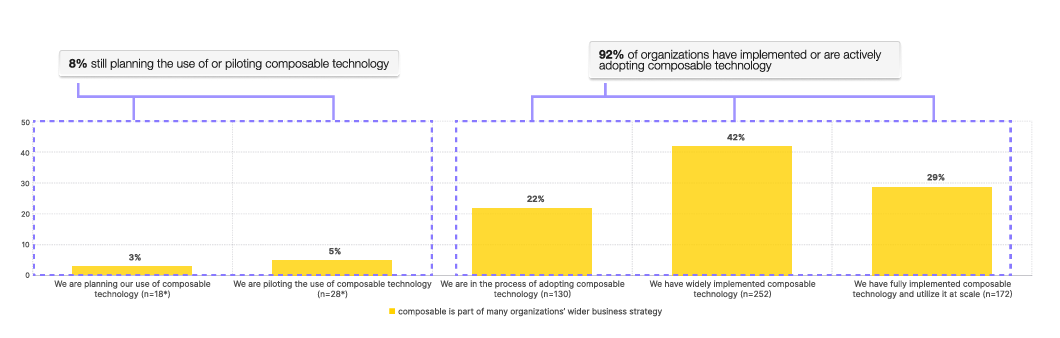
Let's talk numbers, because the growth of composable has been remarkable. According to the Alliance’s new research, 92% of organizations have implemented or are actively adopting composable technologies – with 71% of organizations already at wide or full implementation. There's probably a bit of nuance here (what constitutes full implementation, for example), but the drift is something I've noted in my discussions with enterprise stakeholders.
Source: MACH Alliance Enterprise Technology Report
But there’s also the size and scale of the ensuing “AI effect.” Generative AI is having a seismic impact on the broader market (said another way, it’s ripping across everything and impacting business outcomes). This is forcing enterprises to adopt AI faster to gain a market edge.
There is, however, a gap – and it's a crucial one. According to the research, 78% of organizations are using AI in-house or ahead of competitors, but nearly a quarter are lagging, using only basic AI tools or relying on third-party vendors. At this phase in AI race, that won't cut it anymore. Enterprises need to enhance their AI capabilities to remain competitive.
Building AI confidence, speed, and success
The findings also suggest that composable-forward enterprises are feeling the wind in their sails. In fact, 98% of organizations with fully or widely implemented composable architectures feel confident in their infrastructure’s ability to support AI at scale. That’s a strong perception indicator – and reinforces the potential for better outcomes.
There’s also the important metric of speed. According to the research, 94% of organizations say that it’s a hugely beneficial factor in deployment velocity, while 87% believe it enables AI-driven business outcomes.
Source: MACH Alliance Enterprise Technology Report
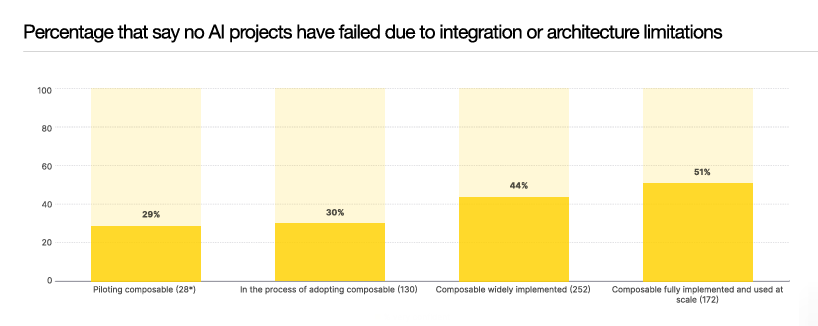
What does success look like? Based on the participants from this research, it’s delivering the opposite of MIT’s astounding 95% failure rate. In fact, 51% of fully composable organizations have reported zero AI project failures due to integration or architectural issues. That's impressive, and speaks to the maturity and mastery over their tech stacks.
In contrast, only 30% of less mature implementations report similar success, suggesting that composable architectures actually reduce project failure rates. Put this in the win column.
Barriers to AI implementation and the need for governance
We often have to remind ourselves of how nascent agentic AI is – at least in its modern construct. While many of the tenets of AI bots and agents have been around for a long time (see Joseph Weizenbaum’s ELIZA chatbot circa 1967), the current scale is unlike anything we’ve seen previously.
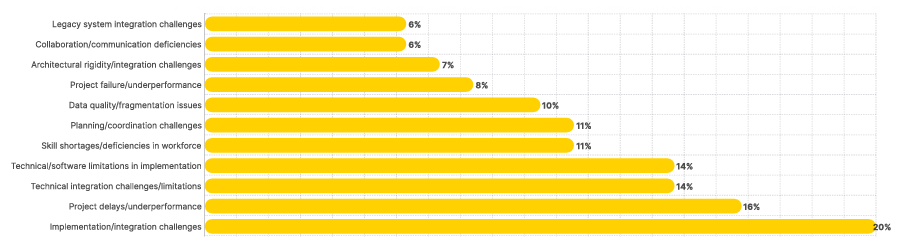
Given how early we are – and how fast we're going – it's no surprise that we’re still hitting the wall in some key areas. As the survey participants echo in the report, 88% of organizations are encountering obstacles associated with legacy technology, integration complexity, skills gaps, data quality, architectural rigidity, and even collaboration across teams. All challenges that MACH patterns and ideologies are designed to address.
Source: MACH Alliance Enterprise Technology Report
As you might guess, there are still deep concerns with AI adoption as it relates to data privacy, security, and other ethical implications. There’s also a persistent lack of organizational vision and structure as it relates to AI. In fact, according to a recent PwC survey, less than half of Canadian CEOs say their organizations have formalized responsible AI and risk processes.
This is alarming when you consider the amount of “Shadow AI” that can creep into enterprise workflows without proper governance. But again, this is a region of governance that the MACH Alliance has long advocated for when driving composable strategies: It’s not just the tech, it’s the mindset.
Rising from these concerns is a deepening need for AI governance standards. In fact, 89% of the survey respondents believe it’s lacking in composable environments – and most are worried about the complexity involved with applying governance to AI implementations.
This is an area that needs clear reinforcement, and there’s a growing call for more guardrails, with some respondents suggesting an industry-wide compliance framework to ensure best practices. Again, this is where the MACH Alliance can provide a foundation.
To that end, 95% of respondents feel the Alliance is a “credible source” as a standard-setting body, pointing to its attributes of trustworthiness, expertise, and industry collaboration. This positions the organization as a key player in shaping the future of the AI governance landscape.
Measuring real ROI from AI investments
The MACH Alliance’s new research shines a light on just how scalable and flexible decision-makers view composable architectures – specifically when it comes to AI readiness.
Organizations with mature implementations are feeling more equipped to make the journey, while laggards face significant challenges in adopting newer technologies. This isn’t a shocker. But it does highlight the need for every organization to remain nimble and agile in a rapidly changing tech landscape.
While enterprises were already feeling the ROI pressure in 2025, this year is more like a vice grip. As AI moves from a strictly IT domain to a boardroom consideration, leaders are asking – and being asked – to prove the impact of their AI investments with meaningful metrics.
Gartner has already chimed in, forecasting worldwide AI spending of $2.52 trillion in 2026, a 44% year-over-year increase. That might seem like a big number, but it’s symbolic of the transformation AI is experiencing as the expectations shift from pie-in-the-sky promises to hard returns. According to Gartner analyst John-David Lovelock, big portions of the arc AI are entering the “Trough of Disillusionment" in Gartner's Hype Cycle.
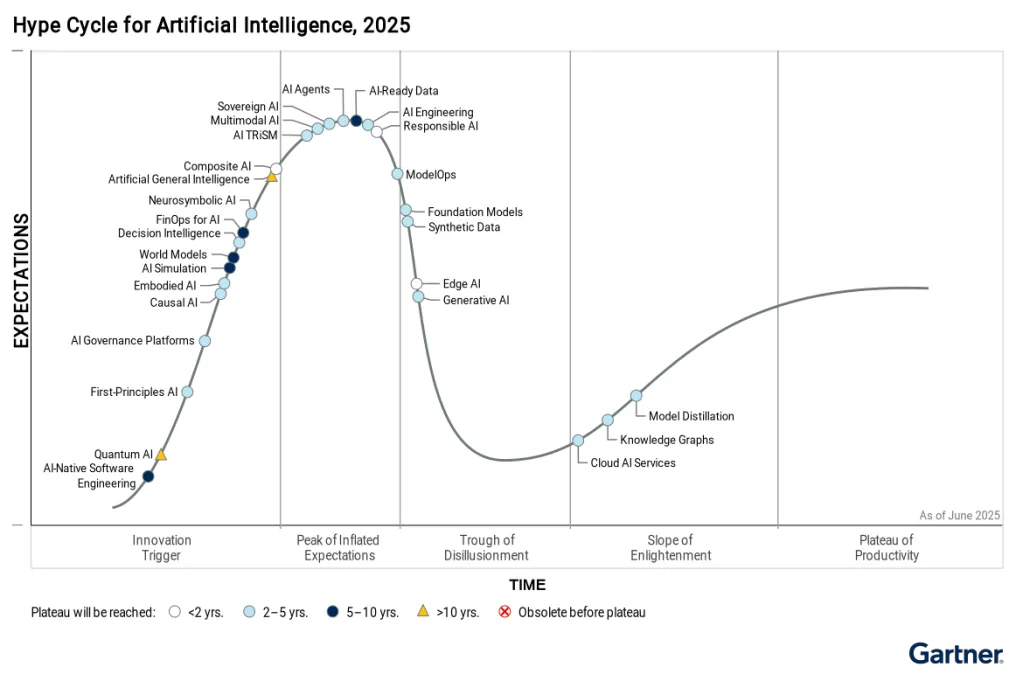
Source: Gartner Hype Cycle for Artificial Intelligence, 2025
“It will most often be sold to enterprises by their incumbent software provider rather than bought as part of a new moonshot project,” Lovelock said. “The improved predictability of ROI must occur before AI can truly be scaled up by the enterprise.”
That word before is key. We can expect the buying and assessment habits to shift as enterprises assess AI value through a much tighter and more discriminating aperture.
So where does the Alliance’s research land on this all-important ROI question? Well, based on the report’s data, 98% of organizations are already measuring ROI from AI investments, with increased productivity being the most common metric. But they’re also monitoring benchmarks like improved customer satisfaction, revenue growth, and operational efficiency.
But in terms of actual evidence, 99% of respondents are seeing measurable results from AI — averaging 4 distinct ROI outcomes per organization. Additionally, 98% of enterprise companies with mature composable implementations say they can support AI at scale.
These numbers point to a clear trend: composable architectures support the success of AI projects, particularly through the all-important lens of ROI.
Why it matters
The MACH Alliance has been a central force in guiding the market’s trend towards composability. One might argue that the tenets of a more open and modular web were trending in that direction, but the “Composable Movement” (yes, it was a thing) threw gas on the fire, breaking the stranglehold of single vendor dependency, diversifying the tech stack, and accelerating experimentation.
But it did something else: It created a community of like-minded people and platforms, which enabled greater interoperability and coordination across both machine and human surfaces. This resulted in more than just a foundational architecture and standards – it created an extensible philosophy and a teachable, repeatable process that’s designed for people.
In fact, in my years of judging the Alliance’s annual MACH Impact Awards, the winning projects have always exemplified the “MACH mindset” through planning, training, and change management. In many ways, this was all a primer for the modern AI revolution.
As the Alliance drives towards the vision of a true industry “Agent Ecosystem” (you can check out the foundation of it here), its core values are once again serving the mission. According to the data in this latest report, there is a call for standards, but also an appetite for a common data model or MACH-style certification to provide a stronger foundation in the agentic era.
In the AI arms race, context has become the Holy Grail. As Jason Cottrell noted, the multi-agent future is arriving faster than most organizations predicted. As specialized AI capabilities multiply across vendors, internal development, and open-source tools, enterprises with the infrastructure to coordinate and share that context will have a competitive advantage.
“Open, composable, connected architecture isn't just accelerating AI deployment today,” he said, “it's determining which organizations can participate in the Agent Ecosystem that's rapidly emerging."
Like any research, my recommendation is to read, absorb, and try to see the forest through the trees. There’s a lot of great data in this report, but it’s through the MACH Alliance's lens – so it’s worth balancing the insights against other empirical sources.
One other point: With the recent SaaS meltdown weighing on tech stocks (and the world, quite frankly), AI is changing the value equation, and calculating ROI will require us to re-examine a confluence of factors. With revenue and licensing models on the cusp of disruption, we can expect more change in the coming months. This is why I like the Alliance’s investment in these reports.
Given this pace of change in AI, having a composable foundation can be an advantage. Not just as an accelerator for adopting new technologies, but for embracing the right policies and practices across your organization. As the research clearly denotes, we need guidance – and the MACH Alliance could be a voice of calm and connection in the agentic storm.
You can download the report here.
If you’re looking to learn more, you can catch the MACH Alliance’s flagship conference, MACH X: Toronto | The Agentic Advantage, April 28-29, 2026. The conference brings together enterprise leaders, innovators, and AI practitioners to map agentic roadmaps. Register now to join.
Upcoming Events

JoomlaDay USA 2026
April 29 - May 2, 2026 – Delray Beach, Florida
Be part of the Joomla community in one of the most iconic cities in the world! JoomlaDay USA 2026 is coming to Delray Beach, and you can join us for a dynamic event packed with insights, workshops, and networking opportunities. Learn from top Joomla experts and developers offering valuable insights and real-world solutions. Participate in interactive workshops and sessions and enhance your skills in Joomla management, development, design, and more. And connect with fellow Joomla enthusiasts, developers, and professionals from across the world. Book your seats today.
CMS Summit 26
May 12-13, 2026 – Frankfurt, Germany
The best conferences create space for honest, experience-based conversations. Not sales pitches. Not hype. Just thoughtful exchanges between people who spend their days designing, building, running, and evolving digital experiences. CMS Summit brings together people who share real stories from their work and platforms and who are interested in learning from each other on how to make things better. Over two days in Frankfurt, you can expect practitioner-led talks grounded in experience, conversations about trade-offs, constraints, and decisions, and time to compare notes with peers facing similar challenges. Space is limited for this exclusive event, so book your seats today.

Umbraco Codegarden 2026
June 10–11, 2026 – Copenhagen, DK
Join us in Copenhagen (or online) for the biggest Umbraco conference in the world – two full days of learning, genuine conversations, and the kind of inspiration that brings business leaders, developers, and digital creators together. Codegarden 2026 is packed with both business and tech content, from deep-dive workshops and advanced sessions to real-world case studies and strategy talks. You’ll leave with ideas, strategies, and knowledge you can put into practice immediately. Book your tickets today.
Open Source CMS 26
October 20–21, 2026 – Utrecht, Netherlands
Join us for the first annual edition of our prestigious international conference dedicated to making open source CMS better. This event is already being called the “missing gathering place” for the open source CMS community – an international conference with confirmed participants from Europe and North America. Be part of a friendly mix of digital leaders from notable open source CMS projects, agencies, even a few industry analysts who get together to learn, network, and talk about what really matters when it comes to creating better open source CMS projects right now and for the foreseeable future. Book your tickets today.