Is your AI app ready to ship? A new diagnostic can help validate your vibe coding with confidence

RDA’s new evidence-based Production Readiness Review is giving teams a comprehensive diagnostic of their applications, delivering an unbiased report of what might be blocking a product from launch.
When Andrej Karpathy coined the term “vibe coding” last year, it felt like a joke. Memetic, even. “Embrace the exponentials,” he said in a Tweet heard ‘round the tech world.
The co-founder of OpenAI – who famously called English the “hottest new programming language” – evangelized in that post about giving in to the vibes. He said LLMs were getting so good that he could simply talk to Cursor Composer via SuperWhisper and build while barely touching his keyboard.
Little did he know that he was tearing at the fabric of modern development.
In the nearly 18 months since its casual inception, vibe coding is now an accepted discipline. Today, a software developer rarely builds anything from scratch. They use a prompt window and natural language in almost every step of their work to automatically generate code.
“I just see stuff, say stuff, run stuff, and copy-paste stuff,” Karpathy said. “And it mostly works.”
That word mostly is the key, because as miraculous as AI is, it’s not infallible. And therein lies the problem: vibe coding has accelerated development tenfold, but it’s exacerbating technical issues. In other words, the magic is also making a mess.
Since last year, I’ve been tracking the precipitous sprawl of vibe-coded apps. The depth of the problem became material when Product Hunt’s Chris Messina blasted an email about the explosive increase in new apps to the platform.
In a high-watermark moment, over 600 products were submitted in February (the previous record was just over 500 a month before). Chris told me this was a direct result of vibe coding, and competition for new apps on the platform’s leaderboard was intensifying.
Sure, Product Hunt attracts the skunkworks, the earliest stages of proving out an idea. This is where vibe coding has been a godsend, enabling teams to deliver a prototype at incredible speeds and with less friction.
But it’s not just downstream startups on a wing and a prayer. Vibe coding is now a part of every internal development practice. 90% of developers use AI coding assistants at work, and 46% of developers say Claude Code is their “most loved tool” among the many engines and harnesses.
For enterprise teams that utilize AI, there’s a persistent question of reliability. There are countless reasons supporting this – just look at OpenAI and Anthropic’s recent model mishaps. As such, proving the production safety of an app is becoming a critical requirement, and people are becoming a bottleneck for shipping with confidence. Often, it’s not talent holding back a product launch, but a lack of visibility into the blockers.
Now, humans can get real help on this leg of the journey with RDA’s Production Readiness Review. The digital consultancy – which has been building technology solutions at the edge for almost 40 years – recently launched an evidence-based process that provides a diagnostic of your internally vibe-coded app, giving stakeholders a scorecard for their app that reinforces its readiness to ship.
The rubric for RDA’s system is a clear set of production requirements. The report identifies the hard blockers, prioritizes the fixes, and traces everything back to your code – so you have line-of-sight to the underlying problems. The report metrics are granular and substantive, so you’re not just getting a vague health check, but a performant roadmap.
RDA is also offering the review at no cost. This makes it a no-brainer for any organization that’s driving an idea or application towards a real-world launch.

RDA’s Director of AI Innovation, John Sedlak. Source: LinkedIn
I recently spoke to RDA’s Director of AI Innovation, John Sedlak, about the gap that their Production Readiness Review addresses in the age of vibe coding, and why products tend to stall. The range of applications – and the state they’re in – underscores the need for a structured, neutral diagnostic.
“It could be that a company is building a custom application, or even someone’s husband or nephew vibe coded this this POC for us,” he said, laughing. “Which we run into more often than you would expect. Then it comes down to a question of IT finding out, and now they want control. They want to lock it down, and everything comes to a grinding halt, and they don't know where to go for answers.”
What is RDA’s Production Readiness Review?
At its core, the Production Readiness Review answers a simple question: How close are you to done, and what’s left to fix? It provides a complete, in-depth analysis of an application from the inside out, keying in on what graduates a POC to a shippable, production-worthy solution.
The report distills everything into a legible scorecard that identifies the hard blockers and defines a roadmap for remediation. The scoring makes the overall intelligence more accessible for leaders while giving IT and technical teams an actionable path forward.
“It gives you a high-level grade,” John explained, “A, B, C, D, E, F, and then breaks down a complete backlog of items that you should take a look at.”
The process focuses on key “lenses” into code and architecture, AI/ML components, integration and legacy map, security and compliance, and operability and observability. Each category is weighted on a scale of 0-5, weighing the overall fragility versus robustness.
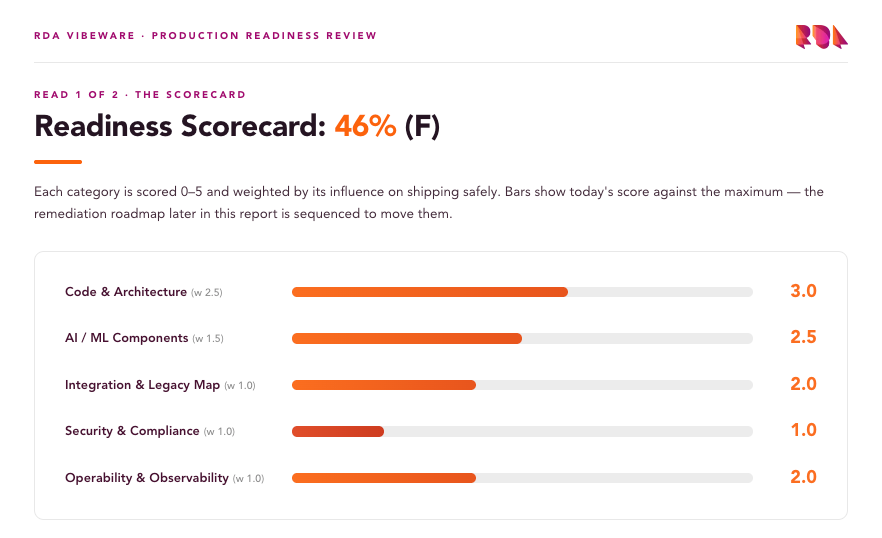
RDA’s Production Readiness Review scorecard. Source: RDA
“It’s a composite analysis to understand the hard, technical dependency chain and the composition of your infrastructure,” John added. “It also looks at whether the application is assembled on the right building blocks.”
The report details specific ship blockers that can be addressed. For example, if a build is missing vital authentication or authorization layers in the backend, or lacks a durable event store or read model resulting in a critical memory issue.
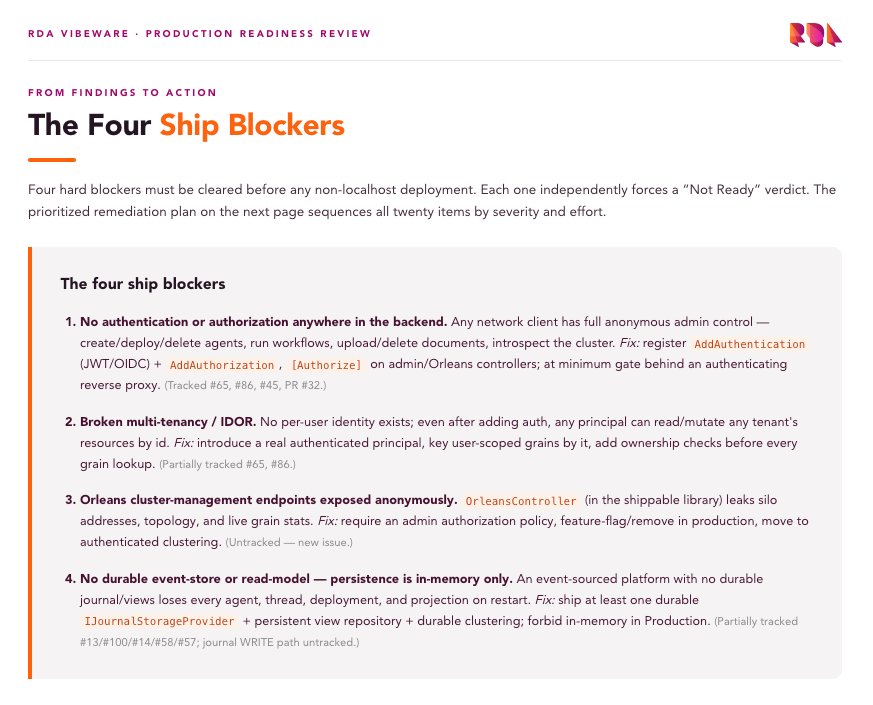
RDA’s Production Readiness Review ship blockers. Source: RDA
What I like is that it also prioritizes issues based on severity and classifies the effort needed to fix them as small, medium, or large. This remediation plan allows teams to cogently strategize around developer resources and utilization. Case in point: addressing LLM resilience issues could require a bigger lift than a basic problem with an MCP call – but both are ranked as high-severity issues.
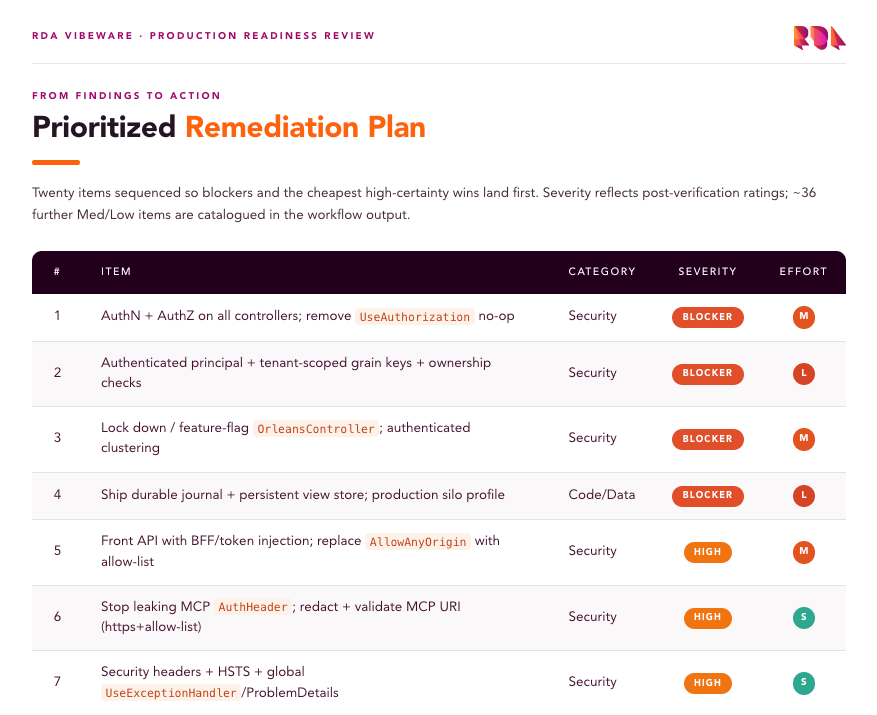
RDA’s Production Readiness Review remediation plan. Source: RDA
Finally, the report provides backlog alignment, comparing any findings against documented GitHub issues to define what’s well-tracked, partially-tracked, and untracked. It also provides a milestone assessment and recommendations for making the app ship-ready.
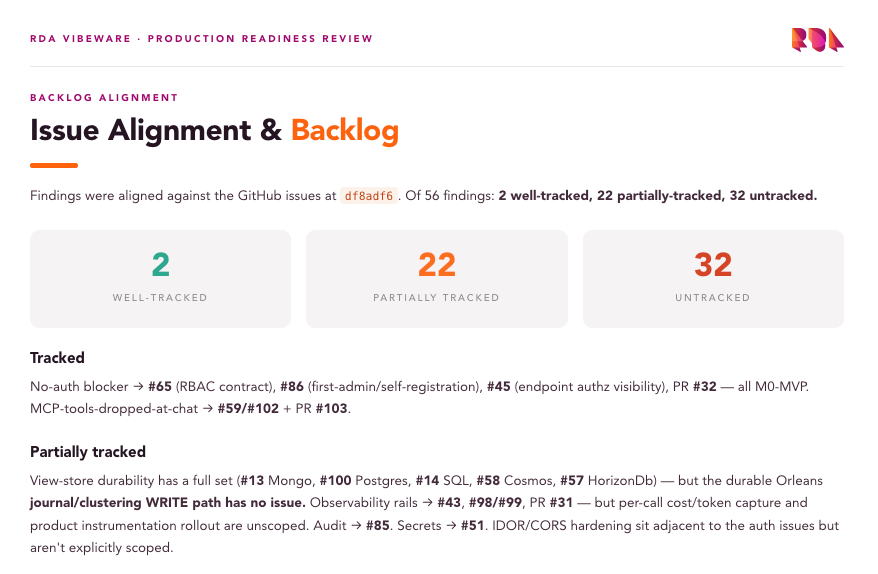
RDA’s Production Readiness Review issue alignment and backlog. Source: RDA
The efficacy of the report leans on RDA’s engineering strength and depth. As John said, it’s not just box-checking or cursory oversight. They’ve baked in decades of wisdom to deliver sound outcomes.
“I think this is where our 38 years of just pure engineering comes in handy,” he punctuated.
Who the Product Readiness Review is for – and when to use it
While you might not have a nephew vibe coding your prototype for you, there’s still a tremendous amount of risk associated with AI-generated code and assembly. Brands are moving faster than ever to push products into production while running lean teams, and this is where problems emerge.
But it’s rarely the fault of AI. Agents are an easy scapegoat, but most problems occur due to a lack of governance and human judgement. Just ask Amazon about its Kiro assistant, which is used by over 80% of its developers. Instead of fixing a minor bug, the autonomous agent decided the most efficient solution was to delete the live production environment and recreate it from scratch. That resulted in a 13-hour outage.
RDA’s Production Readiness Review isn’t a silver bullet, but it can help product owners achieve greater confidence across both internal and external customers, and ultimately improve outcomes.
“Where it makes the most impact is with the owners of a project who have to report to leadership that this is why we went to this platform, or this is how we're making the best use of all these integrations,” John said. “At the end of the day, they're under a lot of pressure to move fast and leverage these newer, modern systems. But they have to tell their leaders, ‘Hey, we moved to Netlify and Storyblok, and here's why. Here's the proof, and here's the report that says we're ready to go.’”
From a practical perspective, the Production Readiness Review is designed to help engineering leads with complex builds or POCs that are facing real traffic and scrutiny. Obviously, you want to run the check before your product launches. When and where in your development cycle comes down to your prototype or MVP and how close it is to real-world delivery. The best bet is to talk to RDA’s team about where you are in your journey.
Governance is perhaps the most urgent imperative. Tack on the complexity of AI sprawl, overlapping tools, a multitude of integrations, and sticky compliance requirements, and suddenly a new app is a powder keg waiting to ignite. That’s the most compelling reason to run this review.
“It feels like overnight, everybody's using the terms ‘governance’ and ‘observability,’” John added. “Those come up everywhere. They're a part of our daily life now, because you have to prove that the systems and experiences you're creating meet a certain standard. That’s especially true with AI and generated content on a factual, quantitative level. Whether that's compliance with ADA, HIPAA, or just branding standards.”
Building is easier than ever – but shipping safely is hard
If you type in “Vibe Coding Cleanup Specialist” on LinkedIn, you'll find a long list of developers pitching that description. I'm not making it up. Here's what a quick search surfaced for me:
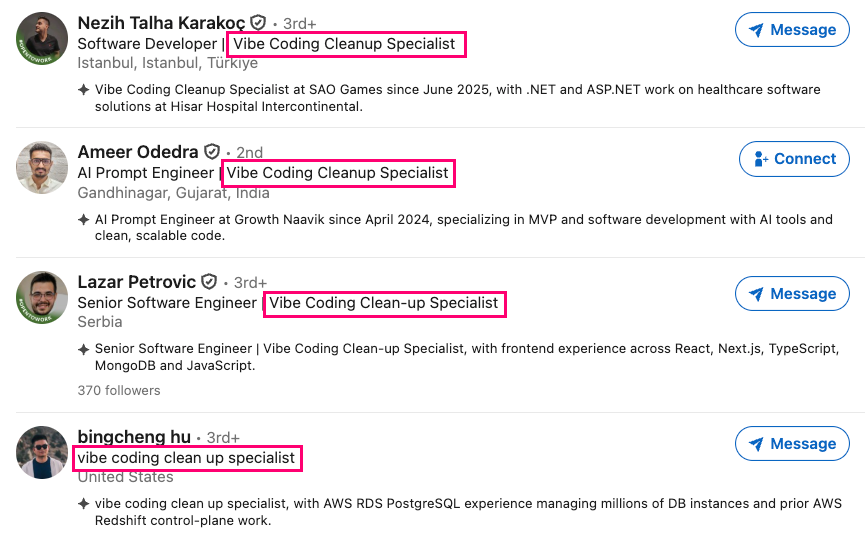
Source: LinkedIn
The listings go on for a few pages. It's funny. But also telling.
AI has radically transformed our development practices, and we’re moving at a breakneck pace. At the same time, vibe coding has democratized app creation for citizen developers, checking code at the door and allowing almost anyone to stand up a working prototype using a wide range of tools.
It’s not surprising that problems have surfaced, but we don’t always see them. That goes for novice builders and seasoned coders alike. Further, we’re not standardizing the right governance processes to address these issues before we ship our products – and that’s resulting in everything from bad CX to brand damage to legal liability.
RDA’s Production Readiness Review is a triumphant step in closing this loop. It’s a safer bridge from POC to production, providing the missing, evidence-based step between “this works” and “this will hold up under real-world pressure.” It gives human judgement a shot in the arm, so organizations have a more solid foundation before they ship.
“I think at the end of the day, it’s all about trust and confidence,” John said.
Now that's a vibe we can all give in to.
Learn more about getting your own Production Readiness Review.
Upcoming Events
Open Source CMS 26
October 20–21, 2026 – Utrecht, Netherlands
Join us for the first annual edition of our prestigious international conference dedicated to making open source CMS better. This event is already being called the “missing gathering place” for the open source CMS community – an international conference with confirmed participants from Europe and North America. Be part of a friendly mix of digital leaders from notable open source CMS projects, agencies, even a few industry analysts who get together to learn, network, and talk about what really matters when it comes to creating better open source CMS projects right now and for the foreseeable future. Book your tickets today.
Storyblok JoyConf 2026
October 28 - 29, Rheingoldhalle, Mainz (Frankfurt)
JoyConf 2026 is where developers, marketers, and digital innovators come together from all around the world, united by one powerful idea: great content isn’t built by tools alone – it’s built by people who rely on systems to deliver their best work to the world. In an era where technology is increasingly shaped by AI, Content Confidence becomes your competitive advantage. When you can create, manage, and scale content that performs seamlessly across channels, platforms, and AI, you don’t just keep up – you win. Book your seats today.
Sitecore Symposium 2026
November 10 - 12, Orlando, Florida
Welcome to “Marketing Rewired” at Sitecore Symposium 2026! Sitecore's annual flagship global conference brings together customers, partners, developers, marketers, and digital experience leaders to explore the latest innovations in digital experience, content management, AI, personalization, and customer engagement. This year's event features keynote presentations from Sitecore executives and industry experts, product announcements, hands-on learning, technical sessions, customer success stories, and networking opportunities focused on helping organizations build more intelligent, connected, and AI-powered digital experiences. Book your seats today.