Vibe-coding FOMO? Fimo.ai offers easy website building with AI-native CMS capabilities


The new entry into the no-code website builder category offers real promise, powered by the minds behind Strapi's popular headless CMS.
Over the years, I’ve built websites a-plenty using no-code builders, from stand-alone products to plug-ins for open source platforms. I’ve experimented with everything from Elementor to Squarespace to Webflow, and had a mix of results up and down the scale.
The devil, it seems, is always in the details.
I remember seeing the first entries in what we’ll call the “modern” era of AI-powered tools that promise a “prompt and a dream” to a working site. In my early trials, I ran into the limitations of what was possible – but improvements have certainly been made over the last year.
The current crop of vibe coding tools is now fairly robust. Watching laypeople conjure apps using Base44 for example, is kinda magical. But it’s also a bit misleading. As I’ve discussed with Matt Biilmann of Netlify, you wouldn’t run these prototypes across the finish line without a competent developer's eye, but they’re giving laypeople a solid starting point.
Websites are a different bailiwick. While some projects might only require a static page, most need a backend to manage the concerns. In other words, you need a CMS to complete the equation. That’s where Pierre Burgy saw an opportunity to do it better with a new platform called Fimo.ai – which officially launched today.
As Pierre explained, existing vibe coding tools are great for building apps, but websites have their own set of unique requirements. As the founder and CEO of Strapi – the most popular open source headless CMS – he’s spent the last decade focused on a better backend experience. Strapi has amassed thousands of GitHub stars and contributors, and millions of downloads, winning the hearts of users across the globe.
With this in mind, Fimo.ai positions itself as an AI-native CMS that focuses on the really important aspects of managing a website – things like translating and updating content with ease, accessing reusable assets, optimizing SEO/GEO, running A/B tests and personalizing pages, scheduling releases, and more.
Already a fixture on Product Hunt, Fimo.ai is a snap to get started with. I created an account using my GitHub creds and was playing around with a sample project in seconds. The UX is sleek, elegant, and incredibly easy to navigate. It all feels fluid. Even a novice will find it comfortable to get around.
Fimo.ai is rich with features
Fimo.ai has a bold roadmap, but it’s rolling out with a complete set of features that will allow you to build with intention and take your project live.
For the purposes of my very first demo sample, I replicated an existing site and prompted a blog to be added. As billed, the process was quick – although the complexity of your task will likely impact your wait time. Still, it’s all like waving a magic wand to cast your project into existence.
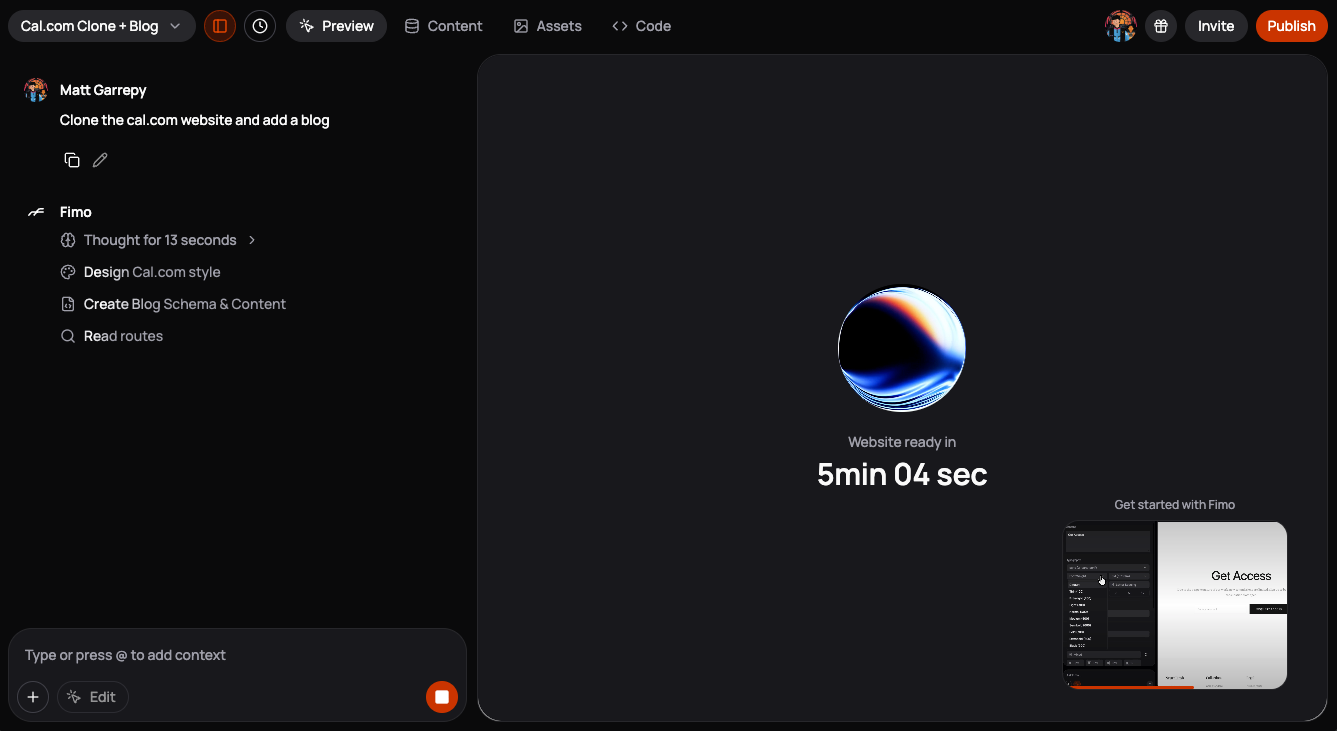
Once inside, I was able to peruse the various entities with little to no friction. Everything is logically within reach, so you can navigate anywhere in seconds. If I wanted to, I could invite users to work with me – and there’s also a sense of presence, so you can see what your team is doing in real-time.
Prompting changes is a slam-dunk. Once my site was fully generated, I was able to start conversationally styling the mechanics. You can adjust content, elements, and even classes across the site. Like any AI generator, feeding it richer, more detailed prompts can improve your outcomes.
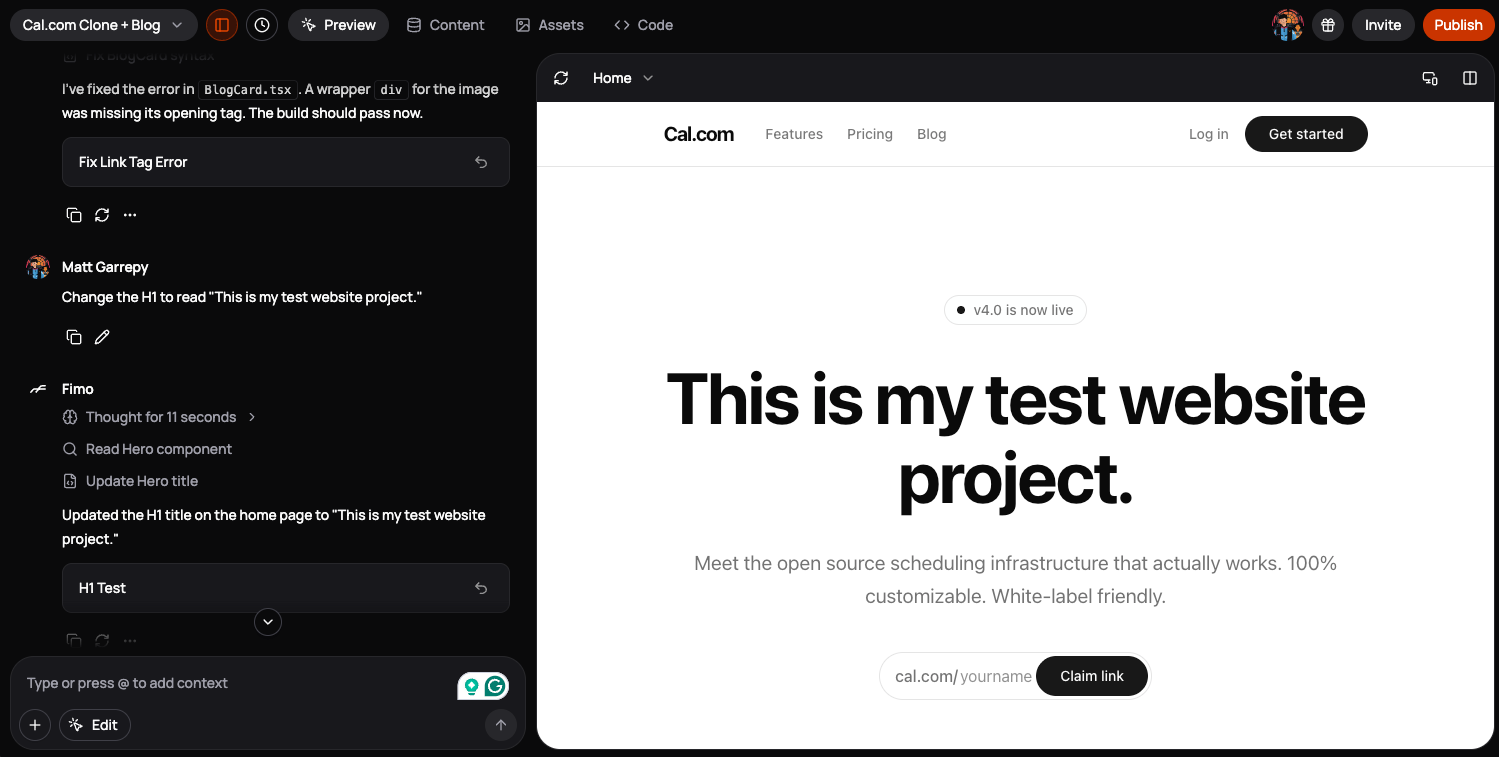
The live preview allows you to access any element to tweak styles and properties, and the built-in CMS lets you manage the content all in one place. As far as assets are concerned, there’s a media library for keeping everything organized and accessible.
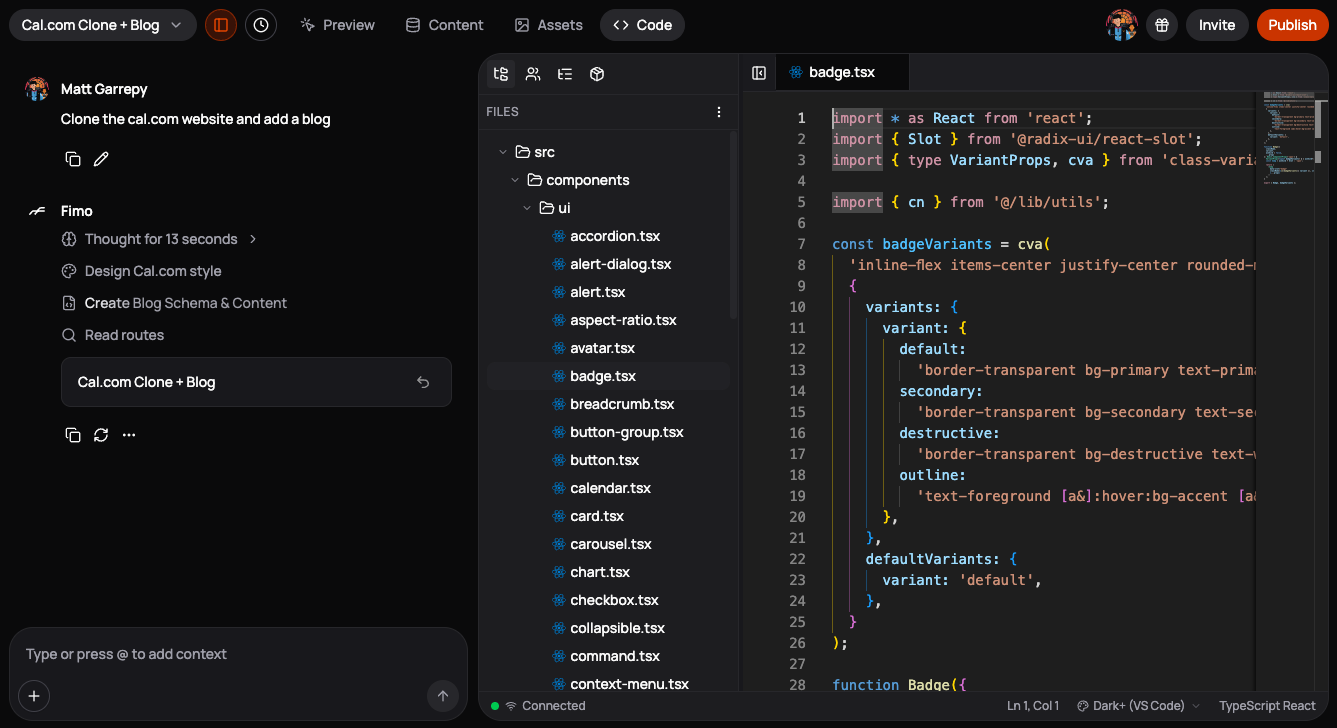
One thing I really like is the ease of toggling into code. There’s a split-view that really makes it comfortable to assess and modify components, and you have access to dependencies and resources at all times.
After I added a blog, I was able to seamlessly access all of the entries and make edits on the fly. The whole experience was very easy to customize and update, and there’s plenty of runway for building this out as part of a robust content strategy – with the underlying structure and fundamentals to support your SEO and GEO goals.
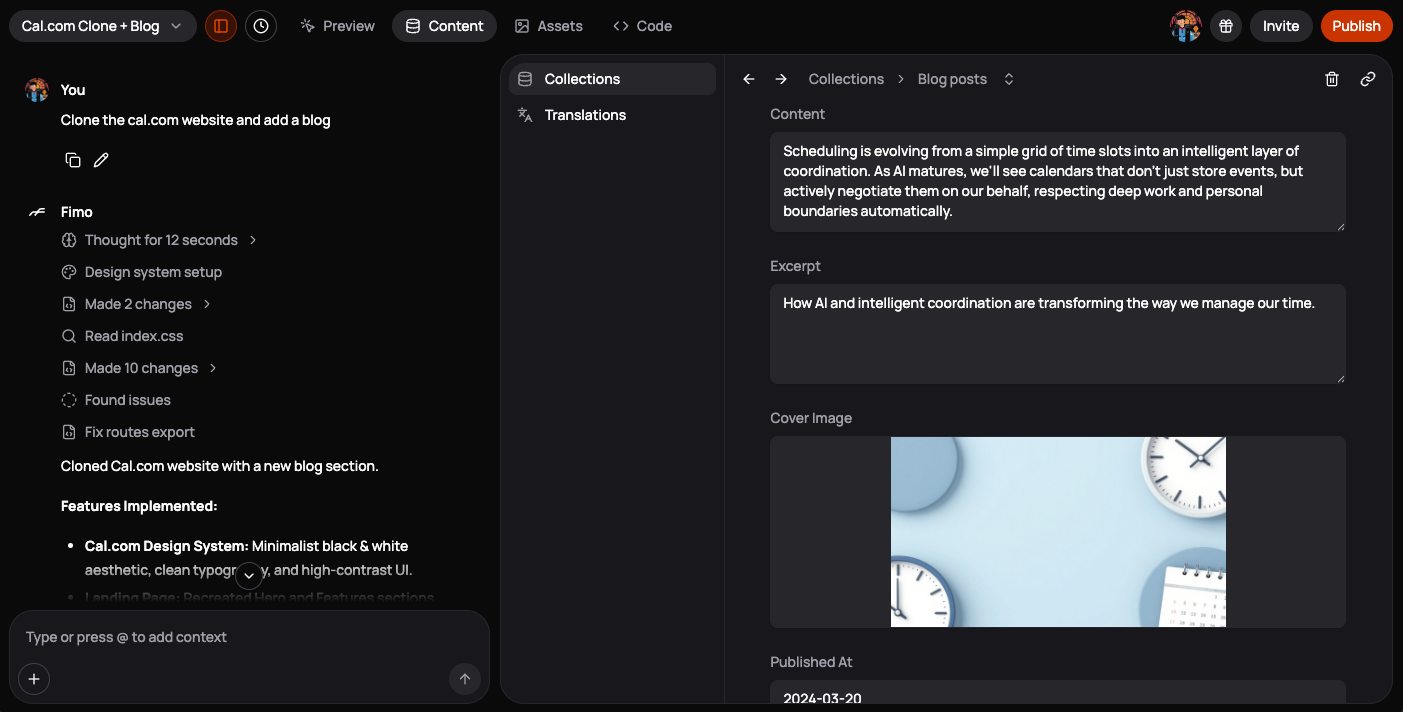
Of course, you’re probably asking, “what if I screw up?” Like any good CMS or system of authority, there’s a content history you can access, allowing you to roll back to previous versions as needed.
On that note: I intentionally created an error in my build (removing a wrapper div for an image), and Fimo not only detected it, but offered to fix it. Seven seconds later, I was back to a proper build and preview – and ready to rock and roll.
Hosting
Fimo.ai doesn’t require a lot of fancy DevOps footwork to bring your site to life. You can go live globally in one click with its secure, built-in hosting. Just click the button in the upper right and it builds and deploys the current preview state. Fimo takes care of everything.
If you have a team, the obvious benefit is the ability to collaborate freely in the preview mode without affecting any visitors to your live production site. In other words, you have a staging environment with a one-click pathway to production.
Every project is published by default under a free fimo.site subdomain. But you do have the option under a premium plan to add your own custom domain, which provides a fully branded experience.
On the roadmap, you’ll soon be able to connect your Fimo.ai project to your GitHub account, so your code and history live in a repo. This will augment the benefits of controlling your version history, collaborating with other team members, syncing with changes, and managing granular code-based considerations like setting up CI/CD pipelines to manage the flow.
Documentation
Based on the quality of the documentation, it’s evident that seasoned content and development people were behind this project. From end to end, the guidance is clear, concise, and well-structured. There’s also a cache of learning resources on vibe coding, prompt engineering, and even how to optimize the use of your AI credits in Fimo.
I particularly like how they’ve simplified many of the instructional posts with a quadrant of benefits, making the explanations much more accessible to laypeople without any coding or technical background.
There’s also the presence of meetups, community, and even a referral program for earning credits – giving it all a grassroots vibe that could grow organically.
Pricing
As I just mentioned, Fimo is an AI website builder, so it’s devouring credits with every prompt. Being judicious and strategic about how you use those prompts is key – and I’m impressed at how proactive they are with advocating for solid prompt engineering.
At launch, Fimo.ai is offering two simple options. The first is a Free plan that offers up to 3 projects and 2,500 monthly credits. That’s enough to trick out a basic site and experiment with the possibilities. The only downside with the Free tier is the presence of the Fimo platform badge, which makes the case for upgrading.
Fimo’s Premium plan is just $25 a month and provides a lot more power. Along with 25,000 monthly credits, you get unlimited projects, 30 days of version history, and the removal of the platform badge. It’s pretty robust considering what you get.
The verdict
The market is awash with AI builders, so there’s plenty of choice if you’re looking for the “easier lane” for launching a project. But having a solid CMS baked into the recipe is a key differentiator, and something that’s only been available in certain platform offerings.
I’ve long been a fan of Strapi, and their collective knowledge and experience have clearly been injected into Fimo. That gives it a content management framework and structural mindset that other builders might be lacking. As someone who also wants access to code – and potentially to a Git-powered solution – Fimo is also tracking in the right direction with its current features and broader roadmap. It really appeals to a wide range of users up and down the technical spectrum.
There’s also a spirit of startup magic in this tool. I love how they tapped Product Hunt as a channel for marshalling grassroots momentum while inviting seasoned builders from the Strapi side into the mix. It feels fresh, even if it's entering a noisy segment of the building experience ecosystem.
My recommendation: It's early days (um, day one, actually), so running a workload is still something I need to assess. With websites, there's a lot to explore in the way of forms, A/B testing, and other factors – as well as the ability to connect with other systems as part of an integrated, composable play. But based on what I've already seen, you should create a free account and give Fimo a spin. When I compare it to other enterprise-grade builders, it's achieving a simpler, more intuitive flow that most users will find satisfying. Be sure to check out the sample projects in the gallery to see just how far uses are pushing it. You might feel a little FOMO, but that should light a fire under you to create some beautiful sites of your own.
Upcoming Events
CMS Summit 26
May 12-13, 2026 – Frankfurt, Germany
The best conferences create space for honest, experience-based conversations. Not sales pitches. Not hype. Just thoughtful exchanges between people who spend their days designing, building, running, and evolving digital experiences. CMS Summit brings together people who share real stories from their work and platforms and who are interested in learning from each other on how to make things better. Over two days in Frankfurt, you can expect practitioner-led talks grounded in experience, conversations about trade-offs, constraints, and decisions, and time to compare notes with peers facing similar challenges. Space is limited for this exclusive event, so book your seats today.

Umbraco Codegarden 2026
June 10–11, 2026 – Copenhagen, DK
Join us in Copenhagen (or online) for the biggest Umbraco conference in the world – two full days of learning, genuine conversations, and the kind of inspiration that brings business leaders, developers, and digital creators together. Codegarden 2026 is packed with both business and tech content, from deep-dive workshops and advanced sessions to real-world case studies and strategy talks. You’ll leave with ideas, strategies, and knowledge you can put into practice immediately. Book your tickets today.
Open Source CMS 26
October 20–21, 2026 – Utrecht, Netherlands
Join us for the first annual edition of our prestigious international conference dedicated to making open source CMS better. This event is already being called the “missing gathering place” for the open source CMS community – an international conference with confirmed participants from Europe and North America. Be part of a friendly mix of digital leaders from notable open source CMS projects, agencies, even a few industry analysts who get together to learn, network, and talk about what really matters when it comes to creating better open source CMS projects right now and for the foreseeable future. Book your tickets today.