10x Marks the Spot: Treasure Data’s Shift to ‘Treasure AI’ Maps New Value in the Agentic Era


The CDP turned Agentic Experience Platform has evolved its brand to reflect an ambitious AI focus, promising to deliver 10x value to marketers in 10 minutes with its innovative AI-native architecture. Interview with Chief Product Officer Rafa Flores.
One might call Rafa Flores a digital buccaneer. Not the Tampa Bay variety, but the swashbuckling type that would make Errol Flynn think twice about raising a sword if one doth protest.
I say this because he’s swung daringly through the tech jungle, powered by a Stanford pedigree and a tacit knowledge of how to win. His LinkedIn profile reads like a product ninja’s mantra: Fail fast, fix faster.
In the last few years, he’s been involved with several startups as they scaled up, maneuvered IPOs, or labored through acquisitions. That includes Treasure Data in 2018, where he led the CDP’s global integration and data teams.
After a busy break, he’s back, heeding the call of CEO Kaz Ohta as Treasure Data takes an evolutionary and challenging step in its arc. And we’re not just talking about a mild shift in tactics.
Just a few days ago, the company officially reintroduced itself as Treasure AI, consolidating under a new URL (the aptly appended www.treasure.ai) and expanding its mission beyond the traditional customer data platform category.
As Treasure's refreshed website states, the company is operating at the speed of AI with the “soul of a marketer," a central foundation that balances the equation of humans and machines collaborating in the agentic era. It’s also a clear stake in the ground as Treasure AI strives to disrupt Salesforce and Adobe in the battle for data, marketing, and the all-important mantle of AI dominance.

Treasure AI Chief Product & Growth Officer Rafa Flores. Source: Treasure Data website
But wait – there’s more. In lockstep with this brand evolution, the company also launched its new Treasure AI Studio, an AI-native solution needed to complete its vision of a fully agentic platform. In a nutshell, Treasure AI Studio promises to arm marketers and data analysts with an AI-powered workspace to access and manage customer data through natural language via the web, desktop, and mobile channels.
Treasure AI Studio is itself a reflection of the accelerated pace of AI development. According to the company, it was built by a single engineer using Claude Code – and in record time. Despite the palpable benefits of AI-induced speed and efficacy, Treasure AI is keenly focused on keeping humans in the loop and is currently expanding its human workforce to support more growth.
When it comes to agentic AI in 2026, it’s all about delivering value, and ROI has become the litmus test for every investment. I’ve been tracking Treasure Data’s moves over the last few years, monitoring its leap from CDP to marketing cloud to “Super Agent” orchestrator. AI has been the figurative “X” that marks the sweet spot, unlocking some pretty astounding capabilities – several of which I personally demoed with its CEO.
Now, “10x” might be where the real treasure lies. I say 10x, because that’s the metric Treasure AI boldly claims it can deliver to marketers in 10 minutes with its Agentic Experience Platform.
Can they back it up?
If the continued innovation tracks with what I’ve been seeing so far, they might be digging up gold. And that’s exactly what Rafa is hunting for as he builds a brand to compete on the high seas of AI.
From CDP workhorse to Agentic Experience Platform
If you only saw the headline, Treasure Data’s shift to Treasure AI might look like an opportunistic dive into the modern corridors of “AI washing.” As Rafa told me, they’ve been on a long journey to the frontier of agentic AI – and it’s been shaped by a tacit focus on data and a mission to support the needs of the Chief Marketing Officer.
“I think some people who haven't followed Treasure Data for a long time may see this as a completely different company and a hard pivot,” he said. “It's an evolution, and it's not just to chase the AI cloud of noise. When I first joined the company, we were focused on data management for service analytics. And really quickly, we realized as we were working with a lot of data engineers and analysts, that the person they were actually feeding the insights to was the CMO.”
That realization eventually pulled the company into CDP territory, evolving their data management and service analytics towards marketing operations. Over time, he explained, they realized just how much insight they could provide as a more evolved customer data platform.
Of course, that also brought the classic CDP problem into sharper focus: justifying the spend. “The challenge for CDPs is the ROI,” he said. “There's a ton of value in just data alone and making sure you can wrangle that together, but it's hard to prove that when you pay X amount of dollars for it.”
Treasure AI has, over time, chipped away at these problems. In my previous coverage, I’ve dug into their efforts to transform to a “no compute” model and deliver more predictable pricing. Now, as the company embraces its position as an Agentic Experience Platform, that same vein of innovation is unlocking the potential for greater value, moving beyond the customer data yoke and leading with agents as the connective tissue between insight and execution.
One of the crucibles will be defining what that means to an audience and how a vendor delivers in an increasingly noisy space with fuzzy category parameters. With brands like Adobe and Contentstack framing their own definitions of an “Agentic Experience Platform,” there’s already some potential for confusion.
Add to it a crop of tools planting themselves in the broader AXP cohort – focusing on a mesh of orchestration, workflow automation, testing, and personalization – and it’s easy to see how clarity will be key to Treasure AI’s positioning in this new landscape.
AI with guardrails, not gimmicks
Under the new banner of Treasure AI, Rafa explained how the company is reinforcing its family of AI capabilities called AI Suites that sit on top of its CDP and energize marketing in new ways. Launched last June, they’ve been leveraging agentic AI to drive revenue, cut costs, and reduce risk.
The collection of AI Suites covers the full range of marketing, CX, and service functions. This includes multi-channel engagement, personalization, content creation, paid media optimization, and sales and service team enhancement.
"These AI-first solution bundles entirely reshape how we enable customers to use agentic AI to drive outcomes, cost efficiencies, and higher ROI," said Rafa. "Brands are tired of spending millions of dollars on stagnant, legacy tools that don't drive tangible results.”
In particular, Treasure’s Engagement AI suite – which includes AI Marketing Cloud, Engage Studio, its intelligent CDP, and an AI Agent Foundry – provides a comprehensive suite of tools built to drive personalized customer journeys, automate messaging, and optimize marketing ROI in real time. And with the Foundry, agent functions were already becoming a central fixture.
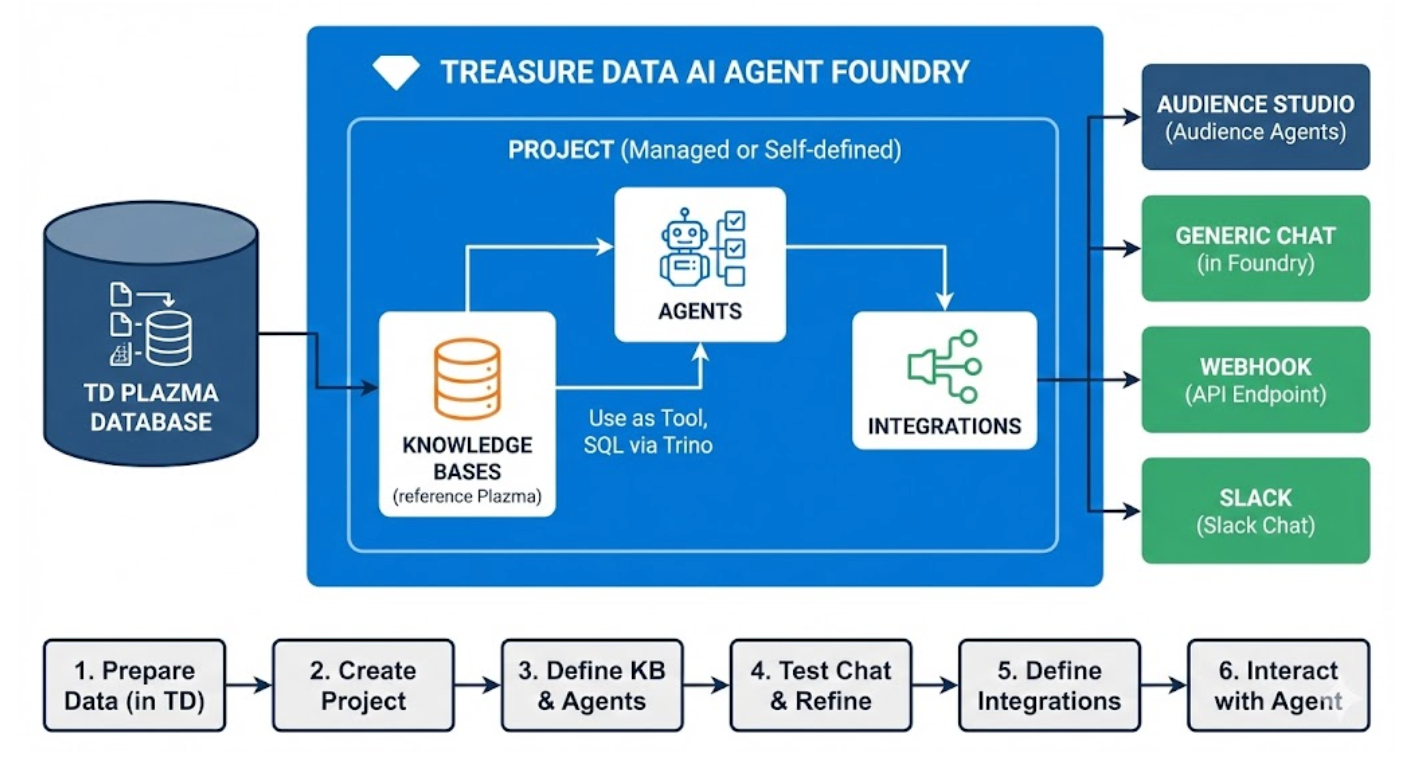
Source: Treasure AI documentation
“When I first came in, there was a question around how to solve all of this,” Rafa recalled. “We launched Engagement, which is omnichannel orchestration. Email, SMS, in‑app, and obviously we have more channels coming down the pipes. We then launched our Personalization AI Suite to ensure you can integrate, bring in your digital assets, and then personalize in real time via triggers, behaviors, you name it.”
The Service AI Suite is all about elevating service experiences by delivering happier customers and superior outcomes. That relies on turning humans working on the customer frontlines into what Treasure calls “superhumans.” The result: customer loyalty and lifetime value with personalized interactions anchored in unified customer data and AI.
Treasure's focus on brand guardrails is also a foundational discipline. As Rafa explained, this part of its Creative AI Suite helps streamline content creation and maintain governance with a self-serve flow. “The competitive differentiator of our creative AI suite is that it has a brand guideline agent that ensures that you can follow company policy,” he said.
That brand guideline enforcement is more than a sidebar feature. As marketers hand more of the experience to AI, both voice and compliance become existential issues. An AI that can’t stay on brand is a liability. Treasure’s bet is that combining creative acceleration with strong guardrails is what will make enterprises comfortable pushing further into automation.
Rafa’s product philosophy backs that up. “I'm a big believer as a product innovator,” he said. “You’ve got to build stuff that people need, not that you have an ego around or you want to build. It's just not going to work.”
What Is Treasure AI Studio?
If Treasure’s Agentic Experience Platform is the engine, Treasure AI Studio is the cockpit where marketers actually sit. It’s the essential interface layer that connects CDP, AI suites, and agents into something usable and, more importantly, livable.
“The missing gap we had was the interface piece,” Rafa admitted. “We’ve had this really powerful CDP that we've run successfully for a long time, and now we've come up with this AI Suite so we can actually drive activation. So how do I orchestrate the base of this thing? And that's where Treasure AI Studio came into the picture – and we have it now.”
Treasure AI Studio is an AI‑native workspace that lets you orchestrate data, campaigns, and insights through natural language, turning hours of manual console work into minutes of AI-assisted conversation. It lets you query data, build audiences, map journeys, and generate production-ready reports – all from a single chat interface across web, desktop, and mobile.
"We’ve had this really powerful CDP that we've run successfully for a long time, and now we've come up with this AI Suite so we can actually drive activation. So how do I orchestrate the base of this thing? And that's where Treasure AI Studio came into the picture – and we have it now.”
The net outcome? No more spelunking through a dozen dashboards or complex tasks like querying data with SQL. You talk to agents that understand the underlying stack so you can build CDP resources via conversation and power through tedious tasks with total control.
“If you think about it, Treasure AI Studio is this interface layer that you can go in and orchestrate, whether you want to orchestrate your CDP, or you want to power the ESP within, or you just want to get daily insights,” Rafa said. “It gives you access to all the logic.”
Treasure AI Studio includes more than 50 pre-built skills that know how to operate on a brand’s customer data, not just answer questions about it. Skills span SQL and queries, real-time CDP, segments and audiences, journeys and campaigns, workflows and pipelines, SDKs and integrations, AI agents, data governance, documentation, and analysis and dashboards.
As Rafa shared with me, the experience is designed to follow you – not the other way around. To that end, the experience points have been expanded to meet users wherever they are. There’s traditional web and desktop versions, but there’s also a mobile version, enabling you to access insights on the go.
“That mobile push came directly from enterprise feedback,” he explained. “We had a few big C‑levels across one of our top brands. The result is an environment where a CMO can check performance, spin up ideas, or adjust campaigns from their phone as easily as from their desk.”
Under the hood, Treasure AI Studio is powered by the aforementioned bank of skills, where users can hyper-tailor the best agents to perform things like segmentation or to generate a journey. And it’s all buoyed by an agent orchestrator that sits above those skills to keep everything organized. That’s what makes this feel like a true agentic control plane.
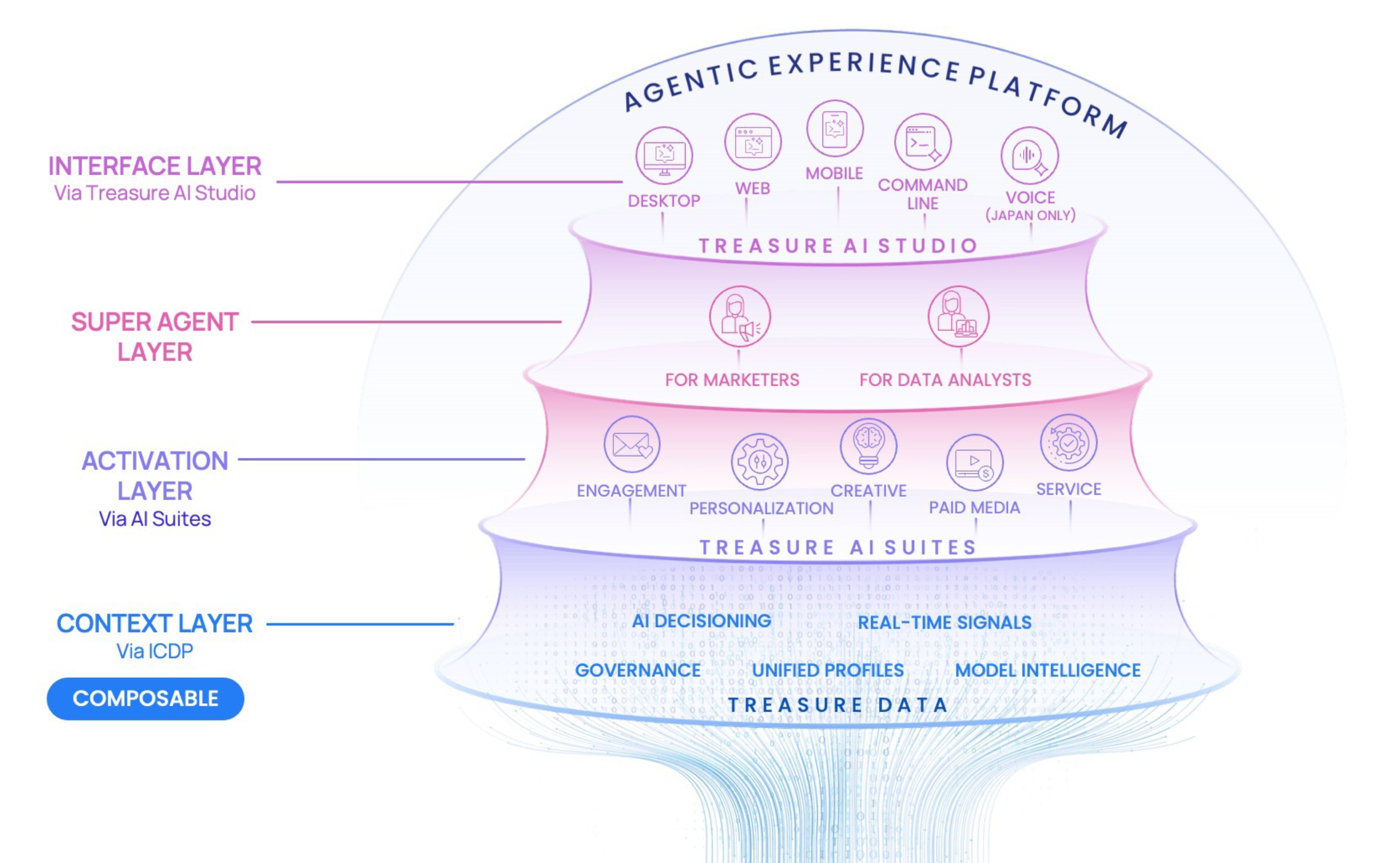
Source: Treasure AI website
I love seeing when product leaders actually live in their products. For Rafa, that got personal with Treasure’s evolving capabilities.
“I'm a builder,” he touted. “I like to build things from the ground up.”
That builder mindset shows up on multiple levels. On the work front, Rafa has used it to overhaul a major HubSpot marketing plan, tasking it to analyze and identify any gaps. The payoff for CMOs and growth officers is time: insights that once took weeks to glean can be produced in mere minutes. But he’s also using it to manage the complexity of his personal life, from family calendars to vacation planning. It’s super extensible.
“In five minutes, I can have insights,” he told me. “I can get on the phone with my team and say, ‘Hey, here's what I’ve got. Take it to the next step.’ And just like that, every day you can get one point better.”
Wrestling with the growing cost of AI
If you’re maxing out Claude Code, you’re already intimately aware of the throttling that’s choking your work. Since March of 2026, users across forums have reported that they’re burning through monthly usage allotments in days – sometimes hours – and being forced to pay more for less.
Peel back the interface, and you’re left with a sobering reality: models and compute aren’t free. Nor are they bound to get any cheaper. For its part, Treasure is trying to reduce the surface area of cost and complexity – something I’ve noted in previous articles, where the company has focused on value over compute.
To that end, Treasure AI prices by customer profiles or behavioral events, not by query volume or processing power. This applies to its Intelligent CDP, but also across its CDP bundled with AI Suites, as well as Treasure AI Studio for conversational AI. The goal is to break the black box surrounding cost and maintain predictability as data scales.
With its AI Studio, which is available with any Treasure AI plan, you get a free workspace – so there’s no license or seat fee. It’s also worth noting that you can try Treasure at no cost with a two-week POC that covers a range of use cases. You can dig into the product details and incentives here.
Part of Treasure AI’s secret sauce is model choice, which is rooted in the cloud. As Rafa explained, their infrastructure is powered by AWS, which is a key partner for the company. By harnessing its Amazon Bedrock ecosystem – the hyperscaler’s platform for building generative AI applications and agents at production scale – they’re able to tap a deeper bench of model agnosticism.
“You can say, ‘Hey, I want to switch this out and pick something else,’” Rafa explained, pointing to the inherent flexibility of AWS. “It's up to you, but it will automatically go and pick the most skilled model for the task at hand.”
On the economics, Treasure is abstracting tokens into a more digestible currency: AI Credits. It's a usage-based system that allows customers to pay for the creation and execution of AI-driven marketing and data tasks. As Rafa said, the system gives you full visibility into how much you're consuming, which can be monitored through the AI Suite Credits Utilization dashboard. AI Credits are fungible, and you can also control who uses what. For enterprises staring down the unknown TCO of AI, Treasure is providing an enhanced framework for transparency.
The more agentic your stack becomes, the more governance matters. In this arena, Treasure’s CDP heritage gives it a head start, weaving in the right instrumentation from security to SSO – all of which flows into Treasure AI Studio.
“It inherits all the permissioning at the top,” Rafa said. “Our CDP has all these really deep controls and rails. If you are a user with view or admin or just regional access for data, it will inherit that.”
Crucially, Treasure AI is maintaining human control at the right levels, allowing users to have maximum oversight. While automation is key, Rafa doesn’t see AI replacing the vital role of marketers and analysts – but as a force multiplier for operating in a new AI-powered business model.
“I don't think AI is going to replace humans,” he told me. “I think it's going to replace humans who fail to want to use it.”
The verdict
Treasure AI is more than a new coat of brand paint – it’s the logical outcome of a company that started in the data trenches and is now evolving into a broader, agentic operating model for marketing and growth. The move from Treasure Data to Treasure AI aligns with a real shift in architecture and ambition, from “collect and unify” to “know, act, win” through agents.
Treasure AI Studio is the keystone, bringing a more cohesive patina to the company’s collection of suites. With it, Treasure now offers a unified, AI‑native workspace that can actually become a daily command center for CMOs and their teams. Couple that with more robust governance and guardrails, a model‑agnostic foundation on AWS Bedrock, and efforts to optimize the pricing structure, and you have a credible, AI‑era alternative to the legacy ecosystems.
Can they make a run against the towering forces of Adobe and Salesforce? They have their work cut out for them, especially as both competitors have repositioned as agentic frontends (Salesforce’s Headless 360 is turning its entire platform into an infrastructure for AI agents). Uphill battles aside, Treasure is leaning hard on its legacy of AI innovation, and that could prove to be a game-changer.
In a CDP category that’s been searching for its next act, this is a strong signal that the future might rest with this vision of an Agentic Experience Platform – and Treasure AI is a reminder that the “X” is now in a different spot.
My Recommendation: I’ve watched Treasure Data move steadily from CDP to full‑fledged marketing cloud, and the evolution to Treasure AI feels like the moment where those investments snap into place. Its “Super Agent” shift was a meaningful first step, but renaming the company and launching Treasure AI Studio marks a bolder commitment to competing head‑on with the market as an AI‑native agentic player.
At the same time, it’s still early days in understanding the true cost of AI‑heavy stacks where usage can increase costs – and fast. Treasure AI’s consumption model and visibility give it an edge in the emerging economics of AI, but you should still model different scenarios and align them to your own enterprise goals. More broadly, I would heed this as a signal of where the CDP category is heading, which also risks dilution as vendors evolve their offerings. That said, if you’re perusing platforms – and you value data, marketing, and agentic innovation – Treasure AI should be on your map.
Upcoming Events

JoomlaDay USA 2026
April 29 - May 2, 2026 – Delray Beach, Florida
Be part of the Joomla community in one of the most iconic cities in the world! JoomlaDay USA 2026 is coming to Delray Beach, and you can join us for a dynamic event packed with insights, workshops, and networking opportunities. Learn from top Joomla experts and developers offering valuable insights and real-world solutions. Participate in interactive workshops and sessions and enhance your skills in Joomla management, development, design, and more. And connect with fellow Joomla enthusiasts, developers, and professionals from across the world. Book your seats today.

CMS Summit 26
May 12-13, 2026 – Frankfurt, Germany
The best conferences create space for honest, experience-based conversations. Not sales pitches. Not hype. Just thoughtful exchanges between people who spend their days designing, building, running, and evolving digital experiences. CMS Summit brings together people who share real stories from their work and platforms and who are interested in learning from each other on how to make things better. Over two days in Frankfurt, you can expect practitioner-led talks grounded in experience, conversations about trade-offs, constraints, and decisions, and time to compare notes with peers facing similar challenges. Space is limited for this exclusive event, so book your seats today.

RAISE Amsterdam
May 20, 2026 – Amsterdam, Netherlands
Sponsored by Kontent.ai, RAISE Amsterdam brings together bold marketing and technology leaders to explore how agentic AI is reshaping the way ambitious brands create and deliver content and what it takes to use it safely, responsibly, and with proper governance. Experience the ideas that are shaping the future and dive into big thinking, innovative strategies, and expert insights. Held at the Klein Canvas, Volkshotel, you'll hear from world-class speakers in dynamic sessions that will reveal how AI-powered content operations are accelerating production, improving governance, and driving creative impact. Limited spots are available, so book yours today.

Umbraco Codegarden 2026
June 10–11, 2026 – Copenhagen, DK
Join us in Copenhagen (or online) for the biggest Umbraco conference in the world – two full days of learning, genuine conversations, and the kind of inspiration that brings business leaders, developers, and digital creators together. Codegarden 2026 is packed with both business and tech content, from deep-dive workshops and advanced sessions to real-world case studies and strategy talks. You’ll leave with ideas, strategies, and knowledge you can put into practice immediately. Book your tickets today.
Open Source CMS 26
October 20–21, 2026 – Utrecht, Netherlands
Join us for the first annual edition of our prestigious international conference dedicated to making open source CMS better. This event is already being called the “missing gathering place” for the open source CMS community – an international conference with confirmed participants from Europe and North America. Be part of a friendly mix of digital leaders from notable open source CMS projects, agencies, even a few industry analysts who get together to learn, network, and talk about what really matters when it comes to creating better open source CMS projects right now and for the foreseeable future. Book your tickets today.