Accessibility Needs Heroes, and Lucy Greco Brings a Paralympian’s Heart to the Digital Field

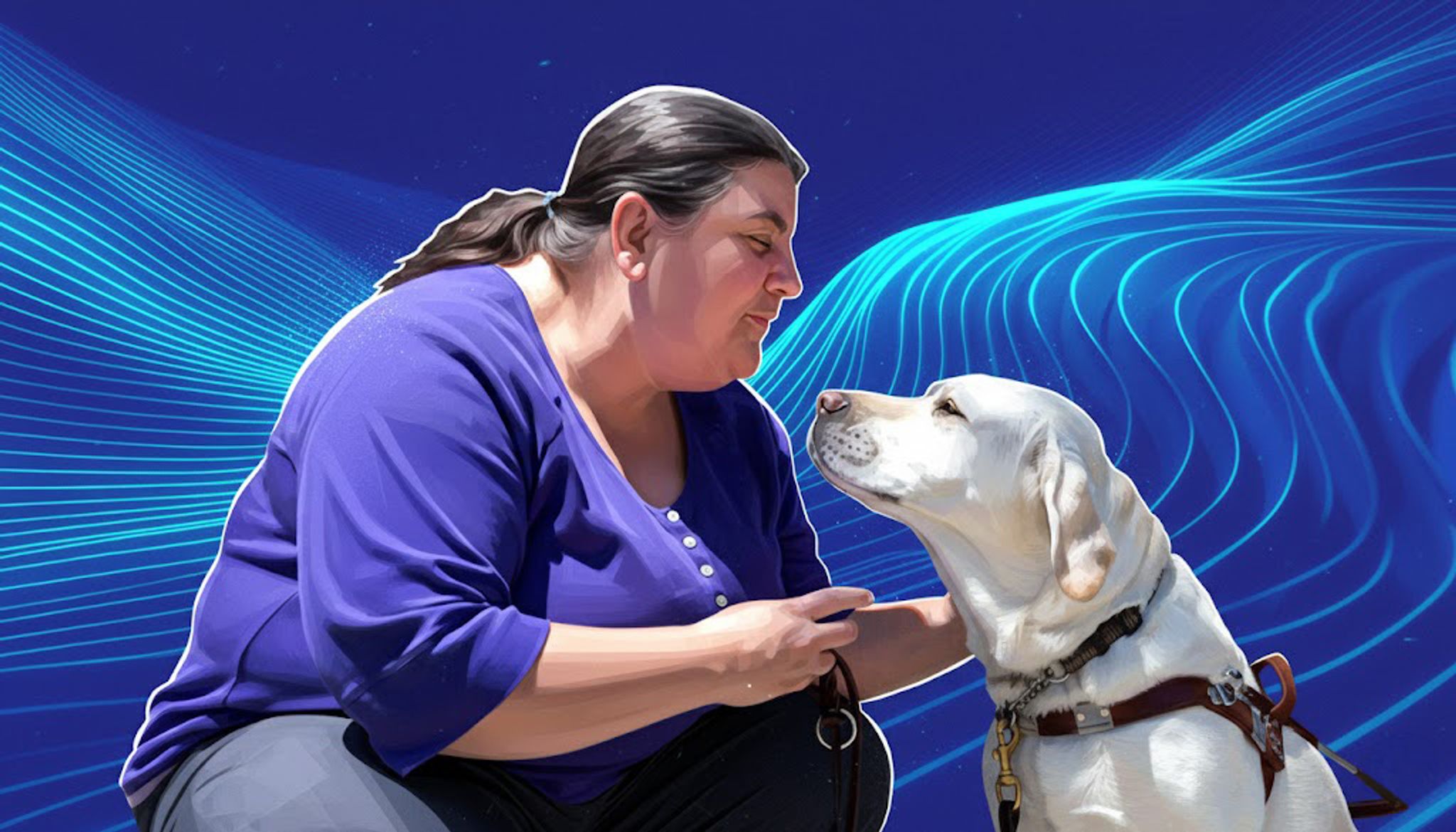
In my conversation with the digital equality speaker and web accessibility evangelist, we leaned into the challenges of institutional culture change, the emerging concerns around AI, and her restless commitment to creating a more inclusive world.
When I started my call with Lucy Greco, there was an unmistakable bark in the background.
A pooch? Could be. They’re common fixtures during Zoom calls in the gig economy.
As it happens, Lucy is blind. So I assumed it might be her guide dog, whom I had become acquainted with at our Boye & Company CMS Connect event in Montreal last August. That’s where I first saw her speak on the critical topic of digital accessibility.
Guide dogs are a breed apart, capable of navigating the world with uncanny sensitivity and intuition. It takes about two years to fully train one, and each handler, like Lucy, is matched based on specific criteria like pace and lifestyle. Along the way, they form a deep physical and emotional bond that centers on trust.
But no, the puppy in question was one of two she was currently fostering – with two more arriving the following day. Her upper threshold, I learned, is seven.
“I thought the new puppy was sleeping, but she was trying to chew the cables under my desk," she cajoled. “We’ve got a full house.”
That’s Lucy for you. Right at home with pushing the upper limits, doing it all with unapologetic joy, blunt honesty, and a heart as wide as an Albertan prairie.
To call her a champion would be putting it mildly. Growing up in Calgary, she told me about her exploits as a Canadian Paralympian, competing in the sport of Goalball. Invented in 1946 to help rehabilitate veterans who had lost their sight during the Second World War, it’s a fast-paced team sport designed for blind and visually impaired athletes.
Here’s the fascinating part: Goalball is played in silence. It has to be. This allows players to hear the sport’s weighted ball, which is imbued with bells. Participants use auditory tracking and tactile floor markings to defend their goal and score against opponents. It requires agility, speed, and team communication – and at the Paralympics level, an athleticism that is off the charts.
“It's specifically made for blind people,” Lucy explained. “You can describe it as a combination of soccer, bowling, and Chinese handball. Or, the way I prefer to describe it is, ‘You play dodgeball to lose.’”
Dodgeball to lose. But everything about it feels like winning.
Maybe it’s her tenacious spirit that has driven Lucy to the top of her game, both personally and professionally. As a life-long web accessibility evangelist, she's focused her superpowers on technology as an activator for inclusive digital experiences. But finding success was a crucible – one that required perseverance.
“As an athlete, I really wanted to grow up to be a physical therapist,” she reminisced. “Going to school in the 80s and 90s as a blind person, things like anatomy and biology, which were key to physical therapy, were not accessible to me. It was just completely out.”
That barrier shaped everything that followed, and for the last 25 years, she’s worked tirelessly to break down walls and create opportunities. She’s done that principally through her work at Access Aces, a consulting firm that provides training, policy guidance, W3C evaluations, UI/UX best practices, and strategic planning services for a wide range of institutions.
As her website proclaims, “Lucy makes accessibility easy!”
Achieving that promise? Not so easy. It requires her to always remain at the cutting edge with assistive technologies – something she did in spades during her tenure at the University of California at Berkeley. In her role as an evangelist, she leveraged her expertise to transform the accessibility posture across the University’s campus, helping to lead the school to a more inclusive future. This included evaluations, system-wide testing, tool procurement, and more.
Along the way, Lucy became a passionate firebrand, a fierce warrior who uses her voice to ignite change. She speaks regularly – and passionately – on a range of accessibility topics. Over the course of her career, she’s supported countless people with physical and motor impairments, helping them to successfully master a spectrum of tools that augment communication and input.
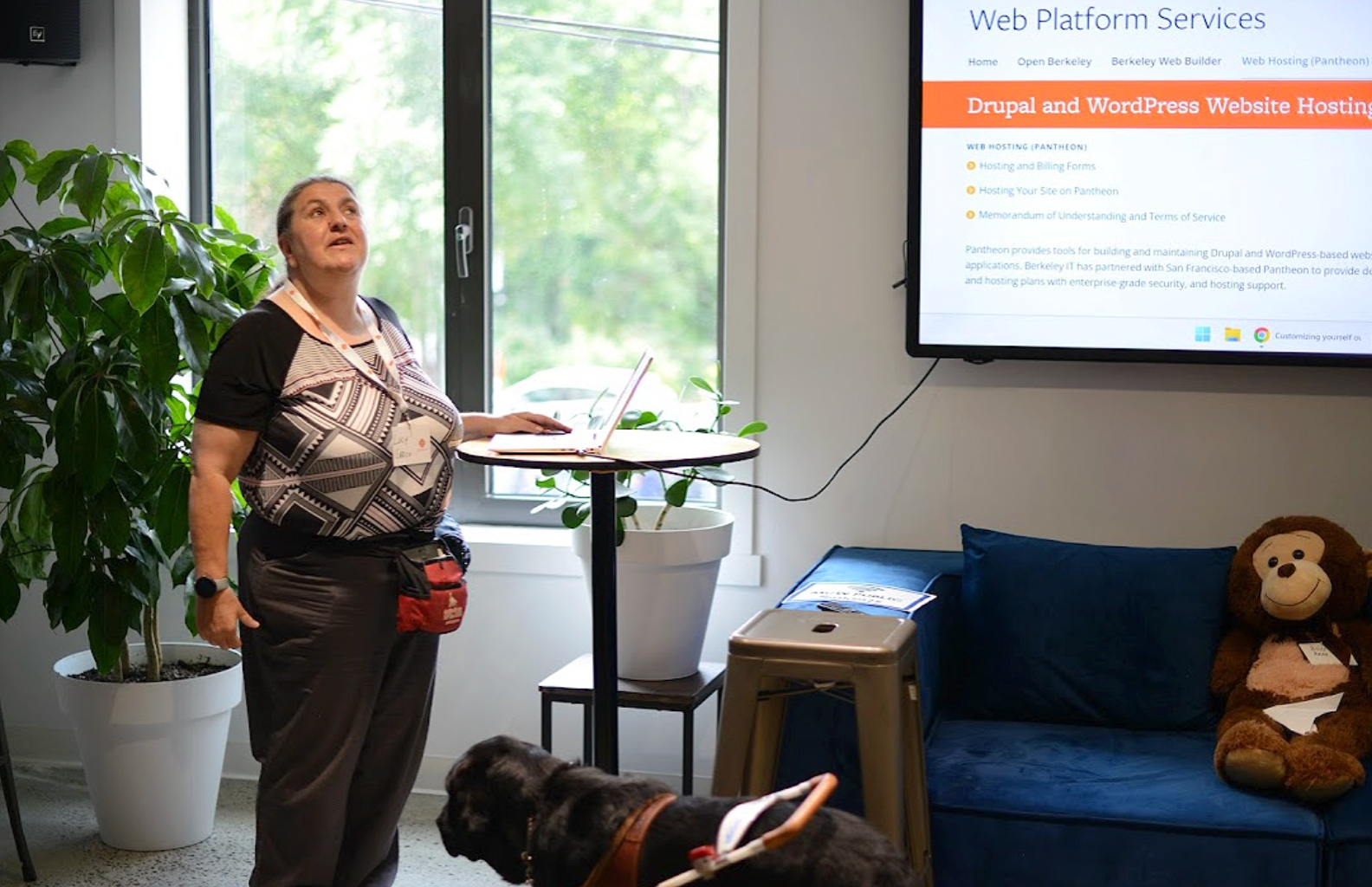
Lucy Greco presenting at the CMS Connect Conference in 2025. Source: Janus Boye/Seb Barre archive
During my own stints as a digital practitioner, accessibility has been a central topic – and a persistently elusive one. I’ve personally managed numerous remediation projects, working extensively with platforms like Siteimprove and Monsido. Despite having more tools at our disposal, accessibility is still treated as an afterthought.
After hearing an inspiring talk from Haben Girma – the first deafblind graduate of Harvard Law School – I realized just how wide this gap is. As such, I’ve written frequently about developing academic and industry resources on accessible design philosophy and the ethics of inclusion.
But the problem is so big that it requires all of us to solve it. Last year’s WebAIM Million Report exposed a sobering truth: Only 5.2% of the top million websites meet basic accessibility standards. The rest fail to meet current WCAG guidelines, as well as Section 508 and state governance in the U.S., and even tenets of the European Accessibility Act.
With the rise of AI, there’s been a promise of meaningful impact at scale. Many see it as a salve, providing unprecedented automation and tooling to address wholesale errors like missing alt tags, ARIA labels, and other functional factors that trip up developers and content creators. With natural, human-like speech becoming a critical benefit of specific models – and ambient agents performing automated checks and remediation – AI stands to have a huge impact on accessibility.
But it’s not that simple. In my recent conversation with Lucy, we dug into this topic, exploring her concerns about communities with disabilities being overlooked in the AI wave. We discussed the positive traction and how certain aspects of AI hold real promise and potential, while specific products are already creating hesitation. We also talked WCAG, its pros and cons, and some of the legal ramifications.
When it comes to accessibility, we often focus on checking boxes and satisfying metrics in our tools. But as Lucy pointed out, there are real human considerations that get overlooked when we “customize ourselves out of accessibility.” This is why we need champions to advocate for change – and that’s exactly what she’s doing.
Discovering technology as a fulcrum for change
Back in my agency days, I consulted with a company called Freedom Scientific, a pioneer in the development of assistive computer technologies for blind and low-vision individuals. They have a line of accessible products, including software that enables screen magnification, reading, and the use of refreshable braille displays for modern devices.
Ted Henter, one of the co-founders of Freedom Scientific, was a former motorcycle racer who became blind after a car accident. In the late 80s, he developed the company’s signature JAWS screen reader software, which became an industry staple. JAWS for Windows is just one of the many products that Lucy has cultivated a deep expertise with. She also works with NVDA and Dragon Naturally Speaking, two highly respected platforms that offer accessible solutions.
Learning has long been a foundation of Lucy’s success. After pivoting from physical therapy, she pursued literature, which offered a pathway to other opportunities.
“I went for my next big love, which was reading,” she recalled. “And I figured, I need a degree, because as a disabled person, getting a job without a degree at that time was just not possible.”
“As I connected with other people with disabilities, I tended to be the person who would teach them how to use computers.”
Lucy discovered her love of computers in 1985. When she attended college, they were popping up everywhere on campus, and she realized how they could level the playing field for blind students. The timing was serendipitous – and the experience illuminating.
“Personal computers were starting to become very, very popular,” she said. “And I was always an early adopter, because I loved playing with toys. Realizing that a computer could get me through anything that I had struggled with in college wasn’t just insightful, it was just completely liberating.”
That early exposure to assistive technology built on Lucy’s natural proclivity to help others. The “bug” to teach technology started informally but later evolved into more formal programs.
“When I moved to the US, I started volunteering at a school for the blind, and trained people who couldn't get training in other places,” she explained. “As I connected with other people with disabilities, I tended to be the person who would teach them how to use computers.”
A natural coach, Lucy brought real conviction to her early advocacy, upleveling skills and broadening opportunities for blind and disabled people. From simple things like budgeting in Quicken to getting through university courses, she has helped transform lives by sharing her knowledge.
This ultimately led to the founding of Access Aces in the early 2000s, which delivers presentations and training on topics like accessibility and disability awareness, as well as W3C evaluations and strategic accessibility plans.
But her work doesn't stop at the keyboard. Lucy is also a sounding board for consumer products, providing equipment reviews and how-to guides for the blind. She has an active YouTube channel that features “know before you buy” videos that assess the accessibility of devices and home appliances.
Transforming lives – one student at a time
For 20 years, Lucy worked at UC Berkeley in an assistive tech lab, helping students one-on-one and providing both technology guidance and deeply human problem-solving.
One heartfelt story she shared with me – about a grad student coming into her office one afternoon – captured both the stakes she faced and the potential of her impact.
“I've never really been able to read,” Lucy recalled the young woman saying. “I've only been able to get through college as far as I have because my mother would read everything to me. But last year, she passed away, and I don't have the ability to read anymore.”
After performing a quick spot assessment, Lucy set her up with reading software and loaded several options from her library of digitized books. She sat the student down at 10 AM, intending to check back soon – and then got distracted.
“I went back to the room at the end of the day to clean up,” Lucy said. “It was about 5:30, and she was still sitting there at the computer. I'm like, ‘Are you okay? Is everything going well here?’ She turned around and burst into tears, telling me how she just read two of my textbooks. It was the first time she’d ever been able to read a book independently, to understand it, comprehend it, and gain information from it.”
Lucy described it as life-altering, and she has countless stories like this – stories of students who became doctors, business leaders, and technologists. Once they had tools that could actually work for them, it changed everything.
“I had a student who was dyslexic and became a doctor,” Lucy said. “He taught his fellow doctors how to use Dragon [software] to document case notes, and he knew how to use it because I taught him while he was enrolled at the University.”
Lucy’s experiences underscore the impact of technology on people with disabilities and how the academic ecosystem has been transformed. Braille, for example, was once the central channel for blind literacy, but a wider range of form factors like screenreaders, audiobooks, and AI-driven accessibility tools are making it easier for students to excel.
According to Ablr, literacy comes in many forms, and humans learn in different ways. The real power lies in having options and choosing the tools that work best. This is where Lucy has focused on technology as a mechanism for changing lives.
The evolving role of WCAG
Over time, Lucy’s work at UC Berkley evolved. What started as one-off fixes across a myriad of digital applications – specifically websites – scaled into a broader challenge of tackling system-wide accessibility barriers across the University. To meet this charter, she had a hand in shaping everything from procurement to product selection, and nurturing the culture with it.
“It was the first time UC Berkley actually paid somebody to do accessibility work and do it at a systemic level,” she said. “Not student X needs this remediated for them, but more like all students could benefit from this website working better. For example, when we buy a system to help us create our course catalog, we make it accessible by default, instead of having students ask us to have it remediated for them.”
One interesting thing that Lucy discussed is the role of the Web Content Accessibility Guidelines (WCAG). Launched by the W3C in 1998, it’s a set of international standards designed to ensure digital content is accessible to people with disabilities.
WCAG is built on four principles, often referred to as POUR: Perceivable, Operable, Understandable, and Robust. Based on how content scores within this matrix, WCAG applies a level of conformance (from lowest to highest: A, AA, or AAA) to websites, mobile experiences, and even document accessibility.
For website stakeholders – this includes everyone from designers to developers to content editors – the current WCAG 2.2 guidelines provide a foundation for accessibility by coding semantic HTML, using ARIA labels, and designing for accessibility from ground zero. As I’ve already mentioned, these pillars are often neglected, so compliance testing becomes a requirement using automated tools, manual keyboard checks, and screen reader tests.
While WCAG provides some semblance of uniformity, it has long been viewed as a moving target, given that digital experiences evolve much faster than regulatory motions. And while some countries have passed accessibility laws – enforcing compliance much like the ADA (Americans with Disabilities Act) enforces ramps in public buildings – others have not.
I asked Lucy where this all fits in the calculus. While she agreed that it’s essential to have a central body for policies, she admitted an increasing frustration with a “checklist mentality” around WCAG and the requirements of certain settlements. Her own methodology is driven by real people – and tasks that deliver tangible outcomes.
“I don't focus on the W3C,” Lucy said. “I've never memorized the WCAG. It's a tool I have in my back pocket, sure, but what I focus on is how well can a person do what they need to do. When I consult for an organization, I'll say, ‘Tell me the three things you need somebody to do with this.’ Then I try to get them done as a screen reader user, or as a keyboard-only user, or someone who has to use an alternative input like speech recognition.”
A frenetic legal landscape, from ADA to EAA
By now, most digital experience practitioners are familiar with the legal implications of accessibility compliance. Here in the U.S., we’ve seen public sector websites sued for a range of Title II and Section 508 accessibility issues over the years.
Additionally, major brands like Target, Domino’s Pizza, and Netflix have been embroiled in highly publicized, years-long litigation over basic functionality, closed-captioning, and other services that would enrich experiences for customers with disabilities. Some have been resolved. Others are ongoing – and much of that has to do with a lack of clarity.
While the U.S. has struggled to back up digital accessibility with uniform policies, Europe is moving faster. This has been codified with the adoption of its landmark European Accessibility Act (EAA). Lucy explained why this is a significant shift.
“Europe is now requiring accessibility, and it’s going to cause a lot of change, just like it did with their data privacy act,” she said. “The US has never put teeth behind any of the rules they've made. Even with the ADA, somebody could be found in violation of a rule, and all they have to do is fix the thing. There's no actual penalty for violating it. So there's no incentive for them to be proactive. The incentive to do so doesn't happen until they get sued.”
To address this gap, some EU member states are taking a much harder line. Ireland, for example, has a provision for potential jail time for serious non-compliance, along with some hefty fines.
Litigation is already beginning. In France, four major French grocery retailers – Auchan, Carrefour, E. Leclerc, and Picard Surgelés – were all hit with legal action in July of 2025 for failing to comply with EAA standards.
As Lucy said, it’s no accident that major tech players are aligning with the EAA. Many of them operate on a global level, and the penalties aren’t just monetary. They’re reputational.
“When I do my work with big Silicon Valley companies here, I see them all panicking to meet the EAA,” she said. “My husband has worked on a device accessibility team for a major tech company. Everything he's done since he started there has been EAA-focused. I'm on the advisory board for Microsoft for their accessibility projects. Everything they're doing is focused on fixing EAA violations.”
Lucy has experienced these legal battles firsthand and fiercely advocated that responses be as compliant as possible. From her vantage point, companies and organizations often reach for the lowest rung of the ladder to satisfy a legal settlement – and that’s not always in the best interest of people with disabilities.
“I'm all about usability and user experience and best practices,” she said, describing standards that brands arguably care about when it comes to every other user. But with 16% of the global population experiencing a significant disability of some form – and an aging populace that is rapdily fall into that group – it’s a massively underrepresented segment.
Failing them isn’t just a moral shortcoming. It’s a missed opportunity.
Why accessibility overlays miss the mark
One thing that came up in our conversation was the growing pervasiveness of “one-line” digital accessibility tools like accessiBe and Userway. This category of accessibility overlays and widgets has become a popular SaaS salve, in part because they’re relatively cheap – and they only require a single line of JavaScript to activate on any website frontend.
I asked Lucy about these products, and she didn’t mince words.
“We have a huge division in the world of accessibility with those one-line of code overlays,” she said. “For many years, the biggest company that does that, if their tool was on a website, I could not actually use the website. It would see that I was running a screen reader, and it would say, let me help you. Here's my toolbar. Turn me on. I was like, ‘No, I don't want to do that.’ I'd hit ignore, but it would continue to draw my focus back. It went through and replaced alt text on all graphics, even if it had alt text already. It's just terrible stuff.”
From my own experience, these plug-and-play tools are a panacea, and far from being a complete solution. In fact, experts warn that they can only detect about 30% to 40% of accessibility issues, and can’t address complex, context-dependent, or structural issues. On the legal side, they’re not the shield many organizations think they are.
“Last year, there were hundreds of lawsuits filed specifically because they had that tool on them,” Lucy said. “Wow. And it just gets worse.”
According to Lucy, some voices have suggested that accessibility professionals criticize overlays to protect their business interests. She said nothing could be further from the truth.
“I don't know one person who's working in accessibility who wants to make work for ourselves,” she expressed vehemently. “I would rather be out of work or doing something else.”
The promise (and peril) of AI for accessibility
At the CMS Connect conference in Montreal last August, Valtech’s Allison Abraham gave an inspiring presentation of an adaptive digital “AI concierge” for a major auto brand. She emphasized the “mighty forces” at play with AI, data, and cloud technologies, and how the shifting world of digital services can personalize experiences for consumers.
Despite these jaw-dropping advancements, Lucy asked a potent question about accessibility within the context of dynamically-generated AI content and experiences. How do we test it? Will accessibility tools work? Where are the gaps?
Unfortunately, there wasn’t a good answer. And while AI has the potential to solve many challenges, there’s still work to be done to ensure inclusive experiences.
Lucy is neither anti-AI nor naïve about it. She’s excited but wary of highly personalized, real‑time AI experiences that are effectively black boxes for users of assistive tech. Her underlying concern: if every interaction is dynamically generated, how do we ensure it remains navigable and understandable for people with disabilities?
“I love AI,” she told me. “I think it’s very powerful. But the problem is that we don't have an AI that's been trained on good accessibility data yet. It's all being trained on everything that's out there.”
“I love AI. I think it’s very powerful. But the problem is that we don't have an AI that's been trained on good accessibility data yet. It's all being trained on everything that's out there.”
And as the WebAIM Million report established, almost everything out there fails accessibility. As such, we’re training AI on bad patterns at a massive scale, and the trust equation hasn't been solved – yet.
Lucy also shared a particularly stark example of an AI-driven mobility device that detects and distinguishes between obstacles and people. It’s an example of how AI might be doing its job, but failing with the user experience.
“I have a product I wear that’s supposed to help me avoid obstacles and people as I'm walking down the street,” she said. “If there's an obstacle in front of me, it starts making a weird clicking noise, and if there's a person, it makes a high-pitched tone. I can wear earbuds, but that is a horrifying experience to be walking down the street and hearing click, click, click. That's not effective, right?”
Despite those critiques, Lucy is quick to point out where AI is genuinely promising and even liberating. For her, that’s crystallized by advancements in AI-powered gimbals – camera stabilizers that use built-in algorithms and sensors to auto-track subjects, capture smooth footage, and enable hands-free operation. Using these capabilities, she can finally record video independently.
“There are a lot of gimbals on the market for phones and cameras, and the AI allows the gimbal to automatically pivot your camera to follow the subject,” she explained. “As a YouTube producer, I've always had to get my husband to point the camera for me, and he hates participating in my process. I recorded my last two videos without him having to point the camera. I gave the thing the hand gesture it requires, and the camera pivoted. It was beautiful.”
The only problem? She said there’s no feedback for a blind user to know that the camera is tracking them. All it needed was a beep to indicate focus. It’s another example of not thinking through the accessibility lens in a product’s foundational design process.
Still, this example is what gets her excited about the possibilities.
“It’s the real promise of AI,” she said.
Embracing inclusion by design
Again and again, Lucy brought us back to a central theme: Solving accessibility is a people problem. To achieve real outcomes, brands and organizations need to shift their cultural mindset, establish the right policies, and stand by them. Most importantly, she thinks hiring and empowering disabled professionals is the real activation point.
“We're not going to fix it with tools,” she said. “We're going to fix it with people who understand that. And the way to do it is to invest in people with disabilities, bring them into your field and into your office space and work with them.”
Lucy also pointed out that this community is also the most underrepresented in the workforce. According to the U.S. Bureau of Labor Statistics, the unemployment rate for people with disabilities is twice that of the rest of the population (roughly 7.5%).
Further, in 2025, it cited that the employment-population ratio – the proportion of the population that is employed – was 22.7% among those with a disability. In contrast, the employment-population ratio for those without a disability was 65.5%. The chasm can't be ignored.
“It’s a huge issue,” she said. “And these people can do the work. We're also some of the most educated. Most people with disabilities who have an education usually have three to five degrees, because they keep going back to school when they can't find a job. It's a sick cycle.”
For developers and product teams, there are certainly opportunities for growth as regulation becomes fiercer. Last year, the U.S. ADA passed the first requirements for most state and local government agencies to ensure their websites and mobile apps are accessible – a step in the right direction that will require significant support. But Lucy also sees an intrinsic personal benefit in all of this.
“People who end up working on accessibility after they've learned about it find their work so much more rewarding,” she said. “You could be a web coder for decades, and if all of a sudden, you learn that your code wasn't working for 25% of the population, and then you figure out how to make your code work for them? You can get a huge adrenaline rush from that.”
Where accessibility goes next
Lucy’s story isn’t neat. Or linear. It’s full of setbacks and challenges. But it’s also been inspiring and illuminating – crystallized by a moment when a college student with disabilities realizes they can read for the first time. That was a powerful testament to the work she’s done throughout her career and the immeasurable impact she’s had on her community.
For her next act, Lucy is doubling down on teaching and sharing. As she transitions out of her day-to-day (what she loosely calls “retirement”), her goal is to telegraph her wisdom through speaking opportunities and across communities.
“I want to speak at as many conferences and as many events as possible to teach people about accessibility, so that they can experience that same adrenaline rush, that feeling of knowing that the work they’re doing is actually worth something.”
For those of us shaping the CMS and digital experience ecosystem – especially in an AI‑driven world – there’s a powerful invitation in all of this. A call to build richer teams and more inclusive products, where people with disabilities aren’t edge cases but co-creators. Vendors like Kontent.ai are even partnering with organizations like Scope, a disability equality charity, to enhance their platform accessibility and ensure their headless CMS is usable for people with disabilities.
Agentic AI is reshaping every facet of our software, and we're seeing great use cases for addressing accessibility. This year alone, I've participated in multiple demos where AI agents work ambiently in the background to perform accessibility checks and remediate issues. It's impressive.
But as the growth of co-pilots and vibe coding makes software development easier, faster, and less expensive – and agents are being tasked with more responsibility – there’s a growing risk that accessibility will become an assumption, or once again, just another box to check. That could be a recipe for failure.
As Lucy said, AI is a solution, but it's also being trained on our problems. The only sustainable path is one where people with disabilities are at the table from the beginning – designing, building, training, and governing the systems that will define how we experience the web in the years ahead. As such, we should strive to culturally embed accessibility and inclusion into the very core of our models, interfaces, and systems.
And yes, we need humans to continue this fight for inclusion. Smart practitioners with diverse backgrounds and experiences. Champions that can lead the charge to digital equality.
Because people are the real heart – and the real heroes – of this story.
Upcoming Events

JoomlaDay USA 2026
April 29 - May 2, 2026 – Delray Beach, Florida
Be part of the Joomla community in one of the most iconic cities in the world! JoomlaDay USA 2026 is coming to Delray Beach, and you can join us for a dynamic event packed with insights, workshops, and networking opportunities. Learn from top Joomla experts and developers offering valuable insights and real-world solutions. Participate in interactive workshops and sessions and enhance your skills in Joomla management, development, design, and more. And connect with fellow Joomla enthusiasts, developers, and professionals from across the world. Book your seats today.
CMS Summit 26
May 12-13, 2026 – Frankfurt, Germany
The best conferences create space for honest, experience-based conversations. Not sales pitches. Not hype. Just thoughtful exchanges between people who spend their days designing, building, running, and evolving digital experiences. CMS Summit brings together people who share real stories from their work and platforms and who are interested in learning from each other on how to make things better. Over two days in Frankfurt, you can expect practitioner-led talks grounded in experience, conversations about trade-offs, constraints, and decisions, and time to compare notes with peers facing similar challenges. Space is limited for this exclusive event, so book your seats today.
Umbraco Codegarden 2026
June 10–11, 2026 – Copenhagen, DK
Join us in Copenhagen (or online) for the biggest Umbraco conference in the world – two full days of learning, genuine conversations, and the kind of inspiration that brings business leaders, developers, and digital creators together. Codegarden 2026 is packed with both business and tech content, from deep-dive workshops and advanced sessions to real-world case studies and strategy talks. You’ll leave with ideas, strategies, and knowledge you can put into practice immediately. Book your tickets today.
Open Source CMS 26
October 20–21, 2026 – Utrecht, Netherlands
Join us for the first annual edition of our prestigious international conference dedicated to making open source CMS better. This event is already being called the “missing gathering place” for the open source CMS community – an international conference with confirmed participants from Europe and North America. Be part of a friendly mix of digital leaders from notable open source CMS projects, agencies, even a few industry analysts who get together to learn, network, and talk about what really matters when it comes to creating better open source CMS projects right now and for the foreseeable future. Book your tickets today.