Bot Brilliance: ai12z Launches Vibe Coding for Digital Assistants, Personalization, and Adaptive Web Pages

The AI innovator is giving enterprises and content teams a fast and powerful path for creating digital assistants using natural language, along with new features for personalization and adaptive web pages.
When I saw Bill Rogers two weeks ago at the Boye & Company CMS Kickoff 26 in St. Petersburg, I was, of course, expecting some magic. Making sparks fly and igniting the imagination is kind of his thing.
Per the agenda, he was scheduled to give a talk on AI, websites, and the future of agents and personalization – but what he was really doing was hinting at the next wave of innovation for ai12z, the company he started just a few years ago.
As he codified, websites are changing. Simply having one isn’t enough. Much of that is a result of the outside pressure being exerted by AI and its impact on consumer habits and expectations.
Now, in an age of readily available AI-powered chatbots and search features, website visitors increasingly expect these kinds of assistants as the status quo. In some cases, this emergence of a “digital concierge” is promising a faster and more efficient way of finding things.
As such, brands are rapidly trying to adapt their static pages into real-time interactions that move consumers along in their journey. Not an easy task, and many chatbots simply aren’t living up to the billing.
In fact, many are torn down shortly after deploying due to poor performance and brand risk – a phenomenon sometimes referred to as “bot-and-switch.” By one estimate, 75% of AI chatbots fail when handling customer issues, and even one negative experience can have a chilling effect.
Brands are also battling an undeniable drift towards the AI engines. As we saw across multiple presentations at CMS Kickoff, traffic is dying on the vine – and websites need to offer more robust and compelling experiences that simplify and delight visitors.
At the intersection of this transformation is where Bill has been focusing ai12z’s product evolution, harnessing the power of AI agents to bring real, lasting value to the customer experience. ai12z has been a panacea, delivering reliable solutions where others have missed – and forging strong relationships with CMS and agency partners to build purposeful use cases.
Now, the company has just pushed its biggest release to date, enabling users to create digital assistants entirely through vibe coding and natural language.
If I took anything away from the demo that Bill and ai12z’s CMO and co-founder Nicole Rogers gave me last week, it’s this elegant vision where the bot and the web page are converging – and content and experience teams can increasingly shape that convergence using natural language. This new release is also powering both personalization and adaptive web pages, which we dug into during our conversation.
An adaptive boost from bot to page
Ai12z’s new capabilities are pretty slick. They break through the barrier of static, limited chatbot experiences by putting marketers in control, allowing them to curate AI search experiences with branded welcome messages, multi-panel layouts, call-to-action buttons, forms, third-party integrations, and branded UI components – all with a simple but powerful WYSIWYG editor.
Now, designers, marketers, and non-technical users can build and deploy digital assistants without writing a single line of code (or relying on IT to do it). What’s more, the assistant experience now transforms based on what a user asks, making it ever easier for visitors to get answers and move forward.
One of the biggest benefits of this new release is the ability to personalize the experience with adaptive web pages. As Bill explained, an ai12z assistant can start a conversation, but then surface an adaptive experience on a page, complete with banners, calls-to-action, and even content that responds to the interaction. This is particularly powerful when applied to the concept of a landing page – which resonates with marketers as part of a flow.
“You can take over the entire screen if you want,” Bill said. “We become the landing page for a lot of applications. When the digital assistant is talking to CMS and the website, it will adjust that experience, whether it's the welcome panel message changing, or swapping the banner, the CTA, or specific content.”
From a UX perspective, ai12z’s new release also enables you to deploy multiple searches and chat experiences depending on your preferences. As Bill showed me during the demo, this includes a conversational assistant that lives in the corner of your website, as well as a full-page search experience.
You can also add a search bar featuring an AI overview answer with traditional search results displayed just below it, and hybrid search and chat experiences with a panel showing categorized links. There’s a lot of flexibility for how this can be added and deployed based on the CMS backbone you’re leveraging.
Smarter strategies for caching and performance
Giving users a prompt-forward method of creating is fantastic. But the thinking and technology behind this is dynamite. As Bill explained, the innovation is a response to where most chatbots are missing the mark, and how speed and efficiency can improve the overall vector.
“Lots of bot companies are just coming in with a ‘How can I help you?’ message, and ultimately, it's the wrong way to be using AI,” he said. “AI should be more of the tail, not the lead. And the reason why is because on a website, every second counts.”
“Lots of bot companies are just coming in with a ‘How can I help you?’ message, and ultimately, it's the wrong way to be using AI. AI should be more of the tail, not the lead. And the reason why is because on a website, every second counts.”
In this release, Bill said they’ve accomplished two major things. The first is the ability to provide calls-to-action using natural language, but create experiences where consumers might do something in the bot that never actually calls the AI. That reduces the burden and increases performance and accuracy.
But Bill’s also a website and a CMS guy (if you don’t know about his Ektron lore, we cover some of it here), and he understands the persistent challenge of latency. To that end, ai12z has created an advanced, highly intelligent caching strategy that will help deliver responses in milliseconds. Frequently asked questions are automatically cached, dramatically reducing response time and eliminating unnecessary calls to large language models.
“We came up with an algorithm that works really well to say, show the cache here, don't show the cache here,” he outlined. “Based on the conversation, we may or may not need to get fresh data to answer a specific question.”
Vibe code your digital assistant using natural language
Digging into the vibe coding features, Bill explained how this natural language interface lets almost anyone configure their digital assistant without the hassle of code or complexity. It’s a powerful asset that opens up the potential for no-code users to make faster, more responsive decisions using a simple, intuitive interface.
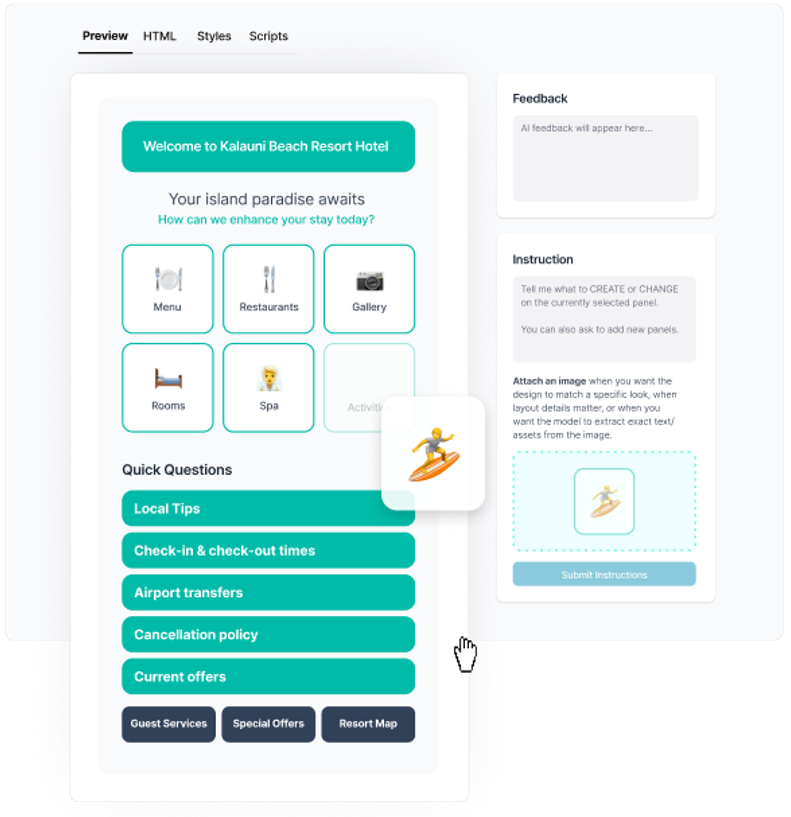
“This is where a non-technical user, marketer, or even designers can use our WYSIWYG environment,” he said. “You're literally just putting in instructions. So as a marketer, I don't have to go to a developer team and be like, ‘Hey, can you change to look like this?’ I can literally just vibe code it.”
Through a new side panel in ai12z, you can easily describe the experience you want and see the digital assistant update. I’ve already mentioned a few examples like multi-panel welcome messages and call-to-action buttons. You can also add custom HTML templates, carousels, and control specific brand dimensions like colors, logos, and layout features. But I particularly liked the concept of forms as a quick conversion point.
Source: ai12z
One of the coolest features is the integrations with third-party systems. At CMS Kickoff, Bill demonstrated how this can work for weather feeds, or pulling live mortgage rates for a chatbot on a financial website. The ability to customize feels almost endless.
“Because we're using Claude 4.5 as the by coding engine, I literally can say I want you to make a gallery of my WordPress blogs,” he said. “It will create a carousel that will show the hero image and a little bit of blog content, and click here, and then it will navigate to the blog.”
Again, all of this is managed inside the WYSIWYG, so you can see the changes without any developers being involved – or having to write any code.
Automatically create multi-panel welcome messages from your site
Where to start? That’s often the quandary with creating any digital experience, and bots are no exception. One of the hardest parts of launching a digital assistant is deciding what that first screen should look like.
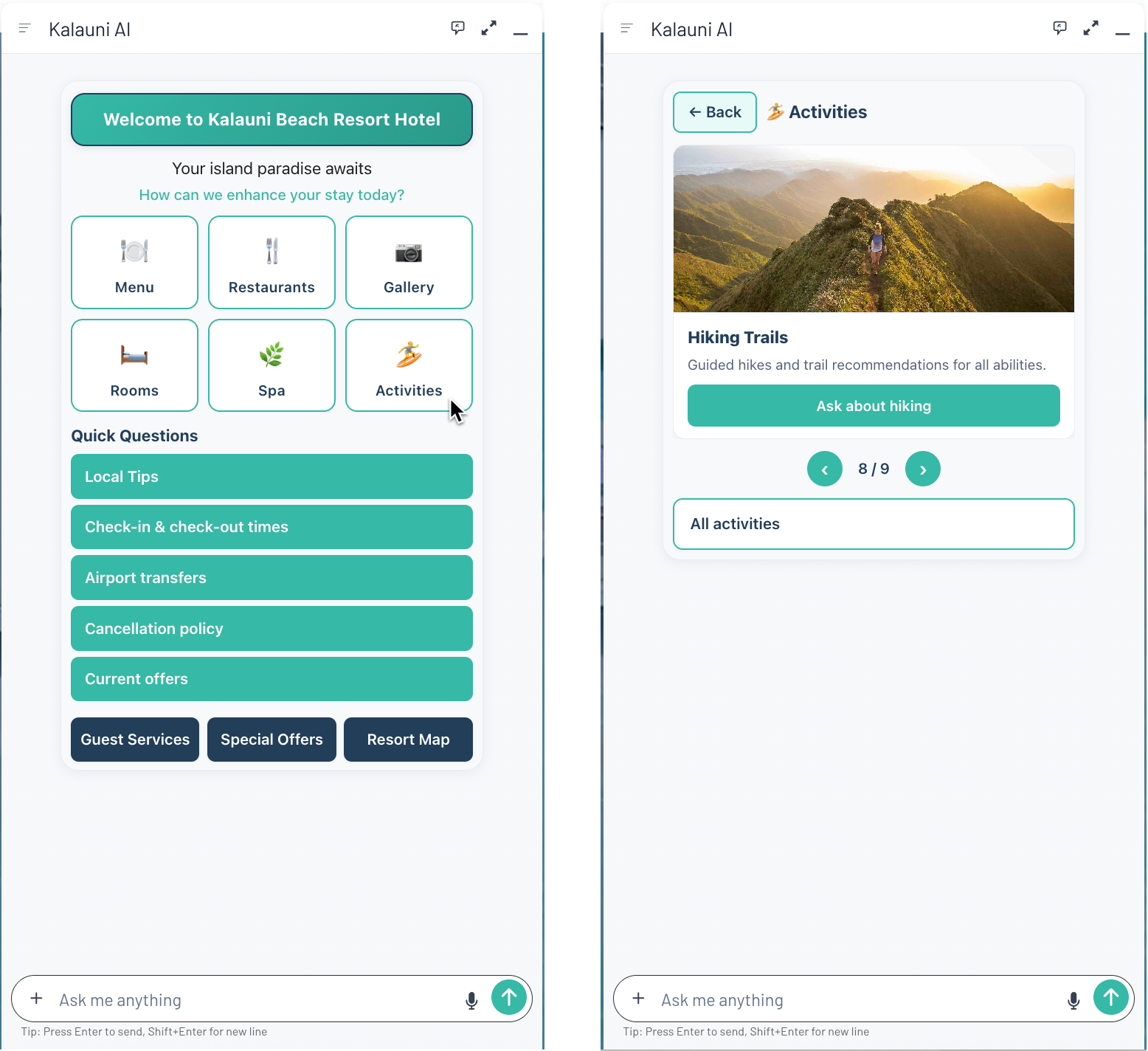
Now, ai12z is mitigating the challenge with a bit of Bill’s magic. Using the Create Agent feature, you simply enter your company’s URL and ai12z automatically analyzes, identifies key content and primary calls-to-action, and generates multi-panel welcome messages that reflect your existing visual identity.
“It automatically creates the bot, but it also creates these multi-panel welcome messages,” Bill explained. “It’s also analyzing the content on your site and then determining what those call-to-action buttons should be based on what's the most popular content, and what the questions are that people are likely going to ask.”
Source: ai12z
That experience can also adapt dynamically based on where the visitor is. For example, a welcome message and panel on your homepage might be different from what’s displayed in the assistant when someone is on your support page, or on a product or pricing page.
The build takes a few minutes, but for larger sites it can be a bit longer. It’s just another way that the tool is simplifying the journey to launching a digital assistant without complexity.
Personalization: The Prime ‘Directive’
Visitor data has gotten murkier as traffic patterns and data collection have evolved. We still know a lot, but relying on demographics alone isn’t enough to power more personalized experiences.
ai12z’s digital assistants are reshaping this at the bot level. Through more advanced reasoning, the system can better understand a visitor’s goals based on their queries. Using these inputs, it dynamically shapes both the response and the surrounding experience.
This could include a myriad of actions, like automatically directing visitors to a relevant landing page, or changing the assistant’s panels – the modular sections that print structured content, actions, and navigation. It could also result in branded messaging transformations, from banners to content to calls-to-action.
This is all driven by a new foundational concept in ai12z that Bill calls Directives, a sort of guardrail that provides essential instructions for how and when an assistant activates things like URL changes, panel updates, or micro-changes like swapping out banners or CTAs.
“The reasoning engine says, ‘Oh, there's a Directive here,’” he said. “When you ask about pricing in the bot, it tells you an answer. But it also changes the welcome message to something specific about pricing, and it changes the web page. That’s the work of a Directive.”
Another Directive that Bill described helps respond to bad actors, offering an automated safety valve against the kind of prompt engineering strategies that can land a brand in hot water. This use of Directives acts as a sensor to help secure the experience against harmful intent.
“When somebody tries to change your system prompt or tries to make the bot do something funny, the AI automatically detects that this is a bad actor,” Bill detailed. “So we push a Directive that says ‘bad actor’ in JavaScript, and it hides the bot and adds a message like ‘Contact Support.’”
As Bill outlined, ai12z’s customers explained how users were trying to fool the bot, and this led to some innovative thinking.
“When we’re deployed on big websites, they don’t want somebody breaking the bot and then taking a screenshot and saying, ‘Hey, look how I was able to get it to respond.’ So this is just a much better comfort level for them.”
Dynamic updates within a landing page – such as swapping banners or calls to action – are currently supported through ai12z’s Magnolia CMS integration, the first vendor that has enabled this level of experience.
Pricing
As part of its new release – and based on customer feedback – ai12z is introducing new pricing packages that shift away from traditional consumption-based models.
ai12z offers monthly pricing that’s billed as an annual subscription. There’s a Free tier that offers 30 days to kick the tires and prototype – no production. At the Starter level, you pay $99/month for up to 15 agents, 4,000 queries, and 1 CMS connector.
The Growth plan is for real traffic and engagement. For $199/month, you jump to 25 agents, 8,000 queries, and 5 CMS connectors – along with a few other goodies like HIPAA compliance and email support.
With Enterprise, you get 50 agents, custom query packages, and a host of features, including persona intent, SSO, advanced branding, e-commerce integrations, and more. You’ll need to contact sales to build a custom plan.
You can sign up for ai12z in a snap, but if you’re new to the whole AI digital assistant gambit, I would highly recommend talking to a rep if you’re looking for scale.
The verdict
I’ve experimented with ai12z during an early trial, and it continues to build on its success with smart, well-grounded features. But they’re really thinking beyond the bot – making web pages equally more conversational and adaptive as part of an integrated experience.
Arguably, most sites could benefit from having a well-designed digital assistant. There’s ample choice in the market for off-the-shelf solutions, but few are embracing the right architectural and (dare I say?) philosophical tenets that will fortify success.
As such, that rush to adopt can lead to failure. The deployment of an agent should be thoughtful, intentional, and approached with the right modicum of friction. As Bill said, AI should be more of the tail, not the lead.
That said, ai12z is greasing the wheels in the right ways and making it faster, safer, and more efficient to build, train, and employ their solution. The latest release demonstrates how natural language can really augment the experience, enabling marketers to be more in control of shaping the experience and optimizing delivery. Also, the introduction of Directives is a welcome addition, particularly the defense against bad actors intent on causing brand damage.
ai12z’s go-to-market is primarily through agencies like American Eagle.com and RDA, as well as content management systems, including Sitecore, Contentstack, Progress, Kontent.ai, and others. Some of these channel partners are OEMing their technology, others are offering it as a transparent enabler. To learn more, you can browse their partner page.
My recommendation: ai12z is bringing trust to the frontier of digital assistants, making it a great option if you’re looking for a fast, secure, and reliable path for adding customizable chat and search agents to your website. The added dimensions of personalization and adaptive web pages are a huge bonus over other products. If you’re experimenting, the Free trial is a great way to get your feet wet, but this solution should be on your short list.
Upcoming Events

JoomlaDay USA 2026
April 29 - May 2, 2026 – Delray Beach, Florida
Be part of the Joomla community in one of the most iconic cities in the world! JoomlaDay USA 2026 is coming to Delray Beach, and you can join us for a dynamic event packed with insights, workshops, and networking opportunities. Learn from top Joomla experts and developers offering valuable insights and real-world solutions. Participate in interactive workshops and sessions and enhance your skills in Joomla management, development, design, and more. And connect with fellow Joomla enthusiasts, developers, and professionals from across the world. Book your seats today.
CMS Summit 26
May 12-13, 2026 – Frankfurt, Germany
The best conferences create space for honest, experience-based conversations. Not sales pitches. Not hype. Just thoughtful exchanges between people who spend their days designing, building, running, and evolving digital experiences. CMS Summit brings together people who share real stories from their work and platforms and who are interested in learning from each other on how to make things better. Over two days in Frankfurt, you can expect practitioner-led talks grounded in experience, conversations about trade-offs, constraints, and decisions, and time to compare notes with peers facing similar challenges. Space is limited for this exclusive event, so book your seats today.
Umbraco Codegarden 2026
June 10–11, 2026 – Copenhagen, DK
Join us in Copenhagen (or online) for the biggest Umbraco conference in the world – two full days of learning, genuine conversations, and the kind of inspiration that brings business leaders, developers, and digital creators together. Codegarden 2026 is packed with both business and tech content, from deep-dive workshops and advanced sessions to real-world case studies and strategy talks. You’ll leave with ideas, strategies, and knowledge you can put into practice immediately. Book your tickets today.
Open Source CMS 26
October 20–21, 2026 – Utrecht, Netherlands
Join us for the first annual edition of our prestigious international conference dedicated to making open source CMS better. This event is already being called the “missing gathering place” for the open source CMS community – an international conference with confirmed participants from Europe and North America. Be part of a friendly mix of digital leaders from notable open source CMS projects, agencies, even a few industry analysts who get together to learn, network, and talk about what really matters when it comes to creating better open source CMS projects right now and for the foreseeable future. Book your tickets today.