In the race to AI visibility, are AEO and GEO really delivering? 97% of digital leaders say yes

As answer engines drive more discovery than ever, a new report from Conductor reveals how enterprise CMOs and leaders are adapting to this new reality – and making gains in an AI-powered world. Interview with Conductor's VP of Marketing and Co-Head of Revenue, Lindsay Boyajian Hagan.
Search isn’t just evolving. It’s being rewritten. That was made abundantly clear at last week's Boye & Company CMS Kickoff 2026.
Over two slightly-chilled days in St. Petersburg, we were served constant reminders of the current “traffic-pocalypse” plaguing brands. Namely, the Gartner study that predicted – and arguably missed by a longshot – just how dramatically website metrics could tank by 2026.
As I noted in my opening keynote, some organizations have reported losing as much as 90% of their traffic, the result of a perfect storm of zero-click searches and chatbots. It’s a stark reminder of just how dramatically the digital world has changed in a year.
The culprit? Our increasing reliance on generative AI for answering more and more of our questions. ChatGPT ended 2025 as Apple’s most downloaded app, outpacing TikTok (how’s that for a shocker) – and GenZ users are driving more of that demand and adoption. And while Google still represents three-quarters of all digital queries, 800 million users on ChatGPT each week is the loudest canary in the coalmine.
In a landscape where generative AI platforms are making discovery easier and more accessible, brand visibility isn’t just about ranking on page one anymore – it’s about showing up across these engines. That's why the evolution beyond pure search engine optimization to AEO and GEO is one of the hottest topics being discussed around the marketing water cooler these days.
According to new research from Conductor – a marketing platform that’s squarely focused the intersection of search and AI – this conversation is reaching peak volume. In its recently published State of AEO/GEO in 2026: CMO Investment Report, the company revealed how enterprise CMOs are responding to this seismic shift, and what we can expect in the year ahead.

Lindsay Boyajian Hagan, VP of Marketing and Co-Head of Revenue. Source: LinkedIn
During my recent call with Lindsay Boyajian Hagan, Conductor’s VP of Marketing and Co-Head of Revenue, she mentioned how her team was now having conversations with more of the C-Suite than ever before – a clear signal that brands are alarmed by the collapse in traffic, and they’re scrambling to do something about it.
"This is the top priority for every single enterprise, and it's coming from the top,” she told me. “It's not just a demand channel, it's not just a brand channel. It's really like your whole company – every decision your customer is making is happening in these surfaces."
She’s right. I’ve been tracking this development from day one, writing extensively about the platforms in our CMS and DXP ecosystem as they adapt to the new paradigm of “GEO readiness.” Brands need enhanced tools to help improve their posture and position within the answer engines, and that’s where tools like Conductor are pushing the envelope to help enhance AI visibility across the scope of market-leading answer engines.
Of course, there’s more to it than just the lost traffic. As Lindsay said, marketers are relying on a broader scope of capabilities to see the forest through the trees when it comes to AI visibility. The old metrics simply won’t cut it, and that’s where Conductor has been focusing its efforts.
"Folks are really hungry for insights,” Lindsay said. “This type of reporting, things like measuring sentiment and mentions and citations and persona coverage across the topics that you care about, is becoming really important, and becoming part of the new metrics pack that marketers want and need going into next year. Because just showing that traffic going down is not the story to tell."
So are AEO and GEO delivering the goods? I had a chance to review some of the numbers from Conductor’s report, and I’ve broken down some of the highlights.
AEO? GEO? Here’s a quick refresher…
It seems like we’re always swimming in new acronyms across the digital lexicon. AEO and GEO have been floating in the flotsam for a while now, but there’s still the potential for confusion – so let’s clear up the distinction. While closely related, they serve very specific purposes and balance a coordinated value equation in this new era of search.
First, AEO (Answer Engine Optimization) focuses on ensuring your content is surfaced directly in AI-generated answers and conversational interfaces. Like SEO, AEO relies on clear structure and direct answers that align with natural language queries. AEO aims to be the provided answer, not just a link, requiring content that's easily extractable, trustworthy, and contextually relevant for personalized AI responses.
Meanwhile, GEO (Generative Engine Optimization) is concerned with your brand visibility within the broader scope of generative responses — whether through citations, summaries, or recommendations. It involves creating clear, authoritative, and contextually rich content that AI can easily understand, summarize, and cite, focusing on depth, factual accuracy, authority, and semantic relevance.
Without getting uber-technical, there’s a big part of AEO and GEO that relies on the adoption of RAG (retrieval-augmented generation) architectures by generative search systems – where external sources are indexed, embedded, and retrieved as semantically relevant text segments to support AI-generated responses. This has moved optimization away from page-level ranking toward the structuring, authority, and (this is key) retrievability of content within vector-based knowledge repos used by LLMs.
Together, AEO and GEO represent the evolution of SEO in an AI-first world where impact is no longer measured by just traffic and conversions. It’s the net effect of answer engine visibility, mentions, and sentiment that culminate in a clearer picture of how a brand is performing – and where it’s making an impact with consumers.
The big takeaway: AEO and GEO are working
For this report, Conductor polled over 250 CMOs, VPs, and senior digital leaders for a glimpse into what technologies they’re investing in, what’s working, and what’s proving indispensable for AI-driven discovery. Of this cohort, 73% classified their AEO and GEO programs as advanced or relatively mature.
The verdict? AEO and GEO are now strategic priorities – not experiments. The findings codify that these modern strategies are grounded not just in optimism, but in real conviction.
One of the most striking findings in the report is the sheer level of confidence marketing leaders have in AI-driven optimization, with 97% of leaders validating that AEO and GEO have delivered positive impacts in 2025. Along with that stunning trend, AI-referred traffic was consistently described as higher-intent and more conversion-ready.
Another standout data point was around preparedness. Brands that invested earlier – reading the tea leaves, so to speak – are already seeing measurable gains in visibility and engagement. They’re also shifting their mindset when it comes to evaluating success. SEO is still a critical consideration, but more attention is being paid to enhancing AEO and GEO and tracking performance to drive better outcomes.
CMOs are placing their bets – and budgets – on AEO
Now that we have a sobering view of the traffic cliff, CMOs are under pressure to respond. AEO and GEO are presenting as sage strategies, and the investment in these technologies reflects a rapidly growing trend towards adoption.
According to Conductor’s research, 56% of companies made significant AEO/GEO investments in 2025 – but an overwhelming majority plan to increase those investments this year. 38% put themselves in a mid-range investment category, which demonstrates real traction. On average, about 12% of digital marketing budgets are now allocated to AI visibility and optimization.
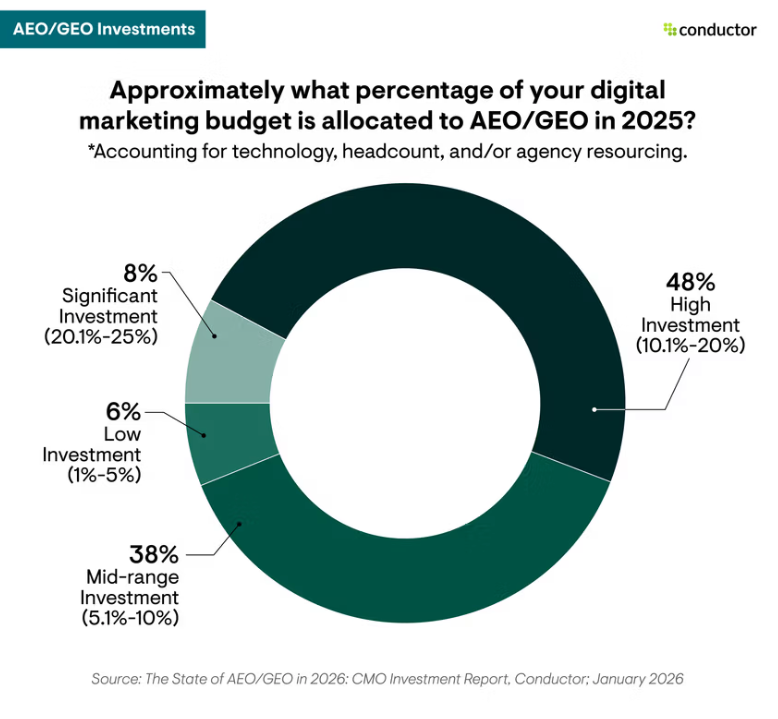
“Looking at this data, it's clear that AEO/GEO has moved from initial adoption to essential solution, with 94% of CMOs planning to increase investment in 2026,” Lindsay said. “This speaks to a fundamental shift in how enterprise brands approach discoverability.”
As she further highlighted, CMOs who aren't already reallocating budget and resources toward AI search experiences risk falling behind their competitors – specifically those that are capturing visibility in the channels where their customers are increasingly starting their journey.
What’s abundantly clear is that AEO and GEO are no longer “side projects” owned by SEO teams or specialized marketing practices. They have graduated to high-value, high-visibility, cross-functional initiatives that involve content, analytics, engineering, and brand teams. And now, they’re drawing the focus of the C-Suite as they view these initiatives as mission-critical.
Technology is the divider between leaders and laggards
We saw a lot of change and innovation in the search realm last year, starting with general visibility and culminating in new tooling and acquisitions that reflect the pitch towards AEO/GEO. This includes Optimizely’s unveiling of its “GEO-Ready” CMS and Adobe’s purchase of SEO darling Semrush.
Despite the general progress and the expanded field of available tools, Conductor’s research highlights a clear maturity gap. Roughly half of respondents are already using integrated AEO/GEO platforms – and those organizations are far more likely to report strong performance and clarity around ROI. Less mature teams, by contrast, are still stitching together point solutions and struggling to measure impact.
The lesson is simple: tooling matters. Brands with a high degree of AEO/GEO maturity understand that relying on point solutions isn’t sustainable for measuring and optimizing brand presence and AI visibility at scale. Without integrated data and workflows, AI optimization remains fragmented and difficult to scale.
As such, we can confidently forecast that more brands will adopt AEO/GEO tools and technologies in 2026, and perhaps lean on proven expertise – agencies and consultants – to help guide those decisions based on their goals.
Marketers face steep challenges
Despite the clear drift towards optimism and enthusiasm, the report doesn’t sugarcoat the hurdles. CMOs consistently pointed to a few major areas where they felt the heat in 2025 relative to their AEO/GEO strategies and increasing AI search visibility.
For starters, scaling AI-optimized content was a critical concern. But as the report indicated, content quality is just one consideration. It doesn’t matter how much content you generate – if LLMs can’t crawl it, it might as well be invisible. As such, ensuring that content is crawled by AI bots and LLMs has become an essential benchmark.
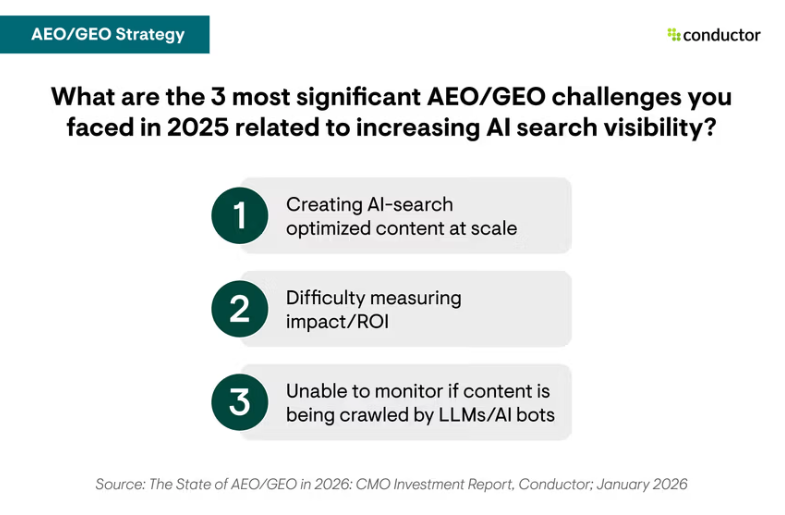
There was also the constant specter of measuring ROI and keeping pace with the rapid changes rippling across AI tools and platforms. It’s one thing to understand how LLMs crawl, interpret, and surface content today – but the technical dynamics can change tomorrow, handing us another “Deepseek Moment.” Practitioners need to be constantly in tune with what’s happening from both a functional and a best practices perspective.
It's evident why these challenges are accelerating investment at multiple levels. Marketers are on the front line and responsible for driving growth – and staying ahead of change is central to success.
What are some winning strategies for 2026?
Obviously, the field of AEO/GEO is evolving, and we can expect more change in the year ahead. That said, Conductor’s research sheds some light on which strategies are gaining traction among high-performing teams.
The top two content strategies that CMOs and digital leaders are embracing? First, it’s scaling AI content generation beyond the use of keywords, focusing on content design fortified with answers that are concise, authoritative, and citation-ready.
The other is optimizing the use of structured data and schema. I know – these might sound like web fundamentals from way back, but they’re more important than ever. Having the right structure in place makes it easier for LLMs and AI bots to crawl and clearly understand their content, brand authority, and context.
Along with these core objectives, marketing teams are focusing on the development of scalable, AI-assisted content workflows with strong human oversight – and embracing new success metrics, including AI visibility, citations, and answer inclusion.
In short, brands are optimizing not just for humans or search engines, but for the systems that now mediate discovery between the two.
The verdict
There’s no other way to say it: AEO and GEO are non-negotiables. The implication of Conductor’s research is hard to ignore, and AI visibility has become a boardroom imperative as these three-lettered acronyms penetrate through to the C-Suite.
I’ve been highlighting this progression for quite some time, particularly as CMS and DXP vendors have positioned their AI and agentic offerings to be inclusive of GEO-ready capabilities. Meanwhile, some platforms have forged strategic alliances with purpose-built AEO/GEO tools, hoping to make up ground and meet the growing demand.
Case in point: Storyblok and OtterlyAI announced a strategic partnership late in 2025 to reduce the friction around licensing as part of a content observability play.
While crystal balls are in short supply, it’s fair to predict that more brands will embrace these new search strategies in 2026. It’s still a nascent field, and many companies are still struggling to gain footing in the AI era. But the warning signs are clear: with the precipitous drop in traffic, organizations no longer have the luxury of sitting by idly.
So what can you do?
Start by adopting AI visibility as a core part of your content strategy. Evaluate and invest in platforms that connect data, insights, and execution. But here’s the big one: you’ll need a top-down approach to change management when it comes to measuring success. Teams need the right leadership to guide them beyond the albatross of clicks and rankings – and into the promised land of the answer engines.
What’s encouraging is that the audience surveyed in Conductor’s report seems to understand these dynamics. They’re investing now. Not because they’re chasing the future, but because they know it’s already here.
In a world that’s drowning in data, the real competitive advantage isn’t necessarily more content. It’s more clarity. Marketers are struggling with cognitive overload from a wide bench of tools, and they’re not getting the precision or relevancy they need. As Lindsay told me in our conversation, consolidating the toolset isn’t the whole answer – it has to be the right tools for this new kind of job.
"You don't want to have a technical SEO tool, an AI tool, a content SEO tool, and a backlink tool,” she described. “Folks want everything integrated. And it's not just about the consolidation of your tool sets within a platform. It's also making those insights and the intelligence available in the workflows."
There’s a lot more insight to be gained from this report, and you can download it here.
My recommendation on Conductor: The AEO/GEO platform race is heating up, and there are some solid solutions in the mix. Conductor has long been a leading contender in the SEO category, and they’re continuing to prove their leadership and innovation in the burgeoning AI visibility space. If you’re evaluating tools for your AEO/GEO strategy, Conductor’s approach to unifying data gives it an enterprise-grade edge that should put it on your short list. Pay close attention to the solid visualization and seamless workflow capabilities for handling your traditional SEO and AEO strategies. I like vendors that make you smarter, and Conductor offers a deep knowledge base of content – so you can continue to get educated on these emerging search topics.
Upcoming Events
CMS Summit 26
May 12-13, 2026 – Frankfurt, Germany
The best conferences create space for honest, experience-based conversations. Not sales pitches. Not hype. Just thoughtful exchanges between people who spend their days designing, building, running, and evolving digital experiences. CMS Summit brings together people who share real stories from their work and platforms and who are interested in learning from each other on how to make things better. Over two days in Frankfurt, you can expect practitioner-led talks grounded in experience, conversations about trade-offs, constraints, and decisions, and time to compare notes with peers facing similar challenges. Space is limited for this exclusive event, so book your seats today.

Umbraco Codegarden 2026
June 10–11, 2026 – Copenhagen, DK
Join us in Copenhagen (or online) for the biggest Umbraco conference in the world – two full days of learning, genuine conversations, and the kind of inspiration that brings business leaders, developers, and digital creators together. Codegarden 2026 is packed with both business and tech content, from deep-dive workshops and advanced sessions to real-world case studies and strategy talks. You’ll leave with ideas, strategies, and knowledge you can put into practice immediately. Book your tickets today.