Brightspot Illuminates the Future of CMS with Human-Controlled, AI-Powered Storytelling

In my wide-ranging conversation with Ravi Singh, President and Chief Product Officer, we explored how Brightspot’s culture of innovation continues to drive success, why they refuse to chase industry fads, and how AI can help unlock the power of our stories.
Ravi Singh wears a lot of hats. But he does it well.
When we last spoke, he was manning the bridge just as Brightspot was about to push its most transformational release yet.
As President and Chief Product Officer at the Reston, Virginia-based CMS vendor (a post he’s held for the last two years), the responsibility for a major version update rolls up to him. Given some of the ambitious features being introduced, there was a lot of complexity at play. And a lot to worry about.
But he was as cool as a cucumber – a testament to his confidence in how Brightspot’s team can deliver for the likes of FedEx, the LA Times, Walmart, and other large organizations that rely on five nines of world-class performance.
“We quietly deliver for the loudest brands in the world,” he told me. “We’re designed for extremely complex, enterprise‑grade security, observability, and compliance. Those are the types of customers we have. And we’ve had a 97% retention rate.”
That’s quite a track record. One worthy of boasting.
Brightspot has long been on my radar, well before it was singularly focused on its core content management business. Originally the flagship product of Perfect Sense, a professional services agency founded in 2008, Brightspot was rebranded – and reimagined – under its new banner five years ago, just as the pandemic-induced exuberance of digital transformation was taking hold.

Brightspot President and Chief Product Officer Ravi Singh. Source: LinkedIn
Through it all, one thing that hasn’t changed is the company’s culture of innovation and its keen focus on customers, partners, and stakeholders. Reflecting those values, Brightspot has established its own unique niche in the pantheon of CMS vendors, providing enterprise performance with an easy-to-use, extensible, and composable posture.
Brightspot offers broad extensibility across industries, giving content and marketing teams a reliable and scalable bench of tools to run their content operations and power their campaigns – everything from microsites to intranets. It offers a rich tapestry of features that support non-technical creators and advanced developers alike.
But one area of deep specialization that sets Brightspot apart is its focus on media and publishing, where it has been consistently positioned as the “gold standard” for fast-paced, news-centric environments. This includes cross-channel broadcasting and the rapid-fire requirements of sports and live events – where real-time coverage and fan engagement require technologies that can perform under pressure.
Brightspot has proven its value in these categories, with marquee customers like NBC Sports’ Golf Channel relying on its battle-hardened capabilities. This past April, Brightspot powered the network to deliver comprehensive coverage of The Masters PGA tournament, which required real-time updates throughout the event. The site also hosted exclusive video highlights and in-depth analysis as part of its integrated experience – one that drew a lot of eyeballs from fans.

NBC Sports GolfPass website, powered by Brightspot
But there's also a lot of heart behind this company. Since its inception, Brightspot has been deeply rooted in resilience, conviction, and generosity – which has been crystallized by its impactful work with organizations like the Special Olympics. The company remains passionate about having an impact at critical moments, working alongside people and teams to help them achieve their vision and business goals.
As Ravi told me, the Special Olympics goes beyond just being a customer. “They're a good moral compass to have," he said, "and that goes back to the founding principles of the company."
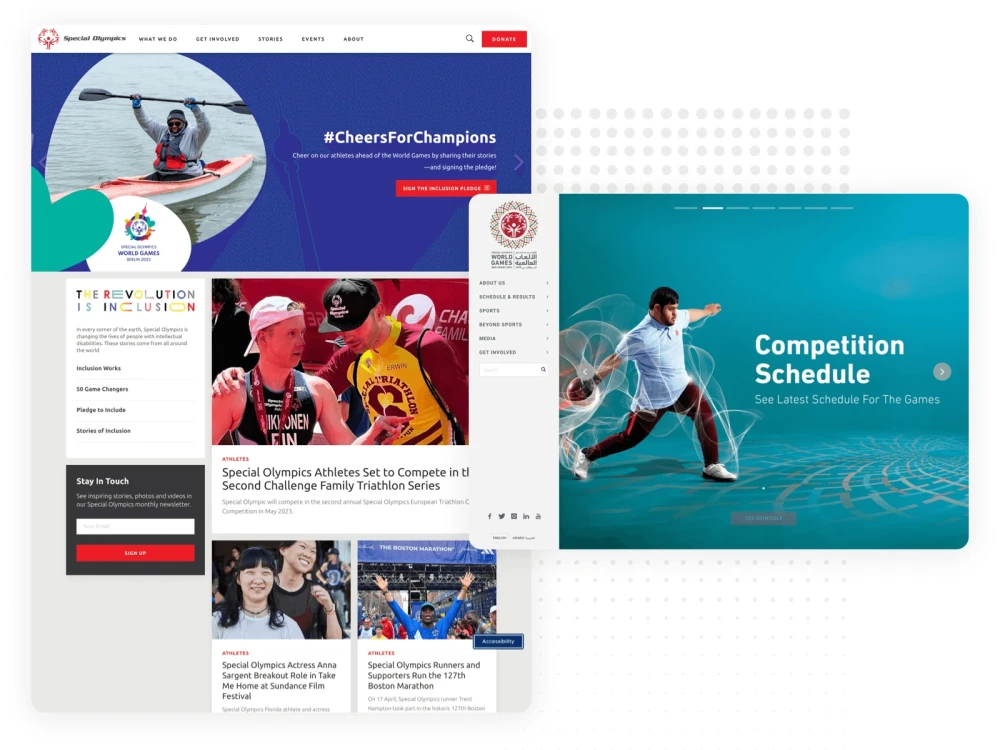
Brightspot's CMS powers the Special Olympics' digital presence
In my conversation with Ravi, we touched on a lot of the contemporary trends and challenges facing the industry, and how Brightspot continues to innovate and resonate. We discussed its approach to everyone’s favorite topic of AI, and how he's carefully listening to customers when it comes to evolving their features.
And we talked about storytelling – something Ravi is passionate about, and a topic that is illuminating the future path for Brightspot in 2026 and beyond.
Fighting cognitive overload
When I covered the release of Brightspot’s latest update and its slick new features, it was on the heels of its first-ever Brightspot Illuminate conference. Sessions featured content from customers like the PGA and Goldman Sachs, and attendees got a sneak peek at the capabilities being released, which answer the central challenge of cognitive overload. You can watch the recordings here.
Lightening the “swivel chair” tendency is something I’ve been hearing a lot about this year from vendors and enterprises. And rightly so: with an unfathomable 15,384 SaaS tools in the martech landscape – and 35 to 45 tools in the average digital marketing stack – it’s clear why people feel overwhelmed. Based on a joint study by Qatalog and Cornell University’s Idea Lab, it takes roughly 9.5 minutes to fully refocus after switching out of a single app or task. That's a huge productivity hit.
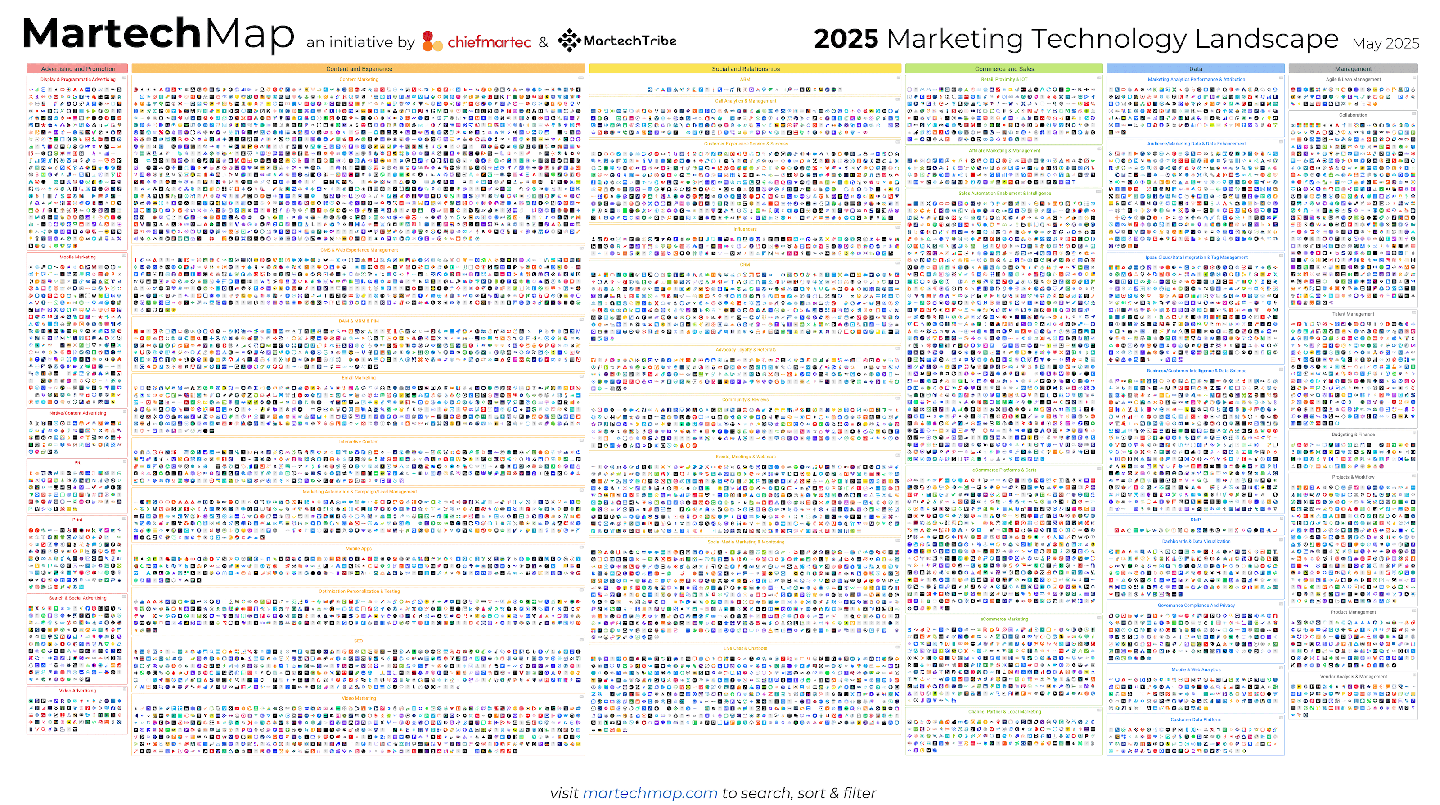
The Martech Supergraphic 2025. Source: ChiefMartec.com
Obviously, cutting through the chaos is key. This is where Brightspot really shines with its new version, providing an even cleaner UX that helps users to focus. The interface has been redesigned to minimize mental overload with more streamlined layouts, contextual collaboration, and simplified publishing to help teams – from content to engineering – stay in the creation zone and not meander with conflated or confusing navigation.
Reducing the noise level was a big focus for Ravi with this release. And it wasn’t just the consolidation of multiple tools – it was about helping customers understand where the value is within a new product update, and not feel overwhelmed by too many vanilla bells and whistles.
“In a world of push notifications and constant attention to adding features, we don’t want to inundate you with new stuff every time our product comes out, where you have 17 new things to learn,” he said. “And you barely understand the last 20 things you got in the last release.”
It’s a great point. A glut of new features doesn’t help if it feels heavy – and it could stymie adoption. Instead, Ravi emphasizes “Genie Moments,” where small, high-impact features can really delight users and make their work easier. This comes from a dedicated and continuous practice of connecting with their users.
Experimentation is a core practice for modern marketers. Brands need to be fast and nimble with their variant tests, so they can optimize performance proactively and drive better results. Typically, this requires an amalgam of tools and steps, which can further entangle a user’s time and resources – and contribute to that dreaded cognitive overload.
In its latest release, Brightspot has endowed its CMS with built-in experimentation, enabling marketers to launch A/B/n tests directly inside the platform and eliminate those arduous and disruptive workflows. Creating new experiments is incredibly simple, and can be done on the fly with multiple variations.
As far as deeper personalization goes, Ravi said that Brightspot will continue to lean on best-of-breed partners and technologies to deliver more robust solutions. Ideally, even with these edge capabilities, he doesn’t want any layer of functionality to feel like a context switch to another platform – and should be fully integrated into Brightspot’s UI.
Avoiding the frenetic frenzy in the AI race
Brightspot has certainly been in the AI game for some time, although not at the recent hyperbolic pace of its competitors. For example, it offers ready-made integrations with OpenAI and Amazon Bedrock for turning prompts into polished, on-brand content faster, putting creators in control while freeing up time and delivering consistent, brand-ready outputs at scale.
As Ravi told me, he sees the true value of AI when it’s assisting people with repetitive or tedious tasks. That's why Brightspot has been taking a thoughtful and intentional approach to how it applies generative AI. This includes features like its Ask AI that deliver trusted, context-backed answers, including AI variations for refining content.
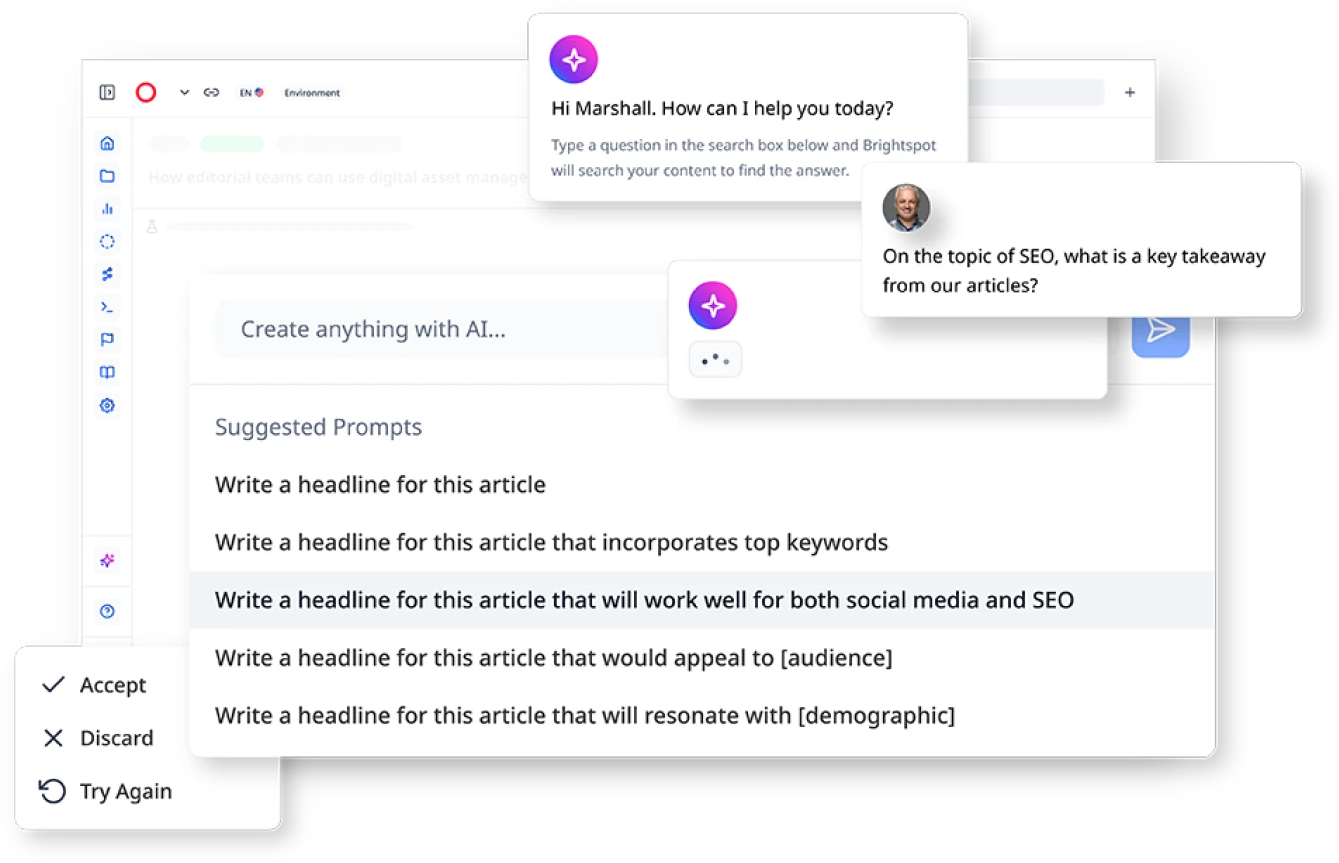
Brightspot AI in action. Source: Brightspot website
In its new release, Brightspot is also giving organizations more confidence to grow their AI adoption with a built-in trust layer that makes every use of AI transparent, auditable, and safe. Expanding on its AI Usage and Tracking features, users now have access to configurable oversight, automated guardrails, and centralized logs that ensure outputs remain compliant, on-brand, and fully under human control.
Users will also be able to accelerate productivity with AI while keeping humans in the loop – and in control. Brightspot’s Assistive AI is designed to speed up creation, repurposing, and optimization while putting people in the driver’s seat. With this smart resource, teams can move faster, whether they’re inline editing, performing SEO and LLM optimization, producing social posts and author personas, and more.
While these gains are benefiting its customers, the journey to AI has been arduous.
“I would say 18 or 24 months ago, I don’t think [our customers] wanted it,” he admitted. As he said, many platforms were trying to build capabilities that people were shunning, particularly creatives who weren’t interested in having content hijacked from them. As such, they've been wary of it. Part of the problem, he acknowledges, was how AI was initially rolled out across the industry.
“Honestly, the implementation of those AI capabilities by many companies was an issue,” Ravi stated. “Everybody was caught up in the moment of building without actually doing the diligence.”
That's compounded by the limitations of foundational models to handle complex tasks. In my recent discussion with Kaz Ohta of Treasure Data, we explored the boundaries of agents relative to LLM performance, and how accuracy only approaches 99% when we give AI small tasks.
Those numbers will improve over time, but we have a lot of work ahead of us before AI can take on heavier loads. And data from both MIT and Cleanlab underscore how the frenetic race to adopt AI has resulted in widespread failures – with many projects dying on the vine before they reach production.
That’s something the MIT report also codified: that the failures most businesses were experiencing were due to accelerated exuberance and fast-tracking the essential training, testing, implementation of guardrails, and other bedrock resources needed to support successful AI. To Ravi's point: we weren't performing the due diligence. And this is where Brightspot is endeavoring to be more thoughtful with its approach to its AI evolution.
Flipping the AI script
In light of these challenges, Brightspot responded by focusing first on governance – not features. This is an area where Ravi had deep expertise, having previously co-founded Austin-based Add Value Machine, where he specialized in adding guardrails around generative AI models.
“We have a really good, robust AI governance and security layer,” Ravi said. “So we sort of went the other way. We said we’re going to start with security and governance first and then add a cornucopia of features.”
This was a relatively seamless leap for Brightspot. The company’s product ethos has always been built on the right governance and security layers, and AI would be no exception. Once customers saw that things like brand and author voice were safeguarded – and editorial control preserved – the conversation shifted.
“We have a really good, robust AI governance and security layer. So we sort of went the other way. We said we’re going to start with security and governance first and then add a cornucopia of features.”
“When we started showcasing how diligent we were and not careening out of control and trying to do 50 AI things, that’s when it all changed,” he said. “I think people are more comfortable with AI as well, primarily because they’re starting to use it at home. They can appreciate the power of it, and they’re willing to bend the power of it to their own will.”
We also dug into agentic AI and MCP (Model Context Protocol) – two of the hottest topics in today’s AI narrative. Ravi’s stance was both pragmatic and contrarian, holding firm to his focus on customer need. He was also candid about the pressure to jump on board the hype train.
“We operate with speed, but not frenetic pace,” he said. “We’re building an MCP agent, but I don’t feel compelled to release our MCP server integration next quarter. Nothing our customers told me so far tells me that, other than buzz. There’s a lot of pressure from marketing teams, but no customer that I know of is making a decision based on MCP availability. It isn’t the deciding factor.”
Brightspot’s focus has long been on deeply embedded experiences, not surface-deep integrations. As Ravi said, people had a sort of schizophrenia due to the repetitive shifting from one application to another. Enhanced workflows are already driving a complete sublimation of capabilities inside Brightspot, allowing you to do things like experimentation in five clicks or less – all without ever leaving the product.
More broadly, Ravi wants agents to manifest with real, user-facing value, not just as an AI-washed label. We’ve seen a lot of that over 2025, and separating the wheat from the chaff has been a chore. Brightspot’s patient and methodical approach – which is buoyed by a solvent vision – stands out in the crowd, and should relay confidence to buyers.
Finally, collaboration is also impacting the equation. As Ravi noted in a recent LinkedIn post, it’s shifting under our feet, thanks to AI changing the input – and not the process. Like everything else in the AI landscape, we’re having the adapt quickly to this new paradigm.
“And if teams don’t evolve how they collaborate,” he said, “they will drown in their own acceleration.”
Differentiating with human-controlled, AI-powered storytelling
Brightspot’s North Star is what Ravi calls “human-controlled, AI-powered storytelling.” It’s been a fixture in company’s marketing this year, echoing its goal of keeping people at the heart of its mission – and its innovation. Ravi is persistently adamant that AI should amplify human storytelling rather than replace it, and that came up several times in our conversation.
“We want to give you the canvas that you can put your soul and creativity into,” he said. “It isn’t replacing the storytelling. It’s replacing the friction.”
That friction comes in the form of drafting and distribution tasks that typically drain creators – and Brightspot aims to lighten the load. If you pour your heart and soul into creating a content piece, it can ease the lift around creating LinkedIn or Facebook posts. When it comes to tasks like spell checking, it acts as an enabler, not a replacement.
“Content creators become curators,” he said. “They become orchestrators. Commanders. They have an army of interns helping them push out to the world something unique that reflects your voice.”
“We want to give you the canvas that you can put your soul and creativity into. It isn’t replacing the storytelling. It’s replacing the friction.”
Projecting this platform of human-controlled, AI-powered storytelling could be one of Brightspot's biggest competitive advantages. With its pedigree as a professional services outfit, customer intimacy is clearly one of its strengths. Dialing in on what users and brands need from their CMS – and supporting human storytellers in specialized verticals like media and publishing – clearly resonates as a differentiator.
I asked Ravi where Brightspot sits in today’s competitive CMS landscape, especially in a market flush with headless CMSes and ripe with confusion and fragmentation. He was clear: they don’t build to match competitor feature lists. Instead, they anchor their strategy around real customer needs, putting structured feedback at the center of everything.
“From a CMS perspective, the intentional decision we’ve made is that we’re not fad chasers,” he said. “We don’t chase our competitors’ roadmaps. What we do is stay true to what our customers need and want.”
Part of the secret sauce to maintaining this intimacy rests with Brightspot’s virtual Customer Advisory Boards, which they hold annually. The input is translated across the company’s product managers, engagement stakeholders, and customer service team. This customer-centric approach is coupled with a disciplined product craft.
“We aggregate all of that to get a really compelling value proposition, and then we trial the capabilities,” he outlined. “We walk through things like Figma prototypes with our customers, gauging their feedback. ‘What do you think about this? What do you think about that?’”
Developing this proximity to customers isn’t something we see with every software vendor. Products often rely on cold polling to upvote features versus engaging directly with users. Investing in this depth of research offers a much deeper connection and more aligned outcomes, and Brightspot has chosen a philosophy that consistently favors real-world value. It's a good story.
Elevating content security
Security is “job zero” for every software company. But that’s typically the domain of cybersecurity. When it comes to content, it’s a different conversation and an alternative set of strategies.
At this year’s CMS Kickoff in January, Brightspot’s SVP of Platform Product, Ping Pan, spoke about some of the challenges that exist around content security – a region of digital policy that is rarely discussed, but has huge implications for websites and publishers.
In our conversation, Ravi explained Brightspot’s approach to security, breaking it down into three component layers: security and governance within the product, general security (e.g. protecting against bots and DDoS attacks), and control over how content is exposed and consumed.
“Number one is security and governance inside of the product,” he said. In relation to the growing use of AI, this is becoming a more critical focus.
Content exposure to LLMs and answer engines has been a moving target. Before, when your content was discovered, you received credit. Now, in this LLM world, that authority is eroding. Brightspot’s role is to enable choice around how that content is being indexed, so customers can enable security roles and take back control. It's not unlike what Cloudflare did to battle the bots at the CDN level, but Brightspot is giving customers more granular control.
“It’s incumbent upon us, from a security perspective, to give our customers the optionality they want,” he said. “We’re partnering with different WAF providers, creating choices so that they can decide how their garden of content gets consumed.”
While choice is important, brands also see the edge of the cliff when it comes to website traffic. The decreases have already been breathtaking, but news gets worse: Gartner predicts search engine volume will drop 25% by 2026 due to the growth and proliferation of AI chatbots and other virtual agents.
“You have SEO traffic that’s dropping because your answers are coming inside of search engines,” Ravi said. “You have social traffic that’s dropping because social walls are saying, ‘We’ll give you the answer, you don’t need to go outside.’”
As consumer habits shift, Brightspot is helping its customers maintain control and observability – which are becoming strategic concerns and not just technical jargon. By elevating choice as an imperative, brands have more agency over how they value and monetize their content – and they can decide who has access and where.
Accessibility as a foundational principle
Throughout the conversation, accessibility was also a genuine pillar of Brightspot’s identity, not a marketing checkbox.
“For us, accessibility is not an afterthought,” he said. “It’s not something where we say, ‘We finished the product, now run the accessibility scanners.’ We don’t think like that.”
Ravi tied accessibility directly to the personal experiences and values of the people inside the company, where they have product managers and QA staff who have very compelling stories on why accessibility is important to them. As he told me, it’s not trite commentary. It’s real depth that they evangelize across the company. Looking ahead, the vision for accessibility is very ambitious.
“In 2026, if we can be so bold as to say that we’ll be the most accessible CMS from a backend perspective ever,” he said. One example of this: everything in Brightspot can be voice-controlled, allowing you to navigate, configure, and create in the CMS.
As I mentioned earlier, the Special Olympics is a critical partner for Brightspot, and one where accessibility is driving their innovation. As Ravi told me, it gives their executive team and employees great joy in being able to contribute in a small way to a big mission.
“Great accessibility benefits everybody,” he said.
The right growth strategy for partnerships
In the last two years, I’ve spoken to all the major CMS and DXP vendors on the map, and most were banking heavily on their channel partnerships to deliver scale. Some have the benefit of large, well-established ecosystems behind them, while others were looking to enrich their partners in a battle of preference against other competitive platforms.
On the topic of partnerships and community, Ravi is clear that Brightspot is in a new phase of intentional expansion. In truth, given their industry and customer sweet spots, it hasn’t been as critical a target. But that’s been changing over the last 12 to 18 months – and becoming a much stronger muscle. A key pillar has been developers and the technical audience, where Brightspot can make a strong case. And they have features forthcoming that will appeal to this cohort.
“In 2026, we’re unveiling a developer evangelism strategy,” he described. “Headless capabilities are going to be revealed. Sample applications are coming. We also now have a leader who’s going to be running the entire developer evangelism strategy.”
Brightspot’s partner strategy also emphasizes depth over breadth. They’re not in a rush to sign up hundreds of experimentation providers, just a few best-in-class partners that can deliver exceptional results. And the same is true for SIs and agencies.
“If we put somebody on the website, we expect a high degree of accountability and a high degree of collaboration,” he said. “We don’t have 50 partners. If we end the year next year with five good partners, that’s enough.”
Code, culture, and the future of CMS
Prior to his leadership role at Brightspot, Ravi served on the company’s board, and told me how the move has opened things up – particularly around the human factor.
“When you take an operator role, you have a different experience,” he said. “You have the ability to sort of downshift a little bit, and you’re able to see your company.”
Getting closer to people behind the product was an important objective for Ravi, and that’s manifesting in a multitude of ways. Back in October, Brightspot held its first official hackathon, which provided an opportunity for its team of “Brightspotters” to develop new solutions that potentially move the product forward.
Having participated in hackthons myself, I recognize the value. Facilitating an internal challenge like this can help energize teams and, as Ravi said, cross-pollinate ideas. I asked him what it meant from his leadership perspective, and he immediately framed it as an exercise that went well beyond technology.
“To me, the hackathon was less about the code as much as it was about the culture,” he explained. “I’ve done hackathons at every company I’ve been at, and I think it’s a great melting pot of ideas. Even more so in a remote-first company.”
The design of the hackathon was explicitly cross-functional and intentionally anti-silo, bringing together a more diverse pastiche of contributors. Participants weren’t just developers, but marketers, product leads, even HR practitioners. This created the kind of cross-collaboration that Ravi was aiming for.
“What it resulted in was a kind of ‘cultural reset,’” he said. “Great ideas can come from everywhere, and we wanted our engineers, designers, and project managers to have a chance to step into the experience.”
The long-term impact of the hackathon went well beyond its initial charter. It yielded dozens of different ideas, with the winners being a visual editing tool that improved the editorial experience, expanded keyboard commands to speed up publishing, a new caching mechanism to boost performance, and even an in-CMS wizard to help new users navigate and learn the platform.
“It was hugely impactful to the organization,” Ravi said. “In fact, so many of those ideas we’ve shared with our customers, and they are going to be impacting our product roadmap in 2026.”
As a category, CMS is changing. That much is undeniable. As platforms race towards AI and agentic parity, differentiation will be hard fought. But Brightspot's focus on people and culture is giving it a distinct voice in a sea of sameness. Together, they have affirmed their role not just as a platform, but as a partner who walks alongside customers in their digital content journey.
Now, in this age of AI, they have an opportunity to leverage this new frontier with the precision they've proven time and again. Combining those superpowers, they have quite a story to tell – a human one that’s worth listening to.
I think you’ll find it illuminating.
Looking for more guidance on Brightspot? Talk to an expert.
Upcoming Events

CMS Kickoff 2026
January 13-14, 2026 – St. Petersburg, FL
Meet industry leaders at our fourth annual CMS Kickoff – the industry's premier global CMS event. Similar to a traditional kickoff, we reflect on recent trends and share stories from the frontlines. Additionally, we will delve into the current happenings and shed light on the future. Prepare for an unparalleled in-person CMS conference experience that will equip you to move things forward. This is an exclusive event – space is limited, so secure your tickets today.

Umbraco Codegarden 2026
June 10–11, 2026 – Copenhagen, DK
Join us in Copenhagen (or online) for the biggest Umbraco conference in the world – two full days of learning, genuine conversations, and the kind of inspiration that brings business leaders, developers, and digital creators together. Codegarden 2026 is packed with both business and tech content, from deep-dive workshops and advanced sessions to real-world case studies and strategy talks. You’ll leave with ideas, strategies, and knowledge you can put into practice immediately. Book your tickets today.