From AI idea to production-ready app in minutes? Meet Domo’s new App Catalyst

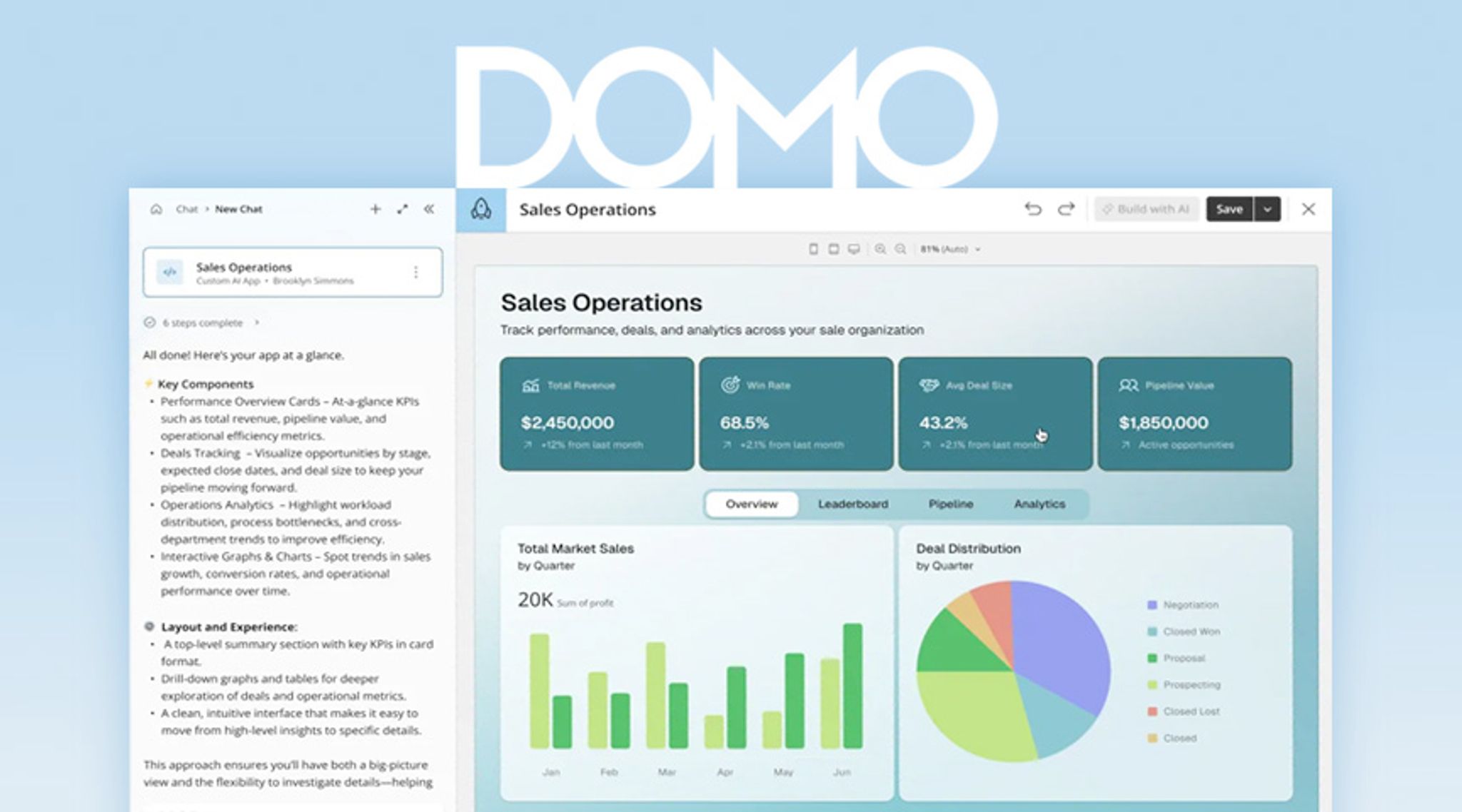
The AI and data products platform has launched a powerful new feature to help organizations scale AI-built apps with built-in governance, security, and control.
To borrow from poker: In 2026, AI is already becoming table stakes in the enterprise software game. And while many of the high-utility agentic capabilities I'm seeing are aimed at value, many features are converging – and in some cases, looking the same.
One area that’s still nascent is the flourishing new class of app builders (think Base44 or Replit). In the realm of vibe coding, they provide a great resource for prototyping by lowering the barrier for development. Now, almost anyone can build a software or business application with just an idea and a prompt, and that's becoming a popular marketing mantra.
The problem? Many of these conjured experiments fall off the tracks before they ever reach production – stymied by underperforming code, poor maintainability, and a lack of alignment with enterprise data and security standards.
During my recent keynote at the Boye & Company CMS Kickoff 26 in St. Petersburg, I talked about the final frontier of adaptable UX in enterprise software – specifically in content management and digital experience platforms.
We’re beginning to see this take shape as some platforms are giving users more control and customization over things like visualization. In certain tools, there's even the presence of handy app studios for building curated dashboards and experiences. At the same time, they’re leveraging a performant, scalable, and secure foundation of an authoritative platform – ensuring compliance and accountability where it matters.
This is where Domo’s new App Catalyst is making waves. Most of today’s AI app builders are optimized for speed, but miss the mark when it comes to managing data, logic, and governance across multiple systems. App Catalyst is designed for what happens after – when applications must be maintained, trusted, and scaled across an enterprise.
As Domo’s Chief Technology Officer and EVP of Product Daren Thayne said, vibe coding showed us how fast ideas can turn into software. But speed alone doesn’t create the durable value that enterprises need.

Domo’s Chief Technology Officer and EVP of Product Daren Thayne
“The next evolution is moving from raw code generation to composing applications that are governed by design and grounded in trusted data,” he said. “App Catalyst is an important step in that direction. It gives teams a production-ready foundation they can extend confidently, instead of starting from code that was never meant to scale.”
App Catalyst is a reflection of Domo’s broader vision for the future of the intelligent enterprise, where AI does more than accelerate experimentation. It helps people and organizations compose scalable, governed applications that connect data, workflows, and people in a single, trusted platform.
But AI is nothing if it can’t support the people using it. In my recent conversation with Domo’s Chief Design Officer, Chris Willis, we discussed the importance of human judgment when using AI tools and technologies. “The hard part is judgment, and that's an essential human skill," he told me. "I don't see models as possessing that.”
At least not yet. But until then, Domo is powering its users with AI tools that are designed to give them more domain than ever before while easing the journey.
Here’s a bit more on how App Catalyst works.
Rapid app building for the enterprise
Unlike tools that focus solely on raw code generation, App Catalyst is really designed for enterprise applications. It helps you compose production-ready app frameworks that integrate with your existing data, governance, and security standards – ensuring that your apps are scalable, compliant, and ready to grow with your business. It also avoids the trap of accruing copious amounts of tech debt or tapping additional engineering resources.
To be clear, App Catalyst is Domo-centric, leveraging its performant backbone. Users can describe the kind of app they want to build using natural language and instantly generate a functional framework that runs directly on their existing data in Domo.
The resulting app foundation seamlessly integrates with Domo datasets and is deployed through Domo’s App Studio – which is designed for building analytics apps with low-code, drag-and-drop tools. It automatically inherits Domo’s governance and security model, including per-user data access permissions. If real data isn’t available yet, App Catalyst generates placeholder data so teams can start building immediately.
At 50,000 feet, App Catalyst is telegraphing a shift in how organizations are building with AI in 2026 and beyond. Early vibe coding approaches might have focused on generating raw code quickly, but real enterprise impact requires a move toward composition over generation.
App Catalyst is a foundation for that future, one where AI helps teams assemble governed, production-ready app frameworks that align with data access, security, and operational standards from the start. This evolution moves organizations away from fragile experiments and toward scalable app building that can actually grow with your business.
From prompt to production
Rather than attempting to deliver a finished application in one step, App Catalyst provides a strong, production-ready starting point. Teams can iterate quickly with live code generation, preview changes instantly, and publish apps with a single click, then continue refining and customizing the application to meet evolving requirements.
As you might guess, App Catalyst brings real AI efficiency to its building experience. It’s frictionless prototyping, allowing you to rapidly ideate and iterate using natural language prompts – and move an idea to a functional app framework in minutes.
The entire experience is self-service, so you can build a pro-code app foundation without extensive upfront engineering to get there. That means almost anyone, even users with no technical skills, can bring an app to life.
Most importantly, App Catalyst provides fierce governance. This is a big one, as most enterprises have to ensure that their apps meet their internal compliance requirements. With App Catalyst, whatever you create automatically respects user-level data access and security policies.
Source: Domo website
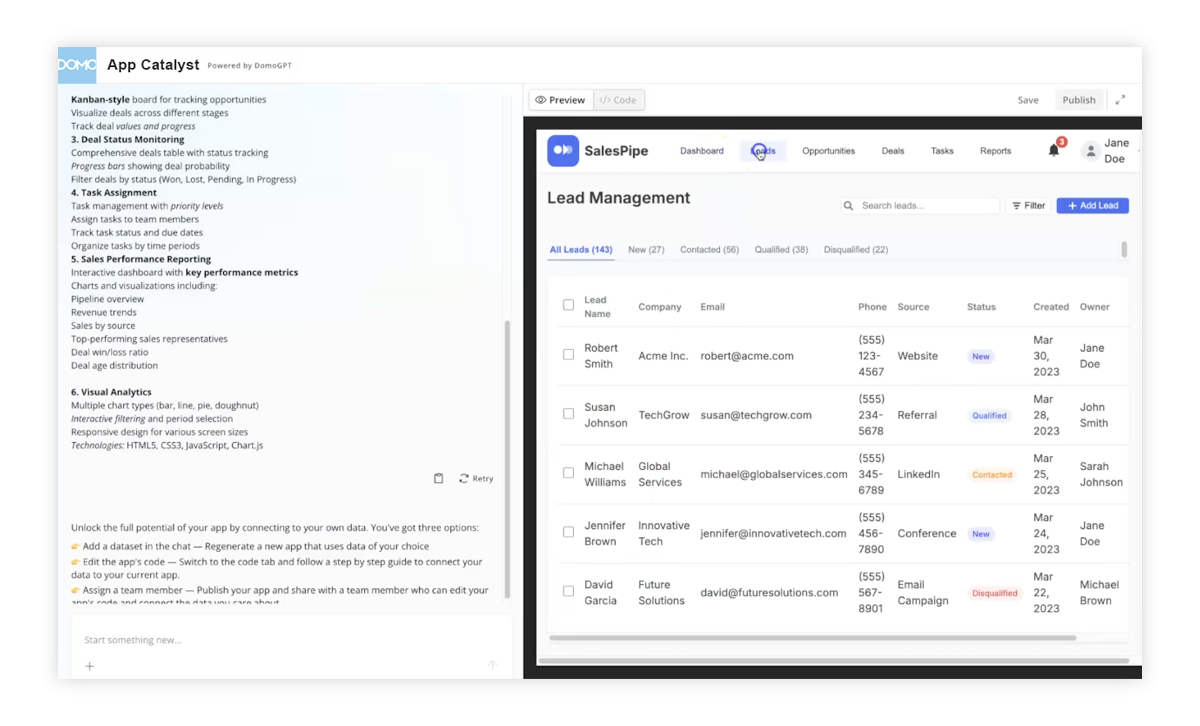
Getting started is super easy. Like other AI interfaces, you use a basic prompt to describe the app you’re looking to build. You’re then moved to a split-screen view as it renders before your eyes.
On the left side, you get a breakdown of what App Catalyst generated. On the right, you can see what it created. And it's not just a dashboard or a view, but a true application – complete with models, text fields, and check boxes.
Brass tacks: It usually takes two to five minutes to generate an app using App Catalyst, although times may vary. On Domo’s website, there’s a great demo video that walks you through the step-by-step process, but jumps over the rendering lag. So keep that in mind when you're test-driving the experience.
Source: Domo website
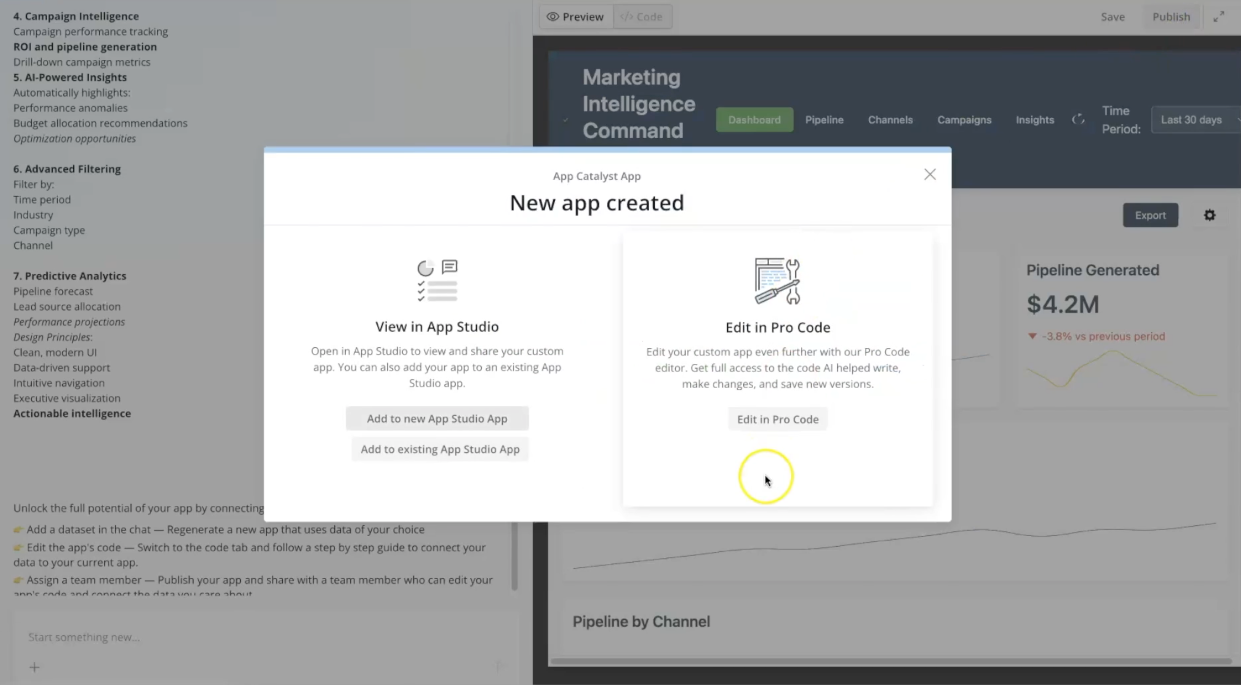
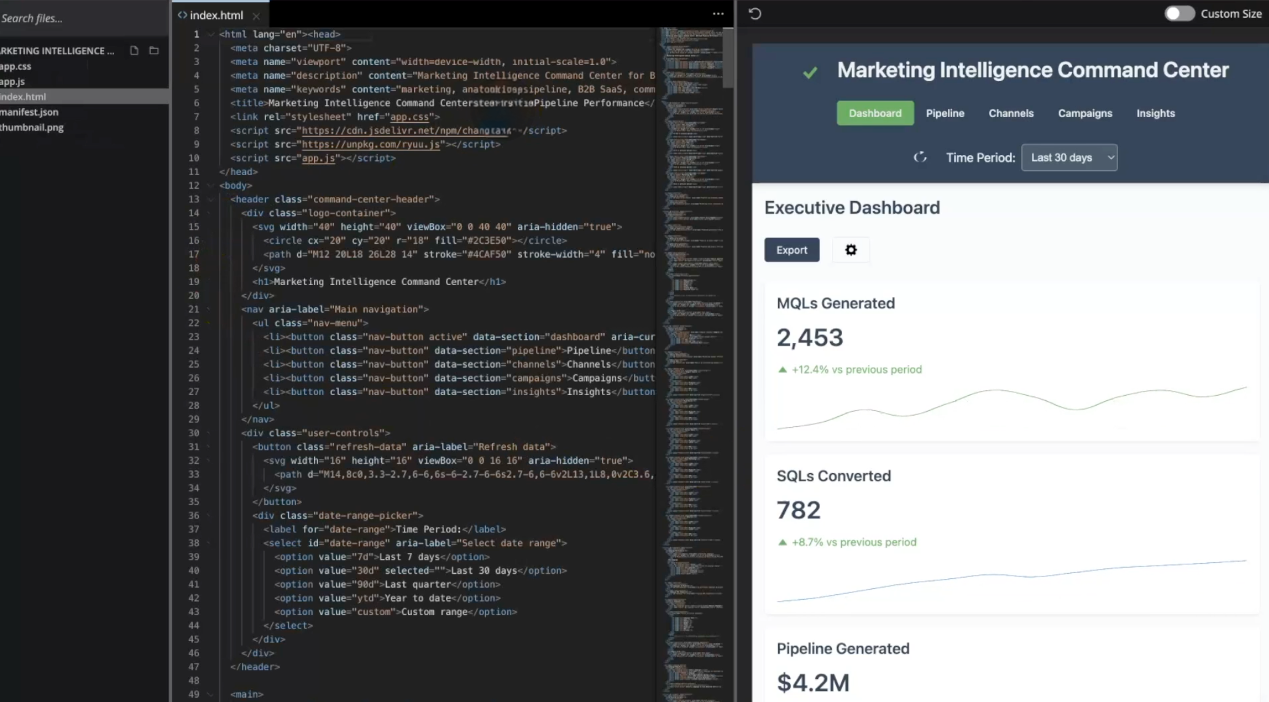
You can also expand and build complete Domo App Studio apps, which can fit in with any other Studio components. If you’re more technical and you’re looking to customize your app further, you can make edits using Pro Code, which gives you direct access to the underlying HTML.
Source: Domo website
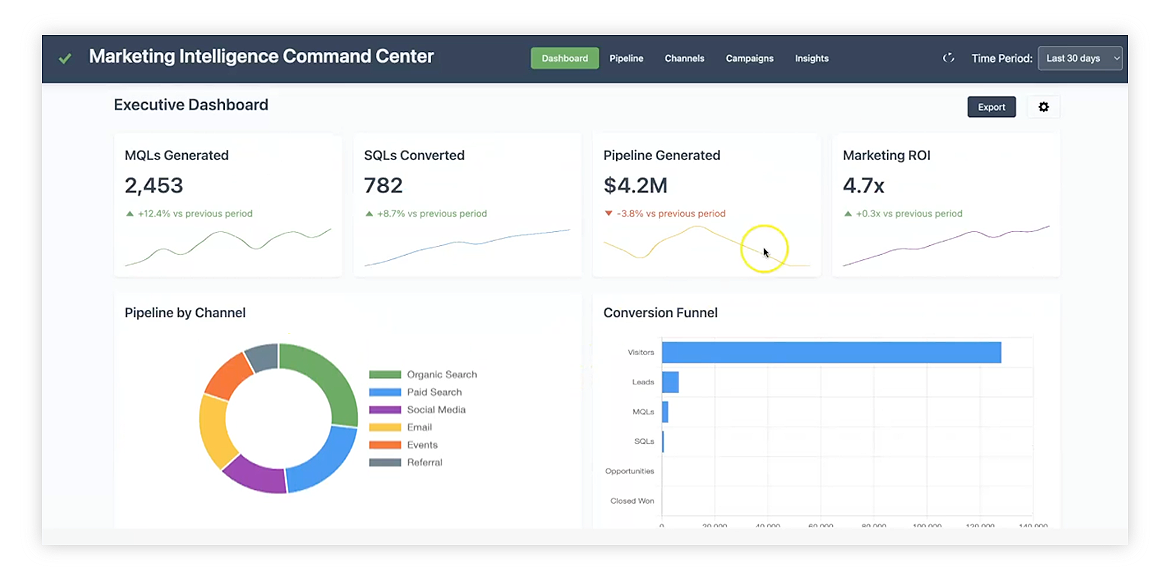
The finished product (in this case, a marketing intelligence command center) reflects the speed and efficacy of the App Catalyst framework. By removing the need for complex setups – or starting from scratch – you can focus on delivering value and avoid the morass of complex logistics. And you can keep on optimizing and refining your layouts and visualizations using the same natural language prompts.
Source: Domo website
As I already mentioned, you can connect to live datasets in Domo or play with dummy data to experiment with the capabilities. App Catalyst ensures your apps are functional and compliant, and automatically respects enterprise-grade governance and security controls. This includes per-user data access permissions, row-level permissions, and column-level masking, ensuring your apps are compliant and secure from the start.
App Catalyst might initially appeal to product managers, developers, and savvy practitioners – enabling them to visualize requirements, demonstrate concepts to stakeholders, and prototype digital products quickly. But over time, Domo plans to expand these capabilities to empower business users to validate ideas, test market hypotheses, and explore what is possible with data-driven applications, all while reducing dependency on IT teams.
The verdict
Domo has always understood the value of data and how we, as individuals and teams, use and experience it. Making it actionable is the key – and with App Catalyst, they’re moving beyond the barriers of studio-grade customization tools and into the realm of true AI app creation. You can describe your app vision in plain language, and the AI handles all the heavy lifting.
My recommendation: While App Catalyst will likely appeal to more technical users (particularly those who are already customizing aspects of their Domo experience), its natural language interface will make it accessible to ambitious low-code/no-code users. That said, enterprise teams should build testing and experimentation paradigms to ensure performant outcomes – and develop general policies and best practices around app generation within their organization’s environment. The big upside: as Domo expands these capabilities, App Catalyst will likely become even more reliant and user-friendly for business users who want to build apps without burdening IT. Definitely worth a test-drive.
Upcoming Events
CMS Summit 26
May 12-13, 2026 – Frankfurt, Germany
The best conferences create space for honest, experience-based conversations. Not sales pitches. Not hype. Just thoughtful exchanges between people who spend their days designing, building, running, and evolving digital experiences. CMS Summit brings together people who share real stories from their work and platforms and who are interested in learning from each other on how to make things better. Over two days in Frankfurt, you can expect practitioner-led talks grounded in experience, conversations about trade-offs, constraints, and decisions, and time to compare notes with peers facing similar challenges. Space is limited for this exclusive event, so book your seats today.

Umbraco Codegarden 2026
June 10–11, 2026 – Copenhagen, DK
Join us in Copenhagen (or online) for the biggest Umbraco conference in the world – two full days of learning, genuine conversations, and the kind of inspiration that brings business leaders, developers, and digital creators together. Codegarden 2026 is packed with both business and tech content, from deep-dive workshops and advanced sessions to real-world case studies and strategy talks. You’ll leave with ideas, strategies, and knowledge you can put into practice immediately. Book your tickets today.
Open Source CMS 26
October 20–21, 2026 – Utrecht, Netherlands
Join us for the first annual edition of our prestigious international conference dedicated to making open source CMS better. This event is already being called the “missing gathering place” for the open source CMS community – an international conference with confirmed participants from Europe and North America. Be part of a friendly mix of digital leaders from notable open source CMS projects, agencies, even a few industry analysts who get together to learn, network, and talk about what really matters when it comes to creating better open source CMS projects right now and for the foreseeable future. Book your tickets today.