MX to the MAX: Tom Cranstoun's New Book Decodes Machine Experience for Humans and Agents


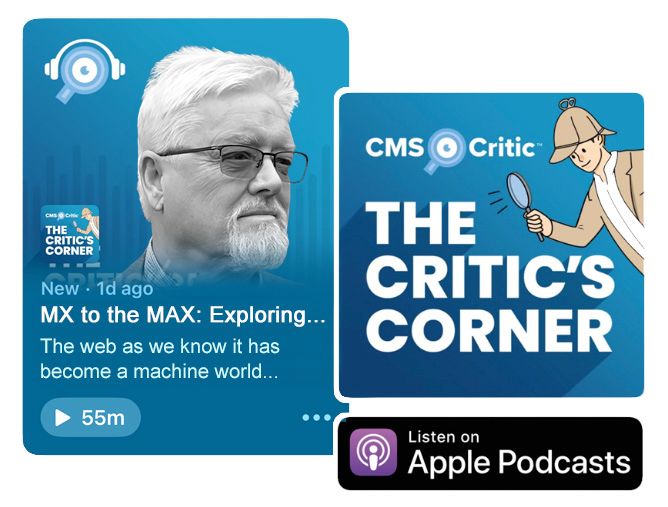
On the latest episode of "The Critic's Corner" podcast, Chief Critic Matt Garrepy sits down with digital pioneer, AI expert, and author Tom Cranstoun to discuss his new book on Machine Experience – and how MX principles can help us design the future of the web.
Listen to the full episode of “The Critic’s Corner” Podcast >
In January of this year, Amazon launched Alexa+, Microsoft gave birth to Copilot Checkout, Google pushed UCP, and Anthropic introduced Claude Cowork.
The infrastructure needed for machines to act on web pages all arrived in a single month, and it changed everything.
The web as we know it has become a machine world, with bots outnumbering humans in the web traffic department. And that’s not hyperbole: last month, Cloudflare recorded the record-breaking moment when machines crossed the threshold.
Are websites and digital experiences ready for this change? What about content, context, and portability? And how do we maintain governance in this new "Wild West" of agents?
No. We’re not ready. And there are more questions – and even more complicated answers – about what’s ahead. This is where Tom Cranstoun’s new tome, MX: The Handbook, aims to make its impact.
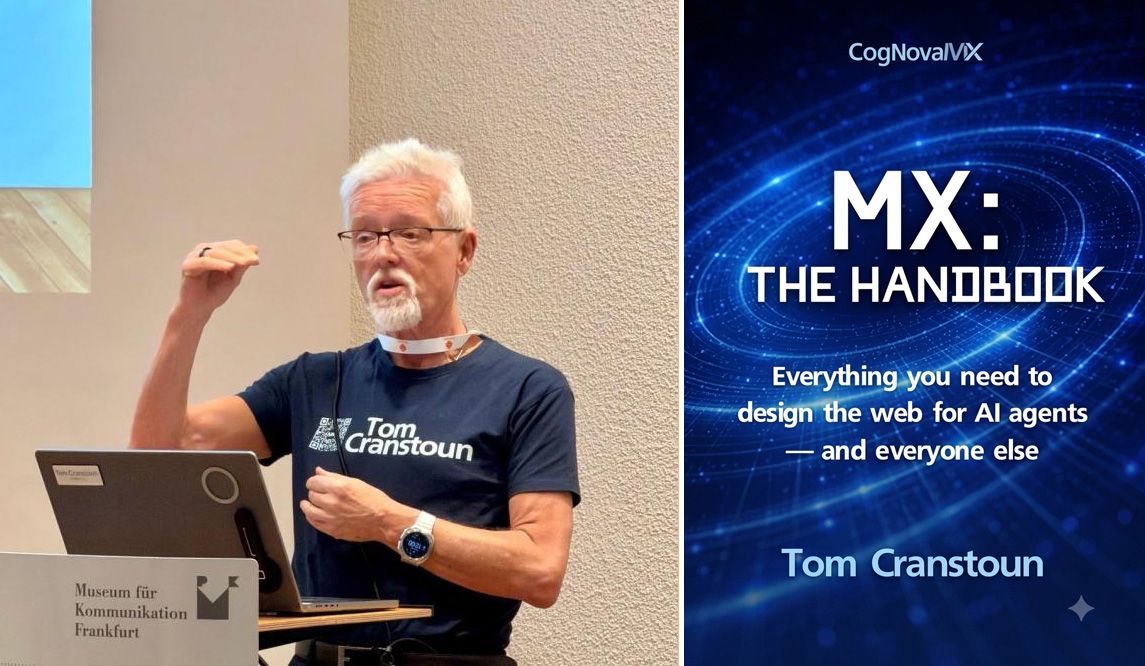
Tom Cranstoun, author of MX: The Handbook
On the latest episode of The Critic’s Corner podcast, lead analyst and Chief Critic Matt Garrepy sits down with Tom to explore the book, which focuses on the rise of Machine Experience (MX) and how it’s the answer to many of the challenges we face.
What is Machine Experience? According to Tom, it's the layer that keeps Content Ops work usable when an AI agent, or any other system, encounters the file outside the environment that produced it. And MX principles apply to more than just web pages. It's videos, podcasts, PDFs, images – anything we make and publish readable by machines (more on that in a bit).
As Tom explores in MX: The Handbook, the web is no longer consumed just by people. AI agents are becoming a new consumption layer for enterprise digital platforms. They're interpreting, transforming, comparing, and acting on information on behalf of users, teams, and other systems.
This is more than just a book. Literally. It has two companion manuals that Tom completed as a set, offering business and technical guidance on designing the web for AI agents – and for humans.
If you’re not familiar with Tom, his resume reads like a tech bible. He started well before the modern Internet was born, developing large-scale projects for brands like BT and the BBC. He later founded his own consultancy, Digital Domain Technologies, where he did groundbreaking work for household names like Twitter and Ford.
Tom also carved out a respected niche around Adobe Experience Manager, becoming a de facto industry expert on building and deploying for a multitude of enterprises. Now, as he embarks on this new chapter of AI transformation, he’s changed his familiar calling card from “The AEM Guy” to “The MX Guy.”
Defining Machine Experience (MX) in an AI-First Web
We've been actively exploring “Agent Experience” with other guests – including Netlify’s Matt Biilmann – for the last few years. But Tom brings his own brand of foundational, systems-level experience to this constantly shifting world of AI machines. He also provides some fresh perspective that's anchored by his deep industry wisdom.
Tom’s journey into MX started with a bout of skepticism. As the story goes, it happened at an earlier Boye & Company CMS Experts event, where everyone was talking about AI creating content. But he wasn’t buying the hype.
As he explains in the pod, that perspective drove him down what he calls the “AI rabbit hole,” where he realized the real problem isn’t just the models themselves, but the way our content is structured – or decidedly unstructured – for machines. The breakthrough came when he accepted that we can’t realistically reprogram models to bridge this gap.
“You can't change the machines, but what you can do is change your corner of the internet,” he says. “You can change the way that you present your information, so that the machine will not be able to make things up if you've got it written down and available.”
For MX, that “corner of the internet” includes not just HTML pages, but PDFs, media assets, and every other artifact that agents can ingest. In other words, a whole lot more than we realize.
‘The Invisible User’ and Why Bots Are Your Biggest Audience
The web, in Tom’s view, now has two primary audiences: humans and machines. And the latter is rapidly taking up all the air in the room. But are we really seeing this machine audience?
One of the most compelling ideas Matt and Tom explore in the pod is the concept of the “invisible user.” In the foreword to Tom’s book, this is framed as the agentic systems that interact with your content – but never show up in your analytics.
Tom argues that most organizations still design and measure exclusively for humans, even as bots and agents are doing more of the actual “consumption” and decision-making work online. These invisible users don’t obey your intended journeys or browse your menus. They don’t watch your videos or click your CTAs. They drop in, grab what they think they need, and disappear.
“The invisible user doesn't appear in your analytics, it comes and hits a page and goes away, it doesn't follow the funnel, so you have no idea what's going on,” he explains. “It's definitely invisible to you, and your site is invisible to it.”
For brands, this is a double-edged sword.
Tom originally considered calling his book The Invisible Users before he reframed it around MX, but the metaphor remains central. Agents are already acting on behalf of customers, and if your content isn’t machine-readable and trustworthy, those agents will get things wrong on your behalf.
Organizations Need Machine Experience
During the pod, Tom draws a direct analogy between the early, chaotic days of web design and where we are now with AI.
Before UX became a mature discipline, every stakeholder “designed” a website in a bespoke manner. The result was inconsistent, often confusing interfaces with fragmented experiences. Only when organizations invested in UX leadership and established solid processes did things start to stabilize.
Tom argues that MX is now at the same inflection point. Most websites today are, in his words, “abysmal” for machine users, even when they’re excellent for humans. His own research – which includes MX readiness audits – has established that almost no sites meet the “high quality” threshold for machine experience.
The fix, as Tom explains, isn’t to just slap more structure on top. It’s adding the right layers of governance and the right humans to own it. “You need a person in charge of the machine experience who tells and instructs the testers how to test for machines, not just for people,” he advocates.
That includes rethinking patterns that work for humans but confuse agents (such as multiple “Read more” links with no explicit context) and making better use of existing capabilities in platforms like Adobe Experience Manager.
Tom emphasizes that many CMSs already provide critical foundations like rich metadata. The missing step is surfacing that metadata in durable, machine-friendly forms such as JSON-LD (JavaScript Object Notation for Linked Data), expiry information, and consistent semantic structures.
Throughout the conversation, Tom reinforces a core theme: metadata is the primary way we communicate with machines. Or, as Kate Kenyon said at CMS Summit 2026 in Frankfurt, metadata is “AI’s love language” – and we need to make it as sweet as possible.
Navigating the Policy Complexities of an AI-First Web
In the pod, key themes emerge surrounding compliance, provenance, and accountability across critical disciplines. Tom points to recent European legal cases where companies were fined heavily for poor accessibility despite claiming “partial compliance,” and he draws a line from those rulings to the tightening landscape around AI governance.
Tom’s response has been to build tools and standards that embed provenance, responsibility, and AI usage directly into content artifacts. That’s why he founded The Gathering, a standards body focused on MX that’s centered on filling the gaps between existing frameworks rather than reinventing them.

One example of how these standards are emerging is Reginald (short for “Registration for Genuine and Notarized Legal Documents”) – an open, MIT-licensed mechanism for attesting to who created a document, when, and how AI participated in its creation.
“You have a piece of the jigsaw that says, ‘I wrote this on this day, it was me, I am me, and this document hasn't changed,’” Tom points out. “So the machine can then choose to trust it or not.”
He also stresses the importance of deterministic processes in AI workflows. While large models infer and “hallucinate” (a fancy word for “bug”), his MX audit tooling uses deterministic probes and scripts to gather facts and generate an audit trail. A generative layer may craft prose, but the underlying data is verified and traceable – a pattern Tom believes regulators will increasingly expect.
MX as the Next ‘Gutenberg’ Moment for Machines
Finally, Matt and Tom zoom out to the broader implications of MX – beyond tweaking HTML templates, tightening markup, or tuning schema. As Tom explains, MX spans every publishing and ingestion point. And not just content in a CMS, but PDFs, images, employment letters, marketing assets, and more.
The portability of content takes the conversation in an interesting direction. CMS platforms provide critical points where MX can be integrated into content workflows. But once an artifact leaves any platform – as a PDF attached to an email, for example – it still needs to carry its MX payload, so machines can correctly interpret, trust, and reuse it. This is where embedded metadata, audit trails, and registries become essential.
Tom sees this as a significant consideration that is rippling across every facet of the digital ecosystem.
“It's bigger than me, and it's bigger than the CMS market,” he says. “It's as big as all of the documents we have ever created. I believe MX is equivalent to the Gutenberg press for machines.”
As agents multiply and enterprises move toward AI-first operations, Machine Experience will become as central to digital strategy as user experience did a decade ago. The brands that thrive will be the ones that treat agents as first-class users – and design accordingly.
How do we ensure the best possible outcomes for both humans and agents? By preparing now. And the best way to do it is by grabbing Tom’s trusty handbook as a guide for the journey ahead.
Other Articles by Tom on CMS Critic:
- Without Cogs, No Machine Moves
- What's ahead for Adobe Experience Manager? An ecosystem revolution. Here's why
- 'How did I not know this?’ CMS Summit 25 changed my understanding of AI
- Trust and Verify: When Internet Drama Meets AI Reality
“The Critic’s Corner” Podcast with Tom Cranstoun
Upcoming Events

CMS Connect 26
August 5-6, 2026 – Montreal, Canada
The best conferences create space for honest, experience-based conversations. Not sales pitches. Not hype. Just thoughtful exchanges between people who spend their days designing, building, running, and evolving digital experiences. CMS Connect brings together people who share real stories from their work and platforms and who are interested in learning from each other on how to make things better. Over two days in Montreal, you can expect practitioner-led talks grounded in experience, conversations about trade-offs, constraints, and decisions, and time to compare notes with peers facing similar challenges. Space is limited for this exclusive event, so book your seats today.
Open Source CMS 26
October 20–21, 2026 – Utrecht, Netherlands
Join us for the first annual edition of our prestigious international conference dedicated to making open source CMS better. This event is already being called the “missing gathering place” for the open source CMS community – an international conference with confirmed participants from Europe and North America. Be part of a friendly mix of digital leaders from notable open source CMS projects, agencies, even a few industry analysts who get together to learn, network, and talk about what really matters when it comes to creating better open source CMS projects right now and for the foreseeable future. Book your tickets today.

Contentstack ContentCon 2026
September 30 - October 1, Amsterdam / October 27-28, 2026 – Chicago
Contentstack’s annual customer conference is the premier event for executives, marketing leaders, and developers to redefine their digital experience strategy. This is your opportunity to step out of the "status quo" and into "elite" status, learning exactly how the world’s most successful brands are using the technology you already own to do the impossible. Enjoy a full day of interactive workshops, certifications, and inspirational on-stage sessions designed to help you become an expert on cutting-edge digital strategies and how to turn Contentstack's CMS and adaptive personalization tools into your greatest competitive advantage. Book your seats today.
Storyblok JoyConf 2026
October 28 - 29, Rheingoldhalle, Mainz (Frankfurt)
JoyConf 2026 is where developers, marketers, and digital innovators come together from all around the world, united by one powerful idea: great content isn’t built by tools alone – it’s built by people who rely on systems to deliver their best work to the world. In an era where technology is increasingly shaped by AI, Content Confidence becomes your competitive advantage. When you can create, manage, and scale content that performs seamlessly across channels, platforms, and AI, you don’t just keep up – you win. Book your seats today.