You can ship in days with AI. But you still can’t sell to the enterprise. Here's why


In an age where software is getting faster and cheaper to build, the game has changed – and there are more vibe-coded tools entering the evaluation equation. But for enterprises, the buck still stops with trust, predictability, and demonstrated value. And the gap between what gets shipped and what gets bought is wider than ever.
Geetha Rajan is a strategy executive advising Fortune 500 companies on AI adoption, AI transformation, and organizational change, and a CMS Critic contributor.
Vibe coding has collapsed the barrier to building software. It hasn’t moved the barrier to selling it.
The numbers tell the story clearly. According to the Stack Overflow 2025 Developer Survey, which surveyed nearly 50,000 developers, 84% now use AI coding tools. Yet only 29% trust their accuracy, down from 40% the year prior.
Google Cloud’s DORA 2025 State of DevOps Report puts daily AI tool usage across software teams at 90%. The volume of output this is producing is staggering. And it is flooding enterprise procurement queues with products that weren’t built for the environment they’re trying to enter.
I’ve spent the past several years evaluating early-stage AI products as a judge and mentor across startup competitions and accelerators and conducting independent research into why enterprise AI initiatives fail at scale. The pattern I see repeatedly: the tools are getting faster, more polished, and easier to spin up.
But the enterprise buying process hasn’t changed at all. And in a market flooded with vibe-coded submissions, the gap between what founders ship and what enterprises actually purchase is wider than ever.
Features Were Never the Moat
Here’s the uncomfortable truth for vendors watching their feature differentiation erode: in enterprise, features were rarely what closed the deal in the first place.
I’ve been in the rooms where these decisions get made. The vendor who won was rarely the one with the best demo. It was the one who made the enterprise feel safest.
Safe means something specific. It means the CISO’s questions were answered before they were asked. It means compliance documentation showed up in meeting one, not when procurement requested it. It means the vendor understood the buyer’s data architecture before pitching a solution that depended on it.
The security data makes the CISO’s caution rational rather than obstructive. Veracode’s Spring 2026 GenAI Code Security Update found that 45% of AI-generated code contains security flaws – and that cross-site scripting failures appear in 85% of AI-generated code samples tested.
Vibe coding has commoditized the how of software development. It has raised the price of the why. When anyone can generate a feature, the buyer’s focus shifts from the code to the standards that ensure the tool can actually function inside a composable, integrated enterprise stack. Architectural credibility isn’t something you can prompt your way into.
Most founders discover the CISO has veto power in week ten, when a data residency concern surfaces that could have been addressed in the first conversation – and the deal quietly dies. I’ve watched this happen: a founder demos beautifully, earns a pilot, and learns in month three that their data handling doesn’t meet the buyer’s regulatory requirements. The product didn’t change. The environment it was entering never changed either. Nobody asked.
The vendors who navigate this successfully don’t avoid the security conversation. They lead with it. Vibe coding can replicate a feature. It cannot replicate the organizational credibility that comes from having navigated these conversations before.
You’re Not Selling to a Platform Decision — You’re Selling to a Population
Every enterprise contains roughly the same distribution of people, each requiring a completely different approach.
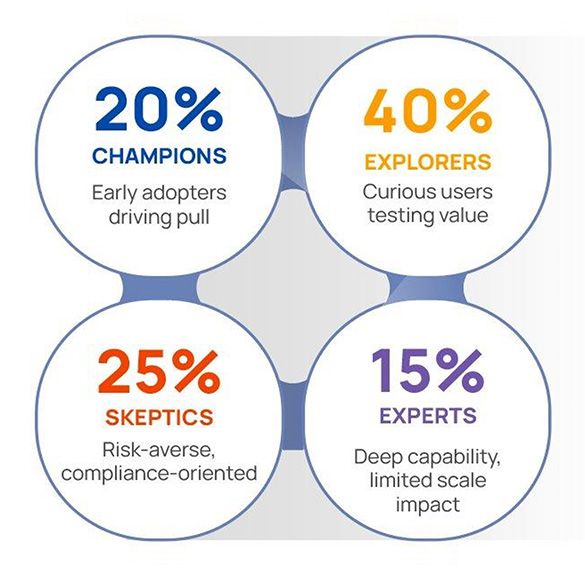
The Four Segments Model – Pilots to Scale™ Framework
From my research across hundreds of enterprise engagements, four segments appear reliably. Champions – roughly 20% of any organization – are already experimenting and will advocate internally. The mistake is finding one and treating it as the whole story.
Explorers, the largest group at around 40%, want to adopt but don’t know where to start. They need structure, not a blank canvas. Skeptics have watched technology initiatives fail before; they move on evidence, not enthusiasm. Experts have deep technical fluency but limited organizational reach – waste them on easy problems and you lose their endorsement entirely.
One playbook fails across all four. The vendors who succeed map their approach to the segment in front of them, not the one they wish they were talking to. Vibe coding can ship a feature overnight. It cannot segment an organization’s adoption posture for you.
The Three Things That Actually Close Enterprise Deals
What remains from every enterprise evaluation I’ve been part of or studied are three things: trust, predictability, and demonstrated value.
Trust is built before the first slide. It comes from signals about organizational seriousness, security readiness, and long-term viability. In a market suddenly flooded with vibe-coded tools, the question enterprise buyers are quietly asking is: will this vendor exist in three years? Will they support the integration we build around them? Can I defend this decision internally when something breaks?
Predictability stems from the pilot’s structure. A pilot run on clean, sanitized data in a controlled environment is not a pilot – it’s a controlled experiment. Real enterprise environments have missing fields, inconsistent formats, legacy systems feeding into one another, and edge cases that nobody documented. The product that performed beautifully in the demo encounters production and produces something entirely different. Founders who scope pilots like a product trial – 30 days, friendly users, no real production complexity – win the pilot and lose the deal.
Value is earned through a business case the buyer helped build. An ROI model you construct alone will be challenged on every assumption when it reaches a procurement committee. A business case built with the buyer’s own numbers and validated by their own team becomes their internal mandate. They will defend it. You are not selling them a product – you are giving them the ammunition to buy it.
The Adoption Gap Vibe Coding Ignores
While vibe coding has produced an explosion in code volume, the reality of production is stark. According to MIT’s NANDA research, 95% of generative AI pilots fail to deliver measurable ROI despite tens of billions in cumulative spend. McKinsey’s 2025 State of AI report found that only 5.5% of organizations are seeing real financial returns. And a March 2026 survey of technology leaders by Digital Applied found that just 14% of enterprises have reached production scale for AI agents.
- We aren’t suffering from a lack of code. We’re suffering from a lack of certainty.
- 78% of enterprises have deployed AI. Only 4% are scaling it.
- That gap is not a technology problem.
It is an execution environment failure – one I’ve tracked directly through my own interviews with over 200 operational leaders, and the basis for the Pilots to Scale™ framework. The middle layer of the enterprise, the managers responsible for translating platform decisions into operational reality, is consistently where adoption stalls. Not because of executive resistance. The organizational infrastructure required to operationalize what was purchased hasn’t been built yet.
Vibe coding accelerates the supply side of this equation. It does nothing for the demand side. If anything, it widens the gap – more products entering an environment no more ready to absorb them than it was before.
What the Moat Actually Is
The vendors who will survive this moment are not the ones who out-feature the vibe coders. They’re the ones who have built something vibe coding genuinely cannot replicate: a track record of navigating enterprise complexity, a community of practitioners who can vouch for them, and an organizational understanding of what it takes to get a platform adopted – not just purchased.
What enterprise is buying has always had the same answer. Confidence that this will still be working and still be supported in three years. Assurance that the vendor understands their environment well enough to be a real partner in it. A reduction of organizational risk, not an addition of organizational capability.
Vibe coding didn’t break the enterprise software model. It exposed what the model was.
Upcoming Events

JoomlaDay USA 2026
April 29 - May 2, 2026 – Delray Beach, Florida
Be part of the Joomla community in one of the most iconic cities in the world! JoomlaDay USA 2026 is coming to Delray Beach, and you can join us for a dynamic event packed with insights, workshops, and networking opportunities. Learn from top Joomla experts and developers offering valuable insights and real-world solutions. Participate in interactive workshops and sessions and enhance your skills in Joomla management, development, design, and more. And connect with fellow Joomla enthusiasts, developers, and professionals from across the world. Book your seats today.
CMS Summit 26
May 12-13, 2026 – Frankfurt, Germany
The best conferences create space for honest, experience-based conversations. Not sales pitches. Not hype. Just thoughtful exchanges between people who spend their days designing, building, running, and evolving digital experiences. CMS Summit brings together people who share real stories from their work and platforms and who are interested in learning from each other on how to make things better. Over two days in Frankfurt, you can expect practitioner-led talks grounded in experience, conversations about trade-offs, constraints, and decisions, and time to compare notes with peers facing similar challenges. Space is limited for this exclusive event, so book your seats today.

RAISE Amsterdam
May 20, 2026 – Amsterdam, Netherlands
Sponsored by Kontent.ai, RAISE Amsterdam brings together bold marketing and technology leaders to explore how agentic AI is reshaping the way ambitious brands create and deliver content and what it takes to use it safely, responsibly, and with proper governance. Experience the ideas that are shaping the future and dive into big thinking, innovative strategies, and expert insights. Held at the Klein Canvas, Volkshotel, you'll hear from world-class speakers in dynamic sessions that will reveal how AI-powered content operations are accelerating production, improving governance, and driving creative impact. Limited spots are available, so book yours today.

Umbraco Codegarden 2026
June 10–11, 2026 – Copenhagen, DK
Join us in Copenhagen (or online) for the biggest Umbraco conference in the world – two full days of learning, genuine conversations, and the kind of inspiration that brings business leaders, developers, and digital creators together. Codegarden 2026 is packed with both business and tech content, from deep-dive workshops and advanced sessions to real-world case studies and strategy talks. You’ll leave with ideas, strategies, and knowledge you can put into practice immediately. Book your tickets today.
Open Source CMS 26
October 20–21, 2026 – Utrecht, Netherlands
Join us for the first annual edition of our prestigious international conference dedicated to making open source CMS better. This event is already being called the “missing gathering place” for the open source CMS community – an international conference with confirmed participants from Europe and North America. Be part of a friendly mix of digital leaders from notable open source CMS projects, agencies, even a few industry analysts who get together to learn, network, and talk about what really matters when it comes to creating better open source CMS projects right now and for the foreseeable future. Book your tickets today.