AI and Accessibility: Incredible Potential, Inconvenient Questions

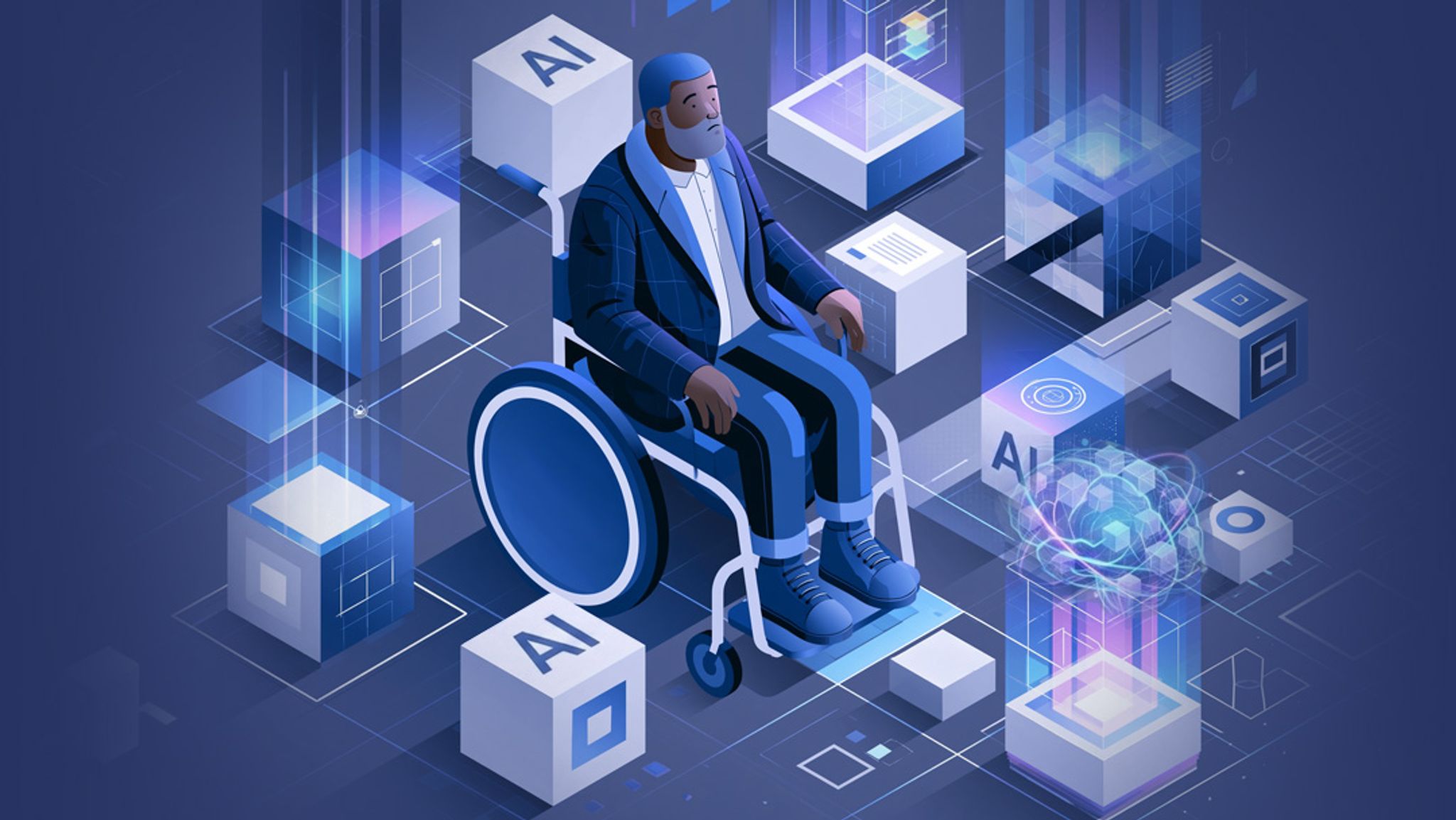
AI is opening up more agency and independence for people with disabilities. But there are pros and cons, and we need better governance and accountability to help ensure a more inclusive future. Here are some key things to consider when weighing what's at stake.
Antonia Fedder is a digital designer, consultant, and speaker working at the intersection of accessibility, inclusion, and sustainability. She is also a CMS Critic contributor.
AI is either the greatest opportunity for the future of digital accessibility or a fast track to cementing existing exclusions. It all depends on who you ask. I honestly think both are happening at the same time, and the decisions that are being made right now will determine where we end up.
The disability market remains both chronically underserved and one of the most severely underestimated in the world, and that’s before you consider the much bigger community of people who use the digital world differently: neurodivergent users, senior citizens, people with temporary impairments, anyone who’s ever encountered a digital interface that wasn’t built for them.
Getting AI and accessibility right is a market question, a rights question, and a design question. This is not a niche problem.
Two kinds of AI, two kinds of possibility
Before we go further, we need to be clear about what we’re actually talking about. "AI" covers a lot of ground.
Discriminative AI works through recognition and classification. That’s the technology behind speech recognition systems like Voiceitt, which learns the unique speech patterns of people with cerebral palsy, Parkinson’s, or Down syndrome, so that they can be understood by voice interfaces made only for standard speech. It supports Microsoft’s Seeing AI, which has enabled blind and low-vision users to manage millions of independent tasks using just a smartphone camera.
Generative AI creates. Be My AI, built into the Be My Eyes app, goes beyond describing images. It enables actual conversations around them. You can ask follow-up questions and explore what you are seeing. Apple’s Personal Voice allows people living with ALS or other speech-affecting conditions to create a synthetic version of their own voice in 15 minutes on a device they already own. Voice banking was available before this function, but it was expensive, time-consuming, and required specialist equipment. AI moved it to the iPhone.
To me, one of the most vivid descriptions of what this access actually means came from Léonie Watson, a blind developer and accessibility specialist, in her talk at FFConf 2024.
She described how generative AI has allowed blind users to go back through photo albums and actually experience what is in those photos: the expressions, the context, the memories. Access to personal history that had been visually inaccessible. One of the most extraordinary things this technology has opened up is that kind of agency and independence, being able to access your own life, on your own terms.
When the picture gets complicated
The same tools make mistakes, and they make them confidently. AI image descriptions are hallucinating. They describe what is not there, or they miss what is. That’s a lot to be asking a blind user to decide in real-time based on what the AI is telling them about their surroundings. The gap between "this is a bit annoying" and "this is a safety issue" is precisely the gap that an intersectional lens helps us see.
The term intersectionality was coined by legal scholar Kimberlé Crenshaw. The key insight is what many people with multiple marginalised identities already know from experience: structural discrimination does not happen in neat, separate categories. Ableism, racism, sexism, class, and language access all intersect and build on each other, and the effects combine in certain ways based on who you are and what systems you are navigating. I use this lens whenever a tool is described as “neutral” or “universal,” because in reality, those words usually mean "designed for the default user" (who doesn't exist).
Bias in AI systems is well-documented, and has real-world consequences. Facial recognition has long had much higher error rates for women with darker skin than for men with lighter skin. Joy Buolamwini's research at MIT Media Lab made this impossible to ignore, though many have tried.
Imagine a blind male user relying on facial recognition to tell him who’s standing in front of him, and getting an error. Then ask what it means to a Black blind woman with the same tool. The tool fails on both, but not to the same degree. That’s the intersectional question: who carries what risk when this goes wrong?
Who built a dataset, who it centres, who it was tested on – these are things that are important to critically question, both for accessibility and equity. If disabled people were not in the room when these systems were built, then you see the gaps in the product.
The Meta Ray-Ban glasses are a telling illustration of how the same technology can exist in completely different realities at once. The American Foundation for the Blind's AccessWorld publication described them as an accessibility tool only by coincidence, designed for social media users with assistive features that exist because of the hardware and AI integration, not because disability access was ever part of the brief.
But for many blind and low-vision users, they’ve become a true independence tool: hands-free environmental description, text reading, and navigation support in a form factor that doesn’t look like medical equipment. Simultaneously, these same glasses are used to film women in public without their consent, which is harmful and violating.
Technology doesn’t pick its context, and its unintended consequences tend to fall on the people who already carry the most risk.
AI as barrier-shifter
AI moves barriers. It doesn’t remove them. The benefits of AI accessibility tools tend to be concentrated on disabilities that are well-represented in training data, languages with large datasets, voices and bodies that systems were designed around, and hardware that people can afford. Coverage that treats these as tools that solve the whole problem ignores the structural question of who still can’t get access – and why.
The gap in governance
Accessibility expertise is still called in late, consulted briefly, then dropped – a structural problem that is, once again, accelerated by AI. Automated checkers can tell you about missing alt text (alternative text) and low color contrast, but they can’t tell you if a real person using real assistive technology will actually be able to use what you’ve built.
A direct word on AI-powered overlay tools: Don’t use them. In the accessibility community, they are widely seen as bad practice because they clash with assistive technology. I recently did an audit of a website for an organization that is very active in advocating for inclusion and runs a blind sports team. They thought the overlay had them covered. It missed big chunks of alt text. It hadn’t tagged the paragraph elements, so a screen reader skips right over the paragraph content. The organisation’s own blind athletes cannot read the articles written about them.
Good accessibility practice is based on the principle of “Nothing About Us Without Us.” Disabled people should be included as designers, researchers, consultants, and decision-makers in all stages of design, development, and testing – and they should be involved from the start. AI can’t replace that involvement. If used well, it could free accessibility professionals to do the work that really matters and make accessibility a default built into the process from the beginning.
Unfortunately, we're not there yet.
This is also a ‘market power’ question
The industry still views accessibility as a cost center, a compliance checkbox, or an edge case. AI can fundamentally change that equation, but only if the tools are built to be accessible, tested with real people, and governed with accountability.
And the case goes far beyond the disability market. Captions were invented as a deaf accessibility feature, and became de facto for anyone watching video in a public space. Voice control, born of the need for motor accessibility, is now used by millions who just find it convenient. Neuroinclusive content is more usable, more memorable across the board, and performs better in AI-driven search contexts, with a clearer hierarchy and less cognitive load. Accessible design leads to better products, for everyone, every time.
Disabled people have always been among the first to embrace and push technological innovation. Many interfaces we now take for granted originated in assistive technology. Getting AI, access, and innovation right is an opportunity to do that again, at a scale and speed that has not been available before. The returns aren't just about equity. They’re about what kind of digital world we build, how well it works, and for how many users.
Both the optimistic and the dystopian scenarios are perfectly plausible. Which one we get depends on decisions being made right now, mostly by people without disabilities, in organizations that haven’t yet asked the right questions.
Upcoming Events
CMS Connect 26
August 5-6, 2026 – Montreal, Canada
The best conferences create space for honest, experience-based conversations. Not sales pitches. Not hype. Just thoughtful exchanges between people who spend their days designing, building, running, and evolving digital experiences. CMS Connect brings together people who share real stories from their work and platforms and who are interested in learning from each other on how to make things better. Over two days in Montreal, you can expect practitioner-led talks grounded in experience, conversations about trade-offs, constraints, and decisions, and time to compare notes with peers facing similar challenges. Space is limited for this exclusive event, so book your seats today.
Open Source CMS 26
October 20–21, 2026 – Utrecht, Netherlands
Join us for the first annual edition of our prestigious international conference dedicated to making open source CMS better. This event is already being called the “missing gathering place” for the open source CMS community – an international conference with confirmed participants from Europe and North America. Be part of a friendly mix of digital leaders from notable open source CMS projects, agencies, even a few industry analysts who get together to learn, network, and talk about what really matters when it comes to creating better open source CMS projects right now and for the foreseeable future. Book your tickets today.

Contentstack ContentCon 2026
September 30 - October 1, Amsterdam / October 27-28, 2026 – Chicago
Contentstack’s annual customer conference is the premier event for executives, marketing leaders, and developers to redefine their digital experience strategy. This is your opportunity to step out of the "status quo" and into "elite" status, learning exactly how the world’s most successful brands are using the technology you already own to do the impossible. Enjoy a full day of interactive workshops, certifications, and inspirational on-stage sessions designed to help you become an expert on cutting-edge digital strategies and how to turn Contentstack's CMS and adaptive personalization tools into your greatest competitive advantage. Book your seats today.