Smell the 'SaaSafras'? Anthropic’s new AI tools are a reminder that change is in the air, but panic stinks

The last day’s tech sell-off is a signal, but not a death knell. Here’s what CMSes and digital experience vendors should be focusing on as AI alters the trajectory of SaaS.
Sassafras is a genus of aromatic, deciduous trees in the Laurel family – Lauraceae, for you nature nerds – which is native to eastern North America and parts of Asia.
Known for its distinct, fragrant smell, Sassafras trees have these uniquely variable leaves that can be unlobed, two-lobed (kind of mitten-shaped), or even three-lobed. Funky, but beautiful.
Living in the Southeastern U.S., I’ve experienced Sassafras in real life, often a fixture along dense forest trails. They produce a lovely yellow pistillate, and the leaves, twigs, and bark have an almost citrusy or spicy note to them. It’s delightful. Alluring, even.

Sassafras Leaves. Source: June Nbg, Wikipedia/Creative Commons
Once upon a time, the bark of the Sassafras tree was the primary ingredient in root beer. It’s hence been recreated using artificial flavorings, partly because the oil derived from it – called Safrole – has hallucinogenic properties as a mild empathogen.
Translation: you feel closeness and affection as it coerces your brain to release serotonin and dopamine.
Right now, people could use a dose of Sassafras as they melt down over the “SaaSafras” – a more-than-mild tech selloff seemingly induced by Anthropic’s new plugins for its Claude Cowork agent, which were launched last Friday.
In simplest terms, Claude Cowork is an agentic AI workspace that goes beyond answering questions. It can perform CRUD functions (create, read, update, delete) on files and folders on your computer, helping you execute tasks and not just engage in Q&A conversations. Less like a chatbot, more like a digital coworker that can get stuff done.
The real buzz is around those plugins, which are designed to automate specialized tasks across departments like marketing, legal, and customer support. Imagine drafting an email in your brand voice, then having a legal agent review it for risk.
That sounds cool. But as we’ve seen, it’s hammering stocks as investors weigh the potential for organizations to just rely on these agents over traditional software. Enterprise giants like Salesforce are feeling a major pinch. Professional services and advertising firms like Publicis are taking a hit as faster automation and shrinking demand for traditional IT services become a shadowy specter along the growth highway.
More fear in the AI forest
Like we haven't had enough anxiety from the likes of AI. Fact is, we've been talking about a “SaaS implosion” as a byproduct of the agentic evolution for quite some time.
The impact is being felt broadly. This includes the categories of CMS, digital experience, and martech vendors, all rolling in a hyperbolic field of “SaaSafras,” anxious that their software might be rendered obsolete by Claude – which, ironically, has been a common companion in the evolution of their own tools.
As expected, software business leaders have pushed back, hoping to quell the fear – but offering sage points. As Cognizant CEO Ravi Kumar said today, AI isn’t magic. It’s not a “plug-and-play switch” that delivers results overnight. If that were the case, we would have seen more economic gains over the last three years.
Instead, we’ve been served consistent data that tells a different story: 95% of AI projects fail before reaching production. 5% of active agentic systems are being refactored every 30 days. And a recent survey from PwC indicates that 56% of CEOs are getting “nothing” from their AI adoption efforts. Investments have been costly, and boards are beginning to focus hard on ROI.
By all accounts, AI isn’t all it’s cracked up to be. At least not yet.
But we’re still spooked by Claude.
Why?
Because we thrive on hype. So let’s take a step back to see the forest through the trees.
Enterprises don’t just buy software – they buy trust. They buy assurances around HIPAA compliance and FedRAMP. They buy accountability and a single throat to choke. They buy performance, security, and scalability for critical workflows.
They don’t just buy products. They buy outcomes.
I’m sure Claude’s plugins will make an impact on productivity. It might be enough to rock some of the overall boat away from big, multi-year software licenses. But they can’t replace a system of authority that provides control, governance, and confidence.
With AI, code might become a commodity, but context is the real goldmine. Legacy players like Adobe have customer data that provides an irreplicable scaffolding for their own LLM ambitions. Meanwhile, hyperscalers like AWS are adding services that will enable SaaS players to accelerate their agentic AI strategies. That could level the playing field and create opportunities.
As Pitchbook said, this is like the era of laying fiber before the internet boom, and there are durable moats. We just need to know where to dig them.
Is this the end of SaaS?
It's a loaded question. Clearly, we're seeing challenges and pressures to the prevailing models. But will this erase the companies behind them, or just force an evolution of how they monetize their services? And what happens to the people behind the products in this great reckoning?
I agree with Nvidia CEO Jensen Huang, who dismissed the idea that AI will make software obsolete. He called it illogical, doubling down on how SaaS tools will use and be used by AI, not replaced by it. He even said that “demanding ROI from AI is like forcing a child to make a business plan for a hobby.”
He went on to say that AI tools have freed up employee time and hasn’t wiped out roles. In fact, from his vantage point, it’s enabling teams to focus on more forward-thinking initiatives and improving core strengths.
Despite Amazon’s recent gutting of 16,000 mid-level workers, large-scale displacement didn’t happen as it was predicted (at least not yet). I wrote about this in my interview with Domo’s Chris Willis, where companies that have downsized with AI have quietly hired back skilled workers.
But labor is, indeed, shifting on all sides. The old model of paying for SaaS software is dying on the Sassafras vine as single-seat software paradigms are replaced by AI agents performing high-value tasks. This is where software companies could move up the ladder as a replacement mechanism – and with that growth, create more of the jobs and opportunities of the future.
I say might, because it’s anyone’s guess.
Is there reason for concern? Absolutely. CMS is changing in profound ways as content transforms. Licensing models are being disrupted. Composable patterns have made it easier to move from one technology to another. And yes, Cursor can vibe code its way to a working website using markdown and sidestep its need for a market-leading headless CMS.
But even if an app can be replaced with a vibe-coded tool or a Claude Cowork plugin, is that the best decision for your business? In some cases, it could be. The cost savings and efficiencies will be there. In others, having a solid, proven system of record is the only way to go.
Smell the ‘SaaSafras’?
There’s a lot of choice emerging in all of this, but it’s been building. Incrementally. We didn’t just arrive here yesterday. And it’s true: some vendors won’t survive what’s ahead. But hasn't that always been the case? Do we really need 15,384 tools on the Martec Supergraphic?
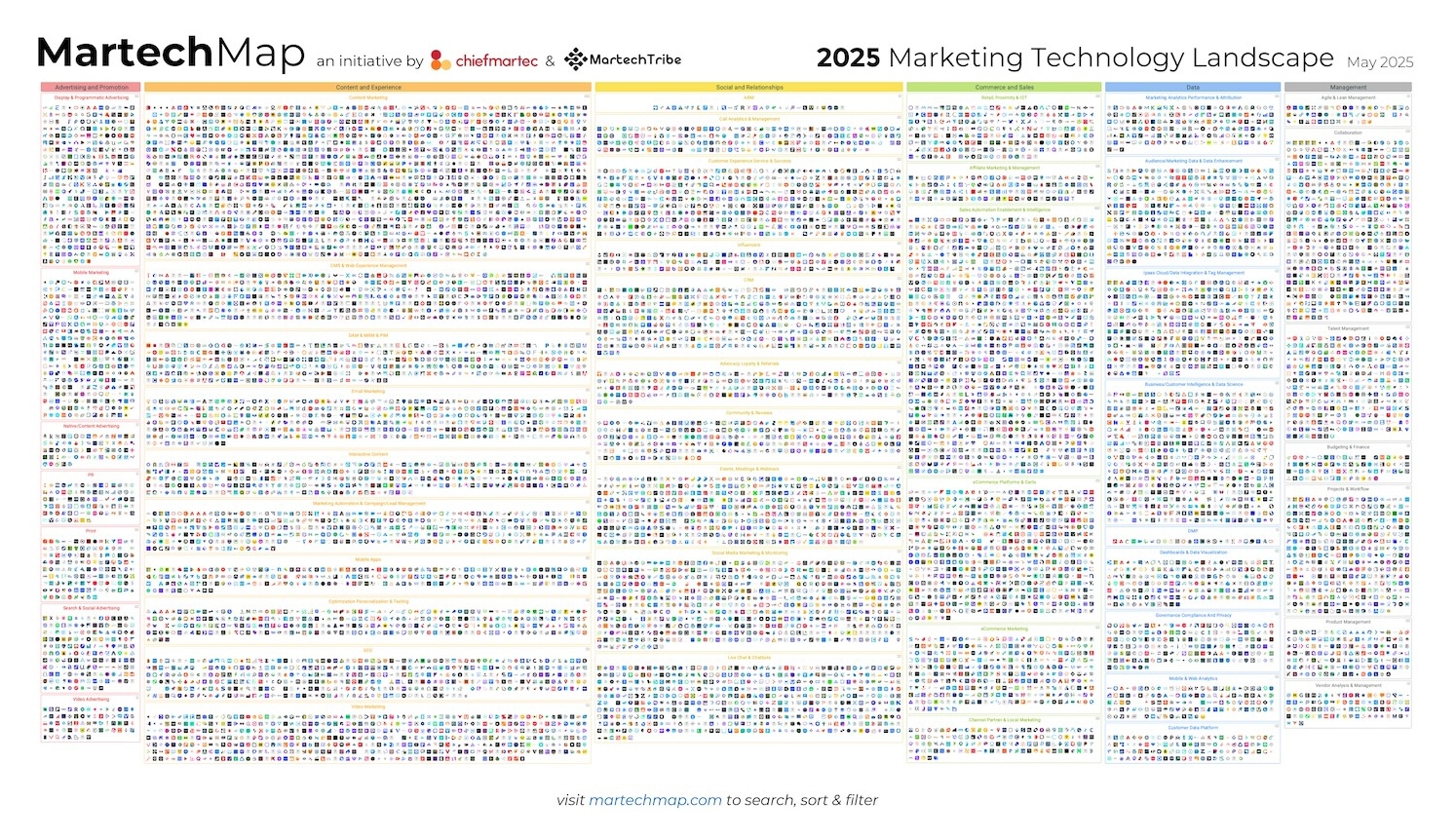
The 2025 Martec Supergraphic. Source: Chiefmartec.com
So how do we move forward? Here are some things to focus on:
- Innovate on the agentic edge but concentrate on productive, workflow-critical solutions where AI can act as a control plane for real work and deliver tangible impact.
- Make governance your moat. Enterprises will always experiment, but in 2026, they’re trading AI novelty for security, scalability, compliance – and, of course, board-worthy results.
- Turn proprietary context into leverage, not just training data. Use the hard-earned structural fundamentals that surround your valuable data – things like schemas and history. They're one of the most important pillars of your IP.
- Kill seat-based pricing before agents kill it for you, and move to outcome- and value-based models.
- Win on orchestration, not generation, because the future belongs to platforms that can manage chaos – not just create more stuff. This is one of the keys to enduring business value.
The strongest roots will survive
That smell in the air today is panic. An emotional sweat that’s a little disorienting and easy to mistake for something more pungent than it actually is.
But this “SaaSafras” moment we’re in isn’t a signal to flee the forest. It’s a reminder to pay attention to what’s growing beneath the canopy. AI agents are absolutely reshaping how software is built, bought, and used. But they won’t replace the need for trust, context, and systems of real accountability.
The vendors that survive this moment won’t be the ones clinging to the old models. They’ll be the ones cultivating deep roots or growing new lobes of innovation. When the hype fades, durable platforms will adapt in the wild – and remain standing.
Upcoming Events

JoomlaDay USA 2026
April 29 - May 2, 2026 – Delray Beach, Florida
Be part of the Joomla community in one of the most iconic cities in the world! JoomlaDay USA 2026 is coming to Delray Beach, and you can join us for a dynamic event packed with insights, workshops, and networking opportunities. Learn from top Joomla experts and developers offering valuable insights and real-world solutions. Participate in interactive workshops and sessions and enhance your skills in Joomla management, development, design, and more. And connect with fellow Joomla enthusiasts, developers, and professionals from across the world. Book your seats today.
CMS Summit 26
May 12-13, 2026 – Frankfurt, Germany
The best conferences create space for honest, experience-based conversations. Not sales pitches. Not hype. Just thoughtful exchanges between people who spend their days designing, building, running, and evolving digital experiences. CMS Summit brings together people who share real stories from their work and platforms and who are interested in learning from each other on how to make things better. Over two days in Frankfurt, you can expect practitioner-led talks grounded in experience, conversations about trade-offs, constraints, and decisions, and time to compare notes with peers facing similar challenges. Space is limited for this exclusive event, so book your seats today.

Umbraco Codegarden 2026
June 10–11, 2026 – Copenhagen, DK
Join us in Copenhagen (or online) for the biggest Umbraco conference in the world – two full days of learning, genuine conversations, and the kind of inspiration that brings business leaders, developers, and digital creators together. Codegarden 2026 is packed with both business and tech content, from deep-dive workshops and advanced sessions to real-world case studies and strategy talks. You’ll leave with ideas, strategies, and knowledge you can put into practice immediately. Book your tickets today.
Open Source CMS 26
October 20–21, 2026 – Utrecht, Netherlands
Join us for the first annual edition of our prestigious international conference dedicated to making open source CMS better. This event is already being called the “missing gathering place” for the open source CMS community – an international conference with confirmed participants from Europe and North America. Be part of a friendly mix of digital leaders from notable open source CMS projects, agencies, even a few industry analysts who get together to learn, network, and talk about what really matters when it comes to creating better open source CMS projects right now and for the foreseeable future. Book your tickets today.