100 Billion Autonomous Decisions? Auxia’s AI Agents Signal a Big Shift for Enterprise Marketing


The customer journey orchestration and agentic marketing platform now processes 400 million decisions each day, giving enterprise customers AI-native capabilities to power real-time personalization at scale.
100 billion. It’s a big number.
Hang on. A little context makes it even bigger: It would take a human approximately 9,513 years to count that high. Assuming they could recite one number every 3 seconds, non-stop, 24 hours a day.
For Auxia – the customer journey orchestration platform that delivers AI-powered, hyper-personalized customer experiences – that figure is a reality. The company just announced that it has delivered 100 billion cumulative decisions on behalf of its customers.
Even more impressive? Auxia’s AI agents now power roughly 400 million autonomous decisions every day, handling tasks like content selection, optimization timing, and determining next-best actions for individual users across channels like web, app, email, and more – all while processing 200 petabytes of first-party data annually.
Not bad for a scale-up that’s only been around since 2022.
But these numbers are more than just an expression of performance. They’re a clear signal that enterprise marketing teams are successfully breaking through the failures of early Gen AI projects – which have persistently plagued organizations – and deploying stable and scalable agentic systems that deliver revenue.

Auxia CEO and co-founder Sandeep Menon. Source: LinkedIn
When I spoke to Auxia’s CEO and co-founder Sandeep Menon last October, he was fired up about the opportunity to bridge the gap that marketers have between content and context, and how Auxia enables teams to harness their first-party data and seamlessly orchestrate 1:1, adaptive, hyper-personalized customer journeys.
As he framed it, agentic AI was the key to the next wave.
“We’re really trying to be an agentic customer journey orchestration platform,” he told me. “We are going from the ‘Old World,’ which is about static, rule-based systems, to one that is much more dynamic.”
Auxia has been on a steady tear since 2024, adding several Fortune 1000 clients and delivering stellar results. That led to a $23.5 million Series A funding round. With cash in hand and an executive heritage from Google and Meta, the company has made significant gains towards its agentic ambitions, where AI is truly impacting outcomes.
“We thought, wouldn't it be great if we kind of reimagined how a marketer's workflow should be in the age of AI?” he said previously. “The way it would work, in our perspective, is that you would always have a set of agents working in the background for you and surfacing insights. And then you – as a marketer – can go and look at those insights and then direct other agents to determine what action needs to be taken.”
This vision sounds great. But herein lies the challenge: most enterprises are still stuck with legacy marketing stacks that limit their AI agility. There’s fatigue, cognitive overload, and a real hunger for more automation to lighten the load without compromising success. This is where Auxia is providing a pathway to an agent-powered “promised land” with real, quantifiable results.
“Enterprise leaders are replacing rigid, rules-based marketing stacks with intelligent agents that optimize customer value in real time,” Sandeep said. “One hundred billion decisions is not just a scale milestone – it is proof that agentic AI delivers measurable top-line impact, not just operational efficiency.”
Real impact and measurable business outcomes
Customer journey orchestration (CJO) platforms help businesses to manage, automate, and personalize customer interactions across multiple touchpoints in real-time, using data-driven insights to improve engagement.
The tighter integration of communication channels and dynamic personalization can enrich those touchpoints across previously fragmented interactions, so you can proactively guide customers to a conversion from any point in the lifecycle.
Like every other segment of software, AI has been changing the game. Auxia’s AI-native solution autonomously determines the best experience for customers by orchestrating cross-channel, real-time journeys across web, app, email, and SMS while optimizing for business goals like activation, retention, cross-sell, and lifetime value.
CJO stalwarts like Braze, Insider One, HubSpot, and Salesforce Marketing Cloud are all moving in the agentic direction, but Auxia is taking a unique approach as a challenger.
Even today, only a small number of enterprises have what we could call “sustainable” agentic systems. According to research by Cleanlab, these systems face significant hurdles, in part because change is fluid. And aside from MCP (Model Context Protocol), large-scale industry standards don’t yet exist.
Said another way: We’re still in the early days, and many organizations are still struggling to get their GenAI initiatives to production, let alone their agent ecosystems.
But Auxia’s growth might be an indicator that the conditions are changing. As Sandeep told me last year, the company’s focus on delivery has been key to its growth, and is reflected in how they engage with enterprise customers – even from a pricing perspective.
“We are very focused on outcomes,” he said. “So a typical engagement would involve going deep into one specific marketing journey or use case that the enterprise wants to transform. Once we identify the use case, then we deploy our system, and the pricing is based on the volume of decisions they take and the usage there.”
There were certainly some notable use cases of Auxia’s success in 2025. In one example, a single enterprise deployment generated $12 million in incremental revenue impact within its first year on the platform. Customers also saw CTRs increase by 5x and cross-sell lifetime value rise 84% compared to prior rules-based systems – with implementations completed in weeks, not months.
According to Auxia, one customer even achieved a stunning 50x increase in new sign-ups after replacing a rules-based personalization stack with Auxia’s agent-driven approach. Impressive.
Auxia is now powering solutions across the Fortune 500, Global 2000, and industry leaders in media, SaaS, insurance, mobile, and entertainment. In terms of brands, the company has added visible industry leaders like Atlassian, Assurant, The Guardian, Comcast, Mercari, and more to its roster.
Continued product innovation, scale, and growth
Auxia has been steadily advancing its global ambitions. To meet the shifting policy and regulatory landscape, the platform has been built with enterprise-grade security, privacy, and reliability at a core level. This includes SOC 2 Type II certification, GDPR compliance, and more.
While its agentic roadmap has also been rapidly evolving, Auxia has been innovating for quite some time. Last July, it released an enhanced version of its AI Analyst agent, which uses a natural language interface to provide marketing teams with high-speed insights into campaign performance.
Before, it was hard to know why AI-powered campaigns were succeeding or failing without complex data analysis. Now, marketers can just ask Auxia’s agent for the answers, effectively giving them a dedicated data scientist.
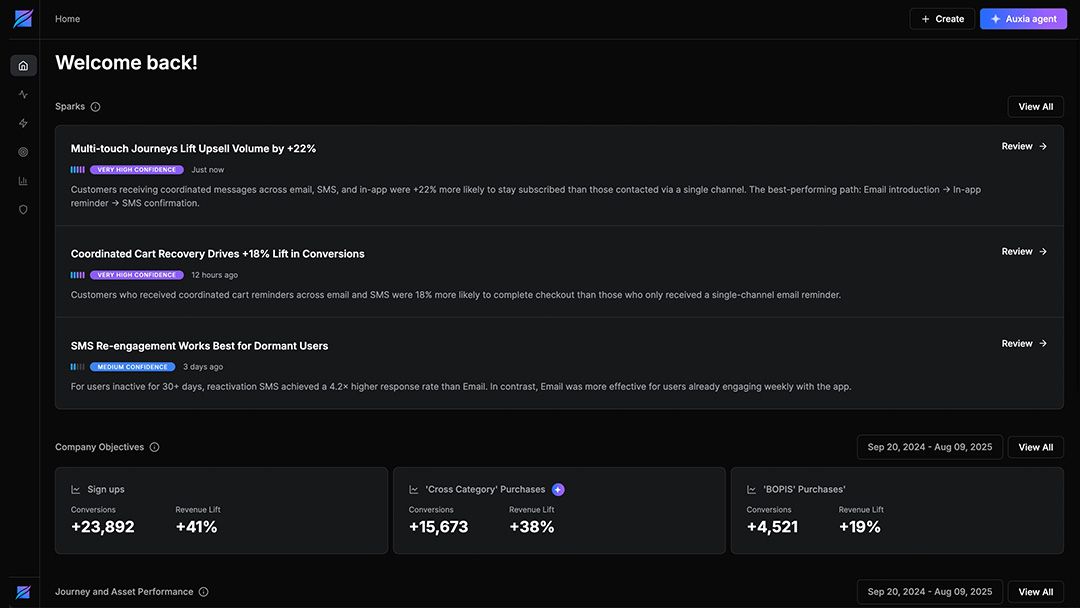
Auxia UX. Source: Auxia
Towards the end of last year, they also introduced a new unified interface that brings decisioning, content generation, and insights into a single view, enabling marketing teams to manage AI-driven campaigns without technical resources.
As Sandeep explained to me during the launch, the new UX also introduced the concept of a “Spark” – a moment of insight that agents uncover and proactively surface for marketers inside a unified dashboard, where it is ranked based on overall confidence. Campaigns are also organized into core marketing workflows called Journeys that align with customer needs.
Under it all, Auxia has also expanded its infrastructure capabilities, scaling the platform to handle over 10 billion events per day, with peak loads of 15,000 queries per second. That reflects a 3x increase in capacity since early 2025.
According to Auxia’s press release, there’s been rapid customer adoption and expansion. The product has been deployed across more teams, channels, and use cases, growing monthly decisions per customer to 6x year-over-year, and generating a heathy 176% net dollar retention (NDR) rate.
Along with expanding its global footprint to include offices in Palo Alto, Tokyo, and Bangalore, Auxia has also quadrupled its headcount with several key hires. Clearly a sign that it’s bullish about the opportunities ahead.
Why it matters
As I noted last year, AI-powered customer journey orchestration is unlocking key benefits for marketers as they look to scale hyper-personalization. Auxia’s vision has drawn real interest and vigor, and they’ve secured the funding to drive the company’s roadmap towards its agentic ambitions.
We’re seeing the fruits of those labors – and not just in Auxia’s net gains. The platform’s surpassing of 100 billion autonomous decisions is a clear signal that AI agents are performing with real outcomes.
As I said previously, I like the composable, agnostic nature of the product. As Sandeep explained in our last conversation, they work natively at the cloud layer, and they’re able to play with CMS and enhance 1:1 personalization with content decisioning via their agents.
“We connect to content management systems, where you can use our agents to determine what is the right content to showcase to somebody at a point in time in their journey to get them to the objective,” he said.
My recommendation: Auxia offers a great market alternative with a clear AI-forward motion towards an agentic marketing platform. Like all CJO products, you’ll want to request a demo and play close attention to how data sources are handled, the usability of workflows, and what native channels you’ll want to use now – and in the future. Customer journey tools are all about experimentation, so you’ll need real-world stakes to fully test and optimize, but you can get a sense in a demo of how granular the personalization is and how you can tailor it. Definitely worth a closer look as you explore options.
Upcoming Events

JoomlaDay USA 2026
April 29 - May 2, 2026 – Delray Beach, Florida
Be part of the Joomla community in one of the most iconic cities in the world! JoomlaDay USA 2026 is coming to Delray Beach, and you can join us for a dynamic event packed with insights, workshops, and networking opportunities. Learn from top Joomla experts and developers offering valuable insights and real-world solutions. Participate in interactive workshops and sessions and enhance your skills in Joomla management, development, design, and more. And connect with fellow Joomla enthusiasts, developers, and professionals from across the world. Book your seats today.
CMS Summit 26
May 12-13, 2026 – Frankfurt, Germany
The best conferences create space for honest, experience-based conversations. Not sales pitches. Not hype. Just thoughtful exchanges between people who spend their days designing, building, running, and evolving digital experiences. CMS Summit brings together people who share real stories from their work and platforms and who are interested in learning from each other on how to make things better. Over two days in Frankfurt, you can expect practitioner-led talks grounded in experience, conversations about trade-offs, constraints, and decisions, and time to compare notes with peers facing similar challenges. Space is limited for this exclusive event, so book your seats today.

Umbraco Codegarden 2026
June 10–11, 2026 – Copenhagen, DK
Join us in Copenhagen (or online) for the biggest Umbraco conference in the world – two full days of learning, genuine conversations, and the kind of inspiration that brings business leaders, developers, and digital creators together. Codegarden 2026 is packed with both business and tech content, from deep-dive workshops and advanced sessions to real-world case studies and strategy talks. You’ll leave with ideas, strategies, and knowledge you can put into practice immediately. Book your tickets today.

Open Source CMS 26
October 20–21, 2026 – Utrecht, Netherlands
Join us for the first annual edition of our prestigious international conference dedicated to making open source CMS better. This event is already being called the “missing gathering place” for the open source CMS community – an international conference with confirmed participants from Europe and North America. Be part of a friendly mix of digital leaders from notable open source CMS projects, agencies, even a few industry analysts who get together to learn, network, and talk about what really matters when it comes to creating better open source CMS projects right now and for the foreseeable future. Book your tickets today.