AddSearch’s AI Conversations is Giving Website Search a Higher IQ


The website search and content discovery company’s newest feature helps modernize website experiences, enabling visitors to interact conversationally and receive clear, trustworthy answers powered exclusively by your website content. Interview with CEO Helena Rebane.
Website search has come a long way, baby.
Yup. We all remember those dreaded days of Boolean mechanics. Back when we fished with keywords, and the use of an “and,” “or,” or “not” could doom you to a barrage of irrelevant results.
Search design improved, thankfully. And so did user behavior. But the traditional model continued to suffer from its litany of links, forcing website visitors to comb through results to find what they were after. Not fun.
Gen AI has changed all of that, specifically with the advent of RAG – Retrieval Augmented Generation. Unlike ChatGPT and other AI engines, RAG principles enable a search service to index and vectorize the content that’s just on your website. When a query is made, the system only searches the data on your website and uses an LLM to generate a natural response.
And presto. More accurate answers because it’s limited to your cache of content. Fewer hallucinations because it’s not trained on misinformation or bad patterns.
AddSearch, a Finland-based SaaS company that focuses on website search and content discovery, is evolving the search experience along this intelligent frontier. The company has over 1,800 customers (including thyssenkrupp, Lysol, and Bitnami) that utilize its AI Search to personalize search experiences and optimize performance via analytics. It's also part of the saas.group, a coalition of SaaS products that includes brands like DashThis.
Now, AddSearch’s newest feature, AI Conversations, is taking things to the next level.
Unlike other market solutions, including AddSearch’s popular AI Answers service (which delivers single, direct responses to individual questions), AI Conversations provides coherent answers by continually reading your company’s library of web content in real-time. This gives visitors a more intuitive content discovery experience where they can interact conversationally and receive clear, trustworthy, non-hallucinatory answers.
AI Conversations also provides a critical layer of conversational context. This is a big advantage, as it enables website visitors to ask follow-up questions, seek clarification, and explore topics naturally without starting over.
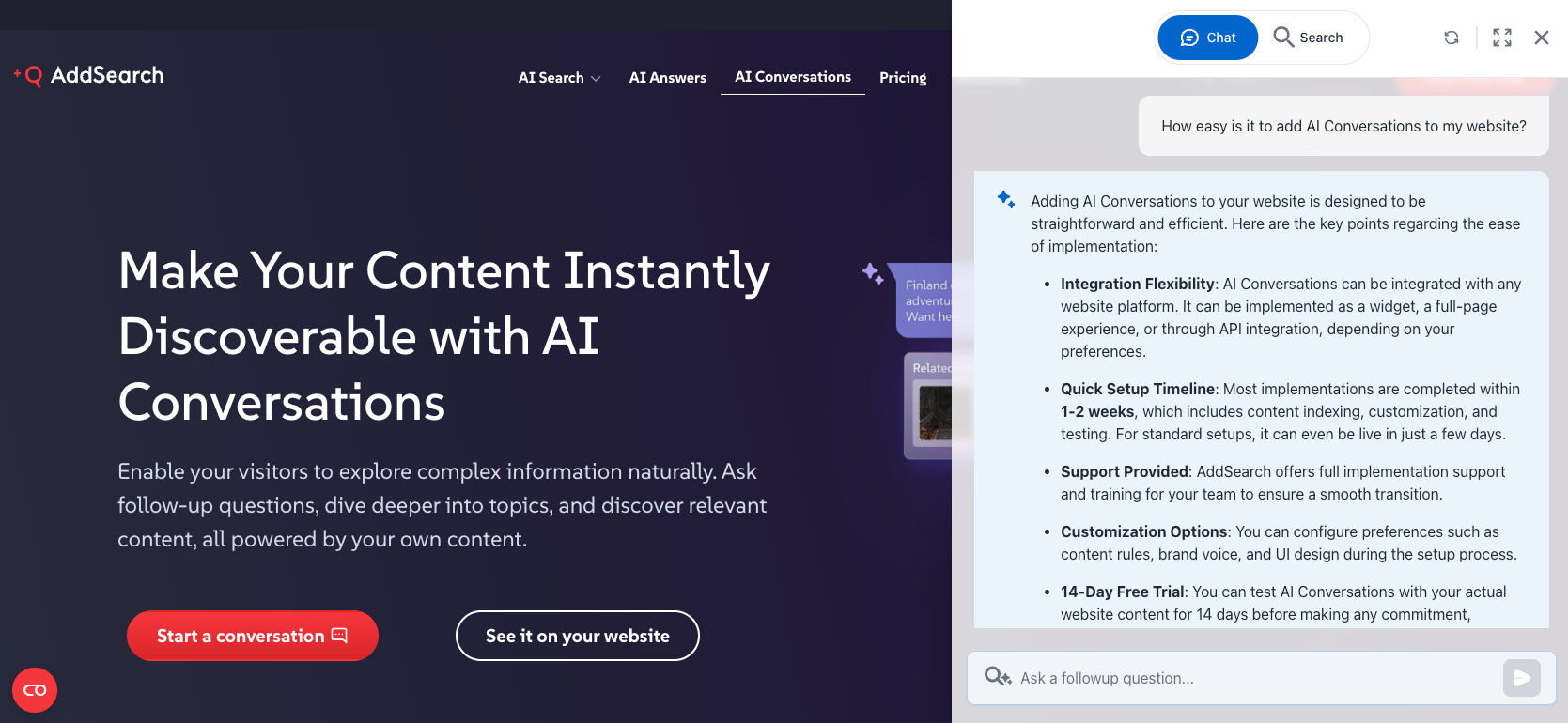
Source: AddSearch website
AI Conversations is ideal for content-heavy websites, surfacing a clean UI for natural, conversational interaction. You can also toggle seamlessly between conversational and traditional search interfaces. It doesn’t require a site rebuild or fancy refactor, and you can be live in days with technical support and fast setup for any CMS via AddSearch’s Crawler or API.
For marketers, site search continues to be a vital part of a well-balanced digital strategy. According to Segmentify, roughly 43% of all retail customers hit the search bar first when they arrive on a site. But as one study suggested, 39% of websites fail to properly support non-product searches. This is where AI can bridge the gap for legacy search experiences.
Even as website visitors shift from keyword searches to asking full questions with AI-powered answers, many websites are struggling to keep up. This is where AddSearch’s AI Conversations is helping brands and organizations accelerate the modernization of their website search and content discovery.

AddSearch CEO Helena Rebane. Source: LinkedIn
I recently caught up with AddSearch’s CEO, Helena Rebane. She's been in the pilot's chair for over five years, navigating the company through the bright horizons and stormy skies of generative AI. She explained why this next chapter with AI Conversations is a game-changer – not just for the market, but for her company's trajectory.
Why traditional search feels ‘broken’
Since 2013, AddSearch has worked at the edge of the search field, studying how user behavior influences expectations. The rise of conversational AI is now repositioning the baseline.
“We’ve always seen that whatever search behavior is happening with Google or different search platforms, it influences what people expect to happen on websites,” she said. “This is what is happening with AI as well. And such behaviors are changing with conversational AI, and this is now what users are increasingly expecting on websites.”
Arguably, websites have evolved. But what’s really changing is the consumer’s search behavior. Thanks to ChatGPT and Gemini, relying on keywords has become passé, and more users have become accustomed to dumping detailed questions into chatbot fields and expecting context-aware answers.
Now they expect it from search, and when it’s not there, it could be a signal that a site isn’t as modern as its competitors.
“The traffic that we get on websites is increasingly coming from ChatGPT and similar platforms,” Helena said. “We assume that when they are using these kinds of tools, and they come on a website, they want to continue to have the same kind of experience. If you have a very outdated keyword search on your website, then the whole website experience suddenly feels very outdated.”
“We’ve always seen that whatever search behavior is happening with Google or different search platforms, it influences what people expect to happen on websites. This is what is happening with AI as well.”
This is why the search experience feels broken – creating friction, slower discovery, and missed opportunities to engage visitors. At the same time, Helena pointed out the compounding effects of zero‑click searches and AI answer engines, which are changing the value perception of site search.
“There’s a big change happening for websites, because in addition to what they see with their site search behavior, they also see this massive decrease in traffic to websites overall,” she explained. “I think this is a big signal, and website owners are saying, ‘Hey, there’s a lot of change happening, and we need to do something. What are the options?'"
As Helena told me, evolving site search could be a salve for battling engagement erosion, and it provides some connective tissue to the broader AI motion. She still thinks we’re in an early adoption phase – and that many companies might miss the boat and struggle to catch up.
This is where AddSearch’s AI Conversations can close the gap, bringing conversational content discovery directly into an organization’s website. It also addresses the long-standing challenge of fragmented web content by consolidating information from multiple pages and sections into actionable responses.
Turning questions into clear answers and insights
As mentioned, the central benefit of focusing AI Conversations on a company’s sovereign website content is trust. Visitors get consistent, on-brand answers instead of weirdly hallucinated replies or grossly inaccurate third-party information.
But Helena noted how this technology is also providing greater visibility into content gaps and quality issues – and that knowledge is invaluable when it comes to understanding customer behavior and optimizing performance.
“Even if you’re not interested in improving your own site search experience, then one of the ways you can use these kinds of tools on your website is to see what people are asking about your products,” she said. “You can review every question people have asked in a search session, and you can see every answer AI provided.”
Bingo. With a RAG approach like this, you know exactly what the source is. That means if you have wrong or outdated content, then your AI answers will be based on that. Not only does this allow you to improve your site search results, but the insight extends into the realm of the answer engines – which are indexing your site content to arm their results.
“You can assume that if your site search gives you the wrong answer based on your website content, then it’s likely that ChatGPT will do the same,” Helena reinforced. “So it could harm your business beyond just your website. So using these tools is a great opportunity to become aware of these problems and fix them.”
In other words, AI Conversations doesn’t just modernize search – it becomes a feedback loop for optimizing your content strategy and brand accuracy.
‘Landing and expanding’ with CMSs and agencies
Rather than tying conversational search to a single platform, AddSearch built AI Conversations to sit cleanly on top of existing digital experience stacks. This includes the all-important content authority of a CMS as a foundational layer.
“We work with any CMS as an agnostic solution,” Helena said, “and we have integrations to WordPress and Shopify as well.”
As a channel conduit, agencies have also been part of AddSearch’s delivery. As enterprises increasingly rely on their agency partners to translate the value and select the best technologies to enhance their websites, AddSearch is emerging as a scalable, performant, and reliable solution.
“We work very closely with digital and marketing agencies all over the world, and there’s been a lot of interest from them,” Helena explained. “Many organizations know that they need to do something, but they don’t know what. And usually that’s when you turn to consultants, right? We also work with agencies that are doing background research to find the best solutions for the customers they represent. The response we hear is that there’s a lot of eagerness to find solutions that will improve the website experience.”
AddSearch also offers an agency partner program, which focuses on supporting the entire lifecycle from sales to implementation to optimization.
From answers to actions: ROI, agents, and security
Helena was clear that the next evolutionary step for AI and websites will be measured not just in user satisfaction, but in delivering tangible business outcomes.
“We see several things happening, but the first thing is that organizations are looking for ROI,” she said. “This is something that we’re also focusing on by helping our customers win business with our solutions. It’s about monetization of the conversational tools. So being able to drive business and track ROI is definitely a big deal on all sides.”
I asked Helena how the emergence of AI agents is potentially shifting the trajectory. As she said, AddSearch’s focus is leading naturally into more agentic experiences, where their AI experiences don’t just answer questions, but they help visitors accomplish tasks.
“We’re focused on agentic behavior that’s not just giving you answers, but actually doing things for you,” she responded. “Maybe you want to get something done when you visit a website, or as a website owner, you want to automate tasks that assist your visitors. That’s something that’s going to grow a lot, and we’re going to focus on that as well.”
Underpinning all of this is a strong emphasis on trust and transparency, specifically as it relates to the all-important questions of security and data privacy. AddSearch already meets SOC 2 certification, emphasizing its dedication to maintaining fierce data protection standards.
Helena doesn’t want security to be a black box. To that end, she advocates for greater transparency – particularly as AI transforms application architectures and the underlying infrastructure.
“We’re putting further emphasis on security and showing the customer the security part a little more, because we see that this is a huge concern,” Helena said. “How is my data being used? How is AI still providing the right answers? We want to provide as much transparency about this and give customers confidence that their information is being used properly – and that AI can be relied on with their website.”
Pricing
AddSearch is solid SaaS, and as I said, relatively easy to add to any site or CMS. I won’t say it’s the easiest (vis-à-vis “one-line” JavaScript solutions), so you’ll need to engage with their technical team on the details. But they stand by having you up and running quickly – within 1-2 weeks, or in many cases, just a couple of days.
I like the clear pricing that AddSearch provides for its search product, which effectively scales based on features. It starts with Core at $119/month and elevates to Growth at $299/month. There’s also an Advanced plan for more robust sites, which includes a custom search UI, SLA, and content and product recommendations. That runs for $599/month.
AI Answers has a starting price of $8,400/year, and AI Conversations currently has no price guidance. You’ll need to connect with their sales team for a demo to inquire about custom pricing, but the AI Answer baseline should give you an idea of what to expect.
The verdict
AI-powered website search and discovery is a no-brainer – and an easy win to enhance any website. As consumers drift toward AI answer engines like ChatGPT and Perplexity, having a congruous experience on your own site will help meet modern expectations, reduce friction, and ultimately drive more conversions.
AddSearch’s AI Conversations provides dynamite value with its conversational context. This is a big advantage, as it enables website visitors to ask follow-up questions, seek clarification, and explore topics naturally without starting over.
The players in the site search category are expanding, and I’ve been tracking several vendors with solid solutions. Some of the core features are becoming more commoditized, and all offer analytics and other goodies to sweeten the search experience.
AI is clearly the game-changer, so tune into how it's being harnessed, where your data lives, and the level of visibility and observability a platform provides. You'll also want to inquire about the agentic roadmap and what kind of automation is available and forthcoming. For example, executing adjustments based on specific analytics results or optimizing an aspect of search criteria via an agent workflow could be great use cases.
There are standout reasons to select specific vendors – particularly around considerations like scalability, compliance, and off-the-shelf CMS or DXP integrations that are sometimes available as a co-sell. These are factors to pay attention to when evaluating options.
My recommendation:
AddSearch has been around the block, giving them more market insight around search experience. They have a proven track record and solid market footprint – and happy customers based on their G2 Reviews. I tend to highlight the “Best Support” and “Best ROI” as true examples of how a product earns its keep.
AI Conversations specifically offers a lot of flexibility. It integrates with any CMS platform and can be implemented as a widget, full-page experience, or via API integration based on your UX goals. It's designed to work on any website, regardless of your site search provider tool. If you want to have AI Conversations as your chat-to-search functionality within the widget, then you'll need to utilize AddSearch as your search provider.
If you’re considering an upgrade to your website search (which, if you haven’t yet, you should), this is a great product that delivers real value. I highly recommend a demo – and add it to your shortlist.
Upcoming Events

JoomlaDay USA 2026
April 29 - May 2, 2026 – Delray Beach, Florida
Be part of the Joomla community in one of the most iconic cities in the world! JoomlaDay USA 2026 is coming to Delray Beach, and you can join us for a dynamic event packed with insights, workshops, and networking opportunities. Learn from top Joomla experts and developers offering valuable insights and real-world solutions. Participate in interactive workshops and sessions and enhance your skills in Joomla management, development, design, and more. And connect with fellow Joomla enthusiasts, developers, and professionals from across the world. Book your seats today.
CMS Summit 26
May 12-13, 2026 – Frankfurt, Germany
The best conferences create space for honest, experience-based conversations. Not sales pitches. Not hype. Just thoughtful exchanges between people who spend their days designing, building, running, and evolving digital experiences. CMS Summit brings together people who share real stories from their work and platforms and who are interested in learning from each other on how to make things better. Over two days in Frankfurt, you can expect practitioner-led talks grounded in experience, conversations about trade-offs, constraints, and decisions, and time to compare notes with peers facing similar challenges. Space is limited for this exclusive event, so book your seats today.

Umbraco Codegarden 2026
June 10–11, 2026 – Copenhagen, DK
Join us in Copenhagen (or online) for the biggest Umbraco conference in the world – two full days of learning, genuine conversations, and the kind of inspiration that brings business leaders, developers, and digital creators together. Codegarden 2026 is packed with both business and tech content, from deep-dive workshops and advanced sessions to real-world case studies and strategy talks. You’ll leave with ideas, strategies, and knowledge you can put into practice immediately. Book your tickets today.
Open Source CMS 26
October 20–21, 2026 – Utrecht, Netherlands
Join us for the first annual edition of our prestigious international conference dedicated to making open source CMS better. This event is already being called the “missing gathering place” for the open source CMS community – an international conference with confirmed participants from Europe and North America. Be part of a friendly mix of digital leaders from notable open source CMS projects, agencies, even a few industry analysts who get together to learn, network, and talk about what really matters when it comes to creating better open source CMS projects right now and for the foreseeable future. Book your tickets today.