AI is eating clicks. But is it feeding the funnel?

The “clickpocalypse” has become dystopian shorthand for AI’s devouring of search, leaving publishers and brands starved for clicks. But new data from Scrunch suggests that the story gets more complicated – and a whole lot weirder – as AI suppresses clicks in one place and influences visits in another. What’s really going on here? And how can marketers adapt to this new reality?
Every Thanksgiving, my father – our family’s resident storyteller and spinner of fish tales – revisits his 2011 trip to Brazil over a zesty slice of key lime pie.
My favorite chapter takes place in the Amazon Basin, where he and an intrepid crew of tourists venture through the densely majestic canopy to Lago da Piranha. This freshwater lake is a hidden gem, but it's also home to the world’s unfriendliest denizens of the deep.
There’s video from the outing, and I think our paternally-carved turkey reminds him of a raw chicken being lowered into the darkly calming waters, where he and his group witness a little carnage.
Tethered to some high-test fishing wire, the bird descends just below the surface of the lake. There's a scuffle. The water roils. Minutes later, the chicken is pulled back up – or what’s left of it.
This snippet from River Monsters will give you an idea of what went down:
Right now, AI is eating clicks like the residents of Piranha Lake. It’s been vicious. The rise of Google’s AI Overviews and the proliferation of zero-click searches have decimated website traffic – and publishers have been hit the hardest by this shift.
I won’t revisit all the gory details. There's plenty of data about AI answers replacing blue links and rewriting the search experience. Some sites are fighting AI companies in court, others are building partnerships and trying to adapt to the new normal. Either way, swimming in this lake is treacherous, and it feels more like treading water in a red, chum-filled sea.
I just read Michael Ianelli’s dynamite article about surviving this “clickpocalypse,” and it was every bit as harrowing as that chicken being lowered into the darkness. As the principal data scientist at Scrunch (now a Sitecore company), he’s working on the front lines of this existential shift for brands.
He and his team did a deep dive into AI’s impact on human visits to news and publishing sites, analyzing millions of events between February and June of this year. This was done via an opt-in panel connecting anonymized AI conversations, Google searches, and publisher visits.
What did they find? Well, in a word, weirdness. Yes, AI is devouring traffic – ferociously. But it’s also eating clicks in one place and returning visits in another.
I found this revelation compelling, but it also exposed a bigger problem for marketers: conventional analytics can identify the last stop before a visit, but not necessarily the first source of influence. In other words, we’re back to chasing the shadow of attribution.
I spent time reviewing this data, and I have a few reflections on what stands out and how we might adapt to it. One thing is clear: marketers are swimming with uncertainty. And it really bites.
Crunching the impact of AI Overviews
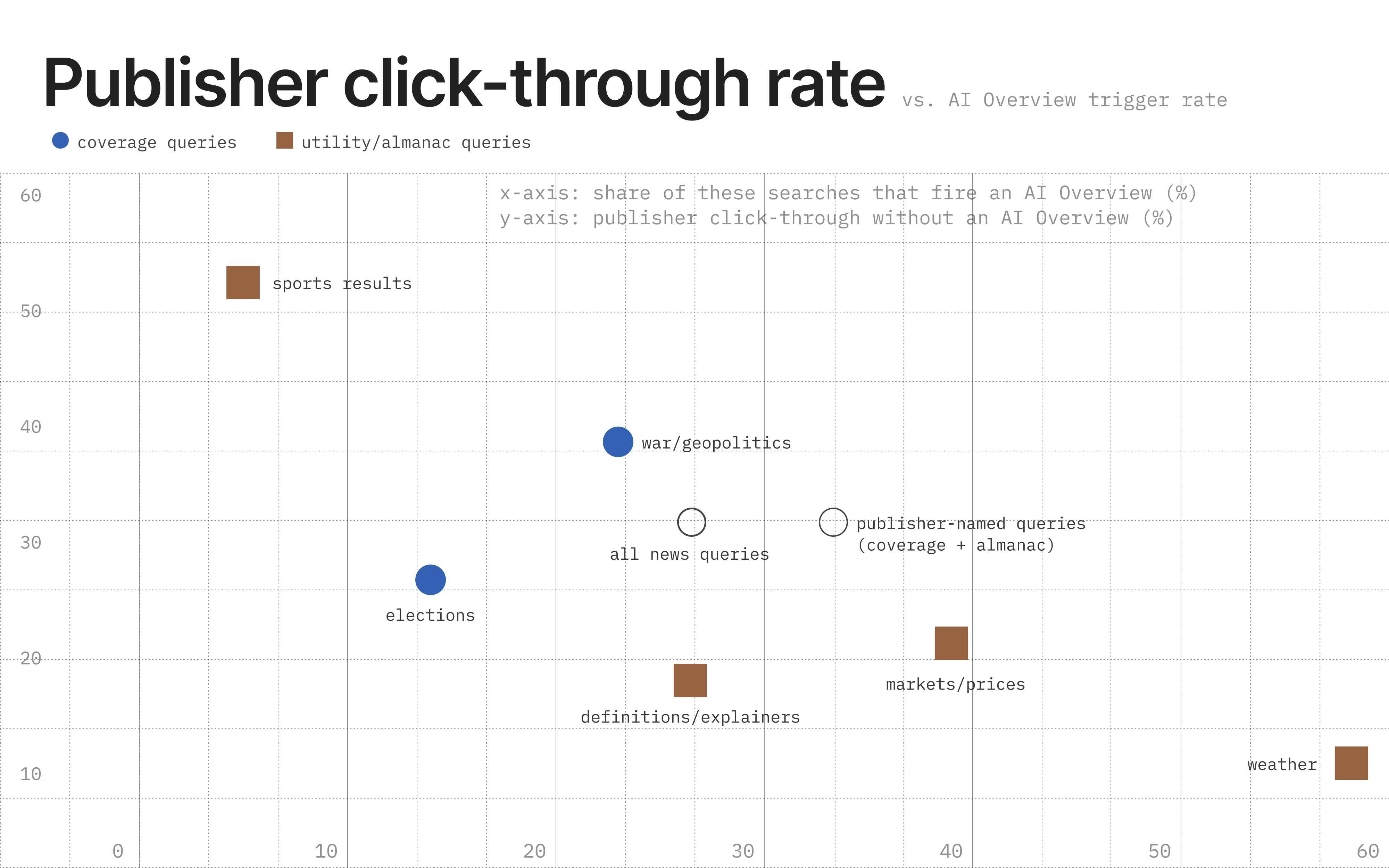
One of the first revelations in the research is perhaps the most profound: news searches with an AI Overview (AIO) convert to a publisher click roughly 20% of the time, versus 30% without one. As Michael suggests, that 10-point gap is the basis for this whole “clickpocalypse” narrative.
But when Scrunch compared the same query appearing with and without an AIO, the difference shrank to around two percentage points. That’s awfully close to zero. In other words, Google isn’t so much reducing the clicks as deploying AIOs in searches where they were already sparse.
Some other juicy nuggets surfaced in the research. For example, across news searches, AIOs appear roughly one time in four. But with low-value "almanac" queries – commodities like weather, market prices, definitions, and explainers – it’s much higher.
Source: Scrunch
But here’s the rub: these all had relatively low CTRs to begin with. Weather, for instance, had a 59% AIO rate, but only a 13% CTR when no generative overlay was present.
Interestingly, searches about war and geopolitical topics hold the middle ground. A currently popular topic like elections, for example, gets an AIO 14% of the time, with a 26% CTR. Sports is a bit more anomalous; it's an almanac entry that only gets an AIO about 5% of the time. But it also appreciates 53% of publisher clicks without an AI overlay.
This can feel like a lot to process, but the through line is reasonably clear. AI Overviews can reduce clicks on an individual search, but the gap is also influenced by the kinds of queries on which Google chooses to display them.
We’re strangers in a strange land. Or… a piranha-infested lake.
AI referral traffic tells only part of the story
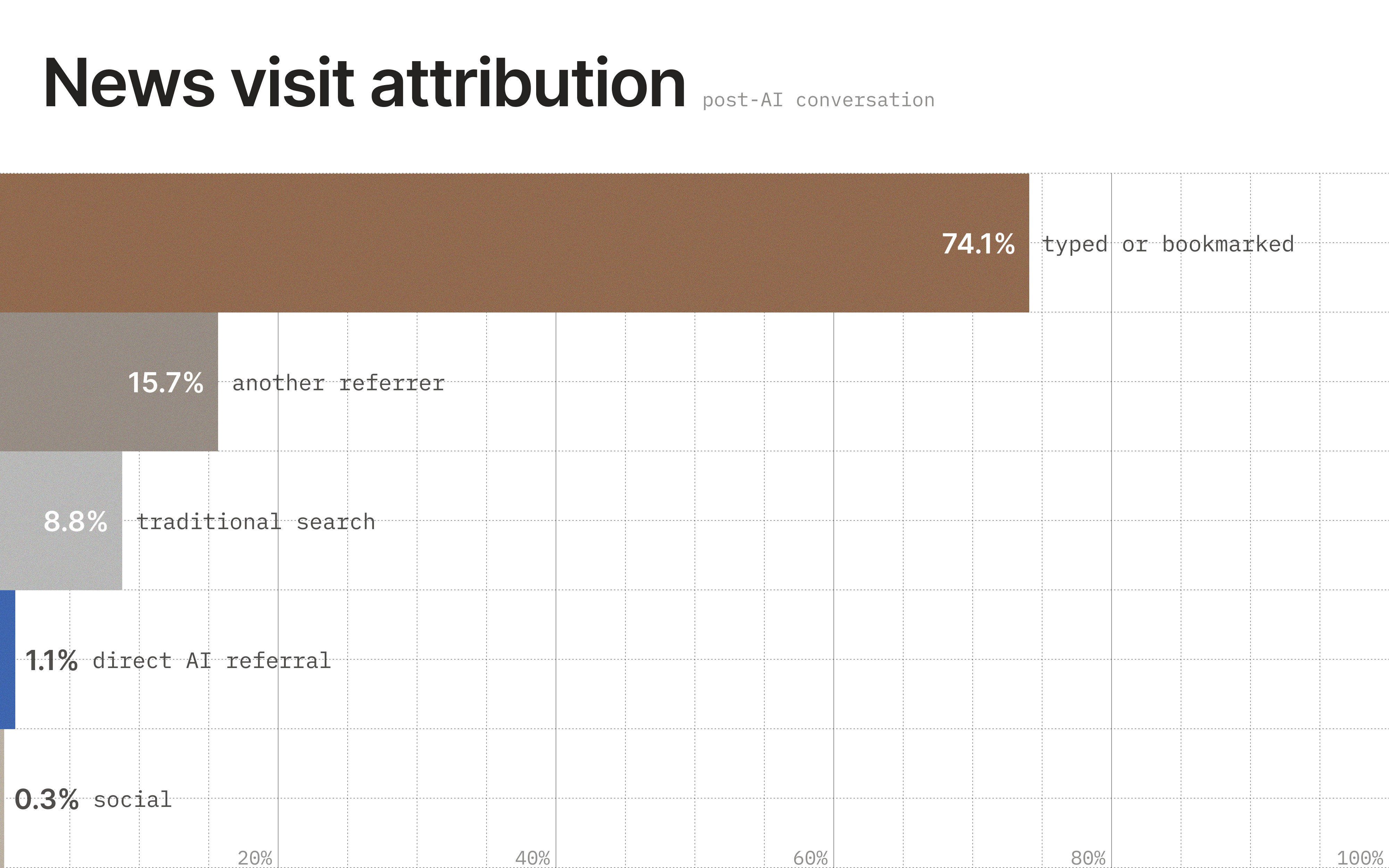
And this is an important point. According to Scrunch, only 1.1% of the news site visits that followed an AI conversation carried a direct AI referral. Meanwhile, roughly three-quarters of the traffic arrived via direct navigation, with the rest coming from traditional search and referrals.
So what about that 98.9%? Is it a result of AI?
Source: Scrunch
Not so fast. Referral analytics record the immediately preceding source, but not everything that shaped the decision. AI influence can disappear when someone later searches for a brand, enters its URL, uses a bookmark, or visits through another platform. As a result, traffic influenced by AI may be incorrectly credited.
This is clearly an attribution blind spot. AI referral traffic measures delivery, but it doesn’t necessarily measure influence. It’s a real hardship for publishers, as modern referral dashboards simply can’t tell you if AI shaped a later search or a direct visit.
AI search may be feeding an invisible marketing funnel
While it might not be altogether shocking, Scrunch discovered that when readers engage on a news topic with an AI assistant, they visit more news sites the following week. In fact, after comparing each reader against their own behavior (news versus non-news conversations), people are 20.5 percentage points more likely to visit a news site after talking to AI about news.
As Michael says, the conversational AI story isn't that AI answers have completely replaced publishers – it's that the answer often becomes one step inside a larger news journey, one that doesn’t necessarily end on the open web. The problem is that conventional analytics can’t fully visualize this.
There’s a key “causality caveat” here. Someone discussing news with an AI assistant already has an implied interest in the topic, and the research doesn’t prove that AI generated entirely new demand. What it does show is that AI conversations and subsequent website activity can be connected even when referral analytics can’t see that connection.
And herein lies the challenge: AI may be eating the visible click while still feeding parts of the funnel marketers can’t see.
Brand strength matters
There are some revealing metrics in the research about which news publishers are capturing readers after an AI conversation. It’s worth perusing the associations that Scrunch uncovered – particularly where a news site is or isn’t mentioned in a prompt and whether a reader was already likely to visit that news site.
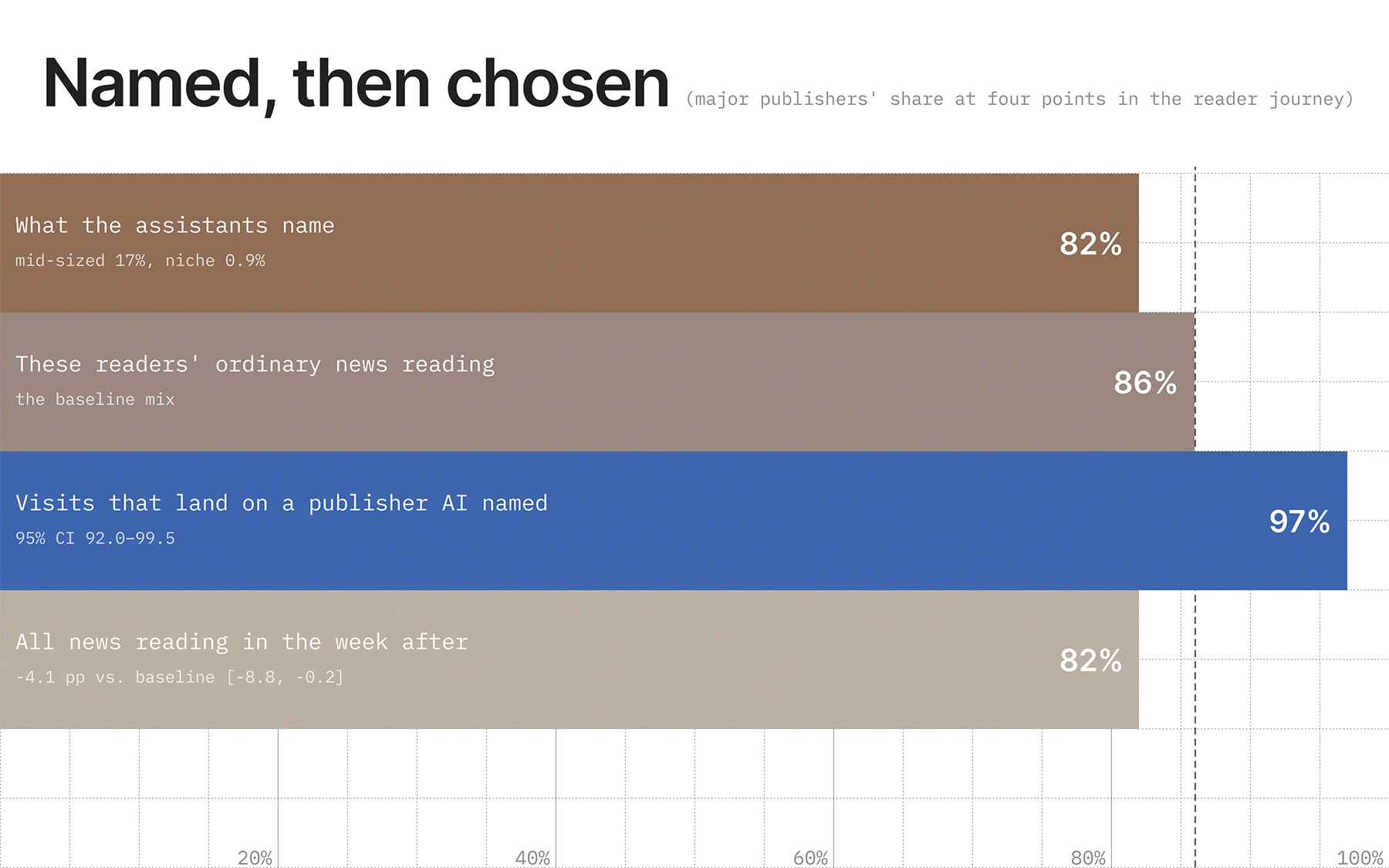
What stood out for me was this: being named by AI isn’t the same as being chosen by a reader. That plays out in the data. According to Scrunch, major publishers make up 82% of the names that AI assistants deliver. 17% are mid-sized, and just 1% are niche.
Source: Scrunch
But here’s the deal: of the visits that land on a named news site, 97% are major publishers. Mid-sized brands are getting decent exposure, but readers simply aren’t choosing them. A week later, those same big players see a 22.9% lift in site visits. Mid-size, a little less than 9%.
Bottom line? Brand strength is the bomb. Readers are choosing news outlets they recognize or have familiarity with. Add existing preferences, perceived authority and trust, or even paywall access they’ve already procured, and major publishers win out.
What should marketers and brands focus on?
Scrunch offers some sage advice for surviving this “clickpocalypse,” and it applies to publishers and non-publishers alike. As Michael observes, the general rule is that AI exposure doesn’t necessarily look like AI traffic. Write that on a Post-it and stick it to your screen.
Marketers are in a bind when it comes to AI referrals and attribution. A news site or product can get mentioned or recommended in an answer, but a consumer might show up a week later through direct navigation or traditional search. We can’t count on an attribution dashboard to connect the dots.
There’s no back door for controlling the answer engines. The best shot a brand has is through influence – and this is where an AEO (Answer Engine Optimization) platform can provide deeper intelligence.
Tools like Scrunch provide detailed recommendations for enhancing answer position, but they also enable marketers to measure brand mentions, track citations, gauge sentiment, and monitor an influence score. Most importantly, they shed light on the “why” and enable marketers to take real action.
If this research tells us anything, it’s that being mentioned in AI isn’t the same as being chosen. While it’s increasingly clear that AI recommendations can have a direct impact on how likely someone is to search for your products or visit your site, brand presence is the most important metric. Consumers make decisions based on credibility, reputation, and recognition across channels – so brands need to keep a watchful eye on more than AI.
What you should expect from your CMS
A big part of the AI visibility equation rests with your website’s content posture – and that waterfalls to the CMS. If it's worth its salt, your platform should help you control and maintain optimal structure and performance. In fact, some tools already provide a layer of AEO and GEO (Generative Engine Optimization) readiness out of the box, helping marketers stay on point.
First and foremost, audit the content in your CMS to ensure that you’ve addressed any outdated, contradictory, or incomplete information. The trouble with content debt is that it isn’t always visible, but AI has a way of finding it. The new breed of agentic CMS is making these audit sprints more efficient while streamlining the remediation.
Along with governing a foundational content model and maintaining a source of truth across websites and channels, a modern CMS should allow specific content to be accessible to LLM crawlers and bots based on your internal policies (for example, gated publisher models might block certain pages). It should also support schema and machine-readable metadata without a lot of heavy lifting.
Connecting your content performance with your analytics is going to be key. Some platforms have on-board visualization, but AEO platforms are aligning AI citations with the content assets that help influence them. Having this insight is becoming a non-negotiable.
Why it matters
I wouldn’t recommend swimming in Lago de Piranha, but it’s comforting to know that these fish don’t generally attack humans. So we’re safe. For now.
It’s true: AI is consuming traffic clean off the bone. But as Scrunch’s data points out, there’s more to the story than just a feeding frenzy. AI is shifting clicks, redistributing them based on different variables. Despite this phenomenon, AI is also driving demand – and the brands that show up in AI answers are best positioned to win.
This whole chapter of AI transformation is frustrating for marketers. Yes, agents are unlocking a world of productivity. But the game has changed. While attribution has always been a challenge, we're in unknown territory, wrestling with new tools and new thinking. Google might not be sold on AEO as a separate discipline outside of search, but marketers are full speed ahead on adopting it.
Whether you’re a news site or an e-commerce shop, AI needs to be able to understand you. That means getting your content house in top shape for the growing audience of agents that are visiting your site. But what people do after your brand is surfaced – whether they visit you next week or next month or via different routes – relies on your overall brand presence.
That’s why building credibility, trust, and recognition in other channels is essential to surviving the “clickpocalypse.” So stay vigilant. Embrace the strategies and improve your odds. Gain actionable insight from reputable tools.
And don’t get eaten.
Upcoming Events
Open Source CMS 26
October 20–21, 2026 – Utrecht, Netherlands
Join us for the first annual edition of our prestigious international conference dedicated to making open source CMS better. This event is already being called the “missing gathering place” for the open source CMS community – an international conference with confirmed participants from Europe and North America. Be part of a friendly mix of digital leaders from notable open source CMS projects, agencies, even a few industry analysts who get together to learn, network, and talk about what really matters when it comes to creating better open source CMS projects right now and for the foreseeable future. Book your tickets today.

Storyblok JoyConf 2026
October 28 - 29, Rheingoldhalle, Mainz (Frankfurt)
JoyConf 2026 is where developers, marketers, and digital innovators come together from all around the world, united by one powerful idea: great content isn’t built by tools alone – it’s built by people who rely on systems to deliver their best work to the world. In an era where technology is increasingly shaped by AI, Content Confidence becomes your competitive advantage. When you can create, manage, and scale content that performs seamlessly across channels, platforms, and AI, you don’t just keep up – you win. Book your seats today.
Sitecore Symposium 2026
November 10 - 12, Orlando, Florida
Welcome to “Marketing Rewired” at Sitecore Symposium 2026! Sitecore's annual flagship global conference brings together customers, partners, developers, marketers, and digital experience leaders to explore the latest innovations in digital experience, content management, AI, personalization, and customer engagement. This year's event features keynote presentations from Sitecore executives and industry experts, product announcements, hands-on learning, technical sessions, customer success stories, and networking opportunities focused on helping organizations build more intelligent, connected, and AI-powered digital experiences. Book your seats today.