‘Crunch Time’ for AI Visibility: Sitecore’s Acquisition of Scrunch Gives Brands an Edge Beyond AEO


The industry-leading DXP just added the power of an AI search and visibility platform to its ecosystem, providing brands with actionable recommendations and content optimization for AI agents – all connected to Sitecore’s workflows. Is this the answer to the answer engines? Interview with Sitecore CEO Eric Stine and Scrunch CEO/Cofounder Chris Andrew.
“Your site isn’t built for AI.”
That’s one of the first structurally sound H2s you’ll read with your human eyes on the Scrunch homepage – which, as of this week, is now a Sitecore company. More on that in a minute.
If you’re feeling a little FOMO on the AI thing, you’re not alone. Most of what’s running on the interwebs wasn’t conceived with a machine or agent experience in mind. Good for humans, sure. Not for bots.
As for those bots? Oh baby. They’ve been doing some heavy lifting – on the Schwarzenegger spectrum. This week, Cloudflare CEO Matthew Prince posted that, for the first time in the internet’s history, they’re generating more web traffic than people.
You read that right. According to the CDN’s Radar dashboard, bots now represent almost 60% of all HTTP requests to HTML content. Humans chime in at just over 40%. Forbes pointed out that Prince had predicted this crossover by the end of 2027.
We’re a year and a half early.
To say that website audiences have evolved is an understatement. This was the core thesis in Scott Liewehr’s recent Guest Critic article, where he explained why we’re not writing with machines in mind. And with this switcheroo in traffic, any brand that’s not giving the bots what they need is at risk of being invisible.
Why? Because the primary job of these automated armies is to serve the answer engines. You know them well: ChatGPT. Google AI Overviews. Perplexity.
This is “The New Web,” where consumers are increasingly searching and discovering. Instead of hitting your site, they’re shifting more of the buying cycle to a place where blue links are an artifact of that old, manual jalopy that’s rusting on concrete blocks in the tall grass of time.
AI-generated answers are influencing brand perception in a big way. Consumers are researching, comparing, and deciding what products and services deserve their dollars. In response, the engines are deciding what offers will surface, which competitors get mentioned, and the types of sources that are being cited.
As a result, by the time buyers reach your site, they’ve already formed an opinion. But they might not get there at all. This seismic shift has created a nosedive in website traffic, and brands are feeling the “zero click” crisis on an existential level. In the publishing industry, there have been reports of up to a 90% decrease attributed to Google’s AI Overviews.
That’s a crunch. And this is where Scrunch has been a salve to the wounds.
Like its peers in this emerging space of AI search and discovery, it’s a relative newcomer – but a potent one. Launched in 2023, it’s made huge strides in delivering solutions for enterprises and agencies like Paychex and Publicis.
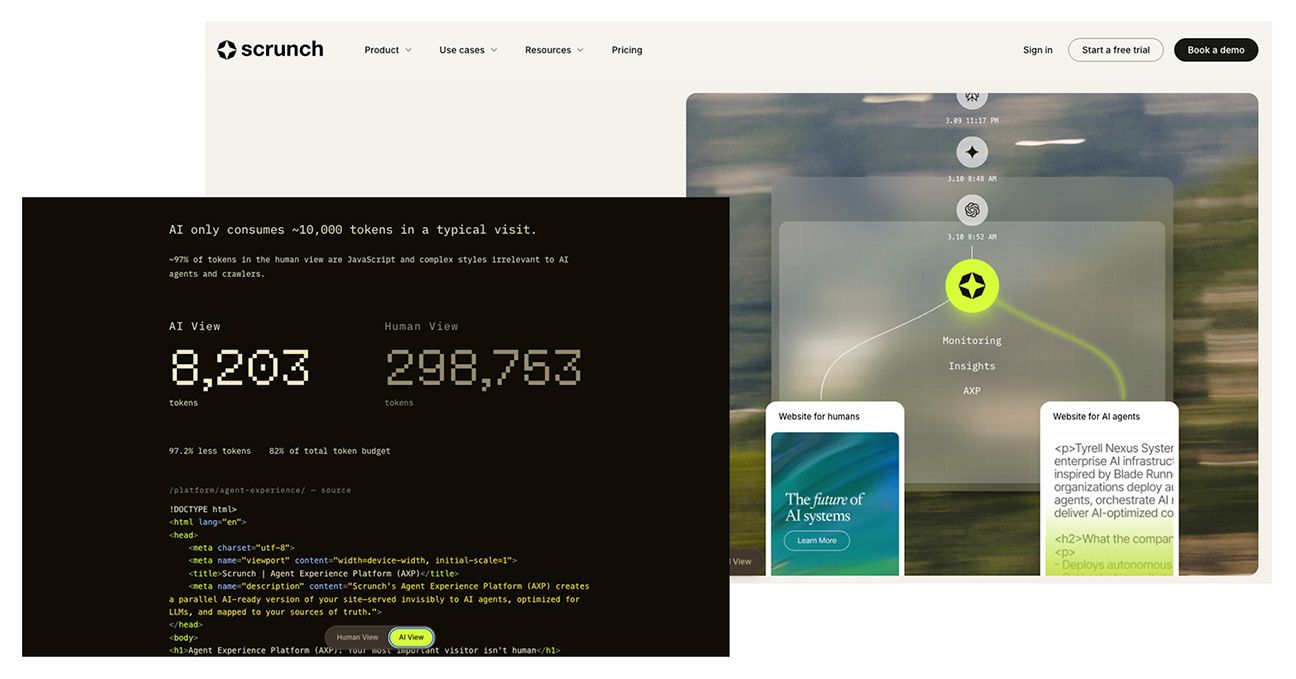
Scrunch's website provides a toggle between human and AI views. Source: Scrunch website
Scrunch has many of the features that standalone AEO (Answer Engine Optimization) tools offer, like brand monitoring and visibility intelligence for citations. But the secret sauce is its Agent Experience Platform (AXP), which detects agents and delivers content that’s formatted for LLMs in a way that AI agents can read and understand.
AXP “scrunches” your website for AI traffic, giving bots the right stuff without compromising the vital human experience that still inspires visitors to engage and convert. It also helps to identify places where AI agents might get tripped up, like underperforming pages that can’t be crawled properly.
What’s awesome about Scrunch is that it makes the response more actionable, providing tangible recommendations to any issues it uncovers. And it’s been delivering real outcomes: Akamai’s Senior Director of Web Strategy Operations Jessie Dawson said that Scrunch has helped them ensure high-intent buyers find and choose them in AI search – and they’ve seen a whopping 364% increase in visibility in non-branded (meaning no mention of Akamai) prompts.
That clearly influenced Sitecore’s decision to acquire Scrunch. Brands need to move from insight to action, and marketers have the challenging job of translating the toolscape to create and curate the right content that can be interpreted by LLMs – and deliver personalized CX from discovery to decision.
Sitecore’s competitors have been advancing their own native AEO and GEO (Generative Engine Optimization) capabilities. In some cases, it’s been a build; in others, a buy. Sitecore went shopping, but there was more to this decision than simply adding an AEO or GEO utility to its ecosystem. And that’s where Scrunch is presenting some enterprise-grade advantages.

(Left to right) Sitecore CEO Eric Stine and Scrunch CEO and Cofounder Chris Andrew. Source: LinkedIn
To mine the answers, I sat down with CEO Eric Stine and Scrunch’s CEO and Cofounder Chris Andrew to explore why this match made sense, and how it positions marketers and brands to win in this AI visibility “crunch time.”
AI Answer Engines: The New Battlefield for Brands
We’ve been talking a lot about AI visibility and the burgeoning field of AEO on both CMS Critic and The Matt & Matt Show. The fact is, it’s still nascent and amorphous.
That’s not just my opinion. At recent events, I’ve run into digital professionals who have never heard of it – or are confused by what it is. You might say they’ve been living under an LLM rock, but our “martech bubble” is also a real phenomenon.
Despite its elevated awareness in the boardroom, where CMOs and even CEOs are acutely aware of their dying traffic numbers, AEO isn’t SEO. Indeed, many of the tenets of traditional search engine optimization are inherent in this new frontier. But applying technical structure, clear content, and authority signals isn’t enough to influence the answer engines.
These are new concepts. Marketers are still acquiring the skillset. Enterprises are assembling dedicated teams. Meanwhile, Google is questioning these new categories: in a recent update to its developer docs, the company stated that AEO and its fraternal twin, GEO (Generative Engine Optimization), aren’t concrete disciplines but abstracted constructs that fall under SEO.
A lot of noise and fragmentation. I asked Eric about the semantics, and from his perspective, the value – and the imperative – is presenting itself in consumer behavior.
“Google has really created a nice bridge between an AI platform and the traditional search experience,” he said. “I think it’s great for selling a lower consideration product where your brand already has a certain amount of identity.”
But for higher consideration products, say financial services or insurance – things that fall into a B2B category – Eric said that AI discovery has become more critical. Users want to compare similar offerings across multiple vendors, and they’re forming opinions before they even buy. If your brand isn’t legible to AI, it’s effectively non-existent in these channels.
Chris also views Google as both leading and reacting to this shift. “I see Google’s response as slightly defensive,” he told me. “They are the leader in AI search between Google AI Overviews, Gemini, and they have the most surface areas today. But they’re seeing their customer journey change, and they’re testing. They’re figuring out how to navigate this path as well.”
He’s also clear that no one – not even Google – has a perfect map. “I think it’s important to be humble and say nobody knows the exact path here, including the leader of the last 20 years. But everybody knows consumers prefer this.”
How are brands reacting to all of this? In a word: unevenly. According to a recent analysis, almost 75% of B2B buyers now use AI tools in their research. But only 22% of marketers currently track AI visibility, and only about a quarter plan to develop content specifically for AI citations. That’s not a gap. It’s a chasm.
AEO is being positioned as a defensive post on this battlefield. But for many existing tools, the framework for success is often incomplete. As Eric said, there’s no longer a central search engine that governs everything. What we have, he jokingly described, is an “unholy love child” of search and social media marketing. That’s forced a reckoning with how we approach it.
“Just like you market differently on TikTok than you do on Facebook than you do on LinkedIn,” Eric said, “this requires a different marketing and technical strategy to appeal to consumers.”
Why Scrunch?
In this new AI paradigm, agents don’t just read a single page and decide how to rank it. They create a model – a patina, really – assembled from a range of surfaces.
Because of this, brands need to do more than optimize page content. They need to build a mechanism across multiple channels that both humans and machines can understand. Scrunch supports this by going beyond publicly available websites to surface valuable data across the broader content corpus.
For Sitecore, helping brands understand how AI represents them is one level of value. The other is about taking action – and that action isn’t just “more content.” Enterprises are already wrestling with more than enough (often too much), and as Scrunch says, it’s not built for AI.
This is where the alignment between the two can truly benefit users: Scrunch will provide vital visibility into buyer queries, brand representation, and competitive positioning across the broad landscape of LLMs, identifying the content, source, and delivery opportunities teams can act on to improve how their brand appears in AI answers.
In turn, these recommendations will be automated within SitecoreAI’s Content Management, Content Operations, and Digital Asset Management solutions. Teams will be able to manage and activate clear, current, and contextualized content across web, social, and other digital channels – helping organizations continuously optimize and drive engagement.
“This is not just about marketing, and it’s not just about technology. These platforms are the first new top‑of‑funnel platform that we’ve had in 30 years, and as a result, winners and losers will be created, just like social media created winners and losers, just like the internet itself created winners and losers.”
- Eric Stine
“This is not just about marketing, and it’s not just about technology,” Eric said. “These platforms are the first new top‑of‑funnel platform that we’ve had in 30 years, and as a result, winners and losers will be created, just like social media created winners and losers, just like the internet itself created winners and losers.”
When it comes to the winners, Chris and the Scrunch team have always followed their customers. As he told me, they crave simplicity – and while Google used to be the easiest path for search and discovery, it was also a time vampire.
“As soon as consumers realized we could outsource top‑of‑funnel discovery, the part we don’t like, the whole top of funnel customer journey was scrunched, pun intended,” he said wryly. “We still like to shop and make the final decision. But it’s literally like I’m sending AI out to retrieve millions of assets and synthesize that into a personal response for me.”
If you visit Scrunch’s website, you’ll see some very cool animations of human-readable content automagically transforming into machine-readable templates. This is an important illustration, because it speaks not only to the enterprise scale needed to meet agentic traffic, but also to the efficiencies that properly structured content can deliver in the way of token consumption. And at a time when AI costs are ballooning, this is a critical consideration.
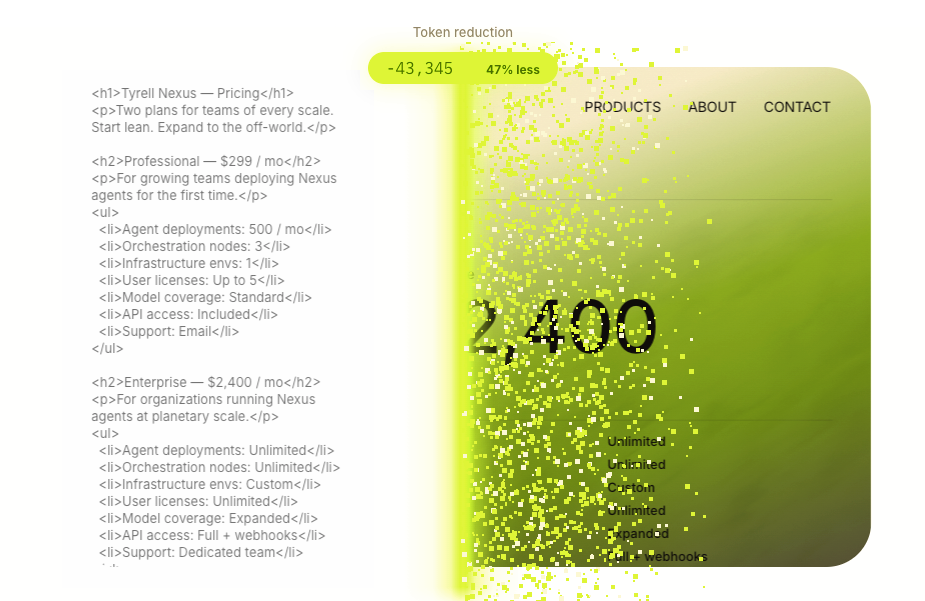
Source: Scrunch website
The projections for agents are staggering. The Wall Street Journal forecasts that within a few years, the average enterprise will have over 150,000 agents “sprawling” in production. Gartner predicts that by 2029, 80% of digital services will be handled by agents; Eric and Chris both agreed that it’s likely to be closer to 95%, leading to new surfaces that are AI brokered.
This compelling growth led Scrunch to focus more on content exposure and unlocking even more knowledge for bots. “We often think, how much does AI understand about your company?” Chris said. “It’s a very small percent of what is on your public website. Behind that is the CMS and the DAM and all these assets that need to be retrievable by AI.”
The work Scrunch is doing with enterprise customers is less about spinning up net‑new copy and more about turning those buried, approved assets into structured, machine‑ready fuel. This is the promise of what it will deliver for Sitecore, its partners, and its customers.
“We’ve seen our customers bringing significant amounts of approved existing content online in formats optimized for AI retrieval and having a massive impact on their presence, their citation rate, and the quality of the answer,” he said. “The consumer of content on the internet is AI on behalf of humans, and we need content to solve that problem.”
For Eric, these technology advantages are key. But what tops his list is meeting customers where they are and preparing them for what’s next. “It’s our obligation as a company that helps brands reach, engage, and serve their audience, to make this a part of our portfolio,” he said. “That’s why we chose Scrunch.”
Turning AI Visibility into Outcomes
I mentioned Akamai’s success with Scrunch and how it achieved a significant leap in brand presence within AI search results. Chris offered a little more context on how they delivered optimized content directly to LLMs to help achieve this lift.
“Akamai partnered with us for monitoring and insights only about a year ago,” he said. “We modeled up what consumers are asking, and then we give them the ability to look at how they’re showing up and where the gaps are. There’s some overlap in the broader AEO/GEO space, but I think doing it in enterprise-grade and enterprise-scale is and will continue to be our differentiator.”
The differentiator sharpens with Scrunch’s Site Maps module, a kind of AI‑first auditing layer. It reveals critical details like what AI is accessing a website, if the intent matches the content, and whether it is technically structured so AI can read it.
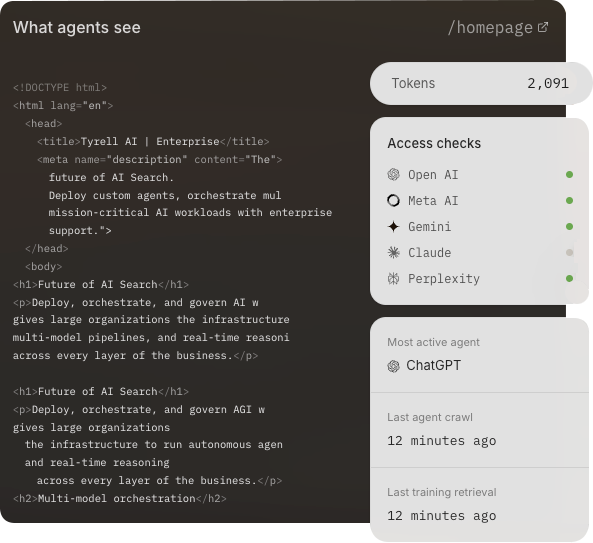
Scrunch’s Site Maps reveal what agents see. Source: Scrunch
By seeing what AI agents uncover, you can identify problems, prioritize fixes, and turn pages into solid sources for AI answers. And because Scrunch can see the path from question to page to answer, it can score every page not just on technical hygiene, but on its real effectiveness for AI agents.
“When an AI model lands on a web page, we can track that, see what it retrieves, and how it responds,” Chris said. “Is it able to answer the likely set of questions? And from there, we score every single page.”
Akamai used those scores as a roadmap, working through Scrunch’s monitoring and insights platform to perform audits and, as he said, “press the optimize button.” That 300% lift in presence is a testament to the page structure that AI needs to retrieve it. The twist is how that optimized experience is delivered selectively to bots.
“When AI visitors are coming into the website, they’re going through the Akamai Bot Manager platform,” he said. “If it’s an AI model that is coming to the website, it gets the optimized version of the website page that we know is structured in the way it wants to retrieve it. When a human comes to that website, there’s zero change.”
The funnel has clearly moved inside AI interfaces, and you can see this firsthand in Scrunch Labs, a skunkworks for the company’s agentic research. One great example is with the high-interest category of GLP-1 products, where data painted a clear picture of AI search archetypes, and how answer engines are engaging retrieval bots throughout the journey.
As Chris told me, the prompts in this study were incredibly revealing.
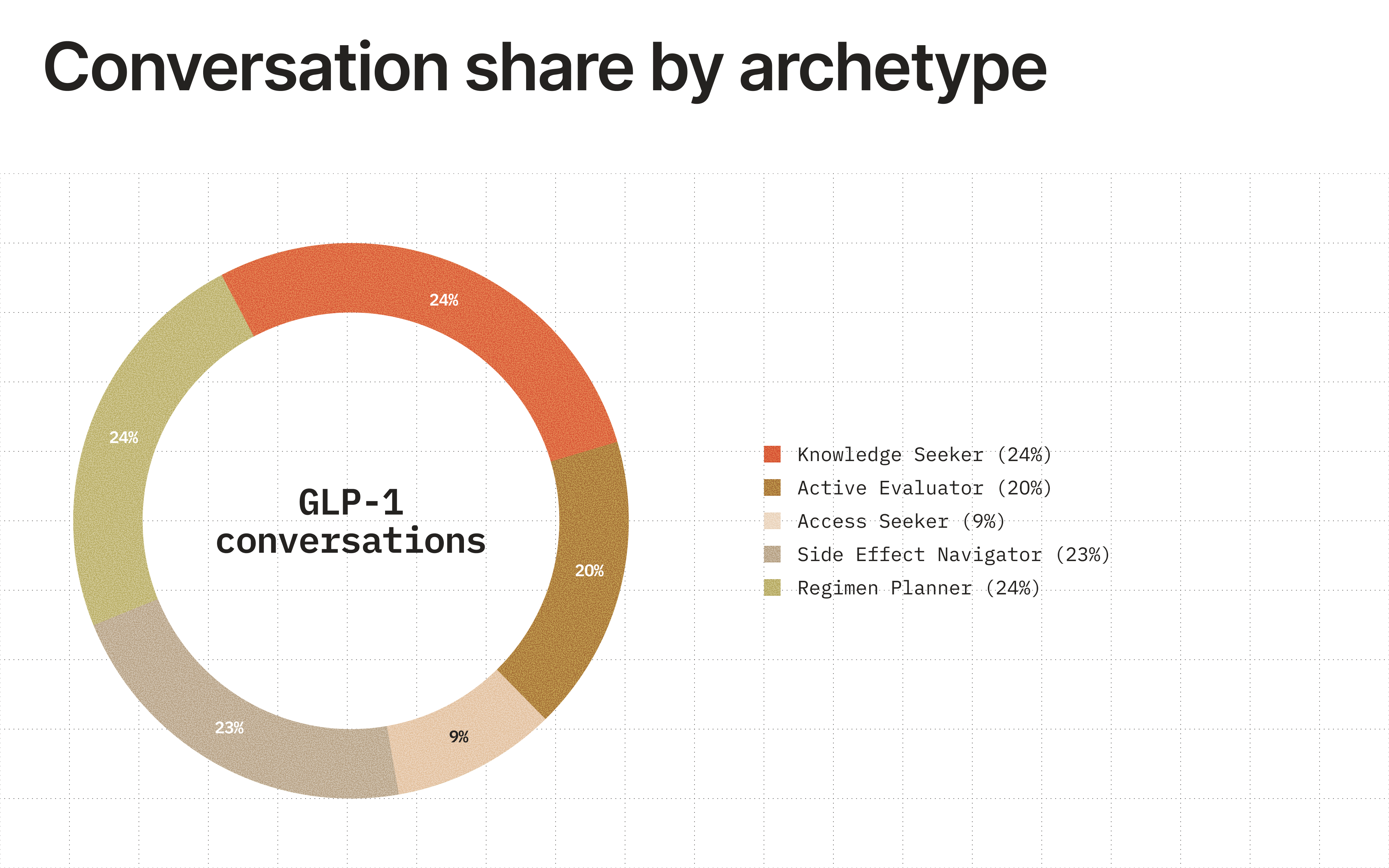
Source: Scrunch website
“About half of the questions were about side effects,” he said. “It was people who are like, I’m going to do this, help me manage and map the side effects. But 10% of the questions were about skin-tightening procedures. That’s a huge opportunity, because I bet that the GLP-1s of the world don’t have the content that the human is looking for.”
Like us, AI doesn’t want to browse the web either. It’s not down to watch your five-minute video or click through your JavaScript toggles. It just wants the data – and that’s what the connection to content in Sitecore can deliver.
“We’re going to have integrations live at the end of June in CMS and end of July with the DAM environment for Sitecore,” Chris said, “and we’ll be able to show immediate improvement, because AI is finally getting the content it needs to answer the question.”
Helping Brands Tell Their Story
Sitecore started as a services shop and evolved into a DXP vendor. That’s been a 25-year journey, but the throughline has always been content – and helping brands tell their story.
“We exist to create great brands that deliver great experiences by helping the marketer reach, engage, and serve their audience,” Eric told me. “That has never been about a format. It’s never been about any specific delivery vehicle, technology, or platform. We’ve always been guided by that mission.”
In Eric’s mind, nothing about the mission has changed in this agentic phase of Sitecore’s arc. But the audience and surfaces have. The bot, not the browser, is the primary consumer. There’s also the question of providing human control at the right points in the system. That’s where Scrunch and Sitecore intersect, pairing a mature governance engine with a new distribution layer.
“For the average enterprise, I can’t press a button and just generate a bunch of AI content,” Chris said. “It dilutes their brand. It’s non‑compliant if they’re in highly regulated spaces. The 25 years of Sitecore expertise on workflows, approvals, compliance, HIPAA, for whatever vertical you may be in, there’s a lot of methodology the marketers put into perfecting what they can put forward. Being able to use that to source information for AI becomes the differentiator.”
I asked Eric what this means for Sitecore as it ushers in a quarter-century of CMS while standing at the precipice of significant AI disruption – where it intends to lead, not follow.
“It is a very big moment,” he said. “I really can’t highlight it, underscore it, say it enough. The speed with which we have adopted this has happened so fast, and we are only at the very beginning. Where we are right now is sort of like asking, ‘Describe the future of commercial aerospace in the year 1927.’ But the one thing I know is that it is going to be transformative for brands.”
The Verdict: A Smart Wedge in an Agentic Future
In a year that has already seen significant changes in the CMS and AI landscape, there’s a clear signal through the noise – and it’s the shift towards the agentic enterprise.
We have enough point solutions in the DXP buffet, but Sitecore’s addition of Scrunch reflects a deeper move towards AI-powered marketing infrastructure. It’s not just adding an AEO widget; it’s wiring AI visibility and optimization into the core stack, where it can truly benefit from the alignment.
For Sitecore, this is a logical – and frankly necessary – evolution toward the agentic future they’ve been executing towards since last year’s Symposium. Answer engines and agents are fast becoming the fabric of discovery and decision. Native capabilities that treat those agents as first‑class channels won’t be a nice‑to‑have. They’ll be table stakes.
For agencies, AEO is already presenting itself as a critical wedge. I’ve written about this at length. For Sitecore and Scrunch – which will bring a combined ecosystem of nearly 700 partners – this is force multiplication of real value at a time when agency models are under pressure.
Now, they can walk into C‑suite conversations with a clear story: here’s how you’re showing up in answer engines, here’s where you’re absent, and here’s how we can use the content you already trust – in your CMS and DAM – to fix it.
“I think this is a big piece of the future of what the agencies in this space will do,” Eric said. “I think it directly ties their content supply chain to their brand strategy in a way that shows up at the top line.”
Critically, Sitecore was careful not to buy a tech‑enabled firm that would compete with that ecosystem. “We chose Scrunch because, unlike some other players in the space, it wasn’t a tech‑enabled service or a neo agency,” Eric noted. “We think that work is best left to the experts who spent years doing it.”
Perhaps the best testament of the Sitecore/Scrunch combination comes from Perficient, a global digital consultancy that’s working with both vendors to build an AI-first marketing engine. According to CMS Carrie Grapenthin, Scrunch helps her team see where its brand is showing up, where gaps exist, and what needs to improve. Then, using Sitecore, they can act on those insights to quickly deliver differentiated content in their unique brand voice.
For marketers, the impact is immediate and pragmatic. Better intelligence about how AI perceives their brand, plus levers to influence that perception – all inside the governance structures they already rely on. This includes more efficient strategies that enable bots to perform seamlessly and less expensively.
In that light, Sitecore’s acquisition of Scrunch looks less like a defensive move and more like an evolutionary step. It’s a way to give brands a fighting chance in AI‑mediated journeys, arm agencies and partners with a powerful new weapon, and re‑anchor the DXP around the reality that bots – not browsing humans – have become the bigger audience.
It’s “crunch time” for AI visibility. And this isn’t just about optimization. It’s about survival.