ai12z Takes AI Visibility from Scoreboard to Playbook, Turning AI Search Insights into Action

The AI experience platform, known for its groundbreaking digital assistants, has expanded its AI Visibility Suite to help organizations succeed with AEO, GEO, and AIO – giving them greater clarity into their presence and actionable recommendations for improving performance.
Highlights
- ai12z has expanded the capabilities of its AI Visibility Suite
- The latest release brings together AEO, GEO, and AIO insights
- Marketers gain deeper knowledge on their referral traffic from AI search tools
- Teams can measure, diagnose, improve, and validate performance
- A Consolidated Action Report prioritizes content fixes
- Agency partners have expanded access for building client solutions
For all the dashboards, metrics, and colorful charts I’ve seen in countless demos, AI visibility has largely been a spectator sport.
Over the last year and a half, I’ve analyzed a boatload of platforms and features, from large enterprise solutions to nascent startups, and each brings something different to their “visibility scoreboard.”
But here’s the thing: a scoreboard is static. It doesn’t tell you which play to run next, or how to filter the deluge of data into actionable tactics. Many marketers I’ve spoken to are still asking, “Now what?”
That’s tough to square. They used to have a lot more confidence about executing. Of course, things worked differently back in the dark catacombs of SEO, when content strategists focused on keywords – and CEOs rarely broached the topic.
Now, the boardroom is awash with the panicked phalanx of tanking traffic, zero-click searches, and a palpable fear of invisibility in answer engines like ChatGPT, Perplexity, Gemini, and Claude.
This explains the mad rush to embrace Answer Engine Optimization (AEO), Generative Engine Optimization (GEO), and AI Optimization (AIO). Noisy new acronyms that might offer a salve to this painful reality.
Might is the keyword that matters. Brands and teams are still figuring out how to harness these insights to deliver value, and a scoreboard simply won’t cut it.
What’s missing is a playbook for taking action – and that’s the gap ai12z is bridging with its AI Visibility Suite.
In its latest release, the AI experience platform has expanded its capabilities, connecting AEO, GEO, and AIO analysis with website traffic, real audience questions, performance analytics, and more. Together, the suite provides rich insights that help businesses see and understand their position in AI answer engines – and how to improve it.
Is ai12z better than the average scoreboard?
Yes. But what puts its AI Visibility Suite over the top are the targeted recommendations that make these insights truly actionable.
Leveraging its deep learning from years of AI engineering and delivery, the system identifies structural issues that impact performance – things like weak pages, low-quality content, missing authority signals, and other issues that might prevent bots from indexing and understanding a website.
Based on these findings, ai12z delivers a clear set of action items in a streamlined report, prioritizing the hit list and guiding marketers with tangible, executable steps.
The AI Visibility Suite is a natural evolution for ai12z, and not because it’s one of the hottest trends of the day. It’s because ai12z is, itself, an answer engine. This puts them closer to the underlying architectural considerations – and the real table stakes – than any other tool.

Ai12z co-founder and CEO Bill Rogers. Source: LinkedIn
As co-founder and CEO Bill Rogers told me during a recent demo, this is a truly unique position, allowing ai12z to become a source for what customers are really asking AI, how they’re engaging with it, and what improvements will actually deliver the goods.
“The value prop here is that we're an answer engine, so we understand the concept of questions and answers that are being scored,” he said. “At the same time, we're gaining a histogram of the types of questions that are coming in, and then we add our analysis.”
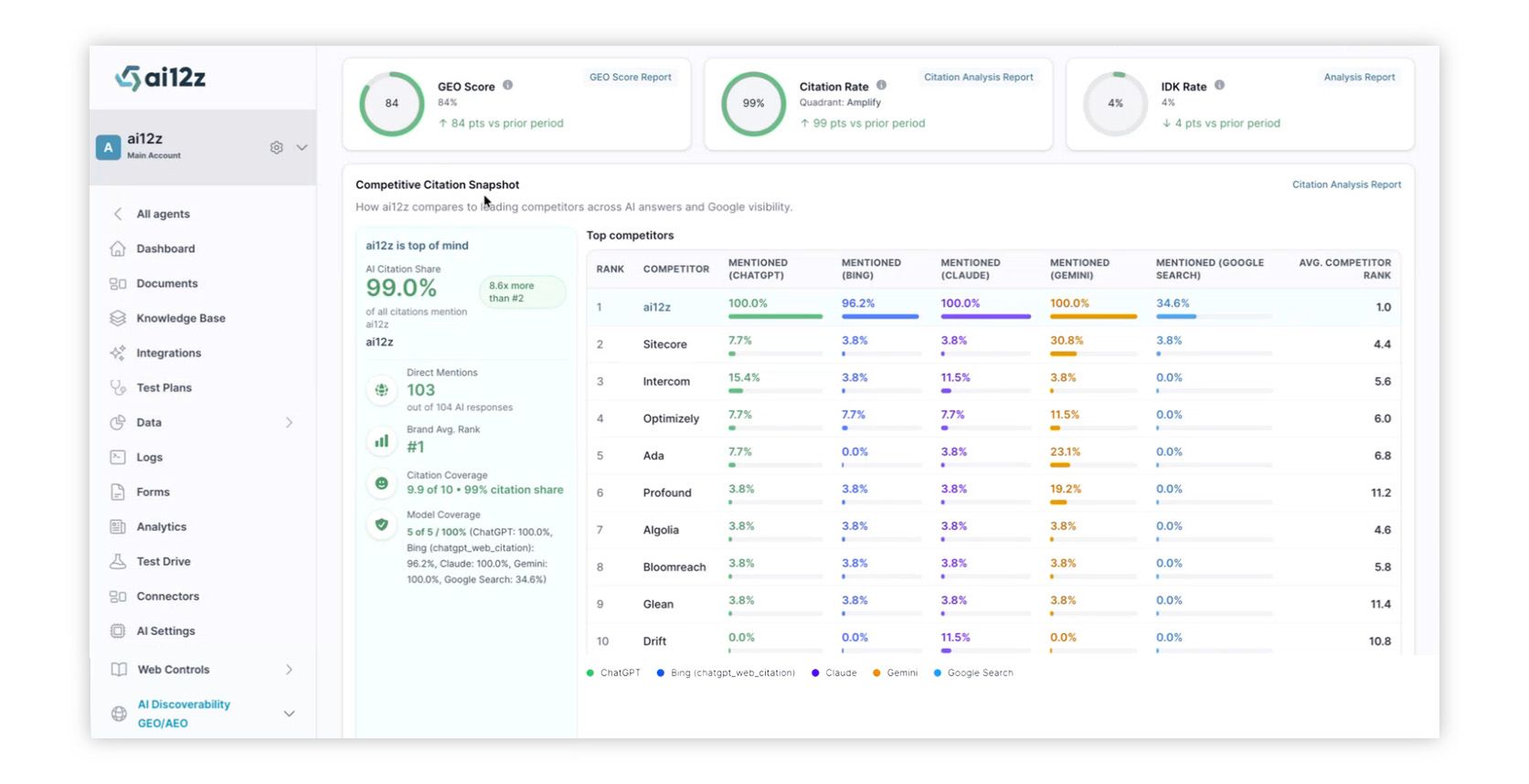
The ai12z AI Visibility Suite dashboard. Source: ai12z
Like the rest of ai12z’s product suite – which includes a newly refreshed website – the AI Visibility Suite is a masterclass in UX. The dashboard sings, providing a clean canvas for your GEO and AEO hygiene, competitive citations, and other key metrics.
You can also toggle seamlessly across your entire ai12z ecosystem, manage user roles and permissions, and collaborate with your team. It’s clearly informed by someone who knows CMS and understands how marketers think inside their stack.
I recently did a deep dive on what’s new in the AI Visibility Suite, and here’s my scorecard. The big takeaway? It’s a playbook for success. Here’s why.
Built on a legacy of AI innovation
While AI visibility is a newer offering in the company’s product portfolio, ai12z isn’t a newcomer to the burgeoning agentic landscape. Founded in 2023, it’s been pushing the boundaries since the dawn of modern generative AI.
AI and machine learning have long been fixtures in Bill’s hemisphere, and for good reason. He’s a digital experience pioneer, the CMS savant behind the legendary Ektron CMS, which later merged with Episerver (now Optimizely). Even in the early days of algorithmic exploration, he saw the potential of AI to evolve the web, and he’s been experimenting vigorously.
Those efforts have yielded real products, well before the crush of vibe coding and prompt engineering. In 2015, shortly after Ektron was acquired by Accel-KKR, he launched Orbita – a conversational AI platform that creates virtual assistants focused on the healthcare industry.
With ai12z, Bill is continuing to shepherd the simplification of AI adoption. Together with co-founder and CMO Nicole Rogers (who brings Google heritage to her role), they set out to deliver search and digital assistants that are powerful yet easy to deploy.

Ai12z co-founder and CMO Nicole Rogers. Source: LinkedIn
Today, ai12z is delivering some of the best-performing chatbots on the market. I’ve used the product myself, marveling at its ability to rapidly index content, leverage semantic caching, and provide site-based answers with a stunning degree of accuracy and control.
Since its launch, I’ve been tracking ai12z’s momentum, building a healthy customer base and white-labeling services with partners in the CMS and digital agency channels. As Bill told me, user feedback keeps improving the robustness. The system now offers an AI commerce assistant, geolocation for retail discovery, live agent escalation for CX workflows, and advanced guardrails for managing security and policy.
Back in February, I covered the launch of ai12z’s new personalization and adaptive web experiences. Based on signals like location, behavior, referral source, or known customer data, the platform can instantly transform a page as users interact with it, surfacing the most relevant content, products, and actions. It’s impressive.
This heritage of bleeding-edge innovation is what continues to put wind in ai12z’s sails. Expanding into AI visibility incorporates these hard-earned foundations, product applications, and industry relationships – all of which are built on trust.
Connecting AEO, GEO, and AIO
Before our recent demo, Nicole framed some of the foundational tenets of AI visibility and how ai12z has approached the challenges and considerations. It was helpful clarification given the dearth of messages crowding this space.
“Our AI Visibility Suite is all about seeing how a brand appears in AI search,” she explained. “Then, it’s measuring how that organization is cited, recommended, and understood across all these different AI search tools.”
Simple enough. But she went further to provide a clear distinction between AEO, GEO, and AIO – which are often viewed as interchangeable buzzwords. It’s worth noting that Google doesn’t view any of these as separate disciplines, but as subsets of SEO.
- Let’s start with Answer Engine Optimization, which is when your content is being used as a source in answers generated by AI search tools. The core metric of success is whether you’re mentioned or listed as a source.
- Generative Engine Optimization is a little different. It’s the practice of organizing and writing content so AI can understand, summarize, and recommend it directly in an AI answer. It’s also about seeing which competitors appear instead. Nicole gave me this example, drawing on her penchant for outdoor activities: “When somebody asks, ‘Hey, I'm going on a hiking trip in Patagonia. What do I need for hiking clothes?’ Is Marmot being recommended versus another hiking brand?”
- Finally, AI Optimization is the generalized shaping of how models perceive your organization. It’s like the ultimate evidentiary test for whether your brand is accurately understood and trusted. Because if it can’t do either, you simply won’t show up.
All three of these arenas are connected, but optimizing for each requires a unique approach. This is where ai12z is unifying insights to give marketers a better shot at influencing the entire spectrum.
Measure, diagnose, improve, validate
As Nicole explained, ai12z’s AI Visibility Suite combines key signals from AEO, GEO, and AIO, stitching together a more complete picture of your presence across the answer engines.
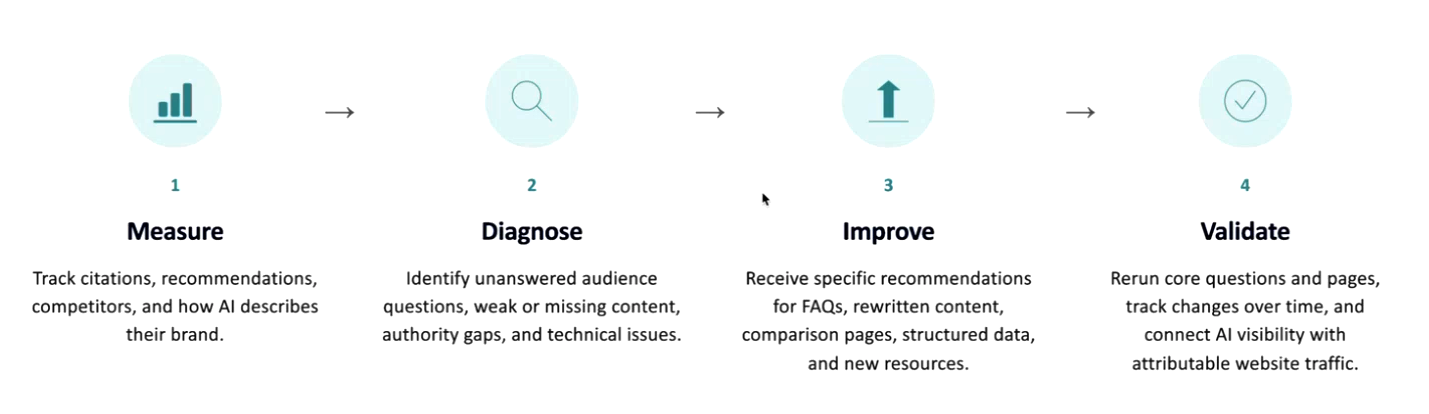
“We're all about establishing that baseline and comparing performance across platforms, and then tracking that improvement,” Nicole said. ai12z crystallizes this process, starting with measuring citations, recommendations, and how AI sees you.
Source: ai12z
The real magic is locked in what people ask – and that’s what ai12z unlocks. “AI search is driven by questions, not just keywords,” she added. “If you can't answer the questions that people are asking, then AI systems won't be able to recommend your content.”
With the AI Visibility Suite, you can identify the questions that really matter, determine if your organization appears for specific queries, understand why competitors may have an advantage, and ultimately validate the results by re-running core questions and tracking changes over time. You can also diagnose and remediate other weaknesses like missing content, authority gaps, and technical issues.
This isn’t a “set it and forget it” practice. Marketers are having to adjust to a whole new philosophy of testing and optimizing. But ai12z is providing a real framework for managing the cycle and driving results.
Seeing which AI tools actually send visitors to your site
One of the more compelling new features in the latest release is the AI Referral Analytics, which enables you to see exactly which AI search tools are sending visitors to your website, from ChatGPT to Perplexity to Google. This has been an “AI black box” in the past.
But what happens after they arrive at your site?
For starters, when an AI-referred visitor engages with an ai12z digital assistant on your site, you can also see the country they originate from, the landing page they visit, their device information, and more. Solid data points for any marketer.
But the AI Visibility Suite goes deeper, showing you the complete conversation with your bot and helping you connect it with the referral engagement. This is key, because visitors often continue the same line of research after they hit your website. Those on-site questions – along with the originating AI search – can provide strong signals about what they’re exploring.
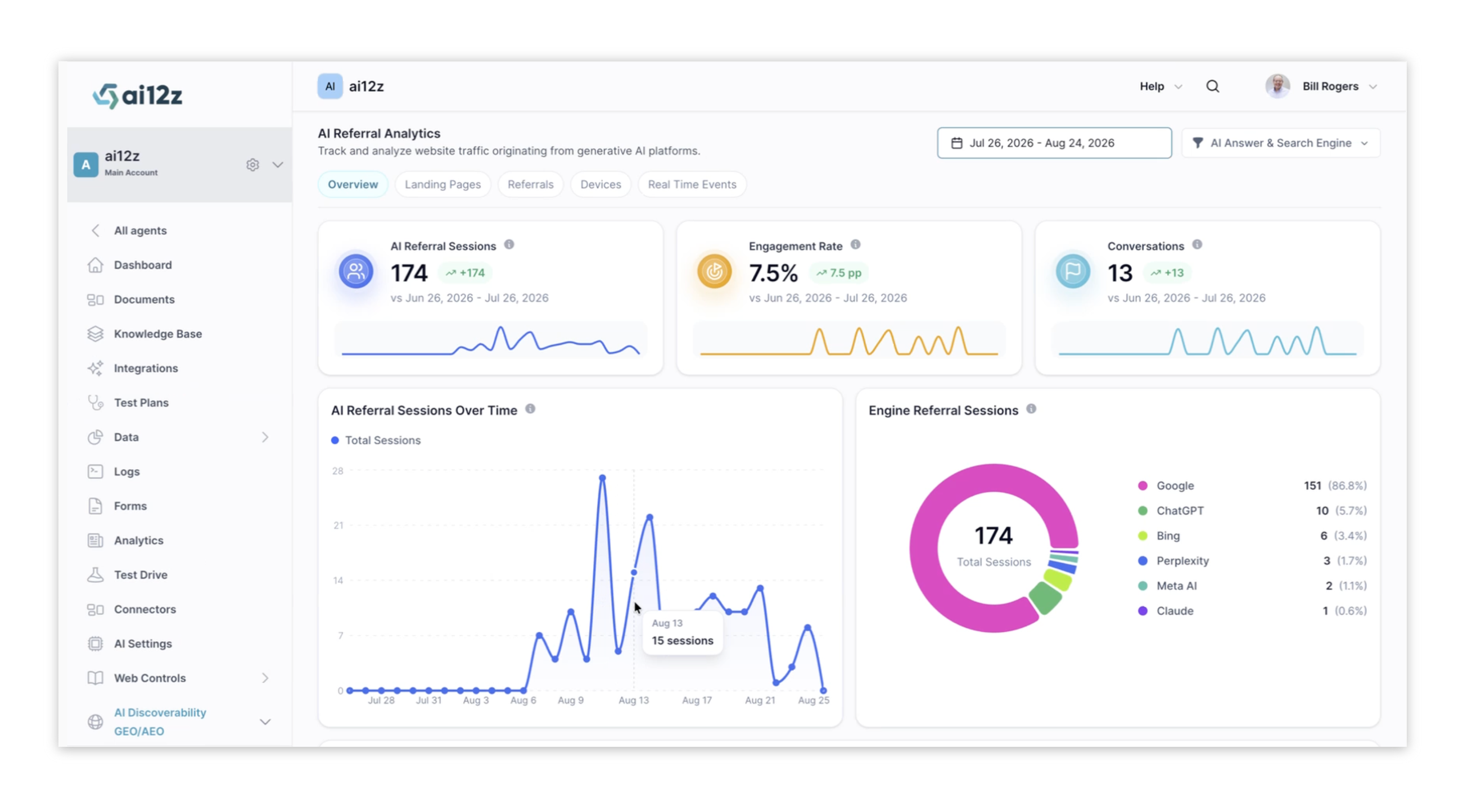
AI Referral Analytics provide deep insight into which AI search tools are driving traffic. Source: ai12z
Nicole cited an example:
“Someone might ask ChatGPT which digital assistant vendors specialize in education,” she said. "They might land on ai12z’s Education solution page and then ask the chatbot a more specific follow-up: ‘Could it help a prospective student find the right program, compare tuition and deadlines, and schedule a campus tour?' By connecting the AI referral, landing page, and on-site conversation, ai12z can identify patterns in visitor intent and the use cases driving their research.”
“Our controls act like a beacon,” Bill explained. “So even if the user doesn't do anything, we're capturing whether or not they came from one of the answer engines. But what’s gold is that after they arrive, if they ask a question, you can actually look at the conversation and know how it all started.”
Attribution is often a missing link with AI referral traffic, but connecting it with your site engagement has been even fuzzier. Now, this view of the research journey – from answer engine to site to conversation – is filling in the blanks.
Are you being chosen by AI Search?
That’s the operative question – and another “AI black box” that frustrates marketing teams. When you ask an answer engine for a recommendation, how do you know if you were chosen by ChatGPT or Perplexity, or if one of your competitors was selected instead?
In the latest release, the AI Visibility Suite lights up this dark alley with Citation Lists, allowing you to define questions and continuously test how AI engines respond to them.
One of the key factors is using the same questions repeatedly to track improvements. They can be real queries from your digital assistant, new questions derived from market research, or even suggestions generated by ai12z. Then, using the Citation Monitor, you can see where you show up in answers, if your content is cited as a source, and which competitors are being surfaced.
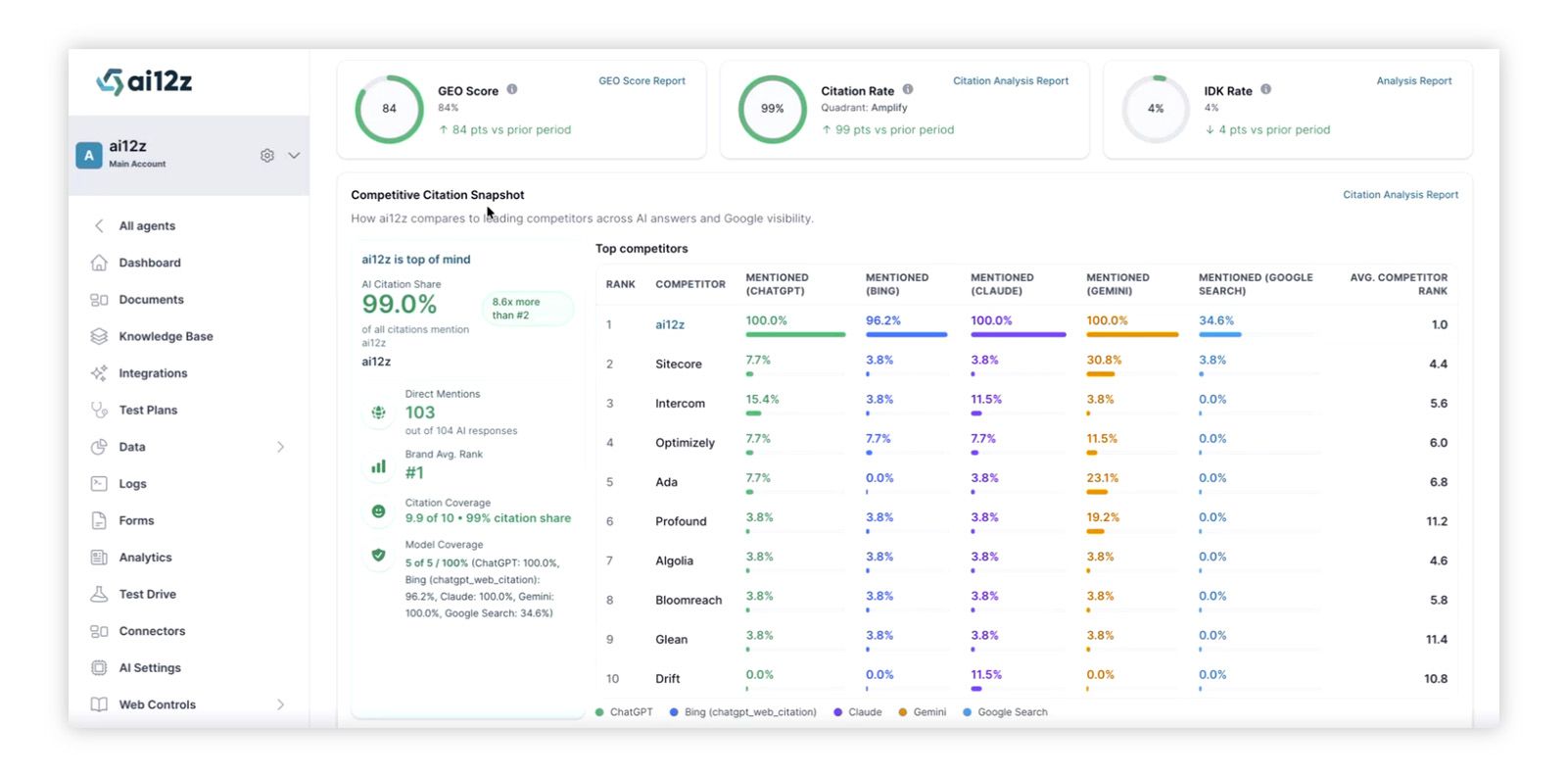
A snapshot of competitive citations. Source: ai12z
I really like this feature because it finally delivers on expectations from the optimization process, giving you a measurable competitive benchmark for improving content and asking the same questions – so you can gauge if the results have changed.
While most of the emphasis has been on Google (for obvious reasons), Bill pointed to Bing Web Search as an overlooked engine, but one that’s still incredibly vital. The new release adds it to the analytical mix.
“Bing is extremely important as part of this strategy,” he explained. “We measure whether your content is being cited there because Bing’s index helps AI experiences find and cite current web content. Changes to the index can appear relatively quickly, making Bing one of the first places where you may see whether new or updated content is improving your AI visibility.”
Creating better content for AI search
As Nicole said, AI search goes beyond the realm of keywords to focus on questions. If you’re not answering them, you’re not showing up in the engines.
To source these questions – and their answers – the suite’s Content Quality feature ingests your webpages and dynamically scores them. It looks for the highs and the lows, mining strong answers and where information is incomplete, unclear, or missing.
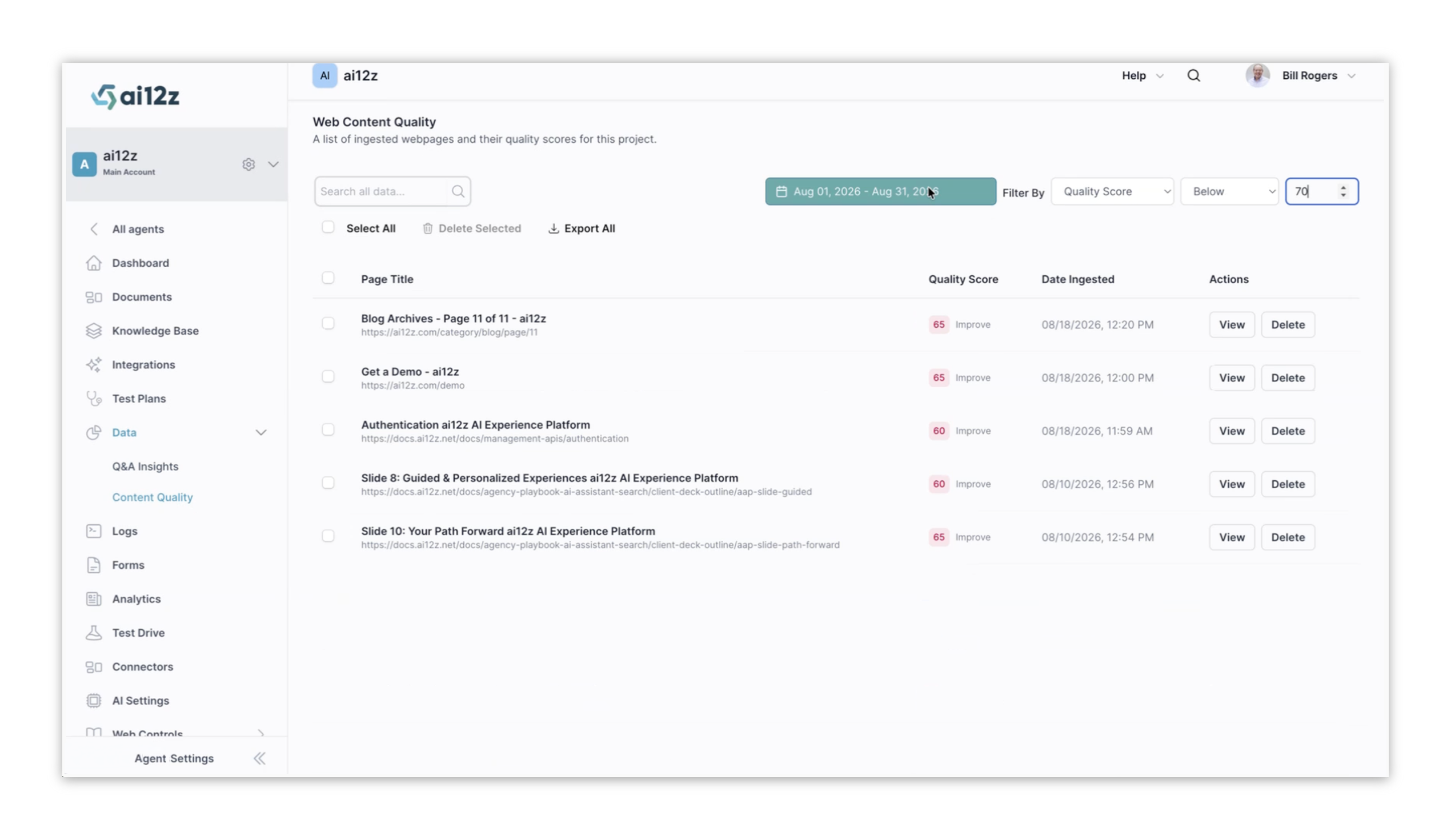
The AI Visibility Suite provides a content quality score for your ingested pages. Source: ai12z
Using the Q&A Analysis, you can drill down into specific questions, answers, metadata, and full conversations to derive more insights. In the process, you’ll also surface low-scoring answers and “I don’t know” responses.
Bill made an important point about those. The system doesn’t only flag explicit “I don’t know” answers – it also detects when an answer is effectively “talking around a question” without really addressing it.
On top of that question-level data, ai12z runs topic clustering. It groups similar questions into themes, scores how well you’re doing in each cluster, and produces top strengths, key weaknesses, and clean reports on what to tackle first.
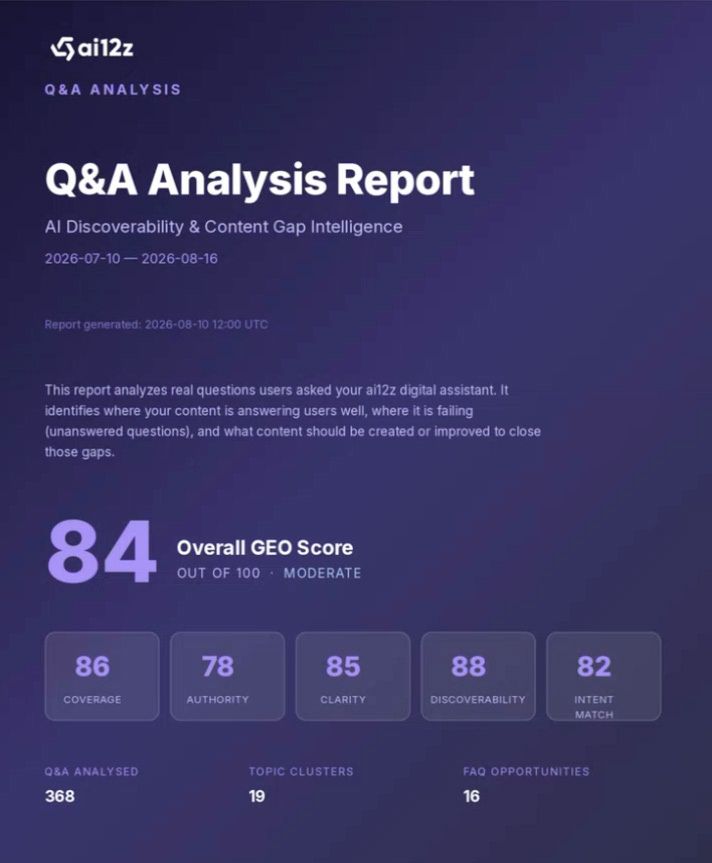
The Q&A analysis can be downloaded as a PDF report. Source: ai12z
For customers with large sites, these Q&A Analysis Reports can easily run dozens of pages, effectively becoming a living map of what people care about and how well your content meets that demand. You can also download them on demand as PDFs.
To top it off, the AI Visibility Suite can recommend specific content to create or improve your results. It can provide a draft FAQ, answer-first copy, and suggestions for entirely new pages. After making these changes, you can continue the testing cycle and monitor the impact.
URL analysis, keyword visibility, and agent readiness
If Q&A analysis is about how well your content answers questions, the URL and keyword tools are about why your content is (or isn’t) answer-engine friendly.
The URL Analysis feature takes a single page and performs a deep inspection, looking at granular technical details like JSON-LD and structured data, sitemap implications and internal linking, and language and localization cues. Bill showed me how a single URL generated a 26-page report of suggestions.
“When you start looking at it, you realize there are things that you could be applying everywhere,” he said. “It's teaching you what you could do with your content to make it considerably better, so your score goes up.”
Questions rule, but keywords still count. Based on your goals, the AI Visibility Suite expands your target keywords into natural language questions people ask. You can compile your list from Google Search Console, on-site search logs, CSV imports, or have it AI-generated.
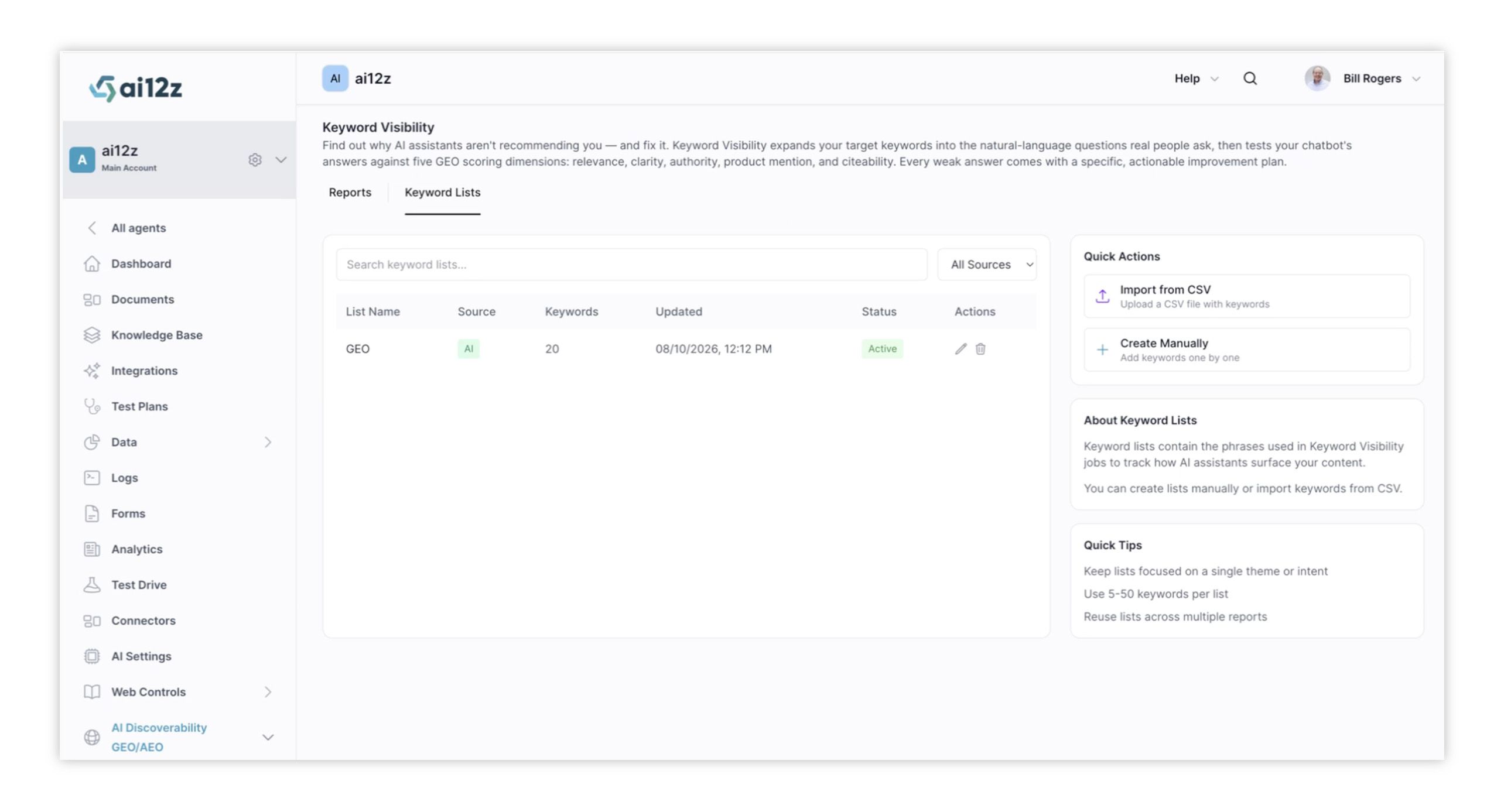
Keyword Visibility expands your target keywords into natural language questions. Source: ai12z
ai12z expands those keywords into natural-language queries, tests them against your content, and scores the results. That data feeds back into the same cluster and Q&A analysis, giving you a way to track your performance.
I really love the Agent Readiness feature, which provides a kind of preflight check for AI engines. It evaluates the vital fixtures that help search tools index your site. This includes robots.txt and llms.txt files, sitemap health, and even page length and token estimates. It also identifies whether you’re accidentally blocking AI systems.
“You'd be surprised,” Bill said. “We often run into people with robots.txt that actually excludes all AI systems. We can identify that problem right away.”
Layered on top is the AI Footprint analysis, which examines your presence across external authority surfaces like Wikipedia, Reddit, and Google Maps – the places AI engines increasingly look to for grounding.
Consolidated Action Report
For me, this is the real standout.
As I said, I’ve seen a lot of AI visibility demos, and there’s a fairly common thread: cognitive overload. Marketers are desperate for insights, but the amount of data being produced can feel debilitating.
ai12z was experiencing the same phenomenon. The sheer volume of information was impressive, but Bill told me their customers were feeling overwhelmed.
“That's why they asked us to come up with this action plan,” he said, “and create something that can summarize what is happening in the report and the things that they should be focusing on right away.”
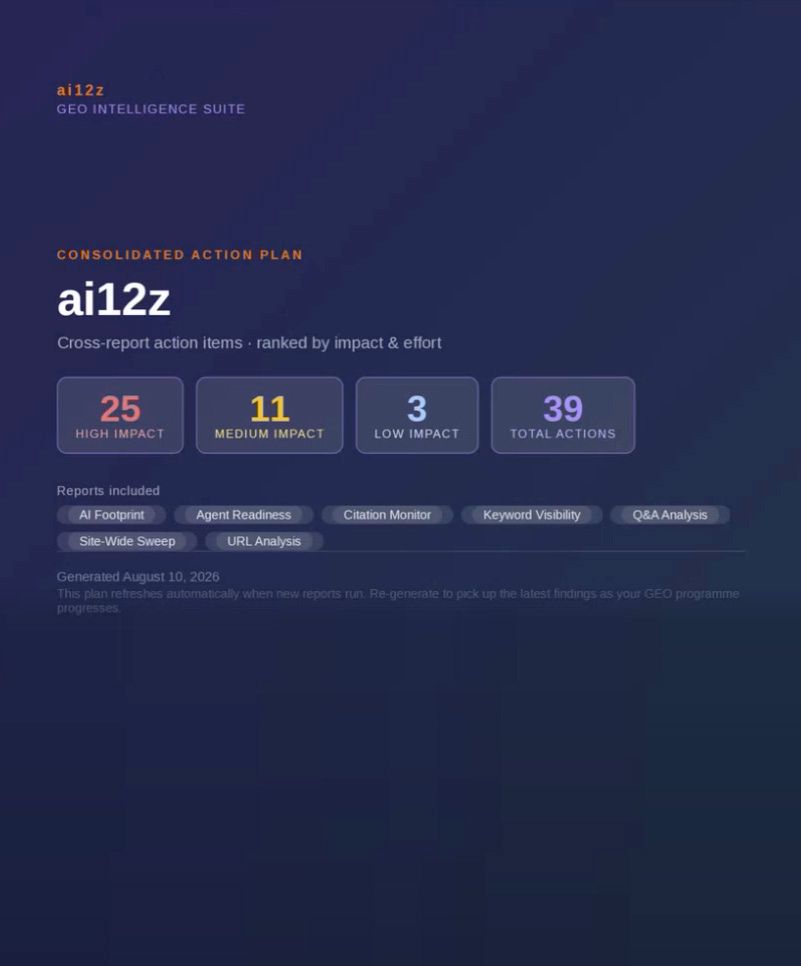
The Consolidated Action Report provides a clear set of priorities. Source: ai12z
ai12z’s Consolidated Action Report really delivers on this front. It distills the most critical insights from the corpus of your data and itemizes a clear set of actionable priorities. Teams can implement the changes, rerun the reports, and update their action plan incrementally. This is where ai12z’s “scoreboard vs. playbook” framing really comes to life.
“Our expanded AI Visibility Suite now brings all the signals together in one place,” Nicole said. “We create this whole action plan with your top priorities and where you'll have the highest impact.”
Giving agencies an AI visibility playbook, not just a platform
If any group has felt the impact of AI most directly, it’s digital agencies. At the Boye & Company CMS Kickoff earlier this year, Karla Santi of Blend Interactive gave a sobering account of how agency models are transforming in the wake of vibe coding, plummeting traffic, shrinking organic real estate, and the sudden centrality of answer engines.
While traditional revenue sources are declining, AI visibility has risen to become a fresh opportunity. The agencies I’ve spoken to over the last year have admitted that their customers need AI guidance. Trouble is, so do the agencies themselves – and they sometimes don't know where to start.
To help address this, ai12z has developed an Agency Playbook for Getting Found in AI Search. The online guide covers the structural details that can help practitioners sell, set up, and successfully manage AI visibility engagements with clients using the ai12z platform.
The playbook is, in a word, comprehensive. It covers key delivery tracks, details the principles of guardrails, and explains how to approach the ongoing optimization practice (and more). It even helps agencies position and sell the service with a facilitator guide and a customizable client deck. These are exactly the kinds of resources you hope for from a channel partner.
“We created this facilitator guide, and in it you have all these different sections that describe what to do,” Bill explained. “It helps them pitch what they need to pitch, and essentially makes it a practice for them.”
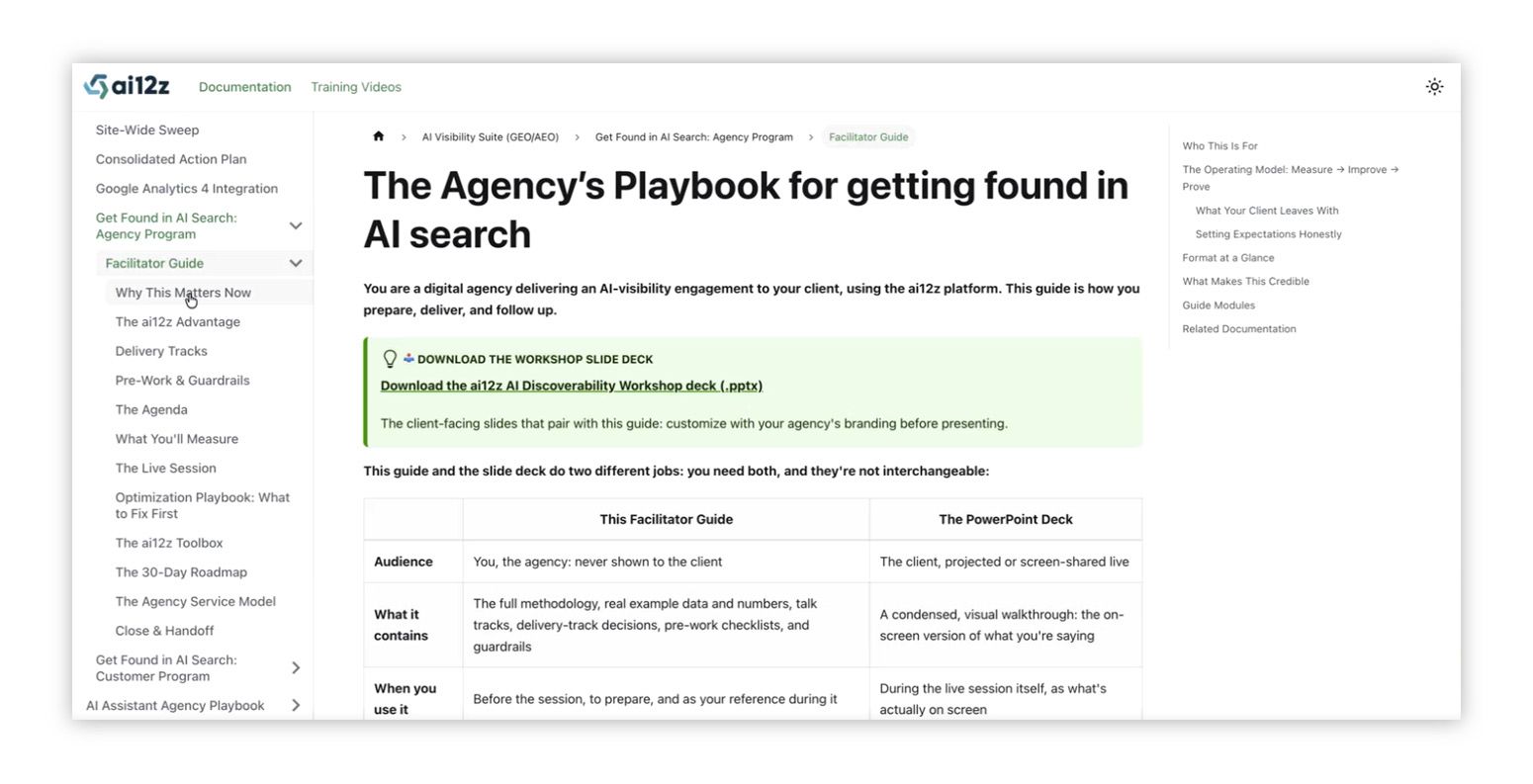
The Agency’s Playbook in ai12z. Source: ai12z
That model of continuous tracking is exactly where agencies are finding value, because it gives them something they can package as an ongoing, measurable service. In that sense, it’s more like a traditional SEO practice than a one-off audit. But it’s also providing a more transparent, data-backed, and repeatable solution that customers will find appealing – especially as ROI becomes a central concern when procuring AI solutions.
The verdict
ai12z’s AI Visibility Suite isn’t just another scoreboard for AI citations and recommendations. It’s much closer to what marketers and agencies have been asking for: a playbook that tells them how to move the ball down the field.
Because ai12z is an answer engine, it has a real structural advantage. It understands questions and answers at the grain of real user behavior, clusters them into intelligible themes, correlates them with AI referrals and traffic, and then synthesizes that into a Consolidated Action Report.
And that report is a goldmine. It goes beyond the scores to prescribe specific, prioritized actions (add this FAQ, fix that page, create this comparison, improve that structured data). Using it feels less like a passive dashboard and more like a coach on the sideline – calling plays, adjusting to the field, and helping you turn AI search insights into actual wins.
Alongside the deep diagnostics and citation and sentiment tracking, ai12z gives organizations something more than visibility. It gives them systems and processes. That’s important for enterprise marketing teams, but it’s also a tenet of the agency playbook, arming partners with a way to turn this model into revenue and long-term client value.
A couple of final notes:
- The product’s documentation is also worthy of the spotlight and reflects the quality of ai12z’s own content and its commitment to customer success. The docs site also includes a bevy of training videos.
- A quick note on pricing: ai12z’s AI Visibility Suite introduces a flexible, usage-based credit model for GEO, AEO, and AIO reporting. You can learn more here or kick things off with a free AEO/GEO discoverability snapshot.
My Recommendation: If you’re a marketer or agency staring at your AI visibility “scoreboard” and wondering what to do next (or where to start), ai12z’s AI Visibility Suite deserves a serious look. Paired with its enterprise-grade digital assistants, it offers one of the most complete solutions for managing your AI visibility strategy.