Seeing the ‘Agentic Forest’ Through the Trees: Andy Cohen on Taming the AI Wilderness

The industry luminary and architect behind Sitecore XM Cloud joins “The Critic’s Corner” podcast to share his trials and tribulations in both the digital and physical realms, and how he’s evolving – and thriving – in the thick underbrush of the agentic frontier.
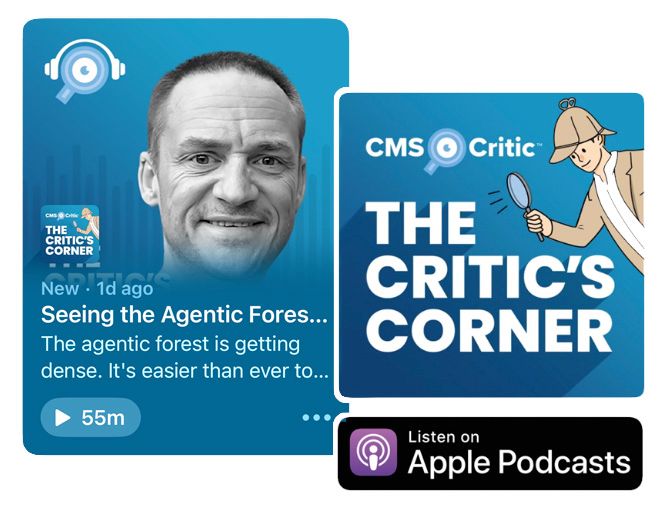
Listen to the full episode of “The Critic’s Corner” Podcast >
The agentic forest is getting dense, and it’s easier than ever to get lost. But we’ve got some perspective on the trail from a seasoned AI ranger on the latest episode of The Critic’s Corner podcast.
Industry legend (if we may be so bold) Andy Cohen is in the hot seat, and he takes us on his personal journey into tech – from an intrepid 8-year-old gamer and hacker... to an avid backpacker nurturing nature... to a pioneering architect building the future of Sitecore in the cloud.
It’s a wild ride that ends – or begins? – in the foothills of the agentic enterprise, and he shares how this unconventional roadmap has uniquely prepared him for what’s ahead
Host Matt Garrepy uses the episode to explore Andy Cohen’s unconventional career path, his pivotal role in Sitecore’s journey to the cloud, and his current work on Kajoo Agentic – an agent-first platform for orchestrating AI-powered workflows and CMS migrations.
Along the way, they tackle the hype and reality of the “agentic enterprise,” the risks of vibe coding, and why fundamentals still matter more than ever.
From a Commodore 64 to the modern CMS landscape
Like so many people in the CMS and DXP space, Andy didn’t arrive here by design. His story starts in the 1980s with a Commodore 64, PC magazines, and the kind of analog friction that defined early home computing.
As he says in the pod, his mother would bring home magazines filled with code samples, and Andy would painstakingly rattle away on his keyboard. Where was this new language taking him? That was yet to be discovered.
“I would type those programs into the computer,” he says. “I had no idea what they were doing as an eight‑year‑old. But I thought it was pretty cool.”
Those primitive workflows didn’t hold him back. It set the stage for the next chapter of bulletin board systems and the pre-Internet underground of software distribution. Hosting his own BBS, Andy discovered he could download and trade games – including iconic Sierra and Infocom titles – without ever visiting a store. As Napster did much later, this activity fell into the proto-realm of piracy.
Andy’s early dabbling in the world of hacking didn’t last long, but it does reveal something important about his mindset: he’s an improviser. And that instinct to push the boundaries of systems, to route around limitations, is a through-line from those early days all the way to his current focus on agentic architectures.
Trading screens for trees
Just as the narrative seems locked into a pure tech origin story, Andy takes a hard turn into the woods – literally. In high school, he fell in love with backpacking and the outdoors, and that passion carried him to UC Berkeley, bypassing computer science for forestry and resource management.
From there, he landed at Mount Diablo State Park, patrolling in a four-wheel drive truck, restoring habitats, and working on restoration projects. The work was hands-on and mission-driven. As he says in the pod, he loved the uniform, loved greeting park visitors, and loved the sense of stewardship.
While an admirable and highly qualified profession, being a forest ranger isn’t the highest-earning career path. And so Andy ended up in a different forest – the kind with four walls, phones, and computer screens. Moving to office work, he was drawn back into the orbit of technology, where he rekindled his interest in networks and systems. He eventually built enough expertise to earn certifications, and that led to his first official programming job in Minnesota, working on web development for staffing software.
What’s striking is how Andy frames the balance between nature and technology. In the pod, it’s clear that the passion still exists for the outdoors, and it’s far from being a discarded phase in his life. In fact, it’s a counterweight, and he talks about the deep motivation to introduce his kids to the outdoors through the national parks, and how nature is always a place to return to when the digital world gets too loud.
That sense of dual citizenship between the physical and digital, the grounded and the abstract, informs how he thinks about AI today. Even in the agentic era, we still build tools for humans who live somewhere other than in our stacks.
Moving Sitecore into the cloud era
For many listeners in the CMS and DXP community, Andy’s most visible chapter begins with Sitecore. Despite his growing tech acumen, he didn’t arrive at the iconic DXP as a product architect or platform engineer, but on the sales engineering side.
Andy’s knack for unpacking systems and quickly adapting was what drew him into the architecture side of the equation. As he explains in the pod, the hyperbolic COVID era landed him in the middle of one of the most consequential transitions in the company’s history.
As the tech world was racing toward cloud-native, SaaS, headless, and composable architectures, moving to the cloud became the mission – Andy was steering the ship to what would ultimately become XM Cloud, Sitecore’s fastest-growing product in its history. The product was a key factor in the company’s 2024 breakthrough to $500 million in ARR.
In the pod, Andy gets frank about the challenges of adopting new technologies like containers and Docker. But what he brought to the table was a relentless focus on the outcomes. He describes himself as a “change agent,” and that mindset, more than any specific tooling, is what helped bridge the gap between monolith and SaaS.
AI, agents, and why work isn’t disappearing
The episode slides naturally into the AI conversation that’s consuming nearly every software category, including CMS. We all see it: every vendor is suddenly “agentic,” every platform is a “front end for agents,” and buyers are struggling to divine the signal from noise.
Like the advent of ATMs as a disruptive technology, Andy sees something similar happening with AI, especially at the agentic layer. While AI has promised to deliver unimaginable automation, it’s not displacing work – but shifting it in different directions.
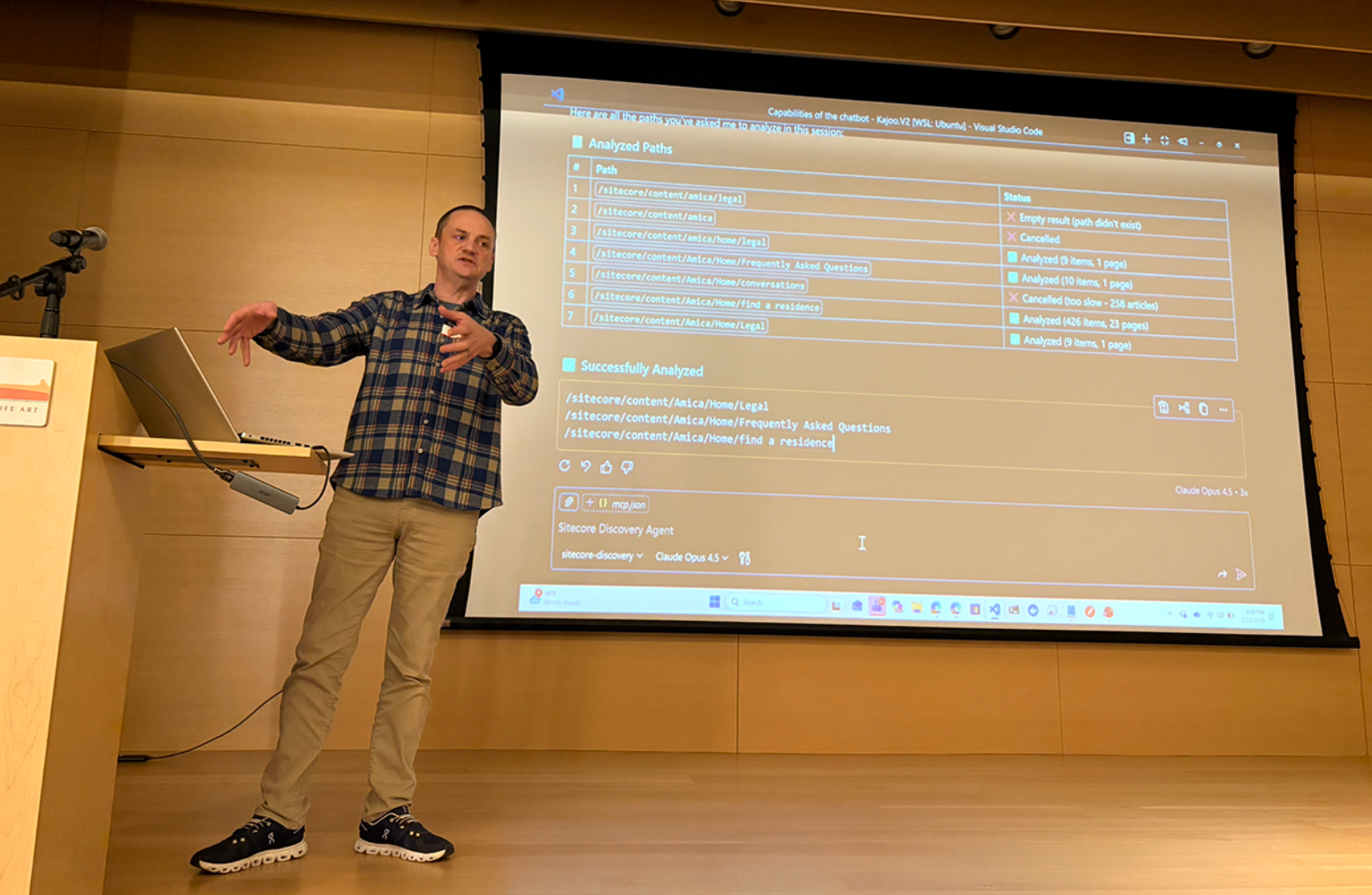
Andy Cohen speaking at the Boye & Company CMS Kickoff 26
“I don’t have less work to do,” he says bluntly. “I have way more than I ever did, and more is being expected out of me.”
One of the biggest revelations in the pod is how Andy sees this coalescing. As he says, he’s now an orchestrator of everything. His tasks look and feel different: he feeds instructions and constraints into models, evaluates what comes back, and iterates. In this sense, he’s wearing multiple hats as a developer, QA engineer, architect, product manager, UX thinker… and the list keeps growing.
Clearly, productivity is a chief benefit of AI. Andy’s experience crystallizes that. But the risks are scaling in tandem. The conversation explores how production outages and security lapses are being caused by an over-reliance on AI-generated code.
As Andy explains, the winners won’t be the teams that blindly replace humans with agents. They’ll be the ones who can use AI to safely increase output while preserving – and even elevating – the standards of quality, security, and maintainability.
Vibe coding and the new developer skill set
One of the most thoughtful parts of the episode is the discussion around education and re‑skilling. Andy’s concerns run deep as he thinks about his own kids and their future in a world where AI is the default thinking mechanism.
“How do you train the next generation of developers when their first instinct is to just ask the model?” he asks. And it’s a poignant question, and Andy dives into the tension between the accessibility of AI-assisted development and the need for foundational understanding.
“I can tell the AI what I want to build, but I have to sit there and babysit because it will write so much stuff that I don’t necessarily want,” he explains. “And if you go and try to run it, it won’t actually even work or do the things that you need it to do.”
This is where the idea of “vibe coding” – building primarily by prompting intent to AI tools – comes under scrutiny. It’s a topic we’ve been following with deep interest as tools become more deeply integrated with these capabilities. Without a grounding in basic concepts like security, data modeling, and system design, new practitioners may be able to get something running, but not diagnose why it fails or what risks it introduces.
The result is a growing layer of tech debt, especially in organizations racing to bolt agents and AI workflows onto existing systems. Fixing this won’t be about nostalgia for pre‑AI development, but about equipping people with hybrid skills – the ability to think like architects and security engineers while still moving at AI-accelerated speed.
In other words, the job isn’t going away. It’s mutating. And to Andy’s point, it’s becoming more demanding.
Kajoo Agentic and the future of agentic platforms
The pod closes by zooming in on Andy’s current work with TechGuilds and Kajoo Agentic, a platform that sits at the intersection of everything discussed in the episode.
Many in the Sitecore and broader CMS community first encountered Kajoo as a transformative migration tool – a system that could ingest an existing website, understand its structure and design, and reconstitute it inside a CMS. It felt almost magical when it debuted at community events, and it previewed the kind of intelligence we now associate with AI-native tools.
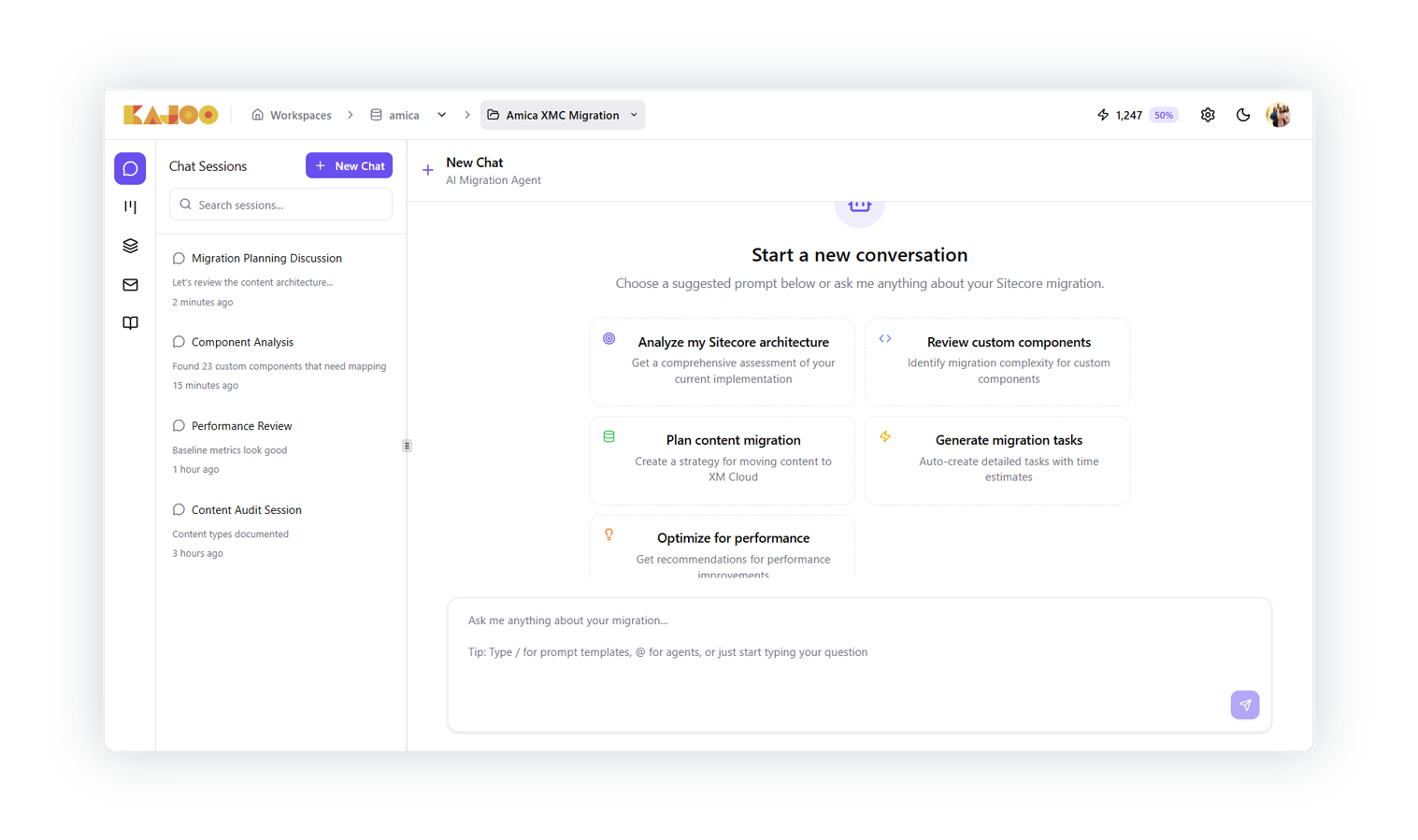
Source: Kajoo.ai
AI has long been a key part of Kajoo’s delivery, but Kajoo Agentic is the evolution of that vision into a full agentic platform. It’s designed both as a general framework for defining and orchestrating AI agents, and as a specialized solution for complex migrations, including to the newly launched SitecoreAI.
Andy underscores how the hard part isn’t just wiring an LLM into a migration script. It’s drawing the boundaries between agents and tools, deciding what must be deterministic and what can remain probabilistic, and managing the reality that model behavior and infrastructure conditions are constantly shifting.
This is where Andy’s decades of experience across digital systems – informed by his penchant for curating natural ecologies – is providing a kind of garden for agents to blossom in the right direction. As a restless explorer, he’s constantly pushing the potential and outer boundaries of technology, and where content, data, and customer experience intersect.
For practitioners and leaders trying to navigate the dense forests of agentic AI, this episode of The Critic’s Corner offers a rare voice of calm and clarity. Andy sidesteps the buzzwords and offers a grounded, human narrative about how we got here and the kind of thinking it will take to tame this wilderness – so we can plant and grow a sustainable future.
“The Critic’s Corner” podcast with Andy Cohen
Upcoming Events
CMS Summit 26
May 12-13, 2026 – Frankfurt, Germany
The best conferences create space for honest, experience-based conversations. Not sales pitches. Not hype. Just thoughtful exchanges between people who spend their days designing, building, running, and evolving digital experiences. CMS Summit brings together people who share real stories from their work and platforms and who are interested in learning from each other on how to make things better. Over two days in Frankfurt, you can expect practitioner-led talks grounded in experience, conversations about trade-offs, constraints, and decisions, and time to compare notes with peers facing similar challenges. Space is limited for this exclusive event, so book your seats today.

RAISE Amsterdam
May 20, 2026 – Amsterdam, Netherlands
Sponsored by Kontent.ai, RAISE Amsterdam brings together bold marketing and technology leaders to explore how agentic AI is reshaping the way ambitious brands create and deliver content and what it takes to use it safely, responsibly, and with proper governance. Experience the ideas that are shaping the future and dive into big thinking, innovative strategies, and expert insights. Held at the Klein Canvas, Volkshotel, you'll hear from world-class speakers in dynamic sessions that will reveal how AI-powered content operations are accelerating production, improving governance, and driving creative impact. Limited spots are available, so book yours today.

Umbraco Codegarden 2026
June 10–11, 2026 – Copenhagen, DK
Join us in Copenhagen (or online) for the biggest Umbraco conference in the world – two full days of learning, genuine conversations, and the kind of inspiration that brings business leaders, developers, and digital creators together. Codegarden 2026 is packed with both business and tech content, from deep-dive workshops and advanced sessions to real-world case studies and strategy talks. You’ll leave with ideas, strategies, and knowledge you can put into practice immediately. Book your tickets today.
Open Source CMS 26
October 20–21, 2026 – Utrecht, Netherlands
Join us for the first annual edition of our prestigious international conference dedicated to making open source CMS better. This event is already being called the “missing gathering place” for the open source CMS community – an international conference with confirmed participants from Europe and North America. Be part of a friendly mix of digital leaders from notable open source CMS projects, agencies, even a few industry analysts who get together to learn, network, and talk about what really matters when it comes to creating better open source CMS projects right now and for the foreseeable future. Book your tickets today.

Contentstack ContentCon 2026
September 30 - October 1, Amsterdam / October 27-28, 2026 – Chicago
Contentstack’s annual customer conference is the premier event for executives, marketing leaders, and developers to redefine their digital experience strategy. This is your opportunity to step out of the "status quo" and into "elite" status, learning exactly how the world’s most successful brands are using the technology you already own to do the impossible. Enjoy a full day of interactive workshops, certifications, and inspirational on-stage sessions designed to help you become an expert on cutting-edge digital strategies and how to turn Contentstack's CMS and adaptive personalization tools into your greatest competitive advantage. Book your seats today.