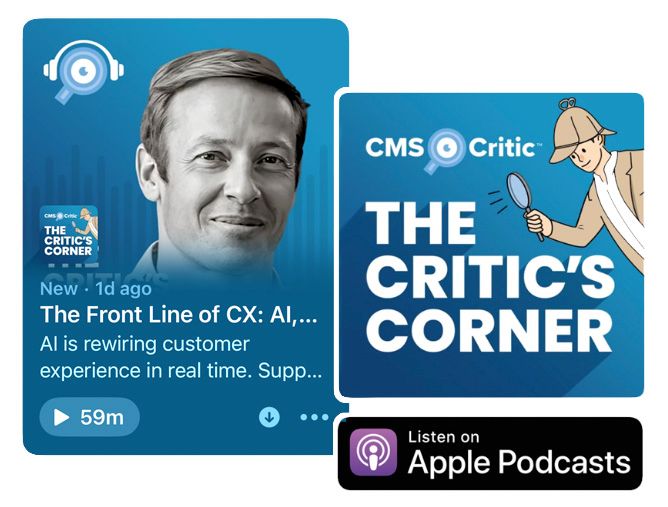
The Critic's Corner Podcast: The Front Line of AI, Agents, and the Future of CX with Dan O’Connell


The Front CEO sits down to talk about how AI is transforming the hallowed corridors of customer experience, why the "The Coordination Tax" keeps piling up, and where humans and machines can work together to improve support at every level.
Listen to the full episode of “The Critic’s Corner” Podcast >
Like every category in the thick jungles of enterprise software, customer experience is having an AI moment.
The changes have been big. And they're getting even bigger.
But this trend isn't new. The CX category has long been a pioneer for tech innovation and disruption. If you've been around long enough (like I have) and engaged with any kind of customer support service, you've witnessed the transformation.
For starters, the IVR (Interactive Voice Response) forever altered how phone calls were facilitated through call centers, and how consumers engaged in their first touch with a brand's support system. It was a game-changer, opening up new levels of automation and productivity.
Of course, we had to break a few eggs to make an omelette. We tend to remember the frustration of clumsy prompts and poor voice recognition more than the seamless successes of navigating a menu. How many times have you asked to speak to a human, only to be answered with “I didn't understand that, please try again…”
That's just how support works. The bad experiences really stand out.
IVRs really hit the gas in the 1990s and kept improving over the decades. From Salesforce to Zendesk, new tech flooded the floors of call centers, streamlining tickets and enhancing collaboration.
Fast forward to 2026, and AI is disrupting everything. Agents are being deployed across our tools. Products like Eleven Labs are pioneering synthetic avatars that sound like their human counterparts, and call center operators are harnessing AI tools with natural language to get work done.
Every day, agents are automating more and more of our CX operations. Support leaders are racing to deploy virtual teammates across the customer journey and reduce costs at scale. At the same time, customers are bringing more complex problems, higher expectations, and a deeply human need for empathy when things go sideways.
The thing with AI is that it tends to amplify whatever you give it – good, bad, or downright ugly. The technology promises scale and efficiency, but the real question is whether we’re actually improving CX, or just scaling the chaos of already broken systems.
On this episode of “The Critic’s Corner” podcast, I sit down with Dan O’Connell, CEO of Front, to unpack this tension. Front, which positions itself as an AI-powered customer operations platform that brings humans and agents together around customer work, is blazing an evolutionary trail beyond traditional help desks and siloed support tools.
Dan isn’t just another SaaS CEO parachuting into CX from the outside. He started his career working an 866 line at Google, then worked his way across nearly every role you can imagine in customer support and sales. Along the way, he built and sold a startup, giving him unmatched perspective on bootstrapping an idea into a business.
Now, he’s leading Front past $100M in ARR and into a world where agents and humans are meant to be teammates by design rather than by accident.
This conversation spans nearly 25 years of support history, from clunky tool stacks and offshoring to agentic systems and AI‑driven coordination. If you care about CX (and you should), this is a great discussion on balancing the human reality of working alongside machines, the hidden costs in solving problems, and how AI can unlock what's next for customer experience.
From dozens of tools to agentic CX
During the pod, Dan looks back at his first job in 2003, where he recalls the gaggle of different tools needed to handle CX. The image is instantly recognizable to anyone who has ever worked in a support role: multiple windows and dashboards, different systems for tickets, knowledge, CRM, and communication, all tenuously held together by the humans moving between them.
“I think about the 19 pieces of different software that we had just to support customers, and then I fast-forward 25 years, and here we are," he recalls. "We've got agents that can handle the phone and do pretty complex things, and I would never have [imagined] that, to be quite honest.”
Given his deep industry experience, Dan traces the industry’s evolution during our exchange. We talk about the rise of centralized call centers and ticketing systems, the wave of offshoring and outsourcing in the mid‑2000s, and the shift to SaaS help desks and modern collaboration tools.
Today, that journey has brought us to agentic systems in CX – environments where AI agents can handle tasks that would have seemed impossible two decades ago. Dan draws a sharp comparison between today’s AI wave and the offshoring era of the previous decades. As he recounts, companies chased lower‑cost labor in new geographies.
“There was a lot of offshoring and outsourcing at one point in the mid‑2000s, and so that was a massive transformation that happened in many businesses around customer support and service," he says. "How do we go to a lower-cost resource or a lower-cost geo to service customers?”
Now, the dynamic has shifted with AI, and the lower‑cost “labor” is surfacing in the form of digital agents. In both cases, the surface promise is similar (greater efficiency, faster response, more coverage), but the deeper questions disappear. We're still left asking: What happens to the human workforce? How does this change the brand experience? And where exactly is the line between efficiency and empathy?
These questions aren't theoretical. They show up vividly in high‑stress, high‑stakes scenarios like insurance claims, travel disruptions, or financial decisions – moments when the presence of a human on the other end of a phone can change the entire emotional texture of an interaction.
Dan and I both shared personal stories in that space (mine was a recent car accident), and the contrast between polished AI onboarding flows and the steady voice of a human adjuster is pretty hard to ignore. For me, having a sympathetic shoulder on the other end of the phone made a horrible event a little easier to manage.
‘The Coordination Tax’ and the hidden cost of CX
A big part of our conversation centers on a concept Front has been researching in depth, and we've covered on CMS Critic. It's called “The Coordination Tax,” and it’s the invisible line item in customer operations that doesn’t show up in most dashboards, but is quietly shaping the experience for both customers and practitioners.
Here's a bit of the backstory: Dan’s team set out to understand the hidden work it takes to serve customers across people, teams, tools, and systems. The results were, in a word, sobering: for every hour teams spend actually solving a customer problem, they can easily burn up to three hours just coordinating around it.
Where, oh where, does the time go, you ask? You probably have some clues already. It leaks away in Slack threads and email chains. It evaporates in side conversations that require tracking down the right person or handoffs between systems that don’t talk to each other. And it disappears in the constant wrestling matches with fragmented, siloed data as users try to squeeze out basic answers.
“Every business on the planet can tell you what their CSAT is, or what their resolution rate is," Dan says. "But the vast majority don't measure all of this Coordination Tax that's showing when solving these customer problems.”
This is exactly where AI becomes a double‑edged sword. If we drop agents into broken processes and scattered data, they won’t fix the underlying issues – they’ll exacerbate them. If your workflows are messy and your information is inconsistent or outdated, AI doesn’t magically clean everything up. It simply scales whatever you already have. And that’s as true in CX as it is in content operations.
We see the same propensities in CMS and DX. Content debt becomes AI debt. If your website and internal knowledge base are filled with half‑maintained FAQs, contradictory policies, and orphaned pages, AI will happily ingest everything and project it into answer engines, chatbots, and agents. “Garbage in, good enough out” used to be a realistic description of how many systems worked. Now, it's a tangible business risk – especially in regulated industries.
“If you don't solve these problems, rushing to deploy AI is going to amplify the problem," Dan observes. "It's this self‑fulfilling flywheel of impact and effect.”
Front’s work on “The Coordination Tax” is worth a closer look, especially if you’re grappling with these issues inside your own CX functions. You can explore the research at research.front.com.
Agents as teammates
Agent sprawl is a real phenomenon. As I've noted in previous articles, Gartner predicts that the average enterprise might have as many as 150,000 agents swarming around their production workloads by 2028.
Man, that's a lot. Imagine onboarding 150,000 new employees.
The most pertinent question is, who's watching them – and how?
Dan and I agree that agents should be treated as if they were, indeed, employees, rather than technology assets you bolt onto existing workflows. To be clear, we shouldn't anthropomorphize these constructs – that's a common pitfall. But once you apply this perspective of agents as teammates, a familiar set of questions emerge regarding governance, guardrails, permissions, and more – things we typically assign to people, not bots.
First, agents need some kind of modified onboarding, so they know which problems they’re meant to solve and which they should hand off (or outright ignore). They also need shared context across customer histories, specific policies, and proper content. Given the recent “rogue” trouble that OpenAI and Anthropic just experienced, all of this should be of paramount concern.
Clearly defined permissions are also essential. You need to define what systems agents are allowed to access, what actions they can take, and where they need to defer to a human. And finally, they need firm governance – rules about when they should act autonomously and when human judgment is non‑negotiable.
“You have to think of an agent like a new employee," Dan says. "People want to understand why they're making certain decisions, and when do they clearly hand things off to a person.”
All of this naturally leads into what Dan describes as the emerging control plane for AI in CX. Organizations are quickly realizing that if they want to deploy agents at scale, they need visibility and observability as foundational tenets, so they can better understand how agents are affecting real outcomes like CSAT, time to resolution, and cost to serve. At a granular level, they want the ability to customize tone and behavior while ensuring customer transparency.
A year and a half ago, most of the energy in AI was focused on getting anything agentic into production. The noise level around “agentic commerce,” in particular, was deafening within the MACH corridors when I covered “The Composable Conference” in 2025.
As I noted in my coverage of some compelling research from Cleanlab and Fiddler, agentic experiments have been hitting whitewater for a myriad of reasons, from evolving LLMs to security and infrastructure issues. Now, as we approach 40% of enterprises having agentic systems in play, the focus is shifting to governance and trust. The trick is to employ standards and guardrails without suffocating innovation under layers of bureaucracy, and that balance is still being worked out in real time.
In the pod, we also touch on an awkward truth, and it's this tendency to hold AI to a higher standard. When an agent gets something wrong, we call it a hallucination and write it off to the machinations of modern AI. But when a person misses the mark, we call it being wrong. As a technologist (and a human), it's a frustrating incongruity.
This distinction doesn’t mean we should loosen standards for AI, especially in sensitive domains. But it does suggest that we need to be more explicit about what quality actually means, and how we measure it consistently across both human and machine actors.
Rethinking ROI in CX
When compared to other facets of enterprise operations, one clear advantage CX has relative to AI transformation is measurement. Think about it: support leaders already track cost to resolve, time to resolution, CSAT, NPS, containment rates, and dozens of other signals. That makes CX one of the cleanest domains for experimenting with agents and seeing how they perform.
Within this, Dan draws an important line between full automation and partial automation. Full automation – where an agent takes a case end‑to‑end without human involvement – has a defined and direct ROI. You can see when a ticket never touches a human queue, and you can quantify the savings and the impact on the customer.
Partial automation is a bit trickier. In many cases, an agent can handle the first few steps, like gathering information, retrieving relevant data, or drafting a response before handing off to a human. The value is tangible, reducing the coordination burden and speeding up work.
But because the case still touches people, it’s much easier for organizations to discount that contribution or even underprice it. If you aren’t explicitly measuring “The Coordination Tax” in this region, you might miss just how much value those partial handoffs are creating.
This is where CX leaders will need to sharpen both their analytics and their storytelling. The numbers are there, but the challenge is connecting them to strategy and investment in a compelling way.
“Whether it's full automation or partial automation, the clearest place to experiment with AI is around customer support and customer service,” Dan says.
Open ecosystems, super apps, and the shape of what’s next
So where does CX go from here? And what headwinds are we facing?
Looking ahead, Dan sees two related trends. The first is agent sprawl. Teams across businesses are spinning up agents for finance, HR, recruiting, support, and more. Some of these agents are first‑party offerings from platforms, while others are bespoke creations built on top of Anthropic, OpenAI, and other models. As I said, the number of agents inside a large enterprise could easily number in the hundreds of thousands in just a few years.
At the same time, there is a countervailing move toward platform consolidation. I've written about cognitive overload and swivel-chair moments as practitioners struggle to maintain their stacks, and the swing back towards unified yet composable systems. As Dan says, companies are tired of juggling twenty primary systems, so they’re pushing toward fewer, more powerful “super apps” that can span multiple departments and workflows.
There's a clear tension here. Enterprises want the power and scale of agents across their systems, imbued with strong governance. At the same time, they want choice and flexibility to build their own and bring them under a common, trusted roof. This could be MCP-enabled agents through Claude or another AI harness.
“I think what's really interesting is people are going to leverage first‑party agents provided by platforms, but we also see that there's a big pull in the market for people building their own," Dan explains. "That means leveraging Anthropic or OpenAI or a different platform to go build their agent, and then bring that agent to the platform that they are consolidating their teams to.”
Front is positioning itself squarely inside that second trend while acknowledging the first. The company will continue offering its own first‑party agent optimized for full resolution of customer conversations. But Dan is adamant that customers should also be able to bring their own agents into the fold and treat the platform as the operational hub where humans and digital teammates work side by side.
“One of the big announcements we'll have coming in fall is this openness for our platform," he says. "If you want to use our agent, that's great. We would love that. But if you want to build your own agent to go and do things to help support your teams, you should be able to bring that to the platform.”
It’s a deliberate step away from the “walled‑garden” thinking and toward a more interoperable ecosystem.
Why this matters beyond support
Although this episode is grounded in support and CX, the themes resonate far beyond those teams. On the content and digital experience side, we're battling with many of the same forces.
For starters, AI scales what it ingests, so we need to be mindful of what we're feeding it. “The Coordination Tax” is as real in content operations as it is in customer support. And yes, agents are only as trustworthy as the governance, context, and data we give them.
Across domains, we’re being pushed to answer a new set of design questions:
- Where should automation be the first touchpoint, and where do we insist on human judgment?
- How do we make those choices transparent to the people we serve?
- And how do we keep our systems flexible enough to innovate while still protecting customers, employees, and brands?
Support is a life ring. We all need it at some point, and we expect it to be world-class. That's a tall order to fill, but humans – together with AI – can make that vision more attainable than ever.
If you’re building AI‑driven experiences (whether in support, content, or within your product), this conversation with Dan is a useful snapshot of where we are in 2026 and what’s next. It’s also a reminder that behind every agent, there's still a very human promise being made to someone on the other side of the screen.
Other Articles about Front on CMS Critic:
“The Critic’s Corner” Podcast with Dan O'Connell
Upcoming Events
Open Source CMS 26
October 20–21, 2026 – Utrecht, Netherlands
Join us for the first annual edition of our prestigious international conference dedicated to making open source CMS better. This event is already being called the “missing gathering place” for the open source CMS community – an international conference with confirmed participants from Europe and North America. Be part of a friendly mix of digital leaders from notable open source CMS projects, agencies, even a few industry analysts who get together to learn, network, and talk about what really matters when it comes to creating better open source CMS projects right now and for the foreseeable future. Book your tickets today.

Storyblok JoyConf 2026
October 28 - 29, Rheingoldhalle, Mainz (Frankfurt)
JoyConf 2026 is where developers, marketers, and digital innovators come together from all around the world, united by one powerful idea: great content isn’t built by tools alone – it’s built by people who rely on systems to deliver their best work to the world. In an era where technology is increasingly shaped by AI, Content Confidence becomes your competitive advantage. When you can create, manage, and scale content that performs seamlessly across channels, platforms, and AI, you don’t just keep up – you win. Book your seats today.

Sitecore Symposium 2026
November 10 - 12, Orlando, Florida
Welcome to “Marketing Rewired” at Sitecore Symposium 2026! Sitecore's annual flagship global conference brings together customers, partners, developers, marketers, and digital experience leaders to explore the latest innovations in digital experience, content management, AI, personalization, and customer engagement. This year's event features keynote presentations from Sitecore executives and industry experts, product announcements, hands-on learning, technical sessions, customer success stories, and networking opportunities focused on helping organizations build more intelligent, connected, and AI-powered digital experiences. Book your seats today.