Why Universities With 50 Websites Are Losing Students – And What to Do About It


Managing a large portfolio of university websites can result in digital fragmentation that impacts your institution's brand reputation – and costs you students. Here's why traditional solutions fall short, and how a different architectural approach is the answer.
Daniel Serrano is the CEO of Griddo and a CMS Critic contributor.
Most universities don't have one website. They have dozens – sometimes over a hundred. Engineering has its own site. So does Business. Admissions runs campaign landing pages while Alumni Relations maintains a separate portal. Each school, department, and initiative accumulates its own digital presence over time.
Managing this ecosystem with legacy tools isn't just an operational headache. It's costing institutions students.
The Hidden Cost of Digital Fragmentation
The root cause is structural: universities are decentralized by design. Different schools control their own budgets and naturally select their own technology. Over the years, this has produced a patchwork of WordPress instances, aging Drupal installations, and department-specific tools that don't communicate with each other.
For IT teams, this means maintaining multiple platforms, each with its own security requirements, update cycles, and vendor relationships. For marketing teams, it means duplicated effort, inconsistent messaging, and constant requests to IT for changes that should take minutes but take weeks (Caylor Solutions).
But the real damage shows up in the student experience. Recent data from Educause reveals the scale of the problem:
- 57% of students report that their institution's digital experience causes them stress at least "sometimes"
- 47% have missed a critical deadline – a payment, registration, or assignment – because they couldn't find the information they needed across siloed systems
- 41% say this confusion negatively affects their ability to learn or succeed academically
- 60% spend more than five minutes trying to locate essential items
These aren't minor inconveniences. Missed payment deadlines affect revenue. Missed registration deadlines affect retention. And when nearly half of students struggle to navigate the institution's digital presence, that's a brand problem with enrollment implications.
Why Traditional Multisite Approaches Fall Short
The conventional response to this fragmentation has been multisite architectures – spinning up WordPress or Drupal instances from a shared codebase. This gives institutions limited scale and no governance.
You can deploy 50 sites from a central installation. But ensuring brand consistency across all of them? That still requires manual oversight, style guide enforcement, and expensive agency rework when departments inevitably drift. The underlying content remains siloed. The user experience remains fractured.
Meanwhile, according to Transact + CBORD (soon to be Illumia), 44% of higher education leaders cite implementation complexity as their biggest technology challenge when modernizing. Generic CMS platforms weren't designed for the specific governance requirements of higher education, where you need centralized control over brand and data while preserving departmental autonomy over content.
A Different Architectural Approach
Solving this problem requires rethinking the relationship between governance and autonomy. The goal isn't to centralize everything — that would create bottlenecks and kill the agility that departments need. The goal is to centralize what must be consistent (brand, data, security) while decentralizing what should be autonomous (content creation, campaign execution).
This is the approach we took when building Griddo. The platform emerged from Secuoyas, an agency with 18 years of experience working with institutions like IE University. That experience revealed a consistent pattern: universities needed a "connective tissue" that could wrap around their existing systems while providing governance at the ecosystem level.
Two architectural decisions proved essential:
Embedded Design Systems: Brand Consistency Without Bottlenecks
The most visible symptom of fragmentation is inconsistent brand appearance. Even when institutions have comprehensive brand guidelines, enforcement across dozens of sites maintained by different teams is nearly impossible with traditional tools.
Griddo addresses this by incorporating a fully brand-tailored Design System directly into the platform core. This isn't a style guide that teams reference – it's a structural constraint that makes brand drift architecturally impossible. Departments get full autonomy over their content while working within components that guarantee visual consistency.
The result: marketing teams stop policing brand compliance and start focusing on strategy.
Centralized Multi-Site Governance: One Dashboard, Full Visibility
For institutions managing large ecosystems – some of our clients operate 45+ websites – administrative overhead compounds quickly. Updates that should be instantaneous require coordination across multiple platforms and teams.
Griddo's architecture provides a single administrative layer across the entire ecosystem. Marketing campaigns, news, events, faculty profiles, and institutional data can be managed from one location and deployed instantly across every relevant site. This centralization works because of an API-first architecture (MACH: Microservices, API, Cloud, Headless) that integrates with existing university systems – Student Information Systems, CRMs, ERPs – rather than replacing them.
Measured Results
This isn't theoretical. IE University, operating a complex multi-site ecosystem across multiple languages and programs, has documented concrete outcomes:
- 40% reduction in site management overhead – time previously spent on coordination and maintenance is now redirected to marketing activation
- 70% reduction in infrastructure costs – consolidating from multiple platforms to a unified architecture eliminated redundant licensing, hosting, and maintenance expenses
These metrics matter because they translate directly to capacity. A 40% reduction in management overhead means the existing team can execute more campaigns, respond faster to market opportunities, and focus on strategic work rather than platform maintenance.
The Strategic Imperative
Digital fragmentation in higher education isn't a technical inconvenience – it's a strategic liability. When students can't find information, they miss deadlines. When they miss deadlines, institutions lose revenue, and retention suffers. When brand presence is inconsistent across dozens of sites, institutional reputation erodes.
The solution isn't more platforms or more manual oversight. It's an architecture designed specifically for the governance requirements of higher education: centralized control where it matters, decentralized autonomy where it counts.
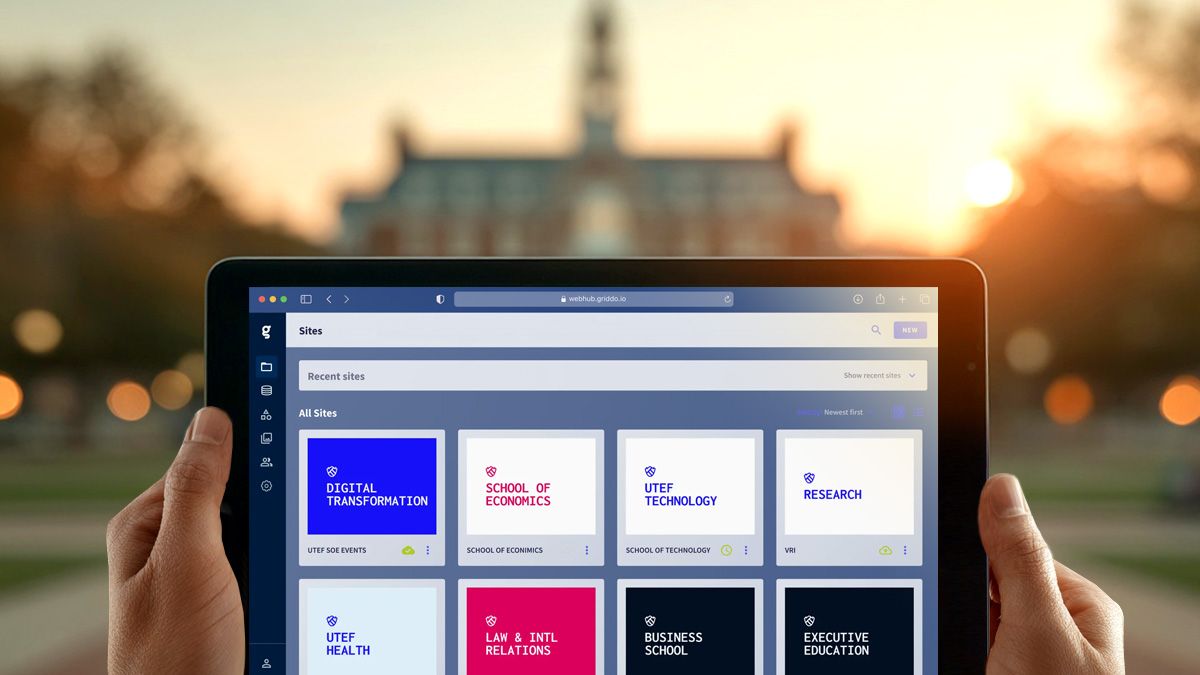
See Centralized Governance in Action
If your institution is managing multiple websites with inconsistent technology, fragmented data, and brand drift across departments, the complexity won't resolve itself.
To see how a purpose-built DXP handles multi-site governance across a real university ecosystem, request a demo at griddo.io
Upcoming Events

JoomlaDay USA 2026
April 29 - May 2, 2026 – Delray Beach, Florida
Be part of the Joomla community in one of the most iconic cities in the world! JoomlaDay USA 2026 is coming to Delray Beach, and you can join us for a dynamic event packed with insights, workshops, and networking opportunities. Learn from top Joomla experts and developers offering valuable insights and real-world solutions. Participate in interactive workshops and sessions and enhance your skills in Joomla management, development, design, and more. And connect with fellow Joomla enthusiasts, developers, and professionals from across the world. Book your seats today.
CMS Summit 26
May 12-13, 2026 – Frankfurt, Germany
The best conferences create space for honest, experience-based conversations. Not sales pitches. Not hype. Just thoughtful exchanges between people who spend their days designing, building, running, and evolving digital experiences. CMS Summit brings together people who share real stories from their work and platforms and who are interested in learning from each other on how to make things better. Over two days in Frankfurt, you can expect practitioner-led talks grounded in experience, conversations about trade-offs, constraints, and decisions, and time to compare notes with peers facing similar challenges. Space is limited for this exclusive event, so book your seats today.

Umbraco Codegarden 2026
June 10–11, 2026 – Copenhagen, DK
Join us in Copenhagen (or online) for the biggest Umbraco conference in the world – two full days of learning, genuine conversations, and the kind of inspiration that brings business leaders, developers, and digital creators together. Codegarden 2026 is packed with both business and tech content, from deep-dive workshops and advanced sessions to real-world case studies and strategy talks. You’ll leave with ideas, strategies, and knowledge you can put into practice immediately. Book your tickets today.
Open Source CMS 26
October 20–21, 2026 – Utrecht, Netherlands
Join us for the first annual edition of our prestigious international conference dedicated to making open source CMS better. This event is already being called the “missing gathering place” for the open source CMS community – an international conference with confirmed participants from Europe and North America. Be part of a friendly mix of digital leaders from notable open source CMS projects, agencies, even a few industry analysts who get together to learn, network, and talk about what really matters when it comes to creating better open source CMS projects right now and for the foreseeable future. Book your tickets today.