Step into the AI ‘Time MACHine’: Jason Cottrell of MACH Alliance on what’s ahead in 2026


As AI agents race from hype to hope, the MACH Alliance is repositioning itself as the composable guide to an emerging agent ecosystem. We leap forward with Alliance president and Orium CEO Jason Cottrell to catch a glimpse of what’s in store for vendors, brands, and the broader digital landscape.
The classic “time travel” trope is one of the most popular narratives in film and media.
As a sci-fi nut, I can’t get enough of it. Go ahead. Challenge me to debate the finer points of tachyons or the stability of an Einstein-Rosen Bridge. And don’t get me started on paradoxes or alternate timelines. That’s my quantum-entangled jam.
We’re on the cusp of the holidays, and as we look ahead to 2026, it’s standard fare to offer up a slate of predictions. Unfortunately, we don’t have Dr. Who’s Tardis on hand (or a sonic screwdriver), so we lean on past experiences to give us hints on what’s ahead.
That was the mission when I spoke to Jason Cottrell, the recently elected president of the MACH Alliance. Jason took the reins in September, fulfilling the Alliance’s charter to adopt an end-user-inclusive leadership model that supports transformation in the AI era.
This year has seen an evolutionary shift as the advocacy group embraced AI transformation as a central focus, unveiling its vision for an “Agent Ecosystem” that unites tech leaders to build the future of enterprise AI. I’ve charted the momentum all year, with the buzz around Model Context Protocol (MCP) and agentic commerce reaching peak levels at “The Composable Conference” in April.

MACH Alliance President and Orium CEO Jason Cottrell. Source: LinkedIn
As CEO of Orium, a consultancy and systems integrator specializing in composable commerce, customer data, and retail platform engineering, Jason brings exactly what the Alliance needs to realize its agentic ambitions. Orium is working at the edge with agents and commerce, blending its composable expertise and AI-ready strategies to provide intelligent, modular solutions for retail brands like New Balance and SAXX.
If there’s a theme to what’s ahead, it’s certainly in the agentic domain, where composable technologies are providing greater flexibility for organizations adopting AI. In fact, according to the 2025 MACH Alliance Global Annual Research report, 77% of enterprises that are well into their composable journey are already using AI. That’s compared to only 36% of those new to MACH.
Based on this data, it’s clear that MACH's open and connected foundation is helping brands “Quantum Leap” (see what I did there?) to successful AI outcomes.
Without question, AI has hijacked almost every headline in the digital space, and rightly so. It’s having a transformative impact on how marketers and developers work, and how platforms and products deliver. The MACH Alliance has aligned with this course, and is hoping to shape the vector and, perhaps, quell the anxiety with the same foundational thinking that elevated composability.
2025 is almost “the past,” my fellow time travelers. It was a year packed with a whole lotta change, but also a gateway to a promising agentic future. According to GlobalData, we've now entered the hyper-growth stage of agentic AI – and this sector is forecast to expand at a CAGR of 48.17% and explode to $45.39 billion by 2029.
As AI keeps dropping daily gifts in our stockings – along with a few DeepSeeking, hallucinating lumps of coal – we’re left wondering: what’s really ahead in 2026? And how do things look through the MACH lens? In my conversation with Jason, he zeroed in on a few big concepts that the Alliance is focused on and why they matter.
I could wrap these five topics in some seasonally-appropriate theming, like Dickens ’ hauntingly prescient A Christmas Carol. But I’m a sucker for the legendary Back to the Future – which never gets old, McFly.
So let's climb into this AI “Time MACHine,” top off our trusty Mr. Fusion, and dial in 2026…
1. Setting the temporal coordinates for high-value agents
Before we go racing into an agent-driven future at 88 miles per hour, Jason is adamant that enterprises establish the right foundations for success. Without the right roadmap and incremental planning, things can take an unexpected turn for the worse.
It’s not hyperbole. Just consult the recent MIT study that suggests 95% of Gen AI projects fail before they reach production. That's compounded by fresh data from Cleanlab, suggesting that the 5% of companies actually running AI in production are rebuilding their systems every 90 days – or faster – due to infrastructure instability and poor performance.
You don’t need Doc Brown to translate the data. The rush to adopt AI and agentic strategies has resulted in missteps around security, scalability, and reliability. That’s why for many brands, 2026 is less about getting the DeLorean airborne and more about getting it out of the driveway.
Cottrell says the feedback from brands and enterprises has been crystal clear: focus on high-utility solutions that yield success. This has been codified by research from PWC, which predicts that enterprises will continue to shift their focus from broad experimentation to strategic implementation of AI solutions that deliver measurable, real-world value and a clear ROI.
“What we’ve heard from big chunks of the market is, I don’t want to go zero to two, I want one,” Jason said. “And that MACH is actually the thing I can move my organization towards.”
He went on to frame MACH’s foundations as a critical step in the journey to agentic transformation – one that allows organizations to take measured steps while enabling greater confidence, and powered by a composable stack that supports a risky trek. Enterprises need to be ready for what’s ahead, and MACH can be a way station to prepare.
“It’s great that we’re talking about this agentic future, but that feels like the summit of Everest, and I’m still trying to get to base camp,” he said. “I can bring in the change management practice. I can get my data in order and my systems accessible. That’s what ‘ready’ looks like.”
To make 2026 an accelerator for success, Jason sees the Alliance deepening its commitment around these fundamentals, helping enterprises plug modern agentic capabilities into architectures that are composable, well-structured, and governable. We’ve already seen the human expertise manifest with the Alliance’s MACH AI Exchange, and that’s exactly the kind of support organizations need to bolster adoption.
Expect more structured programming, guidance, and research aimed at helping enterprises modernize data, accessibility, and architectures – so they can take advantage of agents safely and effectively.
2. The Agent Ecosystem is the ‘Flux Capacitor’ of change
Back in August, I ran a story about the MACH Alliance’s intention to unlock trusted, agent-to-agent ecosystems that drive innovation and collaboration – reinforced by the central tenets of MACH.
At the time, this was being framed as a “refreshing” of its central positioning, positing MACH as the terra firma for AI-ready enterprise architecture. The goal was to ensure that these new endeavors are trusted, open, and scalable across vendor and enterprise boundaries.
Since then, the Alliance has moved audaciously to be a leading voice in the AI pantheon, helping to shape the agent vector. That’s resulted in the development of a membership-powered manifesto appropriately dubbed the Agent Ecosystem. If MACH foundations are the chassis, this burgeoning initiative might be the Flux Capacitor that powers the future.
The Alliance’s Agent Ecosystem crystallizes its market promise as a composable environment where SaaS and AI-native tools connect seamlessly. The focus, according to the website, rests with execution, proving that agents can interoperate and deliver measurable outcomes in real-world production settings.
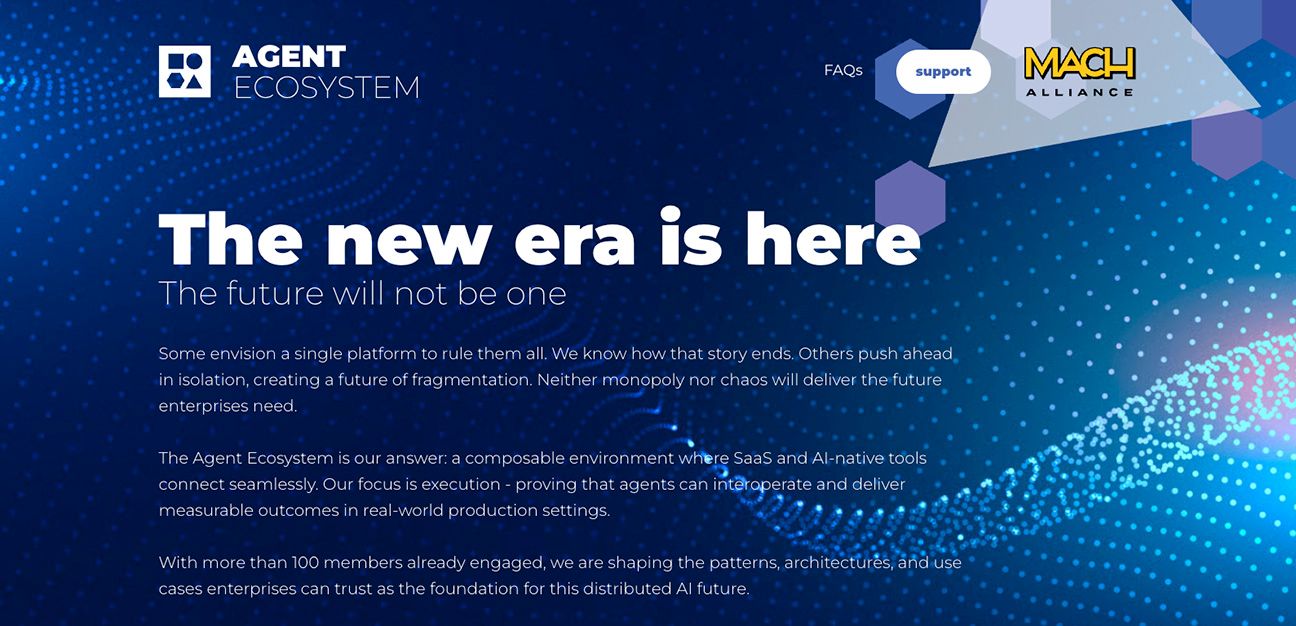
MACH Alliance Agent Ecosystem website. Source: agentecosystem.org
Based on the Agent Ecosystem’s stated mission, the future of enterprise AI will not be defined by a single agent, platform, or vendor – but by hundreds of agents working in harmony. To build a bleeding-edge consortium, the MACH Alliance has opened this cabal to its own members as well as companies beyond its certified platform, laying out the welcome mat to the broader market. As Jason told me, the reaction has been strong and immediate.
“In the last month and a half, we’ve seen more than 70 companies sign on for the Agent Ecosystem pledge,” he said. “And we’ve had many others reach out to us and start following.”
That said, Jason believes MACH members are uniquely positioned for this ecosystem, given their composable postures. He doesn’t see a single, monolithic “super agent” running everything, but a diverse fabric of agents that can be harnessed for a wide range of tasks while enabled by a foundation of interoperability. This is where composability will be a game-changer.
“Pretty much every one of our members was either born for this moment, or they are very actively reinventing themselves to carve out their place in the future of agentic transformation and what enterprises look like with agentic capability at their core,” he explained. “People have recognized that it’s a challenge of composability, that there will not just be one agent that rules them all, but in many cases, hundreds of agents in a typical company that need to work together and alongside people.”
Looking ahead to 2026, Jason has a bold prediction. “We can be one of the first agent ecosystems,” he said. “And I think that’s a powerful concept.”
Indeed. There are plenty of vendors fashioning their own proprietary agent systems right now, and that's creating both opportunities and challenges. But the Alliance’s role, as he sees it, is to be a rallying point that turns scattered agent experiments into a coherent ecosystem. Next year, expect the Alliance to expand its platform as a unifying force for AI, bringing ISV members together to support the growth of its Agent Ecosystem.
3. Powering the time circuits for agent standards
The MACH Alliance has built its value and reputation as a beacon for guidance, with the base MACH architecture serving as its bedrock. One might muse that the Alliance would be a proponent of creating similar standards for its Agent Ecosystem – and while that might be a goal, Jason said they’re intentionally not jumping too far into the future.
For 2026, the priority is experimentation and execution. In other words, doing more work and not freezing things into a rigid spec too early in the process. But ideation is already surfacing via a series of focused AI Exchange hackathons that coordinated with the MACH X Conference in London. The competition yielded some cool solutions that are moving into production-ready status, including a B2B Wholesale agent and a Fraud Detection AI agent.
Gus Fune, CTO of retailer BÆRSkin and Ambassador for the MACH Alliance, said that managing fraud detection is like playing a game of “whack-a-mole,” sucking time away from teams and adding to the cognitive overload. This is exactly why they see it as an ideal use case for AI agents: it's complex enough that you can't just automate it with simple rules, but structured enough that you can measure real value and see early results.
“Today, it’s very much about actually doing,” Jason said, affirming that there’s not going to be an immediate standard on how all agents must work together, or a 42-point guide that outlines interoperable requirements. At the same time, the innovation is putting real ideas and use cases into action.
“We see tens or even hundreds of agent combinations that we’ve encouraged our members to build, and we’ve been at the center of that dialogue and exchanging what we're learning.”
Along these innovation lines, Jason explained how the Alliance is aiming to accelerate real joint builds – pushing the boundaries on what’s currently possible.
“What we’re trying to do right now is just accelerate that process,” he said. “We see tens or even hundreds of agent combinations that we’ve encouraged our members to build, and we’ve been at the center of that dialogue and exchanging what we're learning.”
That empirical base will likely form the foundation for future standards, which will serve more of the agent-to-agent vision that the Alliance has been promoting. But Jason sees this going beyond 2026, with a more immediate focus on eliciting data and feedback. From there, standards can begin to solidify – perhaps in more tangible tools and actionable practices.
“The next year on the agentic front really is about getting our members building those cross-agent use cases much sooner than they might otherwise, and with a bit more deliberate study on what is and isn’t working,” he outlined. “I think for 2027, the goal will be documented best practices, and eventually that may lead back to certification services or other formats.”
4. Exploring ‘alternate timelines’ for CX, data, and commerce
I traveled back in the “Time MACHine” to explore my previous December predictions with former MACH president Casper Rasmussen, and one in particular came up from 2024: the idea that MACH might expand into other industries. MACH’s story started in a retail and eCommerce timeline, but Casper envisioned the broadening of MACH’s core patterns and concepts to concentrated verticals like finance and automotive.
When I asked Jason about this evolutionary path, he was quick to point out that MACH and composable are already making gains across industries. Rather than chase verticals one by one, he sees the Alliance focusing on three intersecting domains that exist almost everywhere.
“I think the focus for us is probably less from an industry perspective, and more at the intersection of customer experience, customer data, and in commerce,” he said. “That’s where we think the confluence of agentic capabilities amongst our members can really reach critical mass. And not just the agentic capabilities, but the associated tools, context, observability, and other infrastructure needed to make it work well.”
As Jason said, the Alliance is already pulling in a wide set of players in different categories, which was evident at the MACH X event. As he looks ahead to 2026 and beyond, industry-specific expansion is almost an inevitable result – especially as more enterprises adopt agentic strategies and look at the Agent Ecosystem as a foundational resource.
“We saw it at MACH X,” he said. “Those three domains appear in so many firms, and that’s why we’ve got banks, travel companies, and automotive firms there. If we deliver value at the center of these domains, then the next phase, from an industry perspective, I think what will come naturally.”
5. Avoiding temporal paradoxes with risk and governance
In this new era of AI, the biggest dangers aren’t theoretical. There are real failures of agentic systems at scale, and they’re creating headaches for brands as they begin to execute in real-world applications. I’ve already shared that compelling research from Cleanlab that codifies how infrastructure instability and reliability issues are plaguing AI agents in production.
But Jason took it one step further, highlighting governance as a critical fault line – and how trust is impacted. “Most of these failures occur when the scope of these agents is too broad, so you can’t appoint them, govern them, and trust them in practice.”
Governance is a decisive factor with every technology, and agentic AI is no exception. In contrast to the failures, Jason said that he’s seeing success around narrow, well-governed agents that are aligned to existing structures and vendors. “It’s narrow agents appointed on specific items with appropriate governance overlaid,” he explained. “That’s where we’re seeing them work.”
“We have a powerful asset in our Ambassador network. When you have these global brands that have been down the path and are willing to be involved, to contribute and advocate, I think that’s a powerful thing.”
Jason also pointed to vendors that are reframing themselves as “systems of action,” where people and their agentic counterparts are effectively sharing workflows. While we’re accustomed to validating the importance of humans in the loop, this points to the emergence of new roles and structures within organizations as AI agents become a default fixture. This blend could further enhance governance.
“We’re seeing concepts emerge,” he explained, “where companies see themselves almost as a system of action, where human and agentic workflows are coming together.”
Looking ahead to 2026, Jason reinforced the importance of governance in the evolution of agentic AI. But doing it the right way requires proven expertise from end-user organizations that have been through the trials and tribulations. This is where MACH Alliance Ambassadors – individuals and brands who have already gone through MACH transformations and are champions of composable – will be an essential lever.
“We have a powerful asset in our Ambassador network,” he said. “When you have these global brands that have been down the path and are willing to be involved, to contribute and advocate, I think that’s a powerful thing.”
Having these battle-hardened minds in the trenches will certainly shape how governance will be created and shared – and ultimately help enterprises mitigate risk. As Jason prognosticated, we can expect governance for agentic systems to be published by brands with supplement from vendors, providing valuable and actionable content in the coming year.
When this baby hits 88 miles per hour…
You’re gonna see some serious MACH.
Said another way: prepare for more acceleration as we turn the corner to 2026.
Look, speed can be scary. Risky. Unpredictable. The same is true of time travel, by the way; it rarely goes smoothly. In this hyperbolic age of AI, we have to move quickly to survive and thrive. But if your calculations are correct – and you have the right copilot in your DeLorean – you might have the means to stay ahead.
For Jason, this agentic wave is the most consequential shift he’s seen in two decades – and the MACH Alliance has a rare chance to help steer it in the right direction.
“This next phase towards agentic transformation is the biggest point of potential that I’ve seen in the 20 years that I’ve been doing this,” he remarked. And while he sees it as truly disruptive, he’s also candid about the challenges of keeping pace. “I wake up concerned about making sure that we’re moving fast enough, because the pace of this market is moving so quickly.”
2026 is still replete with uncertainty, from economic headwinds to geopolitical turmoil. At the same time, the MACH Alliance is trying to evolve its identity – and its value – as a wide-reaching industry authority in agentic AI. As he noted, the group continues to demonstrate its impact by investing in thought leadership, research, education, and human intelligence in the realm of AI.
Despite the challenges, Jason seems bullish about what’s ahead. There’s clearly a lot to be done, but he believes the Alliance has a very unique perspective on this domain. And among its membership, a collaborative mindset that can lay the framework for one of the first agent ecosystems – and a promising horizon for agent-to-agent interactions.
So saddle up, McFly. It’s gonna be a bumpy ride.
But let’s focus on the possibilities, not just the problems. Take a page from Doc Brown:
Your future is whatever you make it. So make it a good one…
Upcoming Events

CMS Kickoff 2026
January 13-14, 2026 – St. Petersburg, FL
Meet industry leaders at our fourth annual CMS Kickoff – the industry's premier global CMS event. Similar to a traditional kickoff, we reflect on recent trends and share stories from the frontlines. Additionally, we will delve into the current happenings and shed light on the future. Prepare for an unparalleled in-person CMS conference experience that will equip you to move things forward. This is an exclusive event – space is limited, so secure your tickets today.

Umbraco Codegarden 2026
June 10–11, 2026 – Copenhagen, DK
Join us in Copenhagen (or online) for the biggest Umbraco conference in the world – two full days of learning, genuine conversations, and the kind of inspiration that brings business leaders, developers, and digital creators together. Codegarden 2026 is packed with both business and tech content, from deep-dive workshops and advanced sessions to real-world case studies and strategy talks. You’ll leave with ideas, strategies, and knowledge you can put into practice immediately. Book your tickets today.