Sweet FlowMotion: Storyblok Transforms Content Updates into Automated Workflows

The headless CMS has released its new automation and orchestration layer, designed to help marketers and developers transform content changes into consistent and governable updates across the entire digital and AI ecosystem. Interview with CEO Dominik Angerer.
I love it when a software product really jams. It’s music to my digital ears.
New features don’t always hit the right notes, but when I saw Storyblok’s FlowMotion debut at its inaugural JofConf in Amsterdam last October, I was feeling the groove. And based on my initial conversations with a few agency partners, there was some Sweet Emotion about the possibilities (queue the Joe Perry solo).
Case in point: I recently caught up with Storyblok MVP Chad Solomonson, and he shared how his agency, RDA, is successfully unlocking “joyful” next-gen capabilities as a Storyblok Platinum Partner. They’ve been consistently pushing the platform’s boundaries and pioneering new solutions – and FlowMotion is igniting new possibilities.
“We are very excited about FlowMotion,” Chad remarked. “It brings more speed and control to marketing teams. Our clients will benefit because strategy, content, and execution will move together.”
In my detailed recap of JoyConf 2025, I called out FlowMotion as one of the clearest signals of where Storyblok is headed. While CEO Dominik Angerer is still laser focused on delivering the best headless CMS, he and his team are building something more: a platform for orchestration, automation, and (crucially) governance in an increasingly AI-saturated stack.
Yesterday, Storyblok announced the full release of FlowMotion, and I sat down with the company’s passionate but humble leader for some additional “context” on this moment. As he told me, FlowMotion is helping both human teams and autonomous agents to move beyond manual coordination with workflows that can power anything – AI or otherwise.

Storyblok CEO and co-founder Dominik Angerer. Source: Storyblok
In our conversation, we talked about new research that Storyblok conducted, and how it exposes the gaps that teams experience with content coordination. FlowMotion is acting as a critical bridge for overcoming these challenges, giving both marketers and developers an elegant, unified framework for success.
Velocity is an essential requirement for every software company – and with AI, speed is becoming hyperbolic. But Dominik is always quick to credit the human side of how they deliver, which has reinforced FlowMotion’s success.
“My team, they surprise me every week,” he said. “Which has never stopped.”
It’s precisely the kind of thing I expect to hear from this down-to-earth CEO.
As such, we also touched on Storyblok’s treasured culture of innovation and how enabling “content confidence” is a guiding principle. Because your AI can’t rock if your content isn’t rolling – and this is where Storyblok really sings.
What is FlowMotion?
If there's a lyrical hook in Storyblok’s theme song, it's FlowMotion – an automation and integration layer that lives inside the platform, allowing you to connect systems and orchestrate processes along the entire content lifecycle.
As I described it at JoyConf, the whole process feels like butter. You can build a new flow, and when ready, it takes over to handle approvals, execute tasks, even push things live. And like all things in Storyblok’s UX, it’s simple and intuitive. Catchy, even. Like a tune you want on repeat.
With FlowMotion, you can adapt workflows to suit your own processes or tools. You can also connect the AI model or agents of your choice, so you have a lot of flexibility to hook things up across your ecosystem.
From a usability perspective, it also serves everyone on your team, providing marketers with an easy-to-use experience while enabling developers – who are focused on complex tasks like migration – to drop into code and write custom transformations in JavaScript or Python.
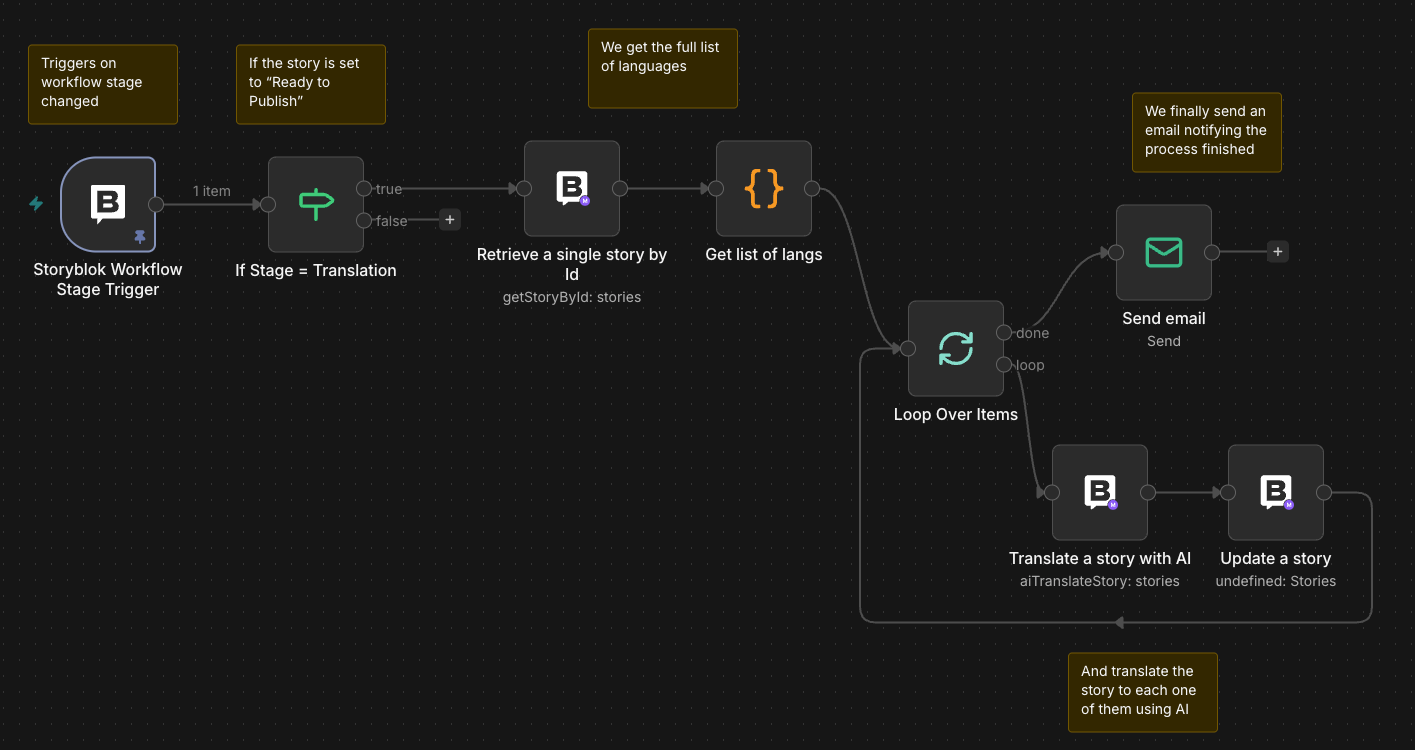
FlowMotion in action. Source: Storyblok
Similar to other drag-and-drop interfaces in tools like Salesforce, FlowMotion is natively visual. In seconds, you can design smart content workflows and even orchestrate AI agents to perform a multitude of tasks. You can activate a flow from any Storyblok action to create, update, publish, schedule, or translate content. You can also sync with systems like DAMs, trigger alerts, and so much more.
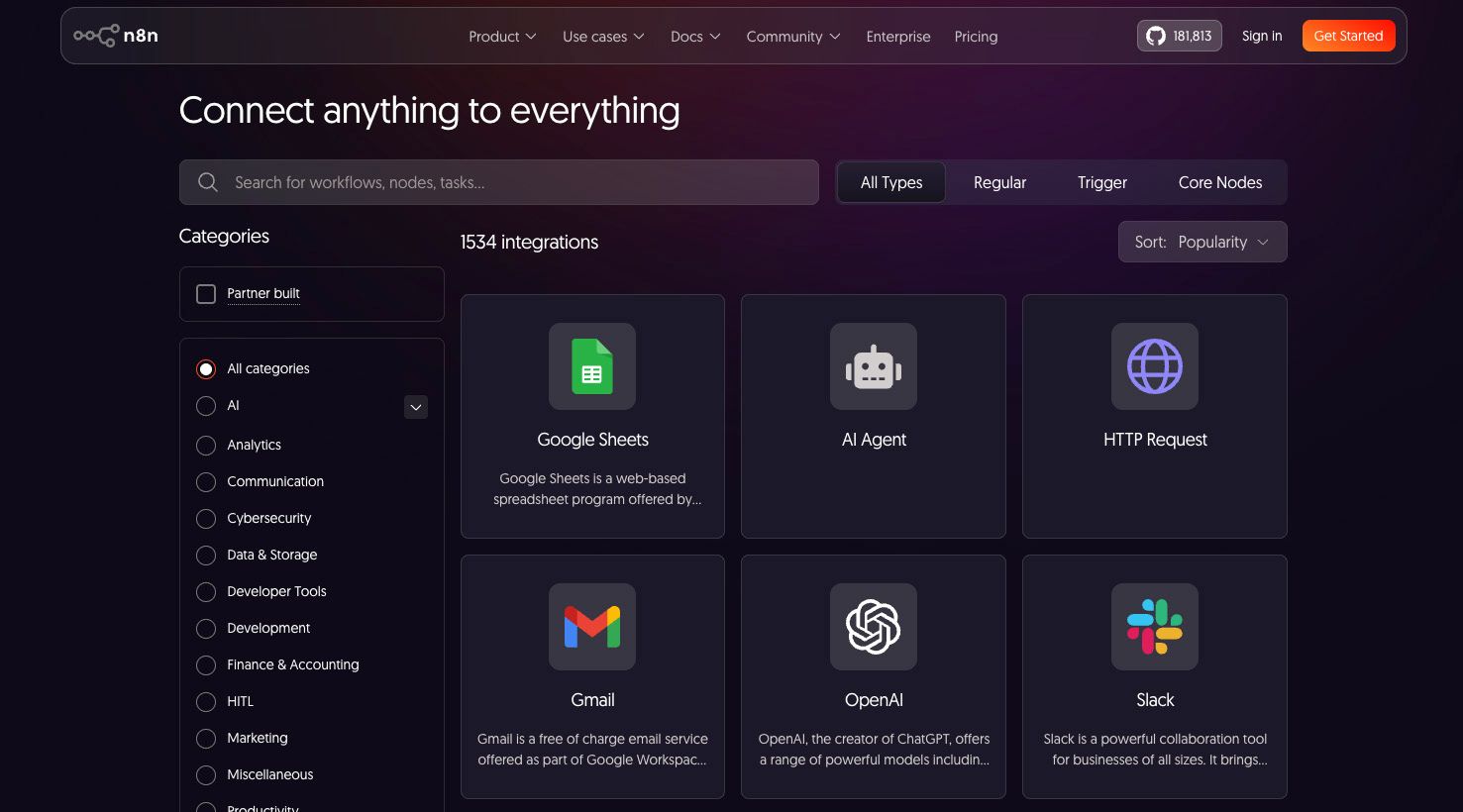
Architecturally, FlowMotion is powered by n8n, one of the most versatile AI workflow builders on the market. Trusted by global brands like Microsoft, Vodafone, and Wayfair, n8n offers dynamite drag-and-drop functionality and a marketplace of off-the-shelf software integrations.
Source: n8n website
Since last year, n8n has grown its suite of enterprise tools and platforms. Choose from hundreds of integrations like Slack and MailChimp, and nodes that govern functions like cron jobs, web hooks, and more. And it’s all frictionless.
One of my favorite things is having a CEO demo a product for me. That’s what Dominik did during our call, showing me just how easy it was to perform a content page migration, but then add a Slack component to the workflow by dragging and dropping from the available integrations. As a software engineer by trade, he illustrated just how magical it can be.
What I love about FlowMotion is how it provides the connective tissue for coordinating work across an ecosystem. It has the ability to connect everything: analytics, e-commerce, CRM. All of it. With this layer of automation, you can spend less time moving your content around – and more time creating better stories that activate your audiences.
FlowMotion has come a long way since JoyConf, evolving from an ambitious beta into a tightly integrated solution that’s ready for real-world scale. What’s striking is how much of that journey has been internally driven by a wide range of stakeholders.
As Dominik told me, his team is using FlowMotion as a backbone to improve and accelerate its own operations – everything from sales to onboarding to internal automation. And this wasn’t a lab project. His sales and enablement teams have already been working with FlowMotion for months, and that’s giving them greater confidence with customers.
“We completely trained our SEs in January on FlowMotion,” he said. “Suddenly, they started building out things to show to clients. Now, they’re really excited about it.”
Solving the content update problem for marketers and developers
As mentioned, the FlowMotion announcement was accompanied by research that Storyblok conducted with 200 marketers and 200 developers, all of whom are working with global brands. According to Dominik, the results underscore the urgent need for FlowMotion.
The thesis is simple: content updates seldom end at “publish,” with a single change triggering approval, localization, catalog updates, search re-indexing, and more. Teams can automate some of this, but the coordination is still happening in Slack, spreadsheets, and scripts – where the cognitive load and “swivel chair” moments are being exacerbated.
Here’s how the impacts are being felt:
- Marketers are getting crushed by coordination. According to the data, 75% reported spending more than six hours a week dealing with this coordination chaos. This includes the manual work of approving, following up, and routing content between systems. Most tools don’t natively communicate with one another, and almost no one has end-to-end workflow coordination. As a result, half of the respondents reported content updates going live late, incomplete, or inconsistently across channels or regions.
- Developers are also swimming against the current. In fact, 88% reported that implementing new automation workflows takes more than a week, with over a third saying more than a month. Engineering resources are tied up with things like integrations, scripts, and workflows – and only a tiny percentage have the kind of centralized and observable workflow logic needed to wrestle down control.
If there’s a recurring tension I see across digital teams right now, it’s this widening gap between marketers and developers in the AI era. Tools promise to “help” both sides of a bifurcated organization but often end up favoring one at the expense of the other, creating friction instead of removing it.
It’s a story we’re all too familiar with. Dominik is seeing that first hand.
“Whenever we talk to marketers and developers, we basically see one clear message from both of them,” he said. “We don't know if we can bring AI to the table without screwing the other one over.”
He couldn’t be more on point. Spin up a marketing-focused AI that auto-generates HTML or fully templated pages, and you might blow up a carefully constructed development pipeline. Put AI solely in the hands of developers, and marketers are left waiting on sprints and tickets to get even basic ideas tested. Same old song and dance (thanks again, Aerosmith).
“Within just a few weeks, we were able to turn a complex, manual content synchronization challenge into a fully automated workflow. Previously, this required a mix of manual updates and custom scripts across different systems and markets. With FlowMotion, we will now handle this automatically, which significantly reduces complexity and frees up time for more valuable work.”
Christopher Bergdahl, Product Owner Web at Systemair
For Dominik, FlowMotion is like a negotiation layer between those worlds. By turning Storyblok content events (creating, updating, approving, translating, scheduling, and publishing) into meaningful workflows, it can take over the coordination of things like ordering tasks, allowing for human approvals, providing AI-enrichment, and more.
It’s also delivering workflows that are versioned, observable, and debuggable, with clear audit trails that take governance to the next level. That’s why he sees it as a business bridge that enables everyone to speak the same language again.
“Right now, they’re frustrated,” Dominik observed of both marketers and developers. “If we can give them an interface where both can work together in a process-oriented way, where they can insert data and information, and then step by step, navigate that through to the chief assessment outcome, they’ll be faster and less frustrated. How can we optimize your day-to-day? That’s what we can now do with FlowMotion.”
Finding efficiency in the automation flow
The AI tools market is currently in a state of what one might call “agentic sprawl.” Every vendor is lamenting the loss of its moats and developing its own flavor of copilots, assistants, and walled-off workflows. Organizations like the MACH Alliance are working towards more uniformity with the realization of an “agent-to-agent ecosystem,” but we’re not there yet.
AI is nearly ubiquitous. Saturating products from end to end. But Dominik had a refreshing take that many vendors blur: AI doesn’t belong everywhere in the workflow. In fact, overusing it can be both costly and operationally risky.
To that end, he explained how FlowMotion’s design makes a sharp architectural distinction between things machines can do cheaply and reliably without LLMs – and cases where AI agents make sense. This helps minimize the burn on tokens while delivering more efficient performance.
“We’re doing these trainings for partners, where we show them the difference,” he said, pointing to the hands-on approach Storyblok takes with customer success. “If you have something where you want to generate a summary or unstructured information, something where it's the proper use case, where AI makes sense, spawn an agent. Let it do it.”
As for the rest? Don’t waste tokens. “The compiling of data, which requires so many tokens, is just getting more and more expensive,” Dominik added. “And this is not a nice place to be.”
Of course, the other side of the coin is how users handle data directly, and this is where FlowMotion comes in. By defining processes once, you can eliminate duplicate efforts. As he told me, customers are buying different UIs and realizing they need to copy and paste between windows – a futile activity that just slows everything down.
“They don't have a shared understanding,” he reinforced. “I don't want to have our users copy and paste things around.”
As an automation and orchestration engine, FlowMotion is addressing this core issue of efficiency. It can be part of the mechanism that operationalizes performance and helps guard against the rising costs of the AI token economy. It’s a critical goal for every AI-forward organization, and an advantage for Storyblok’s system of governance.
Powering agencies with AI and automation
Storyblok has been ambitiously growing West from its European roots, partnering with agencies like RDA to tap channel growth. Their partner ecosystem is expanding, and that’s a testament to their product, training, and support.
But agencies are at their own crossroads as AI puts their traditional revenue models at risk. The shift from billable hours to an AI token economy is real. At the same time, customers are confused and need guidance. This is where Storyblok is helping agencies harness FlowMotion as wedge for transformation, and Dominik explained how that support is manifesting.
“We had a couple of FlowMotion hackathons the last couple of weeks,” he said. “We really spend time and money to onboard the right partners.”
But as agencies move away from billing by the hour to building by the outcome, Dominik sees an opportunity to leverage Storyblok’s AI capabilities – tethered with FlowMotion – to design new systems of execution governed by workflows.
The outlook for agencies might feel sobering, but I’m seeing an increased enthusiasm – and for good reason. Enterprises are struggling to find firm ground in their AI transformation, and agencies can be a lever for guidance and support. This is something Scott Brinker echoed in a recent post.
Still, they need the right tools with the right roadmaps – and that’s where Dominik sees a pivot towards value and requirement engineering. In this sense, FlowMotion isn’t just a value-add feature for Storyblok customers, but a design surface for agencies to reinvent their own offerings around designing, implementing, and governing automations.
Becoming stewards of ‘content confidence’
While FlowMotion was the focus of our conversation, we did veer into the future roadmap for Storyblok. There continues to be strong enthusiasm for Storyblok Strata, which enables vectorized content for intelligent search, conversational chatbots, and knowledge extraction to surface insight and summaries. And Storyblok’s Ideation Room continues to provide a flexible, collaborative, AI-powered playground for experimenting in labs.
One of the most compelling threads in our conversation was Storyblok’s emerging narrative around “content confidence.” More than a marketing tagline, it’s a direct response to the crisis of trust and governance that enterprises are feeling as AI becomes more deeply embedded in their workflows.
For Dominik, this isn’t just about instilling confidence for humans – but for machines as well. And this message couldn’t be timelier. As Matt Biilmann’s vision of the “Agent Experience” becomes foundational and GEO enforces more structure, this piece is becoming paramount.
“This is why we created an automation platform where you can actually focus on how to make things without the need for AI, but still hook AI into the best things.”
Dominik Angerer
“This is about letting your users and agents run with confidence, because that's what's going to happen,” he said. “You need to have one common ground, one common understanding, but maybe in multiple different contexts. And that's where we come in.”
What Dominik crystallized is the future of the CMS as more than a content store. It’s a “context engine” for both humans and machines – a place where structure, permissions, and governance converge. To make it meaningful, he’s advocating for truly open systems, and this is where FlowMotion and its MCP layer intersect.
“This is why we created an automation platform where you can actually focus on how to make things without the need for AI, but still hook AI into the best things,” he explained. “You can reuse workflows, or you have Claude generate them for you.”
I can’t think of a better word than “confidence” to describe the aspirational goal. Content is being eroded on so many levels, but Storyblok is evolving it to a higher plane of reliability and governance within a system of record.
The missing “why”: capturing decision context for AI
Late in our conversation, I asked Dominik about the next frontier as our platforms become conduits for AI. As a software engineer by trade, he sees a deep structural gap in how systems record human intent, both in code and in content.
But why do we make the decisions we do? As humans? He took me back to formula, exploring the black box of context that will never be found in any database or repository. As he told me, extracting a developer’s motivation from lines of source code is impossible, and the same is true of content.
But what if we had that knowledge? Right now, as Dominik explained, this “why” is effectively invisible to both humans and AI.
“It’s not just about the context of the content you're producing,” he said. “I can create a landing page. I can create an article. But why? Why did you decide as a human to do that? This is the missing context. I believe no system is storing the information of why you set it up in a certain way. And this is going to be crucial to have AI really understand the proper context, because it's not just the output.”
Storyblok is experimenting in this area, and Dominik hinted at a paper he’s working on that will go deeper into this “hidden context” problem. If they can find a credible way to encode decision rationale into the content layer – and expose it to AI safely – that could be a game changer.
The verdict
Storyblok continues to build its story around its customers. For modern enterprises, AI agents and automation are clearly the expectations. But if my conversation with Dominik demonstrated anything, it’s the importance of understanding where AI makes sense in the scope of workflows – and he provided sage advice around the efficiency considerations. This is being overlooked in certain corridors, and there’s a reckoning ahead as tokens explode in cost.
FlowMotion represents a promising answer to the challenges that both marketers and developers face in the shared ecosystem. It’s incredibly fluid, allowing you to build rules-based workflows that can assume the rigors of your content operations with total control. While some might question the reliance on n8n as the structural backbone, it reflects a best-of-breed approach that scales access to hundreds of integrations (and growing).
In a market obsessed with slapping AI on every surface, it’s refreshing to see a vendor that’s equally focused on what should not be AI – and on the deeper philosophical questions of context, confidence, and the missing “why” in our digital systems.
Then again, this kind of edgy exploration is Storyblok’s culture, something Dominik has shaped over the years. And it’s why, among other things, its customers will be singing “Sweet FlowMotion.”
My Recommendation: Storyblok has one of the best reputations on the market for its headless CMS. With Tesla, Netflix, and Oatly as customers, you’re looking at a trusted solution that actually delivers on “joyful” user experiences. If you’re evaluating products, you can create a free Starter account in minutes, but enterprise use cases would benefit from a comprehensive demo with a sales engineer. Pricing is clear, but Premium and Elite plans are where larger editorial teams play – and dedicated testing environments are included. As for FlowMotion, it’s only available as an add-on for its Enterprise customers. Put it on your shortlist.
Upcoming Events

JoomlaDay USA 2026
April 29 - May 2, 2026 – Delray Beach, Florida
Be part of the Joomla community in one of the most iconic cities in the world! JoomlaDay USA 2026 is coming to Delray Beach, and you can join us for a dynamic event packed with insights, workshops, and networking opportunities. Learn from top Joomla experts and developers offering valuable insights and real-world solutions. Participate in interactive workshops and sessions and enhance your skills in Joomla management, development, design, and more. And connect with fellow Joomla enthusiasts, developers, and professionals from across the world. Book your seats today.
CMS Summit 26
May 12-13, 2026 – Frankfurt, Germany
The best conferences create space for honest, experience-based conversations. Not sales pitches. Not hype. Just thoughtful exchanges between people who spend their days designing, building, running, and evolving digital experiences. CMS Summit brings together people who share real stories from their work and platforms and who are interested in learning from each other on how to make things better. Over two days in Frankfurt, you can expect practitioner-led talks grounded in experience, conversations about trade-offs, constraints, and decisions, and time to compare notes with peers facing similar challenges. Space is limited for this exclusive event, so book your seats today.

Umbraco Codegarden 2026
June 10–11, 2026 – Copenhagen, DK
Join us in Copenhagen (or online) for the biggest Umbraco conference in the world – two full days of learning, genuine conversations, and the kind of inspiration that brings business leaders, developers, and digital creators together. Codegarden 2026 is packed with both business and tech content, from deep-dive workshops and advanced sessions to real-world case studies and strategy talks. You’ll leave with ideas, strategies, and knowledge you can put into practice immediately. Book your tickets today.
Open Source CMS 26
October 20–21, 2026 – Utrecht, Netherlands
Join us for the first annual edition of our prestigious international conference dedicated to making open source CMS better. This event is already being called the “missing gathering place” for the open source CMS community – an international conference with confirmed participants from Europe and North America. Be part of a friendly mix of digital leaders from notable open source CMS projects, agencies, even a few industry analysts who get together to learn, network, and talk about what really matters when it comes to creating better open source CMS projects right now and for the foreseeable future. Book your tickets today.