Forget the SaaS eulogy. Software isn’t dead – but hiding behind it? That's six feet under

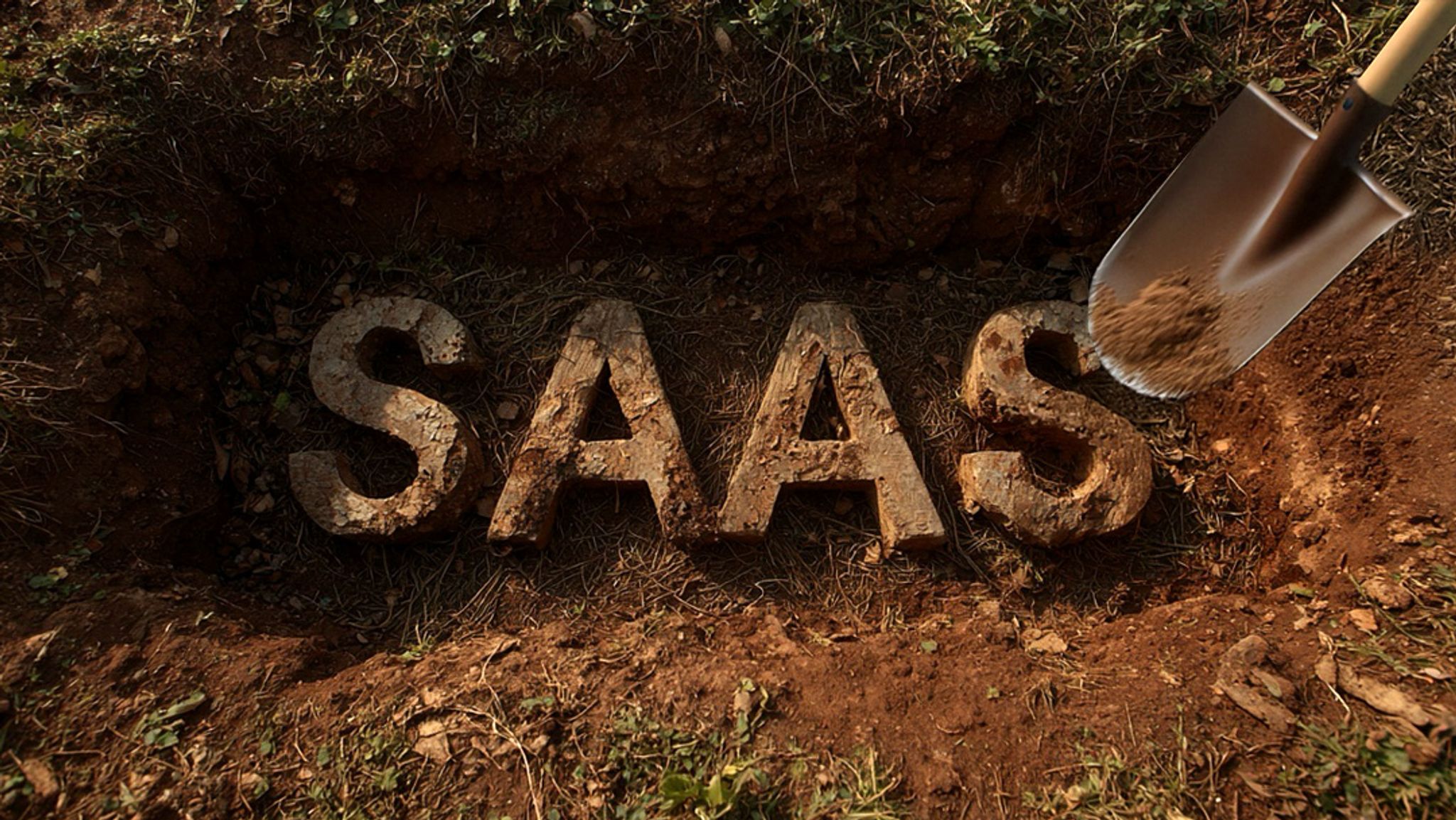
The SaaS funeral march might feel grave, but Sitecore’s Eric Stine isn’t buying the obituary. In our recent conversation, the tech CEO shared his perspective on how brands are adapting to AI discovery, where trust is being tested, and how visibility, personalization, and orchestration are the hurdles – and opportunities – for stakeholders in an AI-driven economy.
Here’s a fun experiment: Google “The death of software.”
I know, I know. We’re going old school here. Close Claude, open Chrome, hold your nose if you must, and give it a shot. The blue links won’t kill you.
Just focusing on the last two months – ever since the fallout from the macabre “SaaSpocalyse” roiled the markets – there have been numerous headlines featuring this phrase, from mainstream media to Medium posts.
Perspectives run the gamut. Let’s dissect a few:
- Mark Cuban pronounced it dead, proclaiming that the “rigid era of SaaS is over.” In a viral interview, he described a world where software will be customized to your unique utilization, and AI models will mold themselves around business needs in real time.
- Andreesen Horowitz’s Steven Sinofsky said “nah.” Not dead. He believes AI is changing what we build and who builds it, but not how much needs to be built – and in his mind, we need more. A lot more.
If you’re brave enough to scroll through a few more pages of results, you’ll find evergreen artifacts, including this gem from InfoWorld in 2005, aptly titled The Death of Software. At the time, the author was responding to the precipitous trend of outsourcing, suggesting it was the curtain call for students pursuing careers in computer science.
“There is simply no worthwhile future in American software,” he said.
So much for accurate prognosticating.
Keep searching, and you’ll see how deep our fascination with doom really runs. No lie: as I was working on this article in New York last week, I received an email pitch from a PR firm, asking me if I wanted to write about “The Death of SEO.”
For a less morose POV, check out Reid Hoffman’s recent obit on the SaaS funeral. We’ve been saying the same thing since this whole AI-induced panic began (you can read my own thoughts on the “SaaSafrass”). The signal is clear: the death of software has been greatly exaggerated.
Yes, the moats around SaaS are being de-moated. The time and materials equation is being rewritten. Panic and fear did hammer tech stocks, but eroding margins isn’t the same as pushing up daisies.
As Reid said, the leap from “the old SaaS model is being disrupted” to “no one will sell software anymore” is (and this is my favorite line) a distinct flavor of foolishness.
There is indeed an AI transformation upon us. No one can argue that. Some companies are adapting. Others won’t survive the shift. But that’s always been the lifecycle, from print to digital, on-prem to cloud. If you need more evidence, just look at the change in digital commerce over the last 20 years.
Still, the allure of vibe coding your way to a new stack is intoxicating. Imagine swapping your CMS with some raw code and markdown like Cursor did, or conjuring a new CRM with Andrej Karpathy’s hot new programming language (it’s English, BTW).
But is it production-worthy? Secure? Scalable? HIPAA compliant? And what about the network intangibles like customer relationships or vertical specialization? Even if your vibe coders can replicate, are they able to roadmap?
I think the biggest challenge today is defining what software is – and AI is a foundational part of that answer. As such, new moats are emerging. Elegant, sophisticated agentic systems and capabilities are being pioneered with deep knowledge, logic, and complex workflows. That's where the frontier of opportunity lies.
At last November’s Sitecore Symposium, I saw this pulsing from the new SitecoreAI, the extensible innovation heart of its Sitecore Studio platform – designed with an agentic core that harnesses AI at every level. It was a bold move and a big investment for the market leader, one that fully embraced AI as the ecosystem’s defining attribute.
In many ways, it breathed new life into the promise of what Sitecore can deliver for marketers, and I heard this from many practitioners and partners who were looking to the ecosystem for terra firma in a topsy-turvy AI landscape.
It also handed agencies a deeper agentic toolbox – and as Scott Brinker recently said, the services side of our business is feeling bullish as enterprises struggle to find their footing. They need more help and better tools to master AI as the next step.

Sitecore CEO Eric Stine
Guiding this complicated transformation is Sitecore’s vigilant CEO, Eric Stine, and we recently sat down to discuss his perspective on software’s so-called demise. As he told me, SaaS isn’t dead, but hiding behind it is.
To Eric’s point, brands can’t cower in this moment. They need to emerge in a power position, built on products that deliver visible, personalized, and trusted answers in an AI-shaped world.
His take isn’t a eulogy – it’s an epiphany.
Why SaaS needed AI (and now AI needs SaaS)
Eric described the recent “SaaSpocalypse” as more of an inflection point, a decade-long growth model hitting the whitewater. But there’s something almost serendipitous about AI’s arrival, which is simultaneously rewriting how products are built, used, and even bought.
A big part of the calculus is the shift towards answer engines, which is changing the discovery game at a marketplace level. This is uncharted territory, and we need a new map to navigate these waters. The legacy rules no longer apply in a world where the agent experience is almost as important as the human one.
And while the fragmentation is real, Eric sees this moment as pivotal to the future of software – and what problems it will solve.
“I don't see it as chaos or noise,” he said. “I actually see this as attention that is long overdue and necessary, both for the survival of software, and what I will call the ‘practical reality of AI’ as the next generation of what software is.”
Eric drew a straight line from hardware to software to SaaS to AI, rendering it less of a “market rupture” and more of a natural turn of the wheel. AI is simply part of what we can see as the next evolutionary step.
So what actually is ending? Not SaaS, he argued – but the shipping of undifferentiated software, hiding behind sales capacity, and expecting the old playbook to keep working. In essence, it was time for a shakeup, and that’s what we’re seeing.
“I love the concept of tension, because AI is forcing software to change. Software will ground AI, and it will change it by giving it that locus and that center of gravity.”
“If sales were a leading indicator of growth, then as an industry, we had hired all of the sales capacity we needed for the product set that existed at the time,” he said. “AI came along just in the nick of time. I think SaaS needed AI, and I think AI needs SaaS.”
That last part is the key. SaaS has run out of runway. It can’t hobble along purely as a delivery model and expect both customers and investors to buy infinite variations of the same application logic. As Eric explained, AI has changed the slope of the curve. But he’s equally blunt that AI, by itself, doesn’t magically replace systems of record or enterprise-grade processes.
“As an industry, AI allows SaaS to innovate with a level of speed, scale, and scope that has not been possible for the 10 years in which SaaS has been the dominant deployment architecture,” he said. “But systems of record are ‘systems of record’ for a reason, and in our industry, that's more important than in places like ERP or supply chain, which have long been linear processes."
Expanding on that, Eric reinforced how Sitecore’s role is to help marketers use this combination of SaaS that’s enabled by AI. At the same time, he pointed to a healthy tension that exists in all of this. He sees that force as a critical design principle, and not necessarily a problem that software leaders should simply “resolve.” It’s more like a fulcrum for transformation.
“I love the concept of tension, because AI is forcing software to change,” he said emphatically. “Software will ground AI, and it will change it by giving it that locus and that center of gravity.”
AI for possibility and speed. SaaS for process and durability. The future, in his framing, might belong to platforms that can hold that tension in place and reap the benefits.
From chaos to orchestration: How AI is elevating marketers
I’ve written extensively about the cognitive load that marketers face – that delicate balancing act as we move from one tool to another, often lacking the essential context to make those shifts more meaningful. According to a Harvard Business Review study, this “toggle tax” results in a loss of anywhere from nine to 23 minutes.
Marketers are drowning in tools, channels, and mandates. Dozens, even hundreds in some cases. And while AI is seen as a panacea, it’s also creating challenges, particularly around the extensibility of agents across discrete systems.
Having developed a deep understanding of the marketer’s persona, Eric outlined where AI is bringing practical relief to the key areas of orchestration, visibility, and conversion. He called it bringing “order to the madness.” And if you’ve ever experienced the “swivel chair” reality of jumping between CMS, DAM, a personalization engine, analytics, and a pile of spreadsheets, you already know what he means by madness.
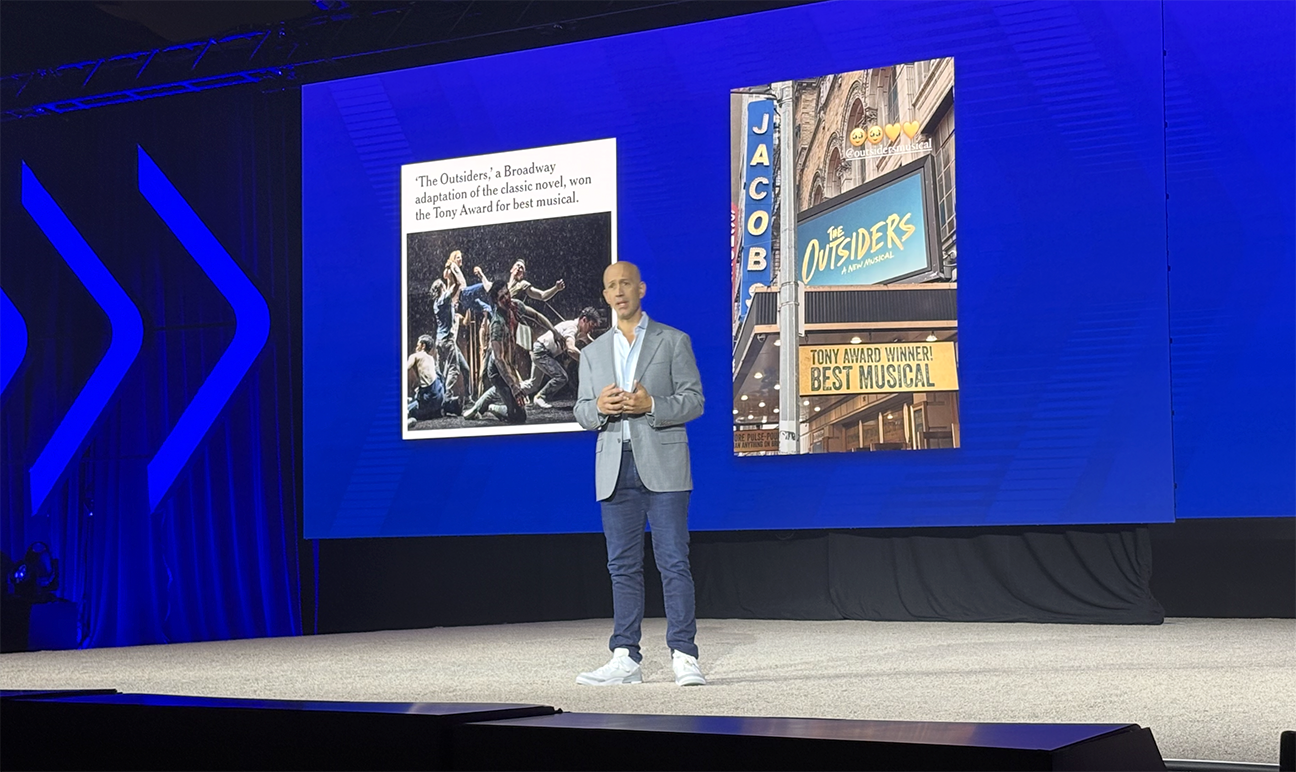
Eric Stine talking about the impact of creativity during his keynote at Sitecore Symposium 2025
“The value of AI is that it allows you to take a SaaS platform and orchestrate the work of the marketer, make visible the identity of the brand and the products or services being sold under that banner, and do it in a way that personalizes the experience down to a segment of one to drive conversion.”
From a workflow perspective, Sitecore’s Agentic Studio is a life ring for marketers, providing a creative workshop that enables humans to build and collaborate with AI. It’s robust, visually succinct, and offers a lot of customizability. It also includes a bevy of pre-built agents that automate complex workflows – things like governance scans for compliance issues and brand agents that validate your assets. It’s all designed to save time and reduce the cognitive load.
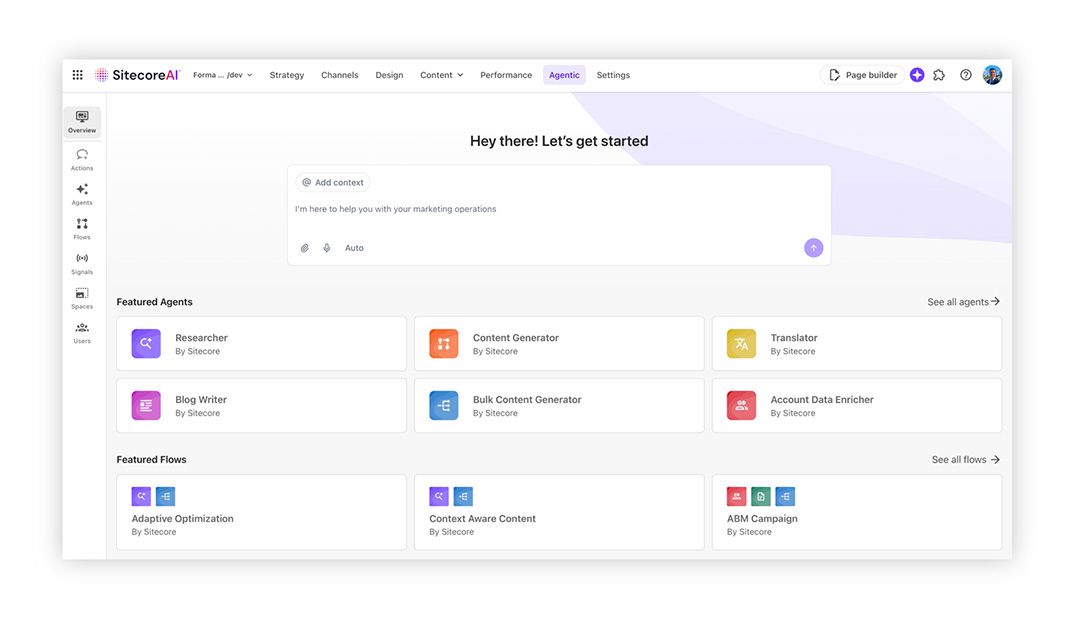
Sitecore Agentic Studio. Source: Sitecore
Given the legacy of tool sprawl and improvisational, patchwork processes, AI is stress-testing the boundaries and empowering marketers in new ways. The brands that win won’t necessarily be the ones with the most software tools – but the ones that can turn their stack into an orchestrated, AI-augmented system that actually reflects how their teams work.
Trust, governance, and the hidden cost of AI bolt‑ons
As I wrote in my own response to the “SaaSafras,” we’re in a token economy. New consumption-based models are emerging as platforms like CDPs are shifting from MTUs to compute utilization. We’re seeing that trend expand elsewhere in the stack.
Cost is always the trump card in any deck. But it’s intrinsically reinforced by transparency. When I spoke to Eric at last year’s Symposium, he zeroed in on this.
“Why would anybody charge you separately for the software and the SaaS?” he asked me then. “I believe that within years, maybe even months, AI is the product we're going to get. Because the expectation is that your product utilizes AI to get better. No one ever charged you when we moved to a fourth-generation object-oriented coding language.”
Fast forward, and we’re seeing that play out. And if Eric has a hard line anywhere, it’s on how vendors are trying to monetize AI. For him, this isn’t just about pricing preference – it’s a question of integrity and trust between vendor and customer, and he was blunt about it.
“The choice we made with SitecoreAI was to deliver all of the existing AI agents and workflows as part of the software. It's not an add-on. We don't sell it separately. It's not an upcharge. I think any company that's trying to sell you an upcharge AI version of their product or a bolt-on AI layer, they don't care about customer outcomes.”
“The choice we made with SitecoreAI was to deliver all of the existing AI agents and workflows as part of the software,” he said. “It's not an add-on. We don't sell it separately. It's not an upcharge. I think any company that's trying to sell you an upcharge AI version of their product or a bolt-on AI layer, they don't care about customer outcomes. They care about multiple expansion. To me, it is a fundamental issue of trust that you don’t try to sell the same thing twice.”
That trust has a second dimension: risk. Not all AI use cases are equal, and painting them with the same brush leads to either overreaction or complacency. The answer starts with developing a clear understanding of where AI is being activated, and what category it fits into.
“AI for process orchestration is a heck of a lot different than AI for customer data or protected information,” he explained. “And I think a lot of companies are struggling with the ‘How do I avoid the IP risk? How do I avoid the data privacy risk?’ You have to teach them the difference between using AI to orchestrate, automate, or scale a business process, as opposed to using AI to generate content or to manipulate data in a way that's going to require a different set of considerations and a different level of governance.”
And that governance can’t break down. If your vendor can’t articulate these differences – and price, package, and govern accordingly – you have a trust problem, not a tooling problem.
Are you the answer? Visibility in an AI‑mediated world
Invisibility is a brand’s kryptonite. Search and AI answers are increasingly pre-funneling decisions, and if you’re not showing up in the right language and context, you risk not showing up in the places that matter – from marketplace to social feeds.
The big question now is, what happens before anyone ever reaches your website? Are you the answer? From Eric’s vantage point, agencies and brands are still underestimating how much of their visibility has already moved into machine‑mediated environments.
Look no further than the commerce battle between Walmart and Amazon. The latter’s revenues surpassed the former for the first time, but the real story is how agents are now on the front line, and Agent Experience – something I’ve explored at length with Netlify’s Matt Biilmann – is becoming a key consideration.
What problem do I solve for customers? It might sound like a basic query, but it’s now a machine-readable objective. For brands, visibility hinges on both humans and AI understanding the language and intent. Your products must be knowable in these new systems, and marketing teams need to build synthetic audiences and test synthetic prompts to help fortify this.
The line from SEO to the LLM era has meant higher stakes. It’s not enough to just buy placement. We have to understand and assess how content performs in the LinkedIn or OpenAI algorithms to achieve visibility. This is where Eric’s “new moat” thesis lives: providing the same clear, trustworthy answer everywhere, at doing it at global speed.
“Do you know what question you are the answer to?” he asked provocatively. “Do you know what questions somebody is actually asking? That you – and only you – are the best possible answer for? What percentage of those questions cite you?”
For marketers, this is the new visibility game. As organic traffic withers, tactics like AEO and GEO are becoming boardroom considerations, and every touchpoint must evolve to meet the machines – all while serving customers with dynamic, personalized experiences that are clear, consistent, and localized.
It’s a tall order, but it’s what Sitecore has been building for.
Change Management and the agentic future of marketing
Of course, none of this lands if organizations can’t change how they work. Change management has been a common point of friction in many of the enterprise conversations I’ve had, and Eric is adamant that we’re again underestimating the human side of this shift.
“We have very, very short memories,” he explained. “Because what worked back in 2007 or even 2013 was ‘teach me how.’ That's the whole reason we created customer success as a function that didn't really exist before then.”
Back then, supporting customers with the “how” evolved into forward‑deployed engineering and embedded expertise, helping to design, deliver, and deploy solutions for the future. This emerged across the entire life cycle, from architecture to adoption.
Sitecore’s own moves – especially around SitecoreAI and Studio – are designed to sit inside that lifecycle, not outside it. Studio, as Eric described it, is essentially an “opening‑up” of the platform, allowing customers and partners to build their own agents and flows with performant guardrails.
“One of the reasons we released Studio with Sitecore AI was to give our customers the ability to open up the SaaS platform,” he said. “We wanted them to be able to customize the delivered code and create agents and flows on their own that were native to the application layer and the application logic.”
That tension he mentioned shows up here again. On one hand, there’s more autonomy for teams. But having a secure and scalable system of authority that provides governance is an essential piece in a world where AI projects and agentic systems are failing in production.
Beneath all of this is Eric’s magnetic pull toward accountability and clarity. Maybe it’s his proven track record as a business leader who understands the value of customer intimacy. But it turns out his experience in acting and stagecraft informed his views on the power of change, and how it can ground both sides of a relationship.
“I had this great audition coach 25 years ago,” he reminisced. “Literally in the first class, we spent three hours on this one challenge: in every single scene, your motivation is to get the other character to change.”
In the AI/SaaS relationship, he sees that same dynamic, where AI is forcing software to change, but software is grounding AI. And for brands, that “scene objective” is equally stark. You need to adapt how you orchestrate work and show up in AI‑mediated channels – or be quietly filtered out.
Is SaaS dead as a doornail? Nah…
The “SaaSpocalypse” might have scared the Dickens out of some market watchers, but Scrooge described Marley's ghost as more gravy than grave. Change always brings intestinal discomfort, and this reaction has manifest like a bit of undigested beef.
When Eric and I last met in person at Sitecore Symposium, this was all still the domain of the possible: AI as the next layer of SaaS, SitecoreAI and Studio as the scaffolding for agentic marketing, visibility as the new moat. In the months since, we’ve seen his thesis start to operationalize, particularly around major agents being launched to address the three pressures Eric framed throughout our conversation: visibility, personalization, and orchestration.
Brands can’t hide behind their software or outdated processes. They have to show up across markets, channels, and answer engines. They have to connect with customers through clear, consistent messages in the right language, and in one-to-one containers. And their teams need to move faster than ever without compromising security or breaking trust.
Sitecore’s agentic strategy is answering this call, providing the underlying fundamentals to meet the challenges and opportunities of AI while addressing the critical role of change management. This is where software truly evolves to its next chapter: as an AI-powered resource that serves the agent-to-human and agent-to-agent future.
It doesn’t feel anything like death. In fact, it’s more like a rebirth.
Upcoming Events

JoomlaDay USA 2026
April 29 - May 2, 2026 – Delray Beach, Florida
Be part of the Joomla community in one of the most iconic cities in the world! JoomlaDay USA 2026 is coming to Delray Beach, and you can join us for a dynamic event packed with insights, workshops, and networking opportunities. Learn from top Joomla experts and developers offering valuable insights and real-world solutions. Participate in interactive workshops and sessions and enhance your skills in Joomla management, development, design, and more. And connect with fellow Joomla enthusiasts, developers, and professionals from across the world. Book your seats today.
CMS Summit 26
May 12-13, 2026 – Frankfurt, Germany
The best conferences create space for honest, experience-based conversations. Not sales pitches. Not hype. Just thoughtful exchanges between people who spend their days designing, building, running, and evolving digital experiences. CMS Summit brings together people who share real stories from their work and platforms and who are interested in learning from each other on how to make things better. Over two days in Frankfurt, you can expect practitioner-led talks grounded in experience, conversations about trade-offs, constraints, and decisions, and time to compare notes with peers facing similar challenges. Space is limited for this exclusive event, so book your seats today.

Umbraco Codegarden 2026
June 10–11, 2026 – Copenhagen, DK
Join us in Copenhagen (or online) for the biggest Umbraco conference in the world – two full days of learning, genuine conversations, and the kind of inspiration that brings business leaders, developers, and digital creators together. Codegarden 2026 is packed with both business and tech content, from deep-dive workshops and advanced sessions to real-world case studies and strategy talks. You’ll leave with ideas, strategies, and knowledge you can put into practice immediately. Book your tickets today.
Open Source CMS 26
October 20–21, 2026 – Utrecht, Netherlands
Join us for the first annual edition of our prestigious international conference dedicated to making open source CMS better. This event is already being called the “missing gathering place” for the open source CMS community – an international conference with confirmed participants from Europe and North America. Be part of a friendly mix of digital leaders from notable open source CMS projects, agencies, even a few industry analysts who get together to learn, network, and talk about what really matters when it comes to creating better open source CMS projects right now and for the foreseeable future. Book your tickets today.