The intelligent CMS: Smarter content management with an AI CMS


An AI CMS brings automation, personalization and compliance to enterprise content management. By streamlining workflows and improving accuracy, it helps teams deliver smarter content and campaign experiences at scale. Discover how an AI-powered CMS can redefine your content strategy today.
Highlights
You’ll learn about how AI transforms enterprise CMS platforms.
- Automation: AI CMS streamlines tagging, metadata, and content workflows
- Insights: Predictive analytics guide content planning and performance optimization
- Personalization: Real-time insights enable the creation of tailored experiences
- Compliance: Guardrails ensure governance and security at scale
Adopt an AI CMS to drive efficiency, insights, and smarter engagement across your enterprise.
Content management today is not what it was in the 90s or early 2000s. The modern customer values personalized interactions. They are also more tech-savvy, privacy-aware and expect seamless experiences across all channels.
Traditional CMS platforms lack the speed, agility and flexibility required to deliver these demands. That makes them redundant for the needs of modern B2B customers. This is why an AI CMS, usually headless, is becoming more popular.
An AI-powered CMS enables real-time personalization, automates repetitive tasks, and powers predictive analytics. It integrates AI into content workflows, enabling faster content publishing while improving accuracy and user experience. This shift is changing how large organizations think about content management.
What makes a CMS intelligent?
An intelligent CMS is a content management system that learns from data and adapts content based on behavior and context. It also offers automation — you can create, optimize and publish hyper-personalized content at scale.
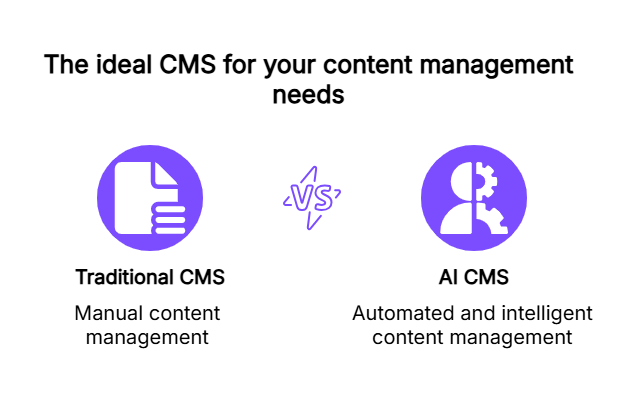
With traditional CMS platforms, you are bogged down with manual inputs, built-in templates and predefined workflows. An AI CMS does not have these limitations. They are built on headless and API-first principles, making them flexible to handle modern content needs. Its key features:
- Machine learning for predictive analytics
- Automated tagging and categorization via AI
- AI-powered search and discovery
- AI-assisted authoring workflows and predictive content performance insights
Overcome traditional CMS issues with Contentstack
Are you tired of slow development times and rising costs due to legacy monolithic suites? Contentstack offers a modern, component-based solution designed for the needs of today's enterprises. Discover agility and improved ROI. Request a demo to learn more.
Benefits of AI-powered CMS for large enterprises
An AI CMS offers speed and flexibility. When a modern CMS is implemented with proper change management practices to support its adoption, it also supports better governance, data-driven optimization, and automation. Here are other benefits.
- Faster content creation and delivery: AI authors’ workflows, ensuring faster editing. It applies the brand’s guidelines, eliminating human errors. Also, its automated tagging, categorization, and metadata generation feature ensures you can publish faster.
- Smarter personalization at scale: An AI CMS tracks data in real-time and adjusts content for relevant audience segments. Delivering on-brand content ensures you can convert more and engage your audience better.
- More efficient search and content discovery: Search and discovery feature powered by conversational AI enables editors and marketers find content quickly, even in large, complex repositories.
- Data-driven optimization: An AI CMS also supports predictive content performance insights, enabling teams to be proactive.
- Improved compliance and governance: An AI-powered CMS can flag missing disclosures, ensure accessibility standards, and apply consistent terminology.
How AI is transforming content management within enterprise CMS
AI integration into content workflows goes beyond using generative AI to create content. It can be applied in other areas, such as SEO, AIO/GEO, personalization, and predictive analytics. Here are some of those ways.
Content intelligence for planning
AI scans competitor content, search queries, and your own content library. That allows you to identify gaps and opportunities in your content strategy and that of your competitors. Based on that insight, AI can also suggest high-performing topics, and align new content with buyer journeys, so content production supports pipeline and sales goals.
AI-assisted content creation and editing
With generative AI, you can generate content drafts, outlines and briefs. The AI is trained on your company’s audience persona, style guide and brand voice — hence, it can enforce the right tone of voice and style across your content.
Automated content tagging and classification
AI-powered DAMs integrated in an intelligent CMS can scan your assets and suggest tags. It can further map those assets into your enterprise taxonomy, ensuring your assets fit into a structured content model. By doing so, marketers can easily search and reuse content.
Personalization at Scale
It is no secret that enterprise customers prioritize brands that deliver tailored, one-to-one experiences. You can integrate a real-time CDP to track customer data and create profiles. Then, use an AI-powered CMS to analyze the data and recommend the most relevant content. That way, you can tailor experiences to different accounts, industries or decision-makers.
SEO and AIO optimization support
AI can analyze search intent and suggest relevant keywords, topics and FAQs. It can be used to find internal linking opportunities, write meta titles and create schema markup. In essence, it becomes your SEO/AIO co-pilot, enabling you to find opportunities, match content to audience persona and optimize existing content.
Knowledge assistant for internal teams
Internal teams can also deploy AI-powered search and Q&A over enterprise content libraries. That way, teams within the organizations, such as sales and product teams, can quickly find answers backed by approved sources.
Governance and compliance guardrails
AI can be deployed to manage policy and style enforcement, as well as regulatory compliance checks. AI guardrails act like a compliance officer inside your CMS. By doing so, it prevents risky or off-brand content from being published. It also ensures that assets are safe, accurate and ready for regulation.
Governance, security, and compliance in an AI CMS
AI CMS platforms automate governance and security processes. However, team leaders still need to set approval workflows that AI should follow. They must apply built-in permissions to allow access to specific authorized users who can check and approve AI outputs.
The CMS offers intelligent security that can flag suspicious usage and trigger reminders for compliance audits. Still, content teams must keep to data privacy and safety regulations, such as GDPR and CCPA. They must also verify AI-generated metadata and tags to ensure compliance requirements are met and use audit logs to track changes made by AI features.
AI integrations that transform content workflows
An intelligent CMS supports AI integration, and that goes beyond automation. It makes your workflows smarter, so you can produce and publish content with more consistency and speed. Here are specific AI integrations that enable that.
- Automated AI tagging and categorization
- AI-powered search and discovery
- Automated metadata generation
- Automated A/B testing for content variants
These features enable enterprises to reduce repetitive work and focus teams on high-impact, creative and strategic tasks.
Fast-track digital experiences with Contentstack
Need to create digital experiences quickly? Contentstack's content and editorial engine enables you to reach new markets and create digital experiences faster. Manage content with ease and speed. Start your free trial today.
Comparing AI CMS options
Most CMS platforms now embed some sort of AI integration or service. However, that, on its own, does not necessarily make such CMSes intelligent or AI-driven in the actual sense. Here are some of the top AI CMS you will find today.
- Contentstack: Contentstack’s AI CMS supports intelligent content workflows and scalable personalization. It is API-first and headless, offering native AI integration, making it ideal for omnichannel delivery.
- Arvow: Arvow uses AI to automate the content creation and publishing process. It offers AI-driven features like content syndication, Google indexing, and SEO-optimized writing. It supports high-quality content at scale targeted at B2B companies.
- Strapi: Strapi is an open-source headless CMS that supports the integration of AI tools and services for seamless content management, optimization, and delivery.
- Adobe Experience Manager: This enterprise CMS uses AI to personalize content, automate workflows, and support data-driven insights. It supports content creation using its built-in generative AI.
While other AI-powered CMS platforms offer great features and support AI integration, Contentstack comes with AI baked in. It offers native AI integrations that require less customization, making it easier to roll out across large enterprises.
Case study

Golfbreaks
Golfbreaks struggled with managing content across multiple international markets. This prompted them to sign up for Contentstack's AI Accelerator. The training exposed them to the benefits of the AI assistant, brand kit and automation tool.
The solutions automated translation workflows, content optimization, and personalization rules. Today, they can launch on-brand content and campaigns faster than ever.
Golfbreaks Digital Product Owner Jack Simkins said, "With Contentstack’s help, our AI use case has been expanded into a much more powerful tool that’s helping us to save time and move faster."
Learn more about Golfbreaks' success with Contentstack’s AI.
FAQ section
What is the difference between a headless CMS and an AI CMS?
A headless CMS is a type of CMS where the architecture separates content from its presentation. So, you have a backend that you can connect to any front-end framework via APIs. An AI CMS is a CMS with built-in AI integration to automate and enhance content creation, personalization, and management.
Is an AI CMS secure for enterprise use?
An AI CMS is considered secure if it features enterprise-grade security, role-based permissions, audit logging, and compliance capabilities. The security of an intelligent CMS also depends on how AI integrations are configured and whether they comply with privacy laws.
What skills do teams need to work with an AI CMS?
Content teams should understand content strategy, governance rules, and how to review AI outputs for accuracy and compliance. Technical teams may need to understand AI prompts, workflow automation, and how to manage AI integrations.
Learn more
AI CMS platforms are redefining enterprise content management. They automate repetitive work, improve personalization and support data-driven decision-making. However, most CMS platforms only support AI integration — they are not truly AI-powered in the real sense.
This is where Contentstack stands out. With native AI integrations, you get an intelligent CMS right out of the box. You do not need extra configurations or endless integrations with third-party AI solutions. If you are serious about leveraging AI for smarter content management, then Contentstack offers the best solution in the market today. Talk to us today to get started.