Turn every URL into an intelligent agent: Fibr AI’s ‘Agentic Web Experience Platform’ is smart

The newcomer in the CRO space is challenging traditional experimentation platforms and paradigms with its new vision for an agentic web experience layer – one that provides a real-time adaptive system that responds to every visitor's intent, from human to machine. Interview with CEO AJ Goyal.
“No one became a marketer to manage dashboards.”
That’s what Fibr AI CEO Ankur “AJ” Goyal said in a recent LinkedIn post.
He’s spot on. Marketers are creators. Passionate thinkers who like to break rules and color outside the lines. Yes, they’re driven by data (aren't we all?), but this breed is also inspired by the hand-crafting of messages that connect and activate audiences.
If anything, DX professionals have become technologists out of necessity, bouncing everything from ahrefs to Zapier. But fatigue has steadily crept in as they grapple with the swivel-chair moments of lost productivity, toggling from tool to tool, trying to carry the context without losing their cognitive grip. And with the average marketing team juggling between 25 and 60 apps in their stack, it’s like drinking from a firehose.
This phenomenon isn’t exclusive to composable stacks. Even marketers swimming in big integrated systems are feeling the crushing weight of data and decisioning at every turn. This “marketing suite fatigue” is something my friend Adam Greco of Hightouch has mused about.
AI continues to be positioned as a salve to this wound, but it’s also a panacea that panders to the pain. Indeed, it’s creating the scale of variants and other resources to arm personalization and A/B testing, but it’s still a haul for marketers to manage the morass.
And then there’s the website, the elder statesman of the digital experience ecosystem. Tool friction aside, marketers are still hamstrung by the morphing effects of AI in a post-cookie world where answer engines like ChatGPT and AI-powered discovery tools are becoming the default method for search.
We already know it: traffic is evaporating, but bots are proliferating as LLMs increasingly crawl, consume, and evaluate website content. This is precisely why GEO – Generative Engine Optimization – has become a boardroom consideration.
The fact is, these robotic website visitors behave very differently from people, and require their own targeted structure, what CMS Critic contributor and AI luminary Tom Cranstoun calls “machine experience.” Static sites simply aren't enough. Today, you need to serve both audiences if you’re still focused on improving conversions.
And frankly, you should be. It’s still the gold standard.
This is where Fibr AI is focusing its mission. The San Jose scale-up is emerging as an alternative to traditional CRO (Conversion Rate Optimization) and experimentation platforms.
Fibr’s promise is simple: transform any static URL into an intelligent, adaptive web experience agent, where each page detects intent, makes split-second decisions, and reshapes the experience in real-time for any visitor. Powered by AI, it instantly understands, transforms, and (hopefully) delights a visitor.
The use cases are compelling. For human visitors, you can create personalized experiences and run continuous AI-led experimentation to test and enhance your page content. Agents do the heavy lifting while teams focus on brand strategy and alignment. Meanwhile, machine visitors are also served optimal content.
Given its unique market pitch, the company recently scored $7.5M in seed funding led by Accel and a healthy panel of investors. There’s certainly a lot of competition in this space, and ample intersection with CDP, CMS, and DXP platforms. In fact, Fibr already works seamlessly with existing tools like Webflow, Contentful, and Sitecore (to name a few).
As AJ told me in our recent conversation, Fibr is taking a markedly different approach that aims to reshape the web and deliver adaptive, real-time context – so we can understand people in the moment.
The need for an agentic web experience layer
Fibr has its roots in the CRO category, which covers software that’s used to analyze user behavior, identify website friction points, and test improvements to increase the percentage of visitors who complete a specified action. In marketing lingo, that’s everything from product purchases, signups, downloads, and more.
CRO tools typically encompass features like A/B testing, heatmaps, analytics, and behavior tracking. They also include A/B and multivariate testing to compare different versions of, say, a website landing page to see which performs better. Some of the more comprehensive suites also offer surveys and feedback collection to enhance insight and decisioning, and audience segmentation to surface more relevant content.
Platforms like Optimizely or Adobe Target are leading players in this experimentation vertical, but many CMS and DXP tools have introduced more native personalization. For all of them, AI is helping to provide more of the essential scale that personalization requires.
“Every link kind of has a memory of its own. If a URL where the customer is coming from is connected to the martech ecosystem, all the context is there… The last mile is optimizing that feedback loop based on the context.”
That said, AJ explained how traditional CMSes were built to support static destinations, not for interpreting context, intent, or behavior. And definitely not for modulating messages to both humans and machines – the latter of which represent a growing share of website visits. This new world requires a dynamic approach, one where AI crawlers get the kind of fast, precise, and semantically structured content they’re looking for.
“We kept seeing the same thing,” AJ said. “We personalize ads, emails, and social before the click, but the moment someone lands on the website, it still resets to zero. The experience stays static and blind to context, so it can’t tell who the visitor is, why they’re here, or what they need.”
As you might guess, this fragmented journey results in bad customer sentiment, lost conversions, and higher customer acquisition costs regardless of whether interest originates via marketing campaigns or AI search.
I'm always cautious when I see the word “agentic." It's becoming ubiquitously atmospheric, fused into taglines and homogenized across the AI hegemony. Fibr’s notion of an “Agentic Web Experience Platform” might feel like marketing fodder, but it reflects its differentiated value relative to the web layer – turning sites into intelligent and adaptive “actors.”
How it works
From a delivery perspective, Fibr is taking a tacitly different approach than its competitors. It turns every URL into an autonomous, context-aware agent, able to adapt in real time and continuously optimize via user intent and key signals like AI predictions, search history, and more – so it can serve enhanced experiences to both human and machine visitors at the moment they visit.
Architecturally, Fibr runs on context graphs, what AJ calls the “nervous system of the Agentic Web.” It connects signals from ads, website behavior, CDP and CRM data, and even custom ML models. It also links actions like clicks, searches, and page views to intent using past behavior and external recommendations. This blend delivers the magic.
Example: Someone originating from a Facebook ad might be interested in product details versus a search query for explicit offers. Based on intent, Fibr effectively rewrites the content, modifies visuals, and personalizes the journey to deliver an optimal experience that converts.
From an operational perspective, you can imagine how CRO could elevate from a small number of A/B tests per year to thousands of micro-experiments running in parallel, adapting each visit based on source, context, and intent. With these kinds of numbers, the company is focused on scale: high-traffic, consumer-facing enterprises across banking, insurance, healthcare, and professional services with brands in the Fortune 500.
According to Fibr, the results speak for themselves. Already, every pilot or customer use case they've run has consistently shown a 20% increase in conversions within the first quarter – demonstrating the ROI of its real-time, contextual adaptation.
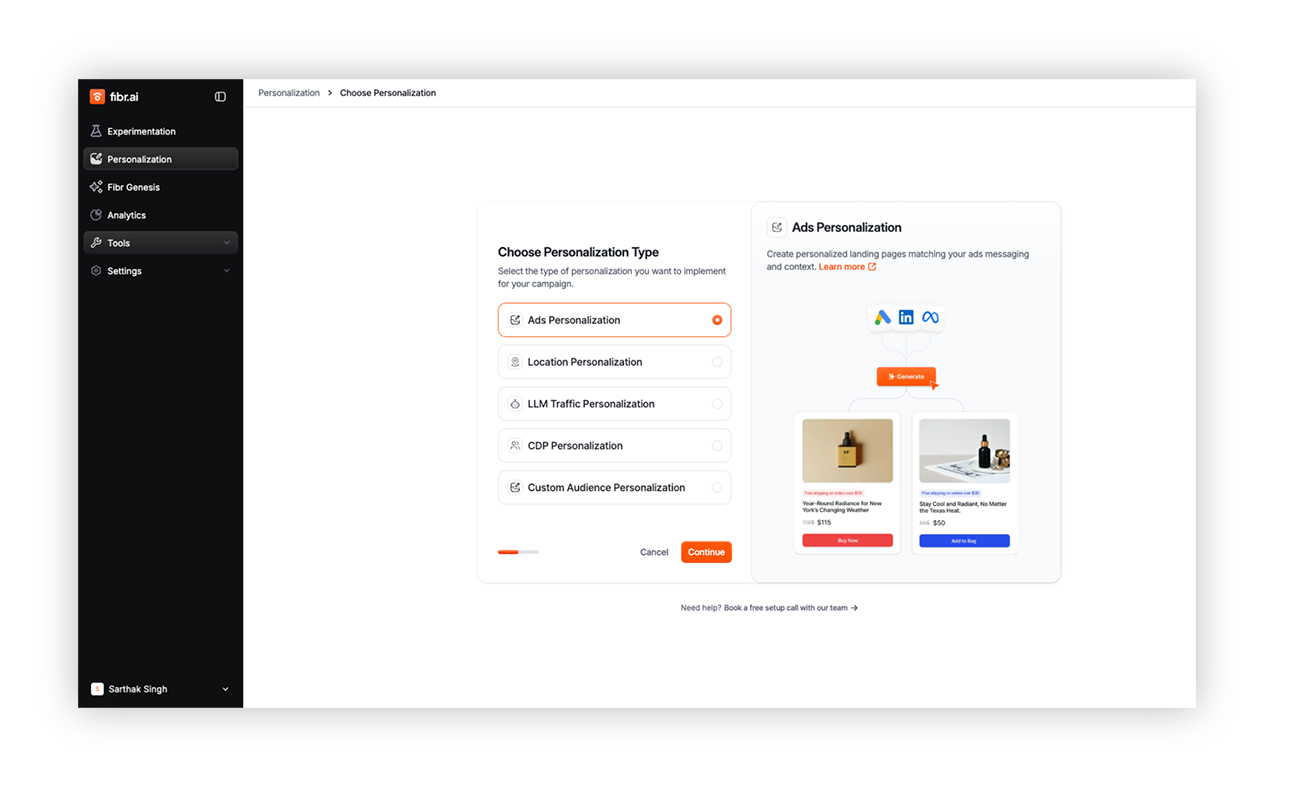
Fibr’s product architecture is divided across its Personalization Suite, which includes solutions for ads, audience, and location personalization. There are also journey, CDP, and LLM-based services, as well as this cool Genesis AI landing page builder that allows you to create responsive, on-brand experiences that are designed to convert – with zero code or complexity.
Source: Fibr.ai
The documentation is really solid, featuring some nice video tutorials that take you on step-by-step journeys for setting up your personalization strategies. The UI is intuitive, easy to maneuver, and pleasingly uncluttered – giving you a lot of space to focus on optimizing your programs.
Source: Fibr.ai
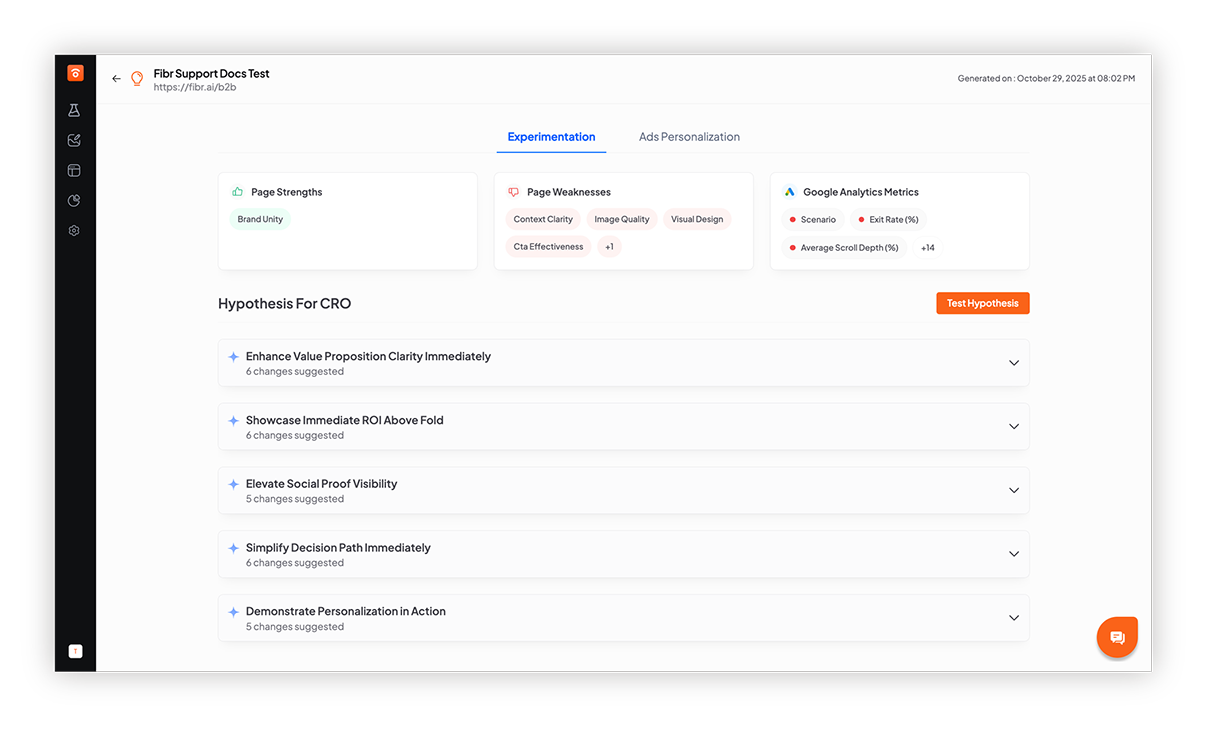
The Optimization Suite is where experimentation lives, with tools for testing, measuring, and improving. A standout feature is Fibr’s Hypothesis Generation, which harnesses AI to identify conversion blockers and automatically deliver data-backed actions.
From healthcare to healthier landing pages
Getting here has been an interesting – if not slightly unexpected – path for AJ. He started outside the typical San Francisco SaaS ecosystem, leveraging his background in CPG and healthcare to run a women’s health company in India focused on PCOS (Polycystic Ovary Syndrome). While there, he hit the limits of traditional performance marketing and landing page design.
As he told me, the business relied on highly targeted Facebook and Google ads around specific symptoms. The challenge, he said, came after the click: no matter how specific the ad, everyone landed on the same generic page.
“When we started creating more dedicated landing pages for each of the ads, we started seeing better conversions,” AJ explained. “But we also realized that we were running 2,000 ads, and there is no way we could have created that many unique landing pages.”
That operational impossibility – thousands of intent signals, but only a handful of static URLs – seeded the core idea behind Fibr as a web layer, capable of adapting at scale to match the granularity of modern acquisition channels.
The hidden cost of traditional CRO platforms
CRO can be pricey. That’s an easy leap to make when you see Adobe at the top of the list, but there are downstream solutions and self-service options. Factors that impact the calculation include traffic volume, scope of service, and complexity.
I asked AJ about the broader marketplace of experimentation tools and what stands out as opportunities for Fibr. As he said, it’s not just about license pricing – it’s the total cost to operate these platforms, which often go unseen. He cited an example of an enterprise running Adobe Target, where the real expense was not the software itself.
“We realized to run it, the enterprise was spending somewhere between five and 15 times the tool cost,” he said. “Another one of the enterprises we’re working with was running 180 experiments, and they spent almost three and a half million. So the cost per experiment is insanely high.”
AJ’s thesis is that the legacy model doesn’t scale for the kind of hyper-personalization modern marketing demands. Instead of selling just another optimization tool, AJ is positioning Fibr as replacing both the tooling and a chunk of the agency and operational layer required to run it.
While cost isn’t the whole picture, Fibr sees an opportunity to optimize the price-performance equation, and has bifurcated its approach for both customers and partners. Its Enterprise plan delivers unlimited visitor sessions, domains, and URLs, with access to web-journey personalization, customized agentic workflows, and dedicated support. There’s also a Starter plan if you’re looking to kick the tires.
The Agency route offers an affiliate partnership and agency program built for empowering brands with a bevy of incentives. Fibr is reinforcing these conduits with the tools, ownership, and AI agents to turn landing pages into high-performing revenue channels for end customers. You can learn more about the program here.
Beyond personalization: URLs as agents
As I mentioned, Fibr’s angle in this CRO epoch is focused on transforming the URL as a static endpoint into an intelligent agent. In this model, each URL accumulates and uses context – from martech tools, CDPs, analytics, and real-time feedback – to adapt content and experience on the fly. That makes the URL itself the atomic unit of intelligence on the web.
“What I’ve been mainly talking about is the URL as an agent,” AJ stated. “Every link kind of has a memory of its own. If a URL where the customer is coming from is connected to the martech ecosystem, all the context is there. If it’s connected to CDP, all the context is there. If it's connected to analytics, all the context is there. The last mile is optimizing that feedback loop based on the context.”
For AJ, this is more than a reframing exercise. It sets up a paradigm where URLs don’t just serve humans – they also interact with other agents, from AI browsers to answer engines. Rather than building a separate layer for machines, Fibr’s bet is on making each URL intrinsically machine- and human-ready.
With that in mind, AJ’s concept is extensible into the horizon of agent-to-agent ecosystem interactions, something the MACH Alliance has been championing.
“If our URLs become agents,” AJ argued, “they can talk to other agents. This is what I tell CMOs. You’re not just optimizing for people.”
If you’ve been following the potential frontier for agent-to-agent functionality, the channels are expanding beyond answer engines and agentic browsers to customer-side agents making decisions on behalf of users. In terms of timing, AJ is realistic: these agent customers are not mainstream yet, but he believes they’re on the near-term horizon.
“We’re still two years away from customer agents really coming to websites and autonomously saying, ‘Hey, I want to use this credit card [to transact].” But he’s betting we’ll get there – and by building the agentic foundation now, we’ll be ready to “flip the switch” when those agents arrive, and without rethinking the entire stack.
Why the web still matters in the age of AI
It feels like we’ve been discussing the uncertain future of websites for quite a while.
I remember a lively (if not harrowing) panel at a Kentico Connect conference I covered way back in 2023, when Scott Brinker was prognosticating the impact of AI on the martech stack. The worry started early as automated site builders promised a “prompt and dream” to build entire sites on the fly. They all sucked back then, but new tools like Fimo are evolving our perception of what's possible.
During our chat, AJ slid into this topic – which, as he observed, is an existential question hanging over everything. With the recent announcement from Google that it might supplant your website with an AI-generated proxy to improve performance, the forces of the web seem intent on rendering a brand’s own website obsolete. Add in the drift towards the answer engines and AI-first discovery, and things feel a little dire.
“Will websites continue to exist?” AJ pondered. “With the whole LLM thing, everyone’s asking, what’s the relevance of the website?”
But his conclusion is clear: We should be maintaining and even enhancing websites, and he makes some salient points. As AJ said, they’re the owned channel for brands – the one place where they can retarget, build long-term relationships, and capture the lion’s share of visitors who don’t convert on the first touch. LLMs might become the new high-intent discovery layer, but they don’t replace the need for a well-structured, adaptive destination.
“With your own website, you still get 95% that you can keep retargeting across multiple other locations,” AJ said. And he also sees LLM answer engines as a more powerful, personalized form of affiliate marketing, capable of serving multiple offers, but with far higher intent. That, in his view, only increases the importance of having a site that can adapt and experiment at a much more granular level – and that’s exactly the space Fibr wants to occupy.
The verdict
Fibr is intriguing – and it’s in an intriguing sector of the stack. AI is having a profound impact on the field of personalization and experimentation tools, and CRO platforms are benefiting in big ways. From data segmentation to heat mapping and session recordings, AI is delivering both granular and expansive insights.
Yes, marketers should still focus on the fundamentals of any conversion rate optimization suite, things like core A/B testing capabilities, intuitive visual analytics, and integrations with the rest of their stack – all things that Fibr delivers. But the roadmap is evolving as agentic features provide the scale and automation that can finally make one-to-one personalization meaningful.
Obviously, agent traffic is changing the game, and we’re still in the early days. Where will it go? And how quickly? Trust is a key point of friction, so it's hard to predict. But at some point, you can imagine your own personal agent planning and executing on your behalf with certain human checks in place.
It's already happening, and solutions are emerging to help enhance the interactions. I’ll point back to Gibberlink’s solution for high-frequency communication. This example is of two agents engaged in a chat session about booking a hotel reservation:
It was an early expression of what Netlify’s Matt Biilmann called “Agent Experience.” While the solution has yet to be adopted (and raised some viral concerns about robots inventing their own unregulated dialect), the point was clear: agents behave differently than humans, and having a machine-focused experience can deliver better, faster, and more efficient results.
Fibr’s vision is clear: a unified, adaptive experience layer across channels, allowing you to identify and label visitors and cluster them into individual or cohort-based segments. With these features, you can better understand intent through signals and behaviors, and personalize experiences in real-time by changing content, visuals, and flows. Like other experimentation tools, the long-term payoff is with continuous learning and improvement.
My recommendation: Fibr is endeavoring to be more than just another optimization tool, positioning itself as a new layer in the web stack – one that’s designed for a future where every URL is an intelligent actor in a blended hive of human and machine visitors. Larger and more established competitors have richer tool suites, but Fibr’s approach is worth considering as you weigh the role of the CRO layer in your integrated stack. Pay close attention to how the entire conversion funnel is handled, from understanding visitor behavior to testing controls and how results are surfaced and analyzed.
There’s a lot here to explore, and while Fibr is a newer player in the mix, they've already scored some high-profile customers, which offers some market validation. With its Enterprise tier, Fibr does provide a dedicated CSM, and I would recommend support through your onboarding and continued optimization.
Upcoming Events

JoomlaDay USA 2026
April 29 - May 2, 2026 – Delray Beach, Florida
Be part of the Joomla community in one of the most iconic cities in the world! JoomlaDay USA 2026 is coming to Delray Beach, and you can join us for a dynamic event packed with insights, workshops, and networking opportunities. Learn from top Joomla experts and developers offering valuable insights and real-world solutions. Participate in interactive workshops and sessions and enhance your skills in Joomla management, development, design, and more. And connect with fellow Joomla enthusiasts, developers, and professionals from across the world. Book your seats today.
CMS Summit 26
May 12-13, 2026 – Frankfurt, Germany
The best conferences create space for honest, experience-based conversations. Not sales pitches. Not hype. Just thoughtful exchanges between people who spend their days designing, building, running, and evolving digital experiences. CMS Summit brings together people who share real stories from their work and platforms and who are interested in learning from each other on how to make things better. Over two days in Frankfurt, you can expect practitioner-led talks grounded in experience, conversations about trade-offs, constraints, and decisions, and time to compare notes with peers facing similar challenges. Space is limited for this exclusive event, so book your seats today.

Umbraco Codegarden 2026
June 10–11, 2026 – Copenhagen, DK
Join us in Copenhagen (or online) for the biggest Umbraco conference in the world – two full days of learning, genuine conversations, and the kind of inspiration that brings business leaders, developers, and digital creators together. Codegarden 2026 is packed with both business and tech content, from deep-dive workshops and advanced sessions to real-world case studies and strategy talks. You’ll leave with ideas, strategies, and knowledge you can put into practice immediately. Book your tickets today.
Open Source CMS 26
October 20–21, 2026 – Utrecht, Netherlands
Join us for the first annual edition of our prestigious international conference dedicated to making open source CMS better. This event is already being called the “missing gathering place” for the open source CMS community – an international conference with confirmed participants from Europe and North America. Be part of a friendly mix of digital leaders from notable open source CMS projects, agencies, even a few industry analysts who get together to learn, network, and talk about what really matters when it comes to creating better open source CMS projects right now and for the foreseeable future. Book your tickets today.