After EmDash — what am I actually buying when I choose a CMS?

Is EmDash really the "spiritual successor" to WordPress? Will it change the way we make decisions about CMS selection? I tried it out — and here's what I think.
Bastian Sirvend is a CMS/DXP expert and analyst, founder of SUTSCHE and enhancely.ai, and a CMS Critic contributor.
We’ve installed EmDash, Cloudflare’s new open-source CMS, which was released on April 1st.
No joke, even if the timing looked like one.
Naturally, we were curious, as LinkedIn and the like were bursting at the seams with posts about EmDash’s tech and functionality, and how it’s supposedly the “WordPress killer.”
Since we’d already got it up and running, we went straight to building a plugin for enhancely.ai, our automation platform that addresses a critical gap in web content: broken or missing structured data. It instantly generates schema markup, enabling AI tools like ChatGPT and Perplexity to better understand website content without requiring manual rewrites.
Automated schema markup without an editor having to lift a finger.
I'm happy to report that it all worked: A fully functional CMS in what felt like an hour, with a plugin created and packaged. We even found a bug in EmDash along the way, fixed it, and submitted a pull request.
What a day.
And ever since then, one question has been on my mind: how will this change the way we select a CMS? There's a lot to unpack here, but let's start with how we've been doing it up until now — and why I believe EmDash is changing things.
How to select a CMS: The SUTSCHE approach
When our team at SUTSCHE supports clients in selecting a system, we consider the decision from five different angles:
- How well does the system meet the functional requirements?
- How does it fit into the overall picture, both technically and architecturally?
- How does it perform within the ecosystem, in integrations, and in interfaces?
- What are the financial and strategic implications — both now and in three years?
- And how will it actually be adopted and operated by the people within the organisation?
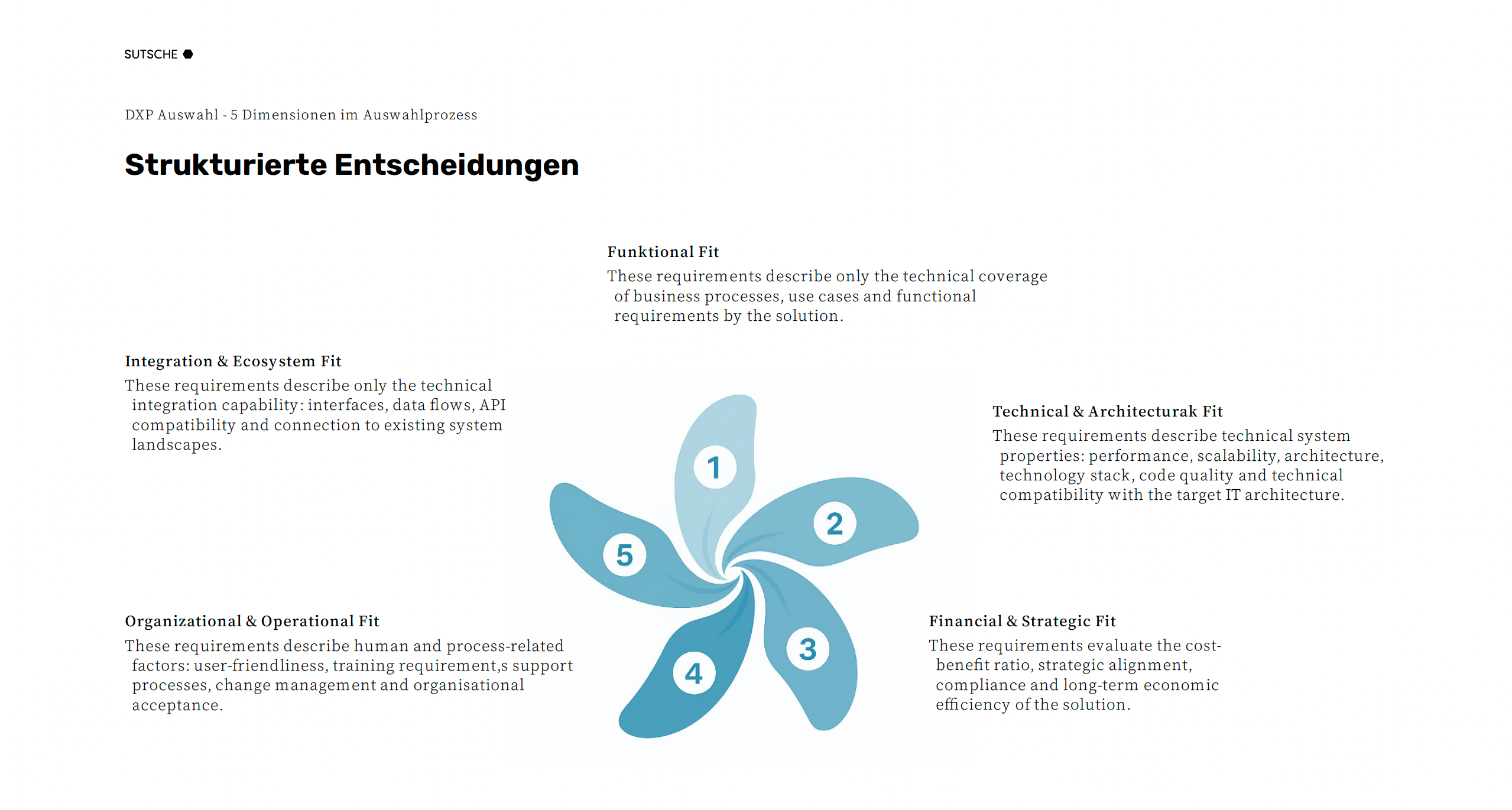
Five comprehensive dimensions. Not just a checklist.
That's always been our approach. Because choosing a CMS isn’t just about features. It’s a decision about the foundation on which a company builds its content. It’s about the paths that lead to the website or shop, not just a piece of software where you tick boxes. Ultimately, it’s a project you’re buying, and that is far more complex than mere functionality.
Then MCP servers were introduced. A new kind of functionality that's operating on a different level from standard functions that are carried out manually. In short, more than just APIs. Suddenly, tasks that had previously been carried out by hand – content migration, schema adjustments, repetitive administrative tasks — could be handled by agents.
The CMS could now be controlled remotely. Manual processes that had been time-consuming for years could suddenly be automated. We've taken this into account in our assessment. A new dimension, a proven framework.
Good. That makes sense.
But with the release of EmDash, something different happened for me…
Not because it’s MCP-compatible. Not because it’s built on Astro or MIT-licensed or can run on Cloudflare.
Because it was built in two months.
By an experienced developer, to be sure. And using AI agents. But still, two months for a complete CMS with an admin panel, plugin system, authentication, migration tool, and MCP server?
The step from “agents controlling a CMS” to “agents building a CMS” sounds big. It isn’t anymore.
Because it means that features that are still missing today will be there tomorrow, and just a few prompts away. The gap between systems — the gap that has structured the selection process for years — isn’t collapsing dramatically. It’s simply shrinking quietly. And other things that should concern customers within the five dimensions are becoming increasingly important.
And this is precisely where I ask myself, ‘How does this change the way we make decisions?’
The functional dimension — does the system have feature X, to what standard, to what extent — has long been the loudest voice in the selection process. It isn’t going to disappear. But it is becoming less prominent. Because the argument that “our competitor doesn’t have that yet” is losing its impact more quickly. Anyone who thinks this is just theory is mistaken.
From my own experience, I can say that the author of this document has created a fully functional website based on a CMS using Claude Code, the documentation for some fairly significant CMS platforms, a template/style guide, and a healthy dose of curiosity. Including a few functional enhancements.
Let’s shift perspective and move up a level here, too. While I was moderating a product presentation, the question popped up in a chat: “Please don’t stone me, but what exactly is the difference between TYPO3 and Umbraco?” An absolutely valid question at first, but one participant’s answer astonished me.
“It's the technology stack," they said.
Yes, that's true. TYPO3 is PHP, while Umbraco is .NET. But are these still real differentiators?
The arguments had already been watered down when it came to clients using agencies to do the programming work. With SaaS, this has been further diluted. And now? In times when IBM shares are plummeting because Claude Code can also speak COBOL, migrating from one technology stack to the next is really just a matter of a prompt and a couple of sharp glances (my old math teacher always used to say when simplifying complex equations, “you just need to take a sharp look once, and then you’ve got it”).
Of course, that’s an exaggeration. There’s still quite a bit involved — but the hurdle is eroding more and more.
What remains are the other four dimensions of decision-making. And I believe they are becoming more important – not less so.
Who do I entrust my content foundation to in the long term? Who will still be supporting the system in three years? What ecosystem is growing around it? Which partners, which community, which integrations? How does it fit into the organization, into the teams, into the actual work processes?
These aren’t new questions. But they’re coming to the forefront. And as I think about it further while writing this, I come to the conclusion that, in the end, it’s still the people, agencies, and project stakeholders who have to bring it to life. No matter what “it” turns out to be. Even with incredibly impressive AI support in feature development, the piece of software must fit into the organization, the IT landscape, and the client’s processes — or find a place there.
And as I think about this further, my talk with Janus Boye at the Boye Aarhus 25 Conference might become even more important. The point was that, due to the development of AI and the lack of adaptation on the part of customers, something needs to change along the entire value chain.
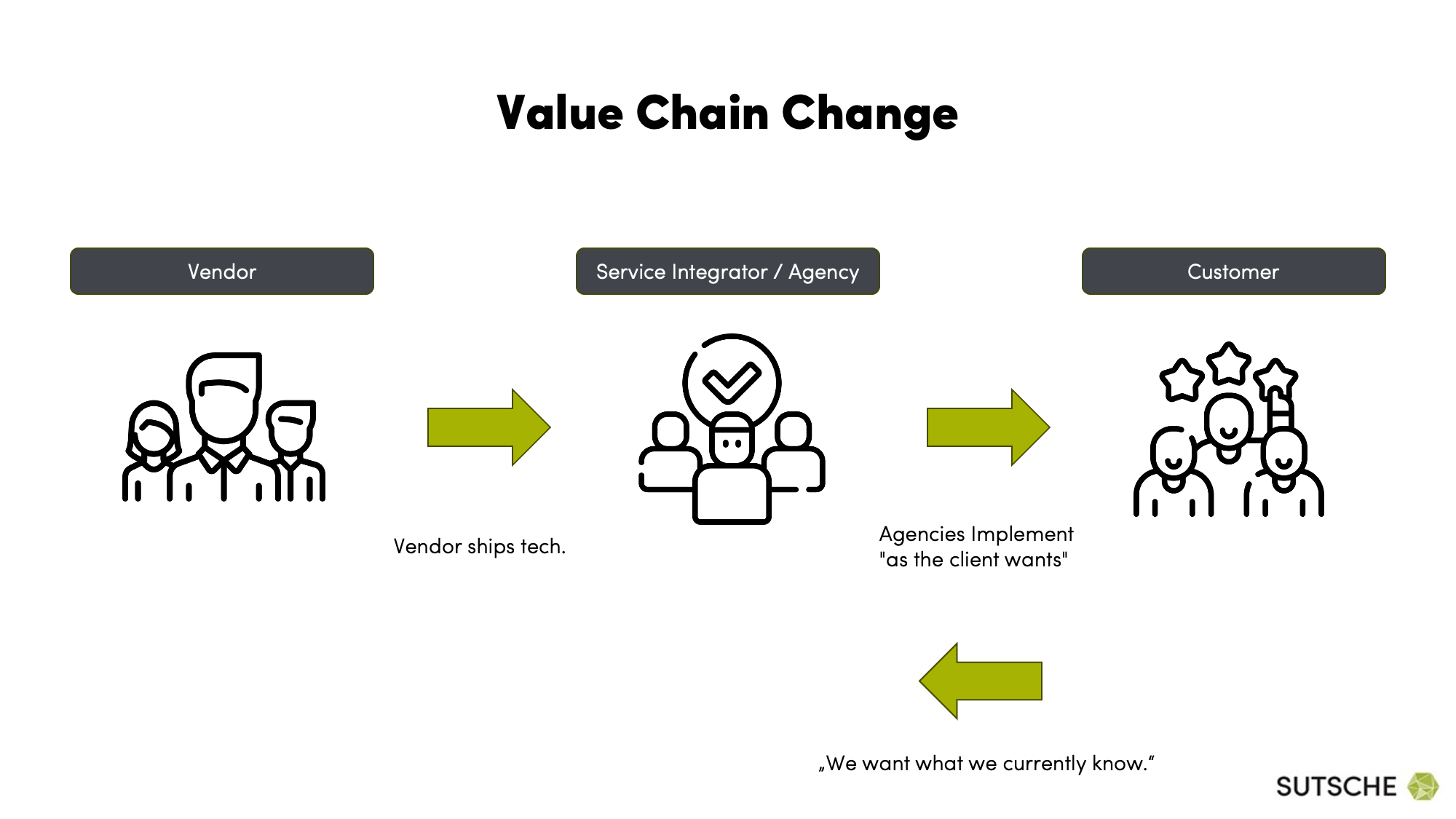
In my view, the role of agencies needs to change dramatically, away from pure development and away from being a “workshop” and towards becoming consultants. The new agency helps clients with organizational development and process optimization. It helps clients to measure and evaluate what has been built and produced, and then to adapt, refine, and optimize it — so that it works even better for them.
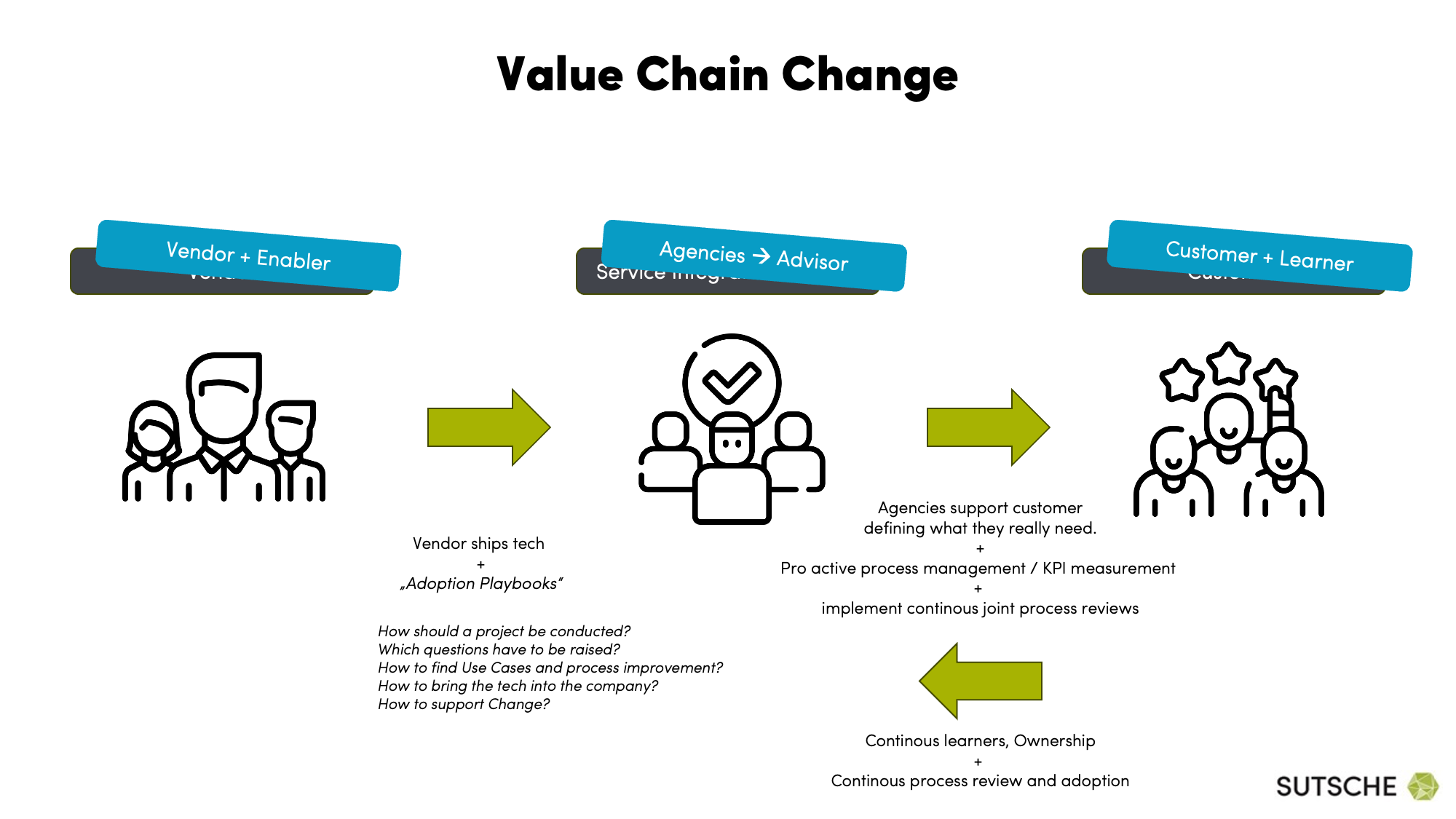
In my presentation, I outlined the role of vendors as enablers. They empower agencies to use the software to ask the right questions of the client and to initiate change, so that the software can truly make a difference. In my view, we may need to rethink or re-evaluate the role of vendors. Beyond a controlled development process, it is perhaps the establishment and empowerment, knowledge transfer, and network design that ultimately bring an ecosystem to life and make the difference. The entire interplay of technology, processes, and collaboration. A genuine network.
EmDash currently has no satisfactory answer (at least not yet) to most of the points we consider when selecting systems and what we’ve discussed. Version 0.1.0 is just version 0.1.0. It’s been “on the market” since 2026.
No ecosystem. No community. No track record.
And I don’t see it as a WordPress killer, either. And as I said, this isn’t based on functionality, tech stack, or anything like that. However, it is a demonstration of what is technically possible. And for some use cases, it’s already a valid choice (quickly creating a landing page, setting up satellite sites, putting up a blackout page, testing a prototype).
For us at SUTSCHE, this means we’ve been asking the right questions all along. Not because we foresaw it, but because a structured decision has always been about more than just a list of features.
Upcoming Events

JoomlaDay USA 2026
April 29 - May 2, 2026 – Delray Beach, Florida
Be part of the Joomla community in one of the most iconic cities in the world! JoomlaDay USA 2026 is coming to Delray Beach, and you can join us for a dynamic event packed with insights, workshops, and networking opportunities. Learn from top Joomla experts and developers offering valuable insights and real-world solutions. Participate in interactive workshops and sessions and enhance your skills in Joomla management, development, design, and more. And connect with fellow Joomla enthusiasts, developers, and professionals from across the world. Book your seats today.
CMS Summit 26
May 12-13, 2026 – Frankfurt, Germany
The best conferences create space for honest, experience-based conversations. Not sales pitches. Not hype. Just thoughtful exchanges between people who spend their days designing, building, running, and evolving digital experiences. CMS Summit brings together people who share real stories from their work and platforms and who are interested in learning from each other on how to make things better. Over two days in Frankfurt, you can expect practitioner-led talks grounded in experience, conversations about trade-offs, constraints, and decisions, and time to compare notes with peers facing similar challenges. Space is limited for this exclusive event, so book your seats today.

Umbraco Codegarden 2026
June 10–11, 2026 – Copenhagen, DK
Join us in Copenhagen (or online) for the biggest Umbraco conference in the world – two full days of learning, genuine conversations, and the kind of inspiration that brings business leaders, developers, and digital creators together. Codegarden 2026 is packed with both business and tech content, from deep-dive workshops and advanced sessions to real-world case studies and strategy talks. You’ll leave with ideas, strategies, and knowledge you can put into practice immediately. Book your tickets today.
Open Source CMS 26
October 20–21, 2026 – Utrecht, Netherlands
Join us for the first annual edition of our prestigious international conference dedicated to making open source CMS better. This event is already being called the “missing gathering place” for the open source CMS community – an international conference with confirmed participants from Europe and North America. Be part of a friendly mix of digital leaders from notable open source CMS projects, agencies, even a few industry analysts who get together to learn, network, and talk about what really matters when it comes to creating better open source CMS projects right now and for the foreseeable future. Book your tickets today.