A Tale of Two Phils: Exploring Umbraco’s Open Source Vision for AI, MCP, and the Agentic Future of CMS


In the latest episode of “The Critic’s Corner” podcast, we chat with two of the key voices shaping the future of Umbraco: CTO Filip Bech-Larsen and AI Staff Engineer Phil Whittaker. What unfolds is a wide-ranging, candid, and forward-looking conversation about how a famously “Friendly CMS” is approaching AI, MCP, and the emerging agentic landscape.
Listen to the full episode of “The Critic's Corner” Podcast >
Two Phils. Two origin stories. And one open source platform that’s trying to do something very intentional in this noisy AI era.
The platform I speak of is Umbraco, a Denmark-based CMS with a .NET heritage and two decades of history under its belt. On CMS Critic, we’ve watched it grow and evolve over the years.
Now, as AI crushes roadmaps and stampedes with change, Umbraco is proving once more just how flexible and resilient its technology and community really are.
I was prepared to have a lively conversation with CTO Filip Bech-Larsen, whom I’ve spoken to frequently, about a slew of topics related to Umbraco’s AI roadmap – namely, its deep focus on MCP (Model Context Protocol). The company is doubling down on this critical component as a key activator in its AI and agentic strategy, along with the recent unveiling of Umbraco.AI and the full availability of Umbraco Compose.
What’s clear is that Umbraco's pace of innovation hasn’t slowed.
Known in many circles as "The Friendly CMS,” perhaps it's apropos that Filip brought a friend to our call – a smart one who just happens to have the same name (OK, so they're slightly different). As such, you get a bonus “Phil” on this episode: Phil Whittaker.
A long-time Umbraco community member and certified platform champion, Phil joined the company late last year as a Staff Engineer with the explicit directive of supporting the company’s AI and MCP transformation. He brought even more context to the conversation through his own technical lens.
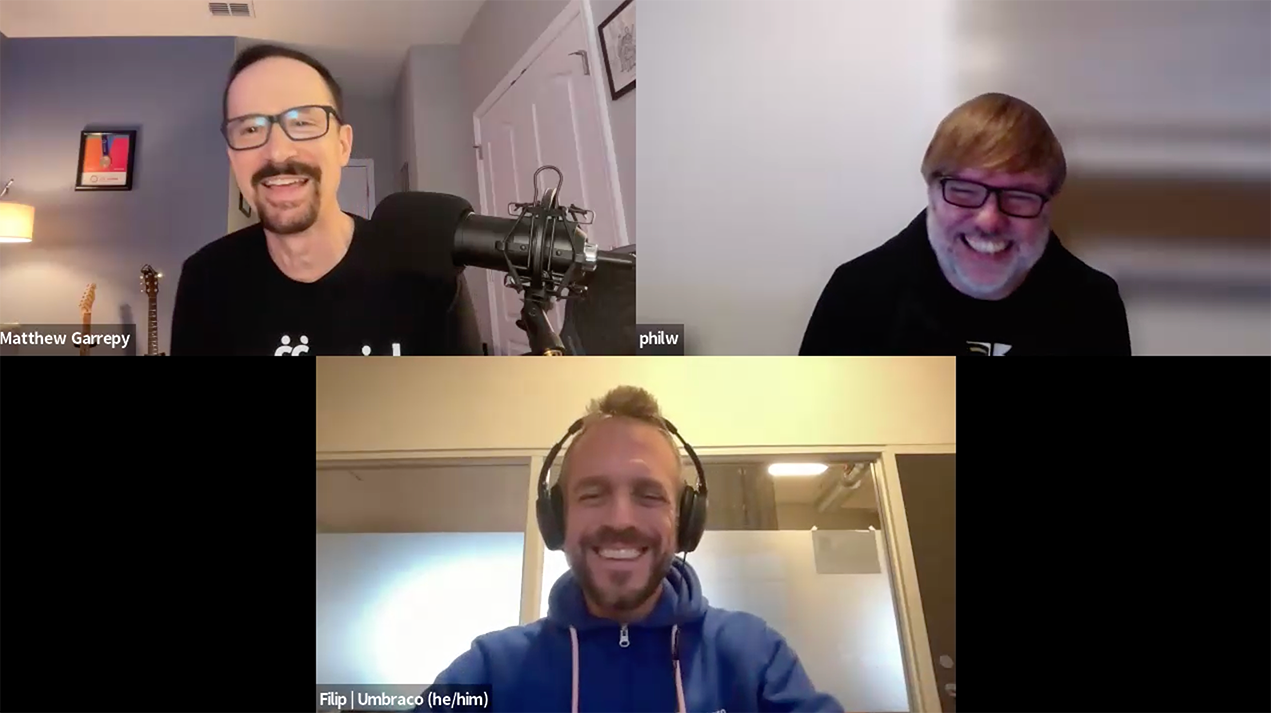
See? Two Phils are better than one. From top left, clockwise: Matt Garrepy, Phil Whittaker, and Filip Bech-Larsen
In the pod, Filip and Phil shared their parallel journeys to Umbraco, elevated by a common belief that the real power lies not just in the product, but in a collaborative ecosystem where people can share ideas and solve problems. Together, they unpacked how Umbraco is staying true to its open values while still pushing into the next era of AI innovation.
We also discussed Umbraco’s two-speed innovation model: a stable, predictable core that enterprises can depend on, and a fast-moving marketplace where partners and the community experiment with AI add-ons, agent workflows, and automation patterns. This approach aims to reduce “AI whiplash” while still delivering practical value for marketers and developers – especially around harder problems like context, experimentation, and personalization.
If you care about the intersection of CMS, AI, and the open web, this episode will “Phil” you up.
Is it DRY or redundant? Anything but.
Parallel origin stories converge with “The Friendly CMS”
Both Filip and Phil came to Umbraco the same way many people do: as accomplished builders. Along their own unique paths, they pushed the limits of creativity – notching successes and facing failure. Along the way, they discovered the power and inclusivity of Umbraco’s community.
For Filip, the exploration began decades ago as a young, ambitious developer. After experimenting with his own custom CMS project, he had an “aha” moment after attending Umbraco's annual Codegarden event. That shaped his view of what was possible with an open source CMS – and a passionate community behind to it.
“I went to my first Codegarden, more than 10 years ago now, and I just fell in love with the product and the community,” he recalled. “It was love at first sight.”
For Phil, the story shares a kinship. Like Filip, he tried to crack his own CMS code about 20 years ago. Ultimately, those efforts led him to the agency side of the development game, where he moved from pure .NET development into content design. That’s where he first encountered Umbraco.
“I started to really get a love for content design and content modeling and all those types of elements that developers really shouldn’t get involved in,” he said, laughing. “But I started to really enjoy it and really get on with it.”
Both Filip and Phil have anchored their respective stories in Umbraco’s community ethos, describing it as something much more than just a collection of connected builders. For both of them, it runs much deeper. According to Filip, this is why the company still embraces the moniker of “The Friendly CMS” across its branding.
“It feels like a big family, really, and that’s amazing,” Phil said.
Open Source, transparency, and the Umbraco ethos
From the beginning, Umbraco’s identity has been defined by its flexibility, openness, and a clear commitment to democratizing the web. Adopting an open source foundation in 2005, just after the Umbraco 2.0 release, wasn’t an afterthought – it reflected a conscious pulse that pumped triumphantly through the culture. These are tenets that Filip has long subscribed to and continues to champion in his vision as CTO.
“Umbraco has always been about flexibility and being able to do just what you want and how you want, and Umbraco was just there to help you and to quickly get out of your way,” he said. “I love the philosophy of open source and democratizing publishing on the web. It still makes my heartbeat. That’s what it’s all about: making it for everybody.”
Later in the episode, Filip connected that ethos directly to how Umbraco thinks about AI and its overall platform strategy. Transparency, he argues, should extend to AI choices as well – and that means not locking customers into a vendor-defined AI stack.
“We want to be completely transparent about our plans so you can make the best decisions,” he said.
MCP as a “pick and mix” toolset for agentic AI
As mentioned, a big thrust for Umbraco’s AI strategy is MCP, and this is precisely where Phil has been targeting his technical prowess and creativity. I’ve been covering the evolution of MCP going back to early 2024, when a few examples were emerging in areas like agentic commerce. Today, there are thousands of MCP servers available across a wide range of ecosystems.
Here’s a quick refresher, just in case you’re not familiar: MCP is an open source standard for connecting AI applications to external systems, enabling AI apps like Claude or ChatGPT to connect to data sources, tools, and workflows to access information and perform tasks.
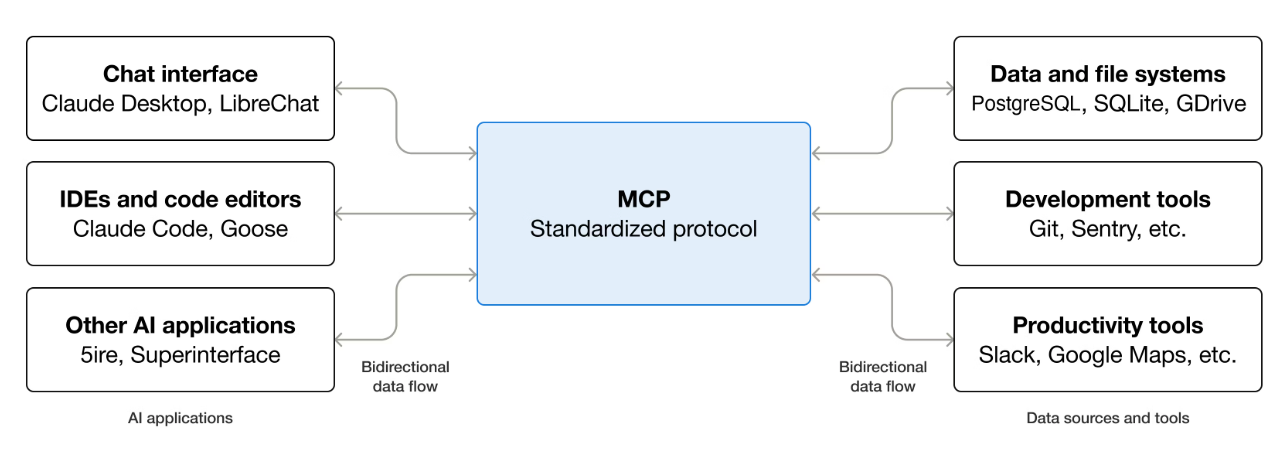
Source: modelcontextprotocol.io
Anthropic, the company that originally pioneered the protocol, has described MCP as the “USB‑C of agentic tooling,” which is an appropriate analogy. But Phil offers a more vivid and perhaps actionable metaphor through the Umbraco lens.
“I see it as a ‘pick and mix,’” he said. “So what you’re doing is laying out your stall of tools, and the agent can pick and choose which ones it wants to use to complete whatever it is you’ve asked it to do.”
For a complex product like Umbraco, that’s powerful. According to Phil, MCP allows “magic” to happen, letting you compose different agents to complete tasks that were previously impossible to do. And they’re already seeing real-world use cases from developers.
“It’s like the keys to all of Umbraco, right?” he said. “People are starting to pick up MCP now and use it in an implementation and production capacity. They’re able to use it and combine it with other elements within their MCP platform, things Figma, and really accelerate what they’re doing and how quickly they can move. This is what allows agents to work with our platform.”
Owning the AI strategy
A recurring theme in the conversation is who should own the AI strategy. For Filip, the answer is clear – and it’s bolstered by a foundational understanding of where your “superpowers” exist.
“We want you to be in charge of your own AI strategy,” he said. “We want to focus on content management, because that’s what we’re really good at, and we have years of experience and a proven platform.”
Filip was explicit about the risk of vendor-dictated AI, and why enterprises and organizations should carefully and thoughtfully choose the AI solution that’s the best fit for their needs – and that doesn’t necessarily come from the same place as your CMS.
“Don’t tie your AI strategy to your CMS or to your PIM or to whatever,” he said. “Find the AI strategy that works for your enterprise. Don’t be forced into using one model over the other just because that’s what your vendor chose for you.”
There’s a clear composable thread to all of this, and Filip reinforced where it aligns with the open spirit of Umbraco. MCP helps make the possibilities of choice more practical by standardizing the bridge between Umbraco and the growing field of models, agents, and other dimensions of a customer's AI preferences.
A two-speed strategy: Stable core, fast ecosystem
One of the things we spoke about in the pod was Umbraco’s solution for balancing stability with the breakneck pace of AI. With change being a weekly or even a daily constant, Filip described a sort of “two-speed” innovation model that supports their success.
This has very real architectural and experimental implications. At one end of the spectrum, it’s about being methodical and stable with AI. That’s balanced by Umbraco’s marketplace of ideas, which acts as a kind of accelerator – a bleeding-edge intersection where the ecosystem can support everyone.
“It’s very important to us that we’re predictable, and we don’t add something that we need to remove later,” he explained. “So we’re intentionally a little bit slow on this, on putting [AI] inside of the core product itself. But there are a few open source things in our marketplace for AI, and there are commercial products out there. With that dual kind of strategy, fast and slow, we get the best of both worlds.”
Phil also zeroed in on the overall flexibility of Umbraco to meet the expanding needs of AI, which is buoyed by its solid foundation.
“When you break it down, Umbraco is a series of tools to build on top of, and that’s always been our power,” he said. “It’s very extensible and very easy to build stuff on top of it, especially in this agentic world.”
The Umbraco community as a force multiplier
Without question, one of the jewels in Umbraco’s open source crown is its highly engaged community. Boasting more than 250,000 developers and users, it's also nurturing a well-established global network of digital agencies.
Umbraco’s ecosystem has already been a wellspring for AI innovation, with numerous third-party packages available via its Umbraco Marketplace. Builders can access everything from content generation to image manipulation, search optimization to translation. For example, plugins like Allyy.io help extend functionality with AI, enabling users to enhance their website with personalized content recommendations.
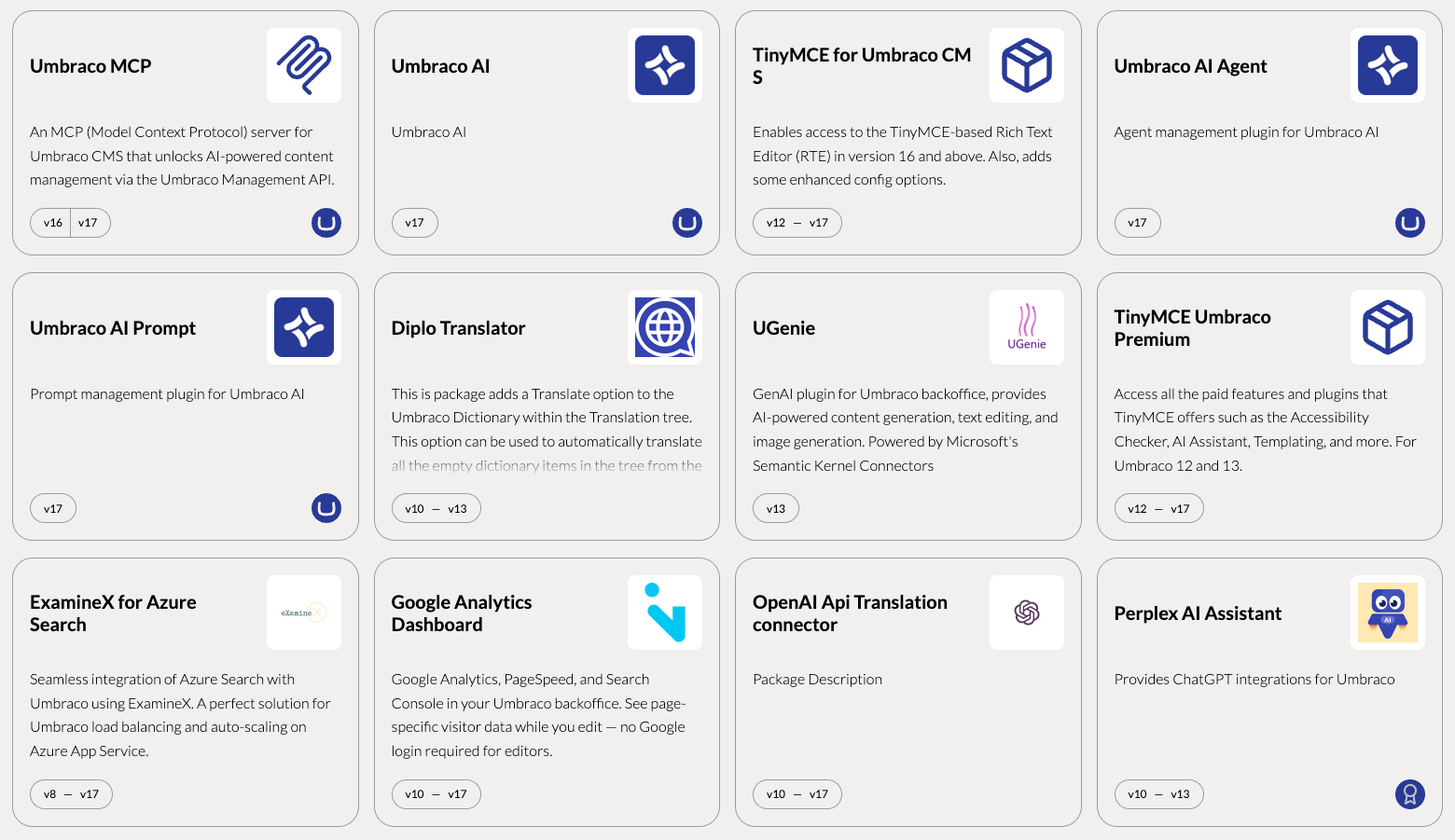
Source: Umbraco Marketplace website
Umbraco’s community is a clear asset to its AI horizon, and Filip sees this charter evolving. As he told me during the podcast, they used to host community hackathons to help fix bugs in the CMS. Now that the platform is exceedingly stable, these events are focusing on MCP and AI scenarios – and pushing the boundaries of where things can go. This is creating sparks of innovation.
“When we do hackathons, we take a full day and get everybody working with our MCP to see what they come up with,” he said. “It’s actually pretty good at writing Umbraco code with a little bit of instruction and access to the MCP server.”
The other part of the equation is partners, which, according to Filip, are still the primary go-to-market channel. As he said, all of these community-focused initiatives are about enriching relationships, elevating awareness, and upleveling skills. The goal is to make this cabal of builders more efficient, so they can translate the value of Umbraco to the end customer.
One thing Filip keyed in on was the air of “competitive camaraderie” that exists in the community. Even though many partner agencies might find themselves vying for the same RFPs, there’s a cooperative sensibility that exists – a mindset of elevating the Umbraco tides and lifting their collective ships.
“There’s really this ethos at Umbraco that we share ideas,” he said. “You might be in competition over a specific customer project, and then the next day, the same people will be on the forum and discussing ideas and growing the business of Umbraco together.”
Phil sees another benefit to this collaboration: helping partners keep up with the pace of AI. “Because this is moving so quickly, I’m trying to help partners,” he said. This is manifesting as support resources, things like blog posts based on new findings or lessons learned.
“Any help that people can get is going to make them better," Phil said.
From prototypes to production
One of the more forward-looking parts of the discussion centered on AI-assisted prototyping and vibe coding, where tools like Lovable are making waves. I asked Filip what he makes of this trend and how these tools might impact the Umbraco ecosystem. He acknowledged both the opportunity – and the risk.
“We’re seeing some of the horror stories about people not really understanding what a prototype is and what should and shouldn’t go into production,” he observed. “I think as they hear some of those stories, people will start to ask, how do I turn my Lovable prototype into something that I can actually trust?”
I’ve written extensively about this shift in the market and how vibe-coded solutions are replacing software at certain levels. Even Cursor – another tool in this ecosystem – recently announced that it would be dumping its headless CMS and using a combination of its own conjured elements to manage its website without a content management system.
Of course, this raises a slew of questions about security, scalability, and governance. Are organizations ready to ensure compliance with vibe-coded solutions? Not likely – and Filip’s betting that these trust factors will continue drawing people to more mature solutions like Umbraco.
“People will be looking at platforms like ours that have user management, data governance, performance, and delivery,” he said. “Then they can ask, how do I turn my prototype into that?”
Phil’s broader take on AI’s direction is also a mixture of pragmatism and confidence. As he said, AI moves quickly, but that’s balanced by some of the fundamentals of how LLMs function – things like the underlying methodology and the critical role of context.
“If you stay true to those things, then I think you’re always going to find yourself,” Phil explained. “The people who are going to be able to differentiate themselves are the ones who can collaborate with AI in the best possible way.”
‘Phil’ your cup – twice
In a market where vendors are racing to declare themselves “AI‑first,” Umbraco is speaking with a clear and unmistakable voice, focusing on a message of AI readiness and open choice. And at a moment when topics like digital sovereignty are permeating every conversation, it’s refreshing to see an open source platform reinforcing its commitments to democratization and transparency while still pushing the AI boundaries.
With MCP as a connective tissue, Umbraco’s two-speed strategy for innovation is providing a sage combo for delivering stability and extensibility. The ace up its sleeve – a dense and loyal open source community – is also giving “The Friendly CMS” a powerful asset for tapping a steady stream of new ideas.
If you care about where CMS is heading in an agentic AI world – and where MCP fits in – this conversation with Filip and Phil is going to be worth your time. It's as much about the technical journey as the philosophical one.
Besides, aren't two “Phils” better than one?
“The Critic’s Corner” podcast with Filip Bech-Larsen and Phil Whittaker
Upcoming Events

JoomlaDay USA 2026
April 29 - May 2, 2026 – Delray Beach, Florida
Be part of the Joomla community in one of the most iconic cities in the world! JoomlaDay USA 2026 is coming to Delray Beach, and you can join us for a dynamic event packed with insights, workshops, and networking opportunities. Learn from top Joomla experts and developers offering valuable insights and real-world solutions. Participate in interactive workshops and sessions and enhance your skills in Joomla management, development, design, and more. And connect with fellow Joomla enthusiasts, developers, and professionals from across the world. Book your seats today.
CMS Summit 26
May 12-13, 2026 – Frankfurt, Germany
The best conferences create space for honest, experience-based conversations. Not sales pitches. Not hype. Just thoughtful exchanges between people who spend their days designing, building, running, and evolving digital experiences. CMS Summit brings together people who share real stories from their work and platforms and who are interested in learning from each other on how to make things better. Over two days in Frankfurt, you can expect practitioner-led talks grounded in experience, conversations about trade-offs, constraints, and decisions, and time to compare notes with peers facing similar challenges. Space is limited for this exclusive event, so book your seats today.

Umbraco Codegarden 2026
June 10–11, 2026 – Copenhagen, DK
Join us in Copenhagen (or online) for the biggest Umbraco conference in the world – two full days of learning, genuine conversations, and the kind of inspiration that brings business leaders, developers, and digital creators together. Codegarden 2026 is packed with both business and tech content, from deep-dive workshops and advanced sessions to real-world case studies and strategy talks. You’ll leave with ideas, strategies, and knowledge you can put into practice immediately. Book your tickets today.
Open Source CMS 26
October 20–21, 2026 – Utrecht, Netherlands
Join us for the first annual edition of our prestigious international conference dedicated to making open source CMS better. This event is already being called the “missing gathering place” for the open source CMS community – an international conference with confirmed participants from Europe and North America. Be part of a friendly mix of digital leaders from notable open source CMS projects, agencies, even a few industry analysts who get together to learn, network, and talk about what really matters when it comes to creating better open source CMS projects right now and for the foreseeable future. Book your tickets today.