Griddo DXP Powers University Websites and Digital Experiences with a PhD in Performance

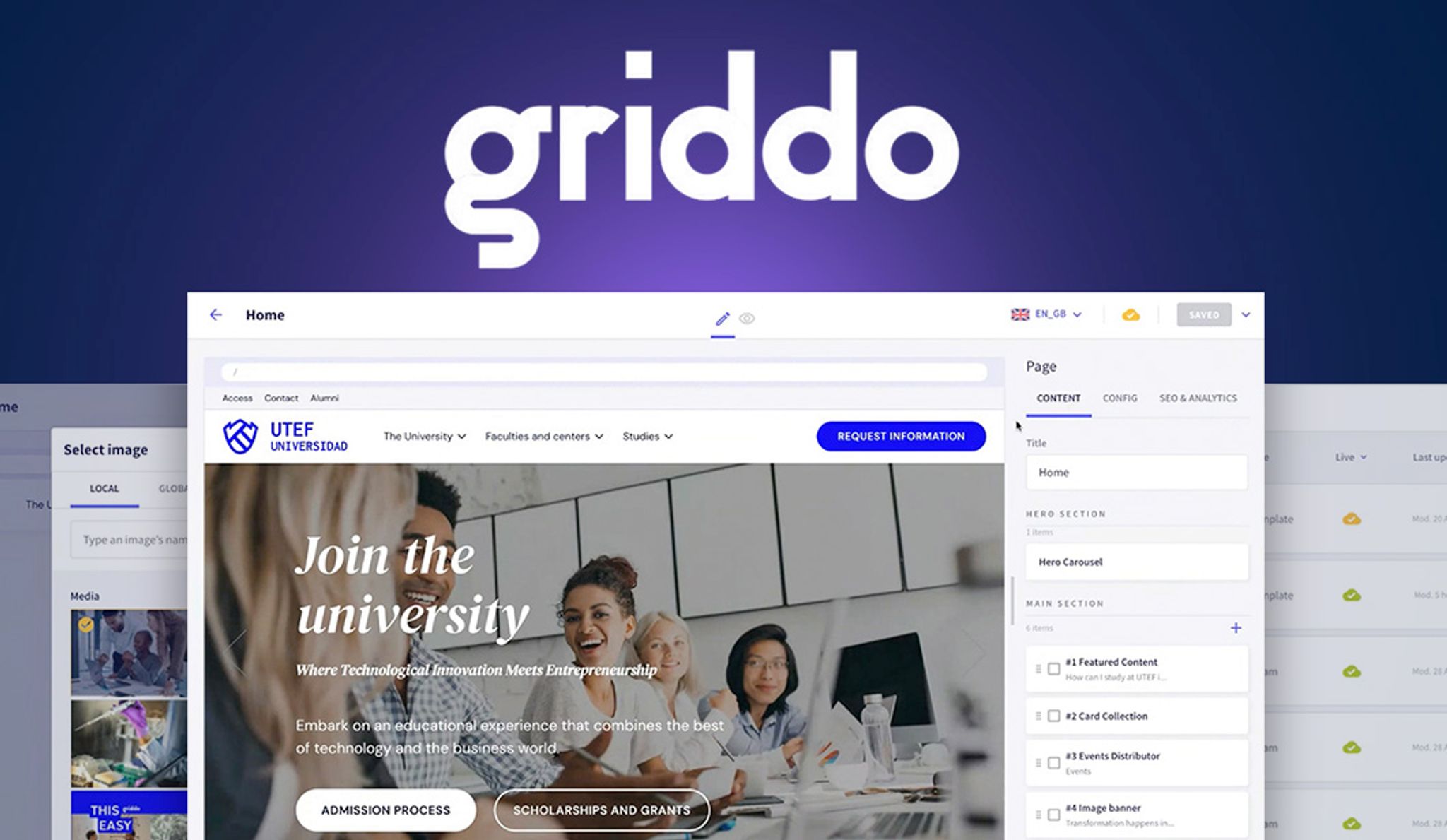
From no-code page building to AI automation, the education-focused platform gives university communications and marketing teams a feature-rich toolset for managing content and digital assets with ease and control – and a future-proof platform for building the next wave of experiences. Here's our comprehensive review.
As content management and digital experience platforms become more commoditized, I’ve noticed a modest trend towards specialization – where tools are aligning with a “sweet spot” in vertical industries like healthcare or media. This is something I spoke about with Kelly Goestsch of the Pipe17 during an episode of The Critic’s Corner Podcast.
It makes sense. Most platforms have achieved parity around core features. To establish differentiated value, some vendors are doubling down on proven expertise in key areas, focusing on capabilities that cater to highly targeted verticals and audiences.
This commonly manifests in features like custom UX, knowledge resources, or even industry-specific compliance. But there are new use cases popping up regularly.
Higher education is certainly one of those specialized sectors, and for good reason. It’s a niche market with very exclusive needs that few platforms are uniquely geared for. But this is where Griddo has earned an advanced degree in excellence, illustrating why universities truly need their own DXP.
From its inception, Griddo has been hyper-focused on education, providing a robust solution that was purpose-built in partnership with Spain’s IE University. As such, the platform reflects a deeper understanding of content operations for higher education institutions, delivering an authoring experience that addresses key pain points around multi-site management, centralized brand control, usability, and distributed content creation.
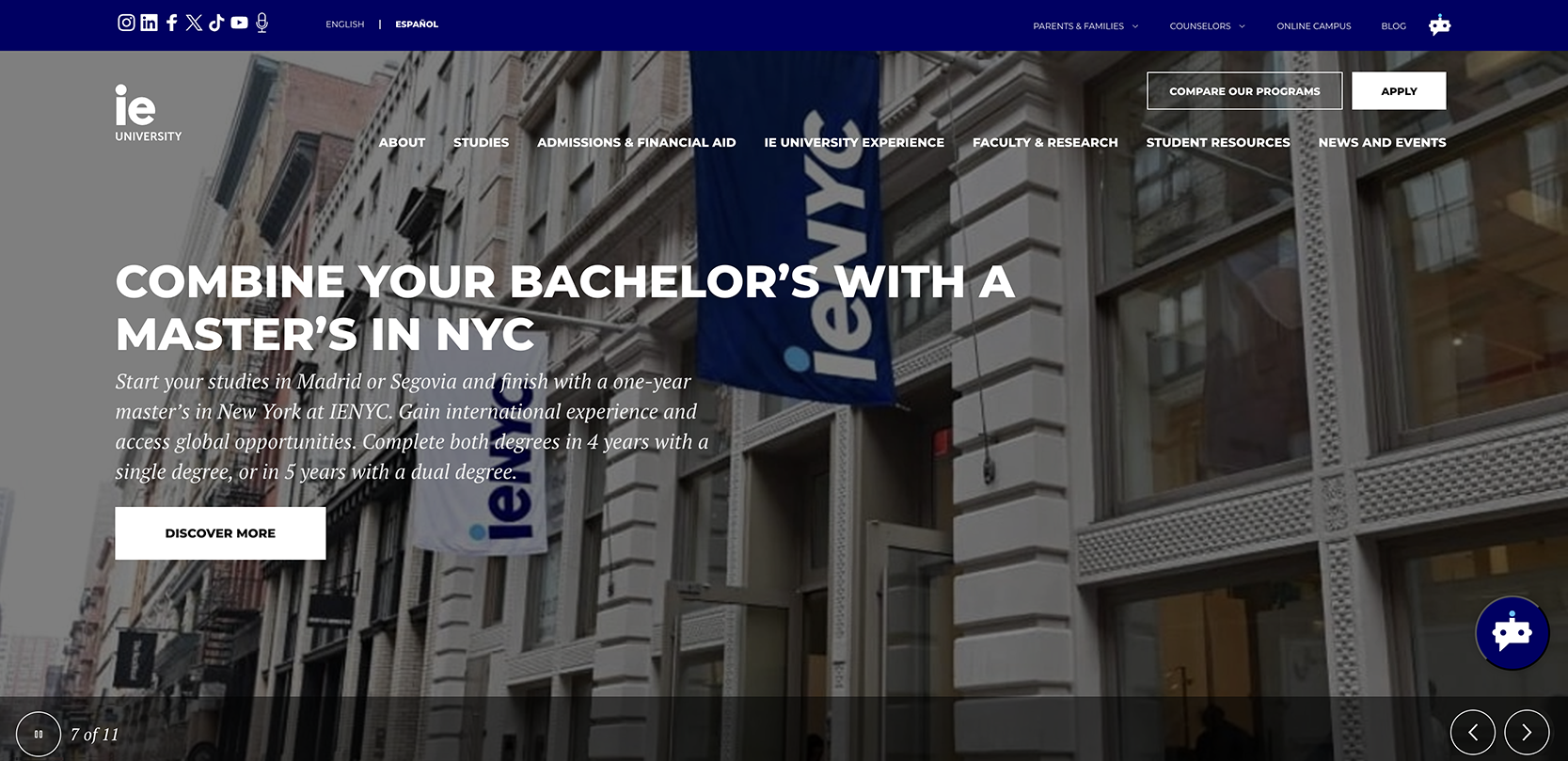
The IE University website, powered by Griddo.
According to Griddo’s chief executive, Daniel Serrano, his team wrestled with these challenges when developing the IE University website. At the time, he was CEO at Secuoyas, the brand agency behind Griddo. The two separated about a year ago, allowing Daniel to focus 100% of his attention on driving the product's growth. The agency, which remains a Griddo implementation partner, is now helmed by Gonzalo Villar, who helped bring Griddo into existence.
Secuoyas's promise of “innovation for digital humanists” is core to the company’s mission. Given this guiding philosophy, it’s not surprising that the IE website experience exposed the shortcomings of CMS and DXP tools when it comes to serving customers in education. As Daniel recounted, it was an illuminating experience.
“When we had to integrate this ecosystem of different websites that the university had, we found that there was a big gap between what a CMS could deliver,” he said. “We couldn’t find a platform that really met the need, so we started to look at a new way of doing things, like connecting to many other different systems and not having this monolithic approach.”

Griddo CEO Daniel Serrano. Source: LinkedIn
To deliver that flexibility, Griddo was designed as a composable system, harnessing MACH architectural guidelines to ensure scalability and extensibility. As Daniel said, his team made an early bet when embracing this modular, API‑first, non‑monolithic approach.
And that bet has paid off: MACH standards have helped eliminate legacy lock-in while providing interoperability and future-proofing around third-party integrations. During the engineering journey, they also addressed compliance and the central pillar of protecting student data, ensuring Griddo is secure by design and ready to meet fierce policy requirements around data privacy.
What makes Griddo a fantastic platform is its DXP ecosystem, which includes best-in-class features for creating dynamic websites, launching special event landing pages, publishing articles, and more – all with an easy-to-use, no-code UI. At the heart of the product is a powerful Design System that makes building new pages and experiences a snap while maintaining guardrails for brand consistency.
As a DXP, marketing is also a key part of Griddo’s feature set, offering enhancements like SEO optimization, integration with rich analytics, and more. Leveraging AI-powered automation, it also addresses accessibility in key areas like meta tagging. There’s also a built-in DAM that allows users to store, optimize, and serve assets across their web properties.
Specialization might be a trend, but Griddo has already staked its claim as the only DXP that’s singularly focused on serving universities. As Daniel said, having a system that’s focused on this category is long overdue.
In this review, we’ll dig into some of the capabilities that make Griddo stand out – and why it should be on your short list if you’re considering a new platform to build the story of your educational institution.
Why universities are a perfect (but painful) vertical
As the first touch on the student journey, university websites are the quintessential gateway experience, showcasing everything from available degrees to online programs.
But this isn’t your average website model. As Daniel told me, most universities have multiple sites within their ecosystem, featuring things like course overviews and curricula that change regularly, and programs or campaigns that require temporary landing pages.
Managing discrete elements and components across any large environment can be daunting. But compounding universities is a pervasive “federation of schools” governance model, where budget silos and fragmented digital ecosystems – along with the universal challenge of disparate geographies – make it even harder to control at an administrative level.
On top of that, university content teams are frequently small and distributed, with many departments or individual schools tasked with handling their own fiefdoms while dodging multiple layers of stakeholders.
“When you think about universities, they have so many touch points. You often find yourself immersed in a very broken experience with different ways of rendering the brand in different websites made by different providers, in different technologies.”
“The fact is that universities typically have a ‘School of Engineering’ or a ‘School of Education,” Daniel explained. “It’s all very divided because of the way universities have been governed. You also have many websites, and the need to have a very centralized control from the point of view of the brand and users and tone of voice. At the same time, you need to distribute the way content is going to be generated.”
Like certain enterprises or the public sector, universities have their own brand of bureaucracy that often creates red tape. This might serve their academic goals on one level, enabling independence across the individual schools within a broader university system. But the ensuing lack of clarity and cohesion can damage brand reputation as a core business asset – and ultimately impede admissions.
Brand decomposition across dozens of independently built sites is a common problem, and Griddo is approaching this as an “ecosystem-first” DXP. As Daniel said of the IE University experience, his team knew that they needed to manage a large pool of properties from the get-go. To achieve the right outcomes, they aimed to bring things together with greater control in a single, composable platform.
“When you think about universities, they have so many touch points,” he said. “You often find yourself immersed in a very broken experience with different ways of rendering the brand in different websites made by different providers, in different technologies.”
Cloud-first, API-first, and fully composable
Let’s first talk about technology. I’ve already mentioned how Griddo’s MACH composition is one of the keys to its flexibility and resilience, and its cloud-first SaaS delivery leverages the trusted AWS infrastructure.
As an AWS partner, they’ve also achieved the status of an Amazon Web Services Qualified Software product, which requires the completion of an AWS Foundational Technical Review (FTR). This helps ensure the security, redundancy, and high availability performance that customers rely on to maintain uptime and governance.
When it comes to SaaS, data ownership is always a sticky wicket. Griddo offers a multi-tenant solution, but universities can also deploy it in their own AWS instance. Not only does this provide greater confidence, but it may also be a requirement based on regional compliance.
It's worth noting that Griddo is fully built in JavaScript, leveraging both Node and React, which are popular frameworks in composable circles that provide a lot of extensibility and large, well-supported dev communities.
Griddo is also API-first, another tenet of its MACH-worthiness. Layered with its decoupled architecture, its private and public APIs enable integrations with functionality that expands the platform’s functionality. This enables native headless CMS capabilities, as well as connections to third-party best-of-breed tools like Salesforce, HubSpot, and Microsoft Dynamics.
But integration doesn’t stop there – it also applies conceptually to a university’s ecosystem, enabling connections with a wide variety of tools and sources via APIs. This includes standard content sections like news and events, but also applies to curriculum, funding and scholarship programs, testimonials, and other communication resources.
A great example is an existing faculty management solution, which many universities already have. Griddo can integrate with these resources to provide a more comprehensive and connected management strategy.
An authoring experience designed for real university teams
As noted, Griddo was born out of necessity, with an actual university use case driving the innovation. That deeply influenced the content authoring experience, which is built around three levels of entities: the broad ecosystem, the individual websites, and the pages themselves.
First, Griddo’s UX is incredibly lightweight, intuitive, and inviting – all welcome attributes for content creators dealing with multiple tasks and struggling with cognitive overload. Everything is deftly organized and easy to navigate, with the main dashboard providing quick access to your most recent work.
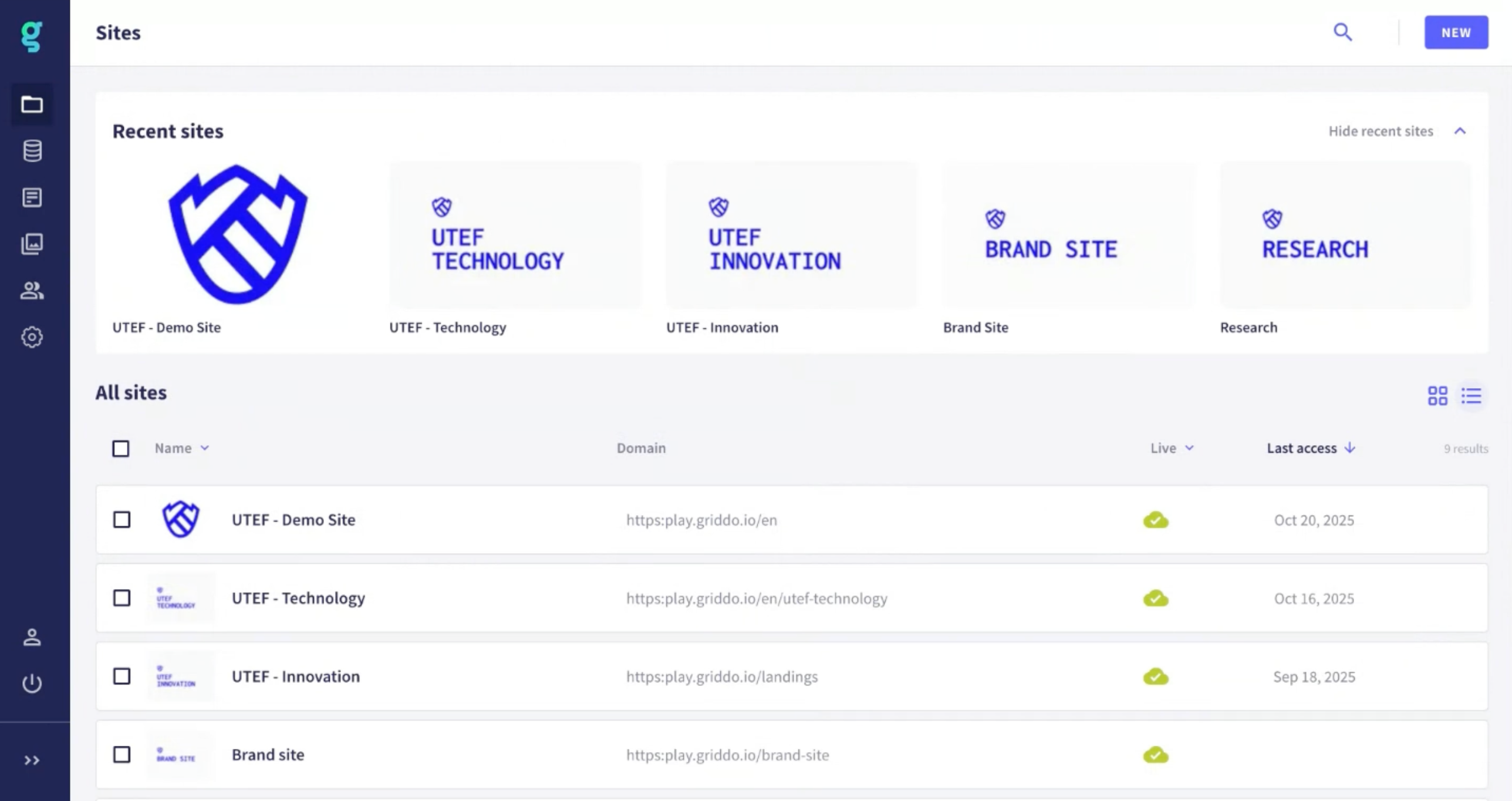
Griddo is multi-site by design, allowing teams to host all of their properties in one place. Its modular nature makes it easy to reuse content almost anywhere, making users and teams more productive. It’s also natively multi-language, making it globally extensible for distributed teams serving different geographies.
Manage users and roles with global permissions
As a system of authority, a CMS or DXP is only as solid as its user governance, and Griddo scores high points for its fluid, easy-to-use Users & Roles. They’re granular, super extensible, and they apply to the entire ecosystem.
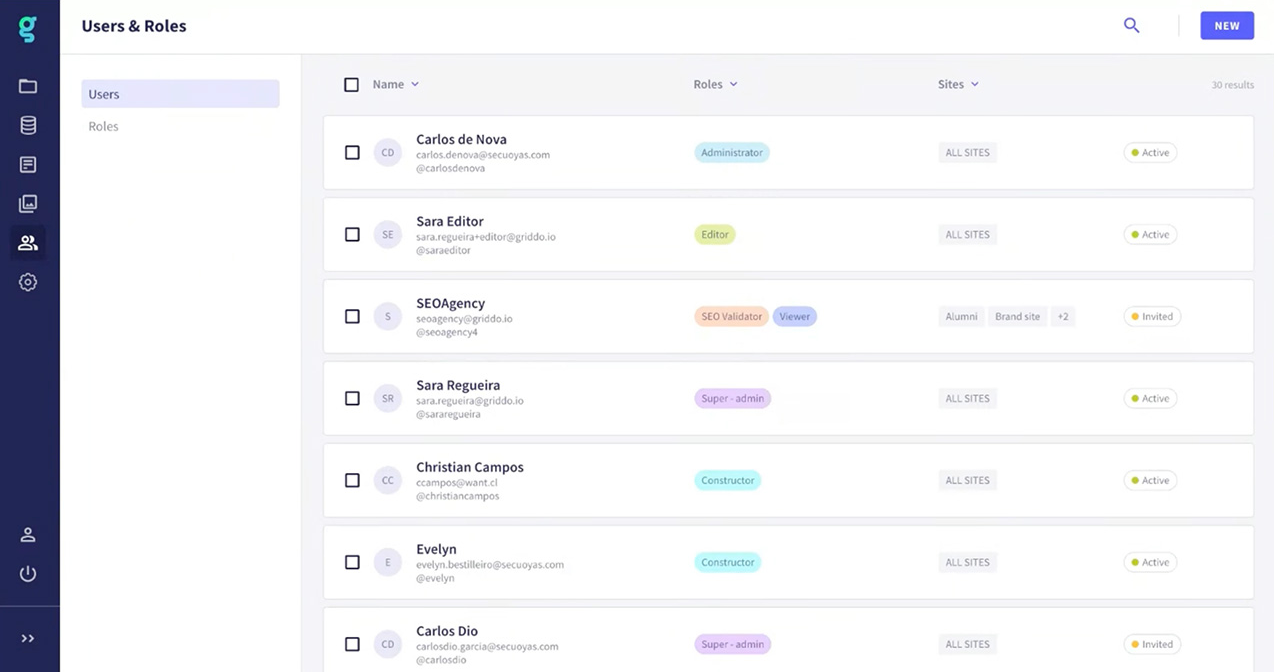
In seconds, an administrator can grant access to specific sites for staff, faculty members, and even third-party agencies or consultants. They can also assign roles based on specific functions like viewing, editing, or performing SEO validation.
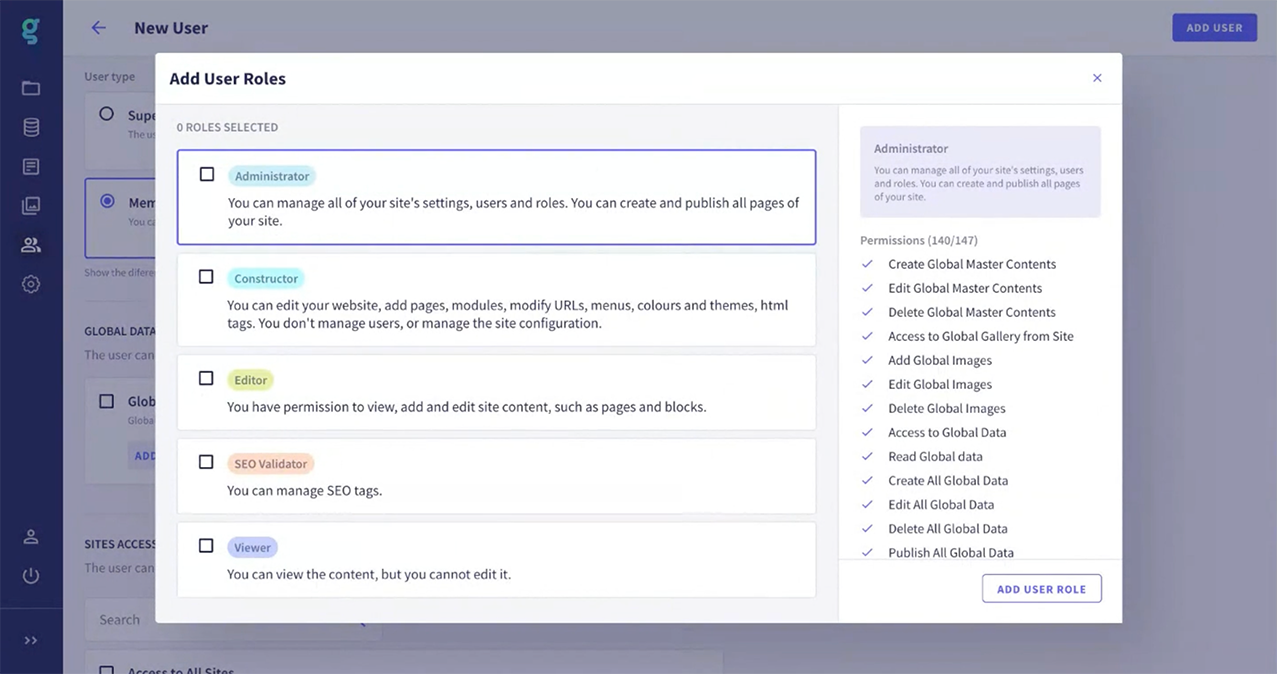
You can also set the permissions around global data access within specific roles, and refine which areas you want them to have access to, such as landing pages, post-graduate studies, and more.
University web ecosystems have lots of sites, pages, and people to contend with. That’s why user management is a critical ingredient for a successful recipe. Yes, it provides a clear trail of traceability for users, but it also enables secure collaboration between team members and external agencies and partners.
This is easily one of the best parts about Griddo’s capabilities, and promises real value for university content teams and their administrators.
Maintain brand control with a centralized Design System
I’ve already mentioned Griddo’s inventive Design System, which provides universal governance over a university’s digital ecosystem. Pumping at the heart of the platform, it provides a firm foundation for nimble teams handling lots of sites and pages.

Griddo Growth Analyst Isabella Otero. Source: LinkedIn
The Design System allows each university to customize its style elements and components around specific parameters. This includes color, typography, and other dimensions. During my demo with Isabella Otero, Growth Analyst at Griddo, she explained how the system’s modules are exclusively tailored to each university. Once in place, the Design System keeps your “brand house” in order – providing the essential guardrails that ensure consistency at every level.
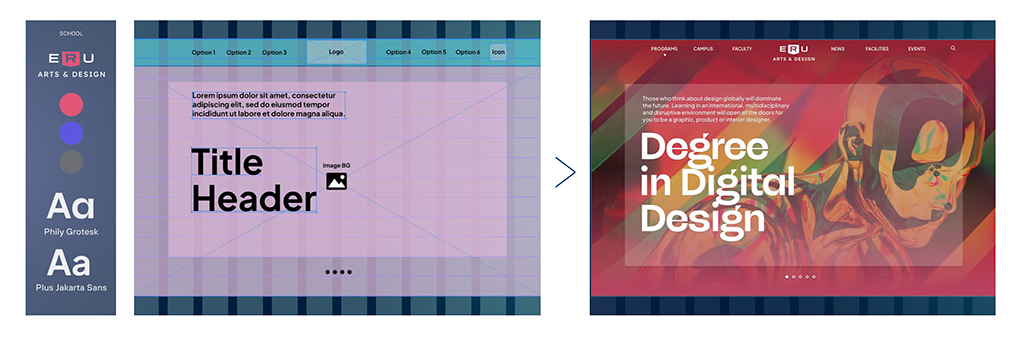
“No one’s going to be able to break this,” she said. “I’m not going to create my content and then feed it into a template and then pray that it looks good when it’s published. So you start thinking, ‘Okay, how do I tell the story?’ And you start using different modules to do it. It’s more like crafting the story while you’re building it.”
Depending on a specific university’s in-house resources, Griddo can provide implementation to support the customizations within the design system. This is where its JavaScript-based flexibility is a huge benefit to design freedom and choice.
Build with no code – and no problems
Leveraging the Design System as the backbone, you can really build and edit without friction. That includes breaking the barriers of code, which often require tickets to IT departments and lengthy cycles for change requests.
Griddo really delivers on the promise of autonomy for university content, communications, and marketing teams. By enabling more direct control, the company claims that users can create and publish 10% faster while cutting their time to market in half.
Let’s start with the UX. Within each site or project, you can quickly drill into your pages, which are aligned around templates or specialized content types. These can be events, news, press releases, or other specific variants like academic areas.
I really like the quick snapshot of the publish status, translation, and even SEO status in the main list view – all super handy resources when you’re managing lots of discrete pages.
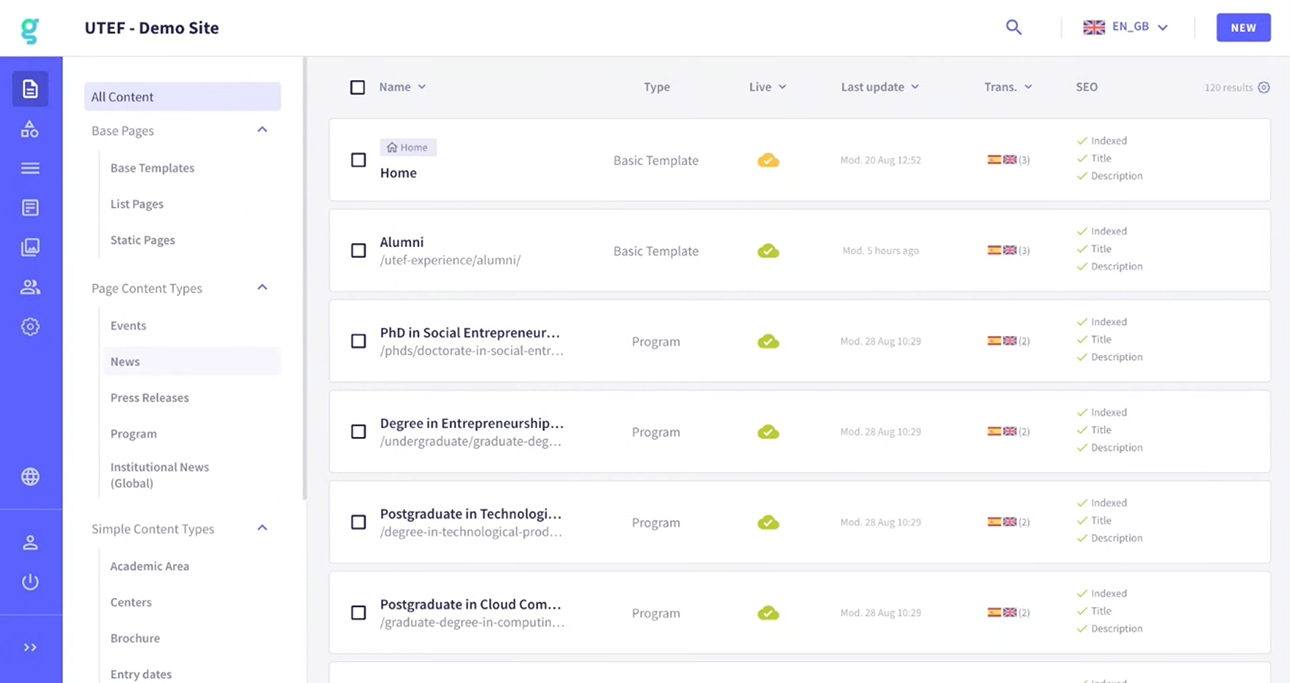
The building and editing experience is literally beyond easy. The canvas is clean and intuitive, with rich controls right at your fingertips. The best part: there’s no code required. Users can drag, drop, and reorder at will, and have an instant live preview as they’re assembling a page. And again, it’s all governed by the guardrails of the Design System.
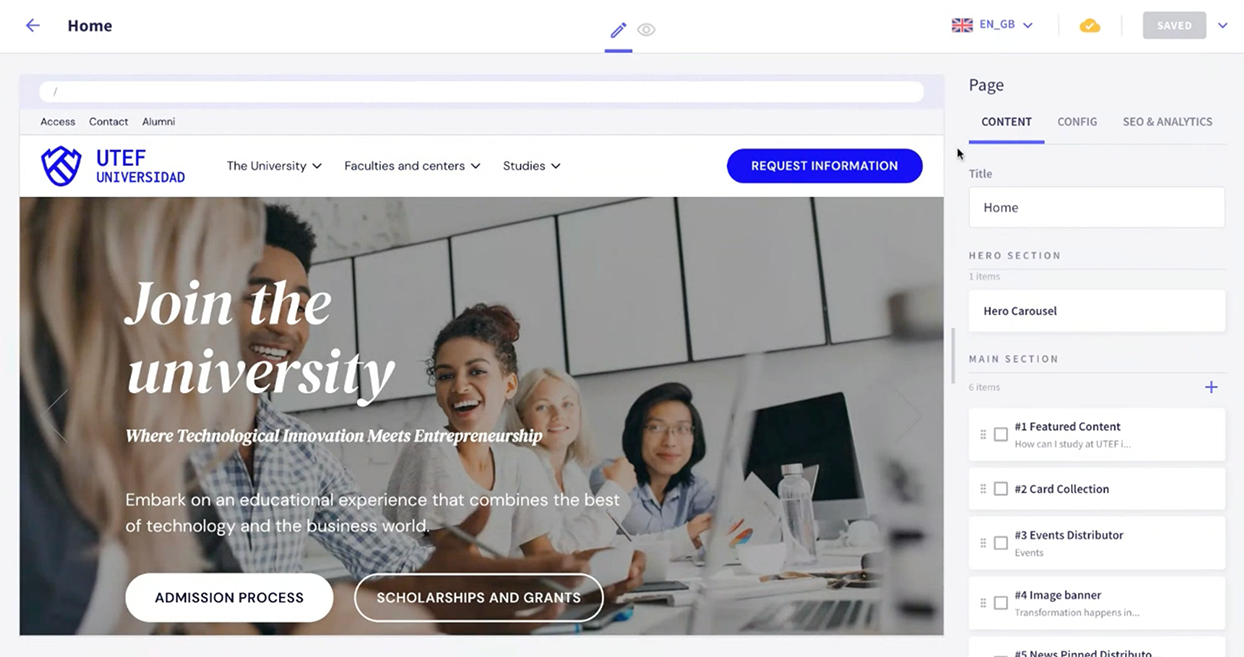
“When the Griddo was designed, it was completely thought of like the author experience was a priority, and that’s why we have the live preview,” Isabella said.
Like many CMS tools, dynamic managers are essential to lightweight building and editing. Griddo’s Design System is built with modules at its core, offering countless options and configurations, from basic content to custom countdown pages. In seconds, you can load one up and start curating the page.
What makes Griddo’s module system unique is how it handles content container structures, which breaks from the age-old limitations of rigid templates. They can be molded or extended over a liquid layout, so that the container always adapts to the content – not the other way around. In other words, you’re no longer imprisoned by the “terror” of the template.
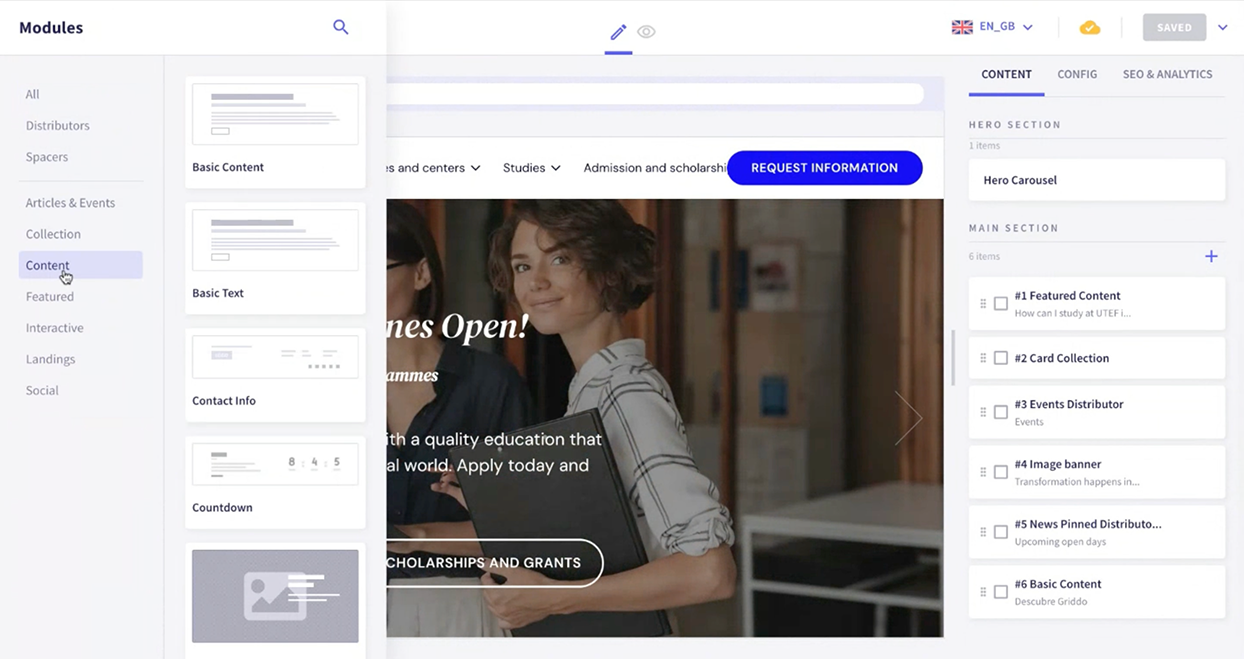
Griddo's Design System is centered around flexibility, allowing each university to style its own set of modules based on its design language and functional needs. As Isabella said, it’s all about aligning with the university’s unique brand.
“What you see with the modules, that’s the Design System,” she said. “They were pre-designed for each customer, and you won’t find them exactly the same way in any other university.”
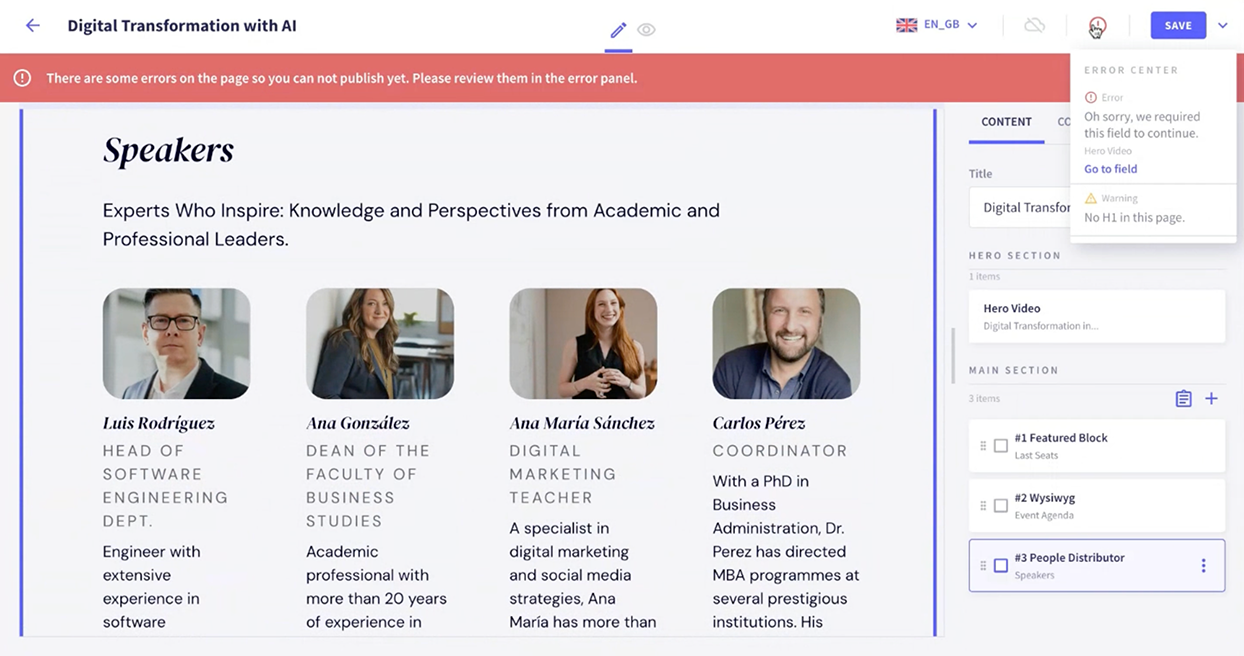
Publishing workflows are easily accessible, enabling you to set your page content to a review status, schedule it for publishing, or publish with a few clicks. Griddo is also “flight checking” your content before you publish. If you happen to miss a field along the way, it flags it and triggers a validation error. This ensures that your page doesn’t go live without a background image or some other critical component.
This is a great asset for editors who are hustling to meet a deadline – and as a human, might miss a step.
Reusable content is a core pillar of Griddo. One of the features I really love is the ability to copy and paste more than just text. You can instantly grab modules and pages from one site and paste them into another while maintaining all of your styles within a given Design System.
Griddo is also natively responsive, and that’s key: according to an EDUCAUSE student technology report, students are using laptops, tablets, and smartphones as part of their mixed digital footprint. It’s just one more facet of its Design System that takes the worry out of the equation.
A powerful built-in digital asset management system
Griddo’s Global Media Gallery – also called “G-DAM” – is an in-app digital asset management system that’s specifically engineered for a university’s unique needs. It’s completely integrated, enabling access to assets from multiple points across the platform.
Like any good DAM, it’s all about taxonomy and organization. What’s nice about the Griddo’s baked-in solution is the ability to maintain local galleries for individual schools. For example, you can tag and isolate X-ray photos that would only be relevant to a School of Medicine.
Images within the DAM are easily accessible via the editor, enabling you to browse for tagged items. While G-DAM stores and serves images, it can also transform them based on specific format criteria such as orientation (4:3, 16:9, etc.).
It also had built-in optimization, which reduces image file sizes to improve load times while allowing users to adjust variables like contrast and highlights within the system – accelerating the publishing of quality content.
Manage files with ease
Like images, documents can have metadata and details modified at will. As Daniel told me, you can also harness AI to automate the generation of alternative text to meet accessibility standards.
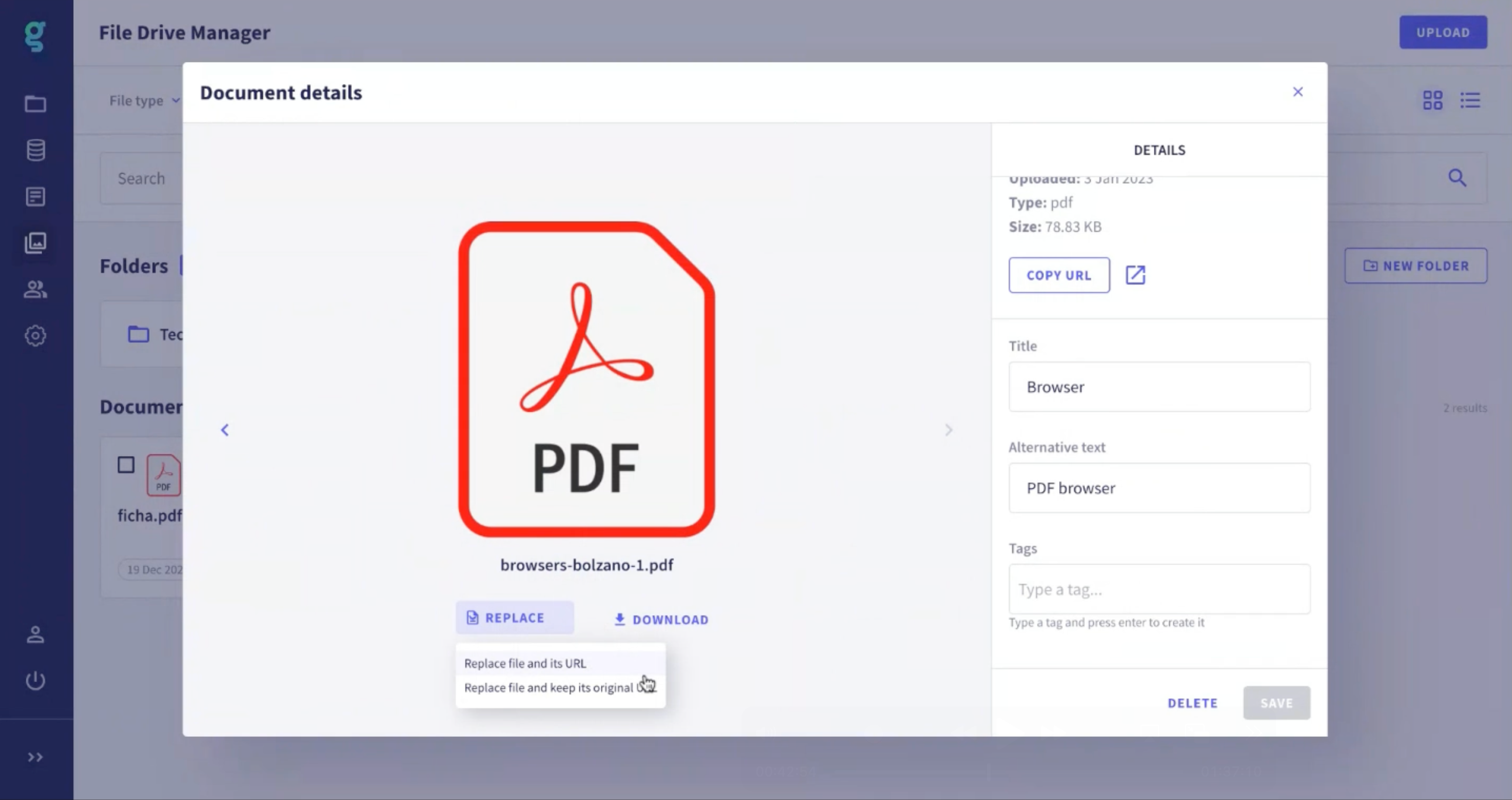
University schools and departments are frequently updating documents like course syllabi, and Griddo’s File Drive Manager allows you some powerful control to manage this flow. When a replacement document is uploaded, you can elect to overwrite or maintain the original path without breaking a link. This gives teams an easier method for document version control on the fly. It’s a slick feature that’s really designed for university workflows.
Of course, you’re not limited to the on-board DAM. Griddo can integrate with leading third-party systems like Cloudinary, giving you access to broader DAM and PIM capabilities that bring their own feature sets.
Marketing power and SEO/GEO performance
In addition to being informational resources, university websites are marketing workhorses, enabling exploration through visually compelling content and videos and converting leads into prospects. To support university marketing departments, Griddo comes packed with some built-in marketing resources that can really enhance performance.
First, Griddo’s approach to page and data structure is designed with SEO in mind, applying rules and schema that are baked into each new page. This is equally important as students turn to answer engines like ChatGPT to research universities, and applying best practices for generative engine optimization (GEO) becomes a critical factor.
Landing pages are a critical program element in every campaign. Griddo makes it easy to build pages without relying on third-party tools, which keeps visitor traffic on a university site. By leveraging reusable web components from the system, you can make a page in minutes or replicate an existing template.
Griddo’s SEO editor is fully integrated into the editing experience, and enables a university to personalize content by language, manage SEO parameters on specific pages, and manage the skut work of URL redirects. That last feature is critical when it comes to supporting successful migrations.
Every marketer needs solid analytics, and Griddo makes it simple to access your performance details directly in the UI. Along with custom configurations, there’s seamless integration with Google Analytics.
A growing AI roadmap
It’s no secret that higher education institutions have lagged behind the commercial market when it comes to digital maturity. But AI is changing the game, and adoption is moving faster.
As an AWS practitioner, I’ve been working with its AI/ML stack for almost a decade, and Griddo has been harnessing Amazon’s best-of-breed tools for solid use cases. For example, Griddo connects with tools like Amazon Rekognition to provide automated, AI-powered image tagging. This solves a key problem for content creators when ensuring digital accessibility.
On the SEO side, Griddo is leveraging OpenAI to automatically generate meta tags for SEO, and DeepL for translations. These are both well-established industry tools that continue to improve their performance. That said, it’s not perfect – but with Griddo, you can employ a “human in the loop” model to validate any generated content and ensure accuracy.
Griddo also offers global semantic search and foundational personalization features, both of which are being expanded to improve performance and relevance for visitors and drive the educational journey.
When it comes to the AI frontier, Griddo is just getting started. As Daniel told me, they’re leading the AI conversation with many of their customers, and they have a clear roadmap for what’s ahead. This includes a planned feature for converting PDFs for course syllabi directly into web pages – something that would save time, enhance SEO, and improve the student experience.
“There are some emerging properties of Griddo, and one is AI search, because we have everything under one database,” Daniel said. “The other is that we can create personalized content. As you navigate through a university website, we can push content that is related to your interests. There’s no point in showing you news about a law school if you’re interested in engineering, so we can switch the information to engineering.”
Pricing
As you know, I’m a stickler for pricing transparency. While Griddo’s sales motion is focused on the classic “human” demo (which I highly recommend as there’s no free trial), it does offer several pricing options for its subscription service.
Griddo takes an institutional category approach to its tiering, but this is really a system for right-sizing the package offerings. This includes a spectrum of levels, from small to large: Institute, School, College, and University.
There are two options for Griddo's IaaS hosting, giving schools greater flexibility around their deployment and cloud ownership. Pricing is relatively straightforward, based on specific dimensions such as number of websites, page count, and team resources. In both cases, the customer owns their Design System and modules, including the source code and repos.
- Griddo Private Cloud Hosting (on premise), which includes a setup fee of € 7,500. The customer owns the cloud instance, but Griddo fully manages it. From a tiering perspective, the Institute plan includes 1 website, 15 authors, and 1,500 pages for € 2,000 per month. It increases from there, with the University plan accommodating anything over 6 users, 50 authors, and more than 7,500 pages for € 5,000 per month. It's important to note that your cloud infrastructure costs are not included in these prices.
- Griddo Cloud, the platform's fully-managed cloud environment deployed on AWS. As a vendor-owned infrastructure offering, Griddo Cloud provides the same plans as the Private Cloud Hosting, but at half the cost: Institute starts at € 1,000 per month and University tops off at € 2,500 per month.
At the high end, you get the complete DXP capabilities, which include extras like CRM integration, SSO, and more. You can also add additional monthly services such as the Griddo File Drive – or Generative Search and Personal Experience, which are only available at the College or University tiers.
On the support side, Griddo offers technical help with an 8 AM - 5 PM SLA, which also covers scheduled release and deployment tasks. You'll get automatic updates with new features, and their team covers the AWS DevOps and cloud maintenance – as well as 24/7 monitoring and alerts.
One other factor that will impact cost is implementation. Currently, schools can work with Secuoyas and Want, a digital agency based in Chile. The company is looking to expand its channel in 2026, specifically in the U.S. But as Isabella told me, they're being selective in recruiting partners with a deep understanding of their model and marketplace.
To schedule a demo or discuss pricing options, you can contact Griddo’s sales team.
The verdict: Graduate to this purpose-built DXP
Griddo really answers the key pain points that higher education institutions are experiencing – and it achieved this specialization through real-world experience and thoughtful, intentional engineering. Its “university intimacy” has translated into both practical and ambitious content management and digital experience capabilities, setting it apart from horizontal solutions that might have similar profiles but lack the purpose-built features.
Without question, Griddo’s core Design System is a standout feature. It effectively tames the “Wild West” with the governance guardrails that help large universities maintain their ecosystem and reinforce their brand reputation. At the same time, the platform’s modules provide nearly infinite possibilities with customization via easy-to-use, no-code tools – all buoyed by live preview capabilities that marketers and content creators demand.
Griddo might appear to be lagging its pure-play DXP competitors when it comes to agentic AI. But the platform is composable at its core, and thus future-proofed for integrations that could make up some ground. More importantly, the higher education segment isn’t screaming for these capabilities (yet). I think Griddo’s emerging AI features, like global semantic search and personalization, are perfect for building on their current AI tooling, which provides practical solutions for enhancing SEO, meta tagging, and more.
I’ve worked with countless CMSes over the years, and a big measure of success rests with users and roles. Griddo has this locked down at a global and granular level, but through the university lens – making it an ideal platform for managing the chaos of large pools of users. Having the breadth of marketing tools under one roof also enhances performance out of the gate, especially in critical areas like GEO.
Finally, a note on accessibility: Along with data privacy governance (think GDPR), accessibility has become a critical requirement for digital experiences – and the education space is held to some of the highest standards of inclusivity. According to Daniel, Griddo underwent rigorous WCAG auditing by a blindness organization in Spain and passed crucial tests, putting it on solid ground.
My recommendation: If you’re evaluating CMS and DXP tools to power your university website, Griddo is one of the few platforms that’s purpose-built from the ground up for this market. It offers a tight toolset in a single platform, bringing a lot of power to small teams that want a composable, scalable, future-proofed solution that can meet today’s demands – but is ready for what’s next.
Overall, it's a solid platform – and I give it a PhD in performance.
Upcoming Events

CMS Kickoff 2026
January 13-14, 2026 – St. Petersburg, FL
Meet industry leaders at our fourth annual CMS Kickoff – the industry's premier global CMS event. Similar to a traditional kickoff, we reflect on recent trends and share stories from the frontlines. Additionally, we will delve into the current happenings and shed light on the future. Prepare for an unparalleled in-person CMS conference experience that will equip you to move things forward. This is an exclusive event – space is limited, so secure your tickets today.