Hard? Hardly. Drupal CMS 2.0 evolves open source content management with AI, visual building – and simplicity

As the iconic open source CMS turns 25, it’s ushering in a new era for marketers, making it easier than ever to launch and manage websites without relying on developers – and reimagining open source for enterprise web publishing. Interview with Drupal founder Dries Buytaert.
Sharing a stage with Dries Buytaert is a bit like standing next to the sun. Much like that massive star in our sky, he’s bright, energetic, and possesses an inescapable gravity that pulls you closer into his orbit.
During our interview keynote at the inaugural Boye & Company CMS Connect conference in Montreal, we covered a number of timely topics, from the current state of open source to the challenges of balancing the commercial goals of Acquia.
Of course, the biggest topic was AI.
At that time, the Drupal Association and its broad open source community (now over 1,000,000 passionate developers, designers, editors, and sponsors across the globe) were driving the open source roadmap towards this burgeoning AI frontier.

Dries Buytaert. Source: Acquia website
Around the same time at DrupalCon Portland, Dries revealed his plans for the first new version of Drupal CMS, appropriately branded as “Starshot.” Fully launched in January of 2025, over two decades after Dries started the project while attending the University of Antwerp, this new aggregation of the Drupal Core promised a curated, out-of-the-box experience for building powerful websites quickly – and making it all more accessible to non-developers.
Recently, there’s been a spark around the Drupal movement. An unabated enthusiasm that’s reflected in the activity associated with the project. What’s clear is that the community has been ignited by Dries and his vision, and that’s translating into growth and advancement.
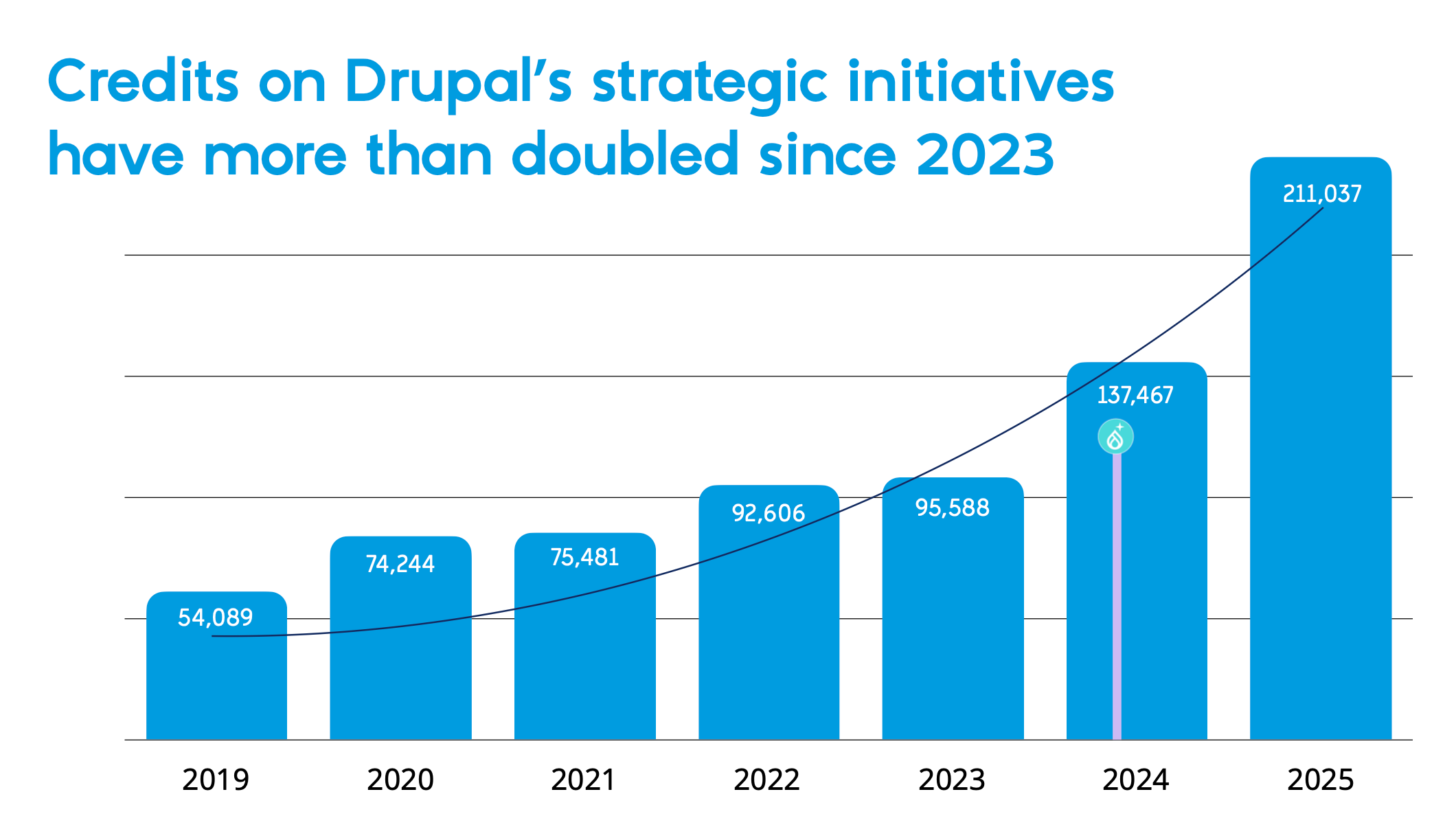
Source: Drupal Association
“This is a chart that I showed in DrupalCon Vienna,” Dries shared. “It shows the amount of contribution to strategic initiatives, and it basically doubled in the last 18 months or so. We haven't innovated this fast in 25 years.”
Now, as Drupal turns 25, a quarter century of that sweat and enduring love is supporting the forward momentum for this storied CMS. Today, the Drupal Association announced the release of Drupal CMS 2.0 – what it calls the biggest evolution in the platform’s history. Built on Drupal Core 11.3, it promises the best performance improvement in a decade, ensuring fast, reliable experiences that scale from startup to enterprise.
Drupal CMS 2.0 is endeavoring to “reinvent” the open source CMS. It was designed with marketers and content teams in mind, particularly those at mid-size and enterprise organizations that need a powerful and reliable CMS to underpin their operations. It’s also targeted at digital agencies, developers eyeing AI-enhanced workflows, and teams with limited technical resources.
This release couldn’t come at a more fortuitous moment. As organizations grapple with uncertainty and wrestle with the fluid dynamics of the economic and geopolitical climate, data and digital sovereignty are becoming central considerations. This is boosting the democratized value of open source as a hedge in securing the software supply chain.
Is Drupal actually ‘hard’?
Well… it depends who you ask. But the perception of “hard” has been an albatross hung squarely around its neck, arguably hindering the overall growth of the project.
Having successfully deployed Drupal sites myself, I agree that it’s more complex than WordPress and its other peers. But hard? I’ve spoken to many practitioners, developers, and agency stakeholders over the years who very much share that sentiment – and certainly when compared to proprietary tools delivering low-code/no-code visual builders that appeal to marketers.
As Dries said, this new release “debunks” the myth entirely.
“With CMS 2.0, we built a platform teams won’t outgrow because it is scalable, flexible, and easy to build on,” he said. “Now marketers and site builders can create professional, on-brand sites without having to rely on developers, avoid unnecessary complexity, or get locked into platforms that don’t adapt. Built on Drupal’s robust open source foundation, Drupal CMS 2.0 puts easy-to-use enterprise-quality publishing tools directly in the hands of marketing teams.”
Sounds like things are easier. And that’s a good thing. But hang on:
“Hard” ain’t all that bad. Because it also speaks to the strength of Drupal’s foundations.
Now, as a new crop of AI-powered tools enters the equation, Drupal CMS 2.0 is acting as a bridge to the next generation of automation – building on a heritage of fundamentals that made this project performant, reliable, and secure. That perceived friction is partly why it’s trusted by large public sector agencies where governance, compliance, and accessibility are critical concerns.
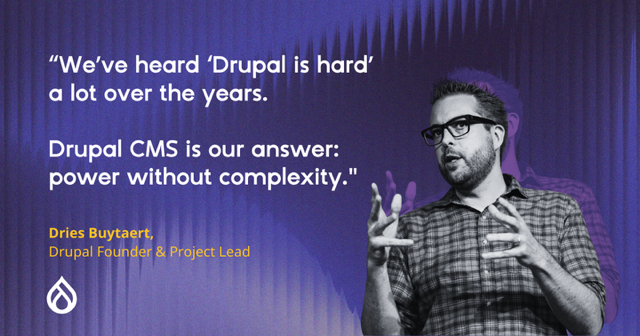
“The reason Drupal was seen as hard is because we have things like content modeling and content relationships and advanced content workflows,” Dries explained. “But now, in the age of AI, these weaknesses, they become incredible strengths – and I think that's pretty exciting for a project like Drupal.”
In my conversation with Dries about the new launch, we drilled into some of the prevailing challenges and opportunities that we’re all facing – and how Drupal’s evolved experience and open source nature are providing a template for success. Even after 25 years as the project’s leader, he’s still an undeniable force at the center of our digital solar system.
A quantum leap with visual building, templates, and integrations
Despite its heritage as a developer-first platform, Drupal CMS 2.0 now allows marketers and content teams to build and manage enterprise-grade websites through an intuitive, visual experience – one that accelerates time-to-launch while maintaining its firm commitment to the open source standards that developers depend on.
One of the big leaps in making Drupal CMS 2.0 easier is its visual-first building, aptly named Drupal Canvas – a visual page-building interface that offers real power without the complexity of code.
The Drupal CMS includes a full component library that allows you to harness the Canvas page builder as a default experience. Using drag-and-drop elements, live previews, and integrated content management, marketing teams can be productive with no Drupal knowledge required – and have total ownership and control over their web presence.
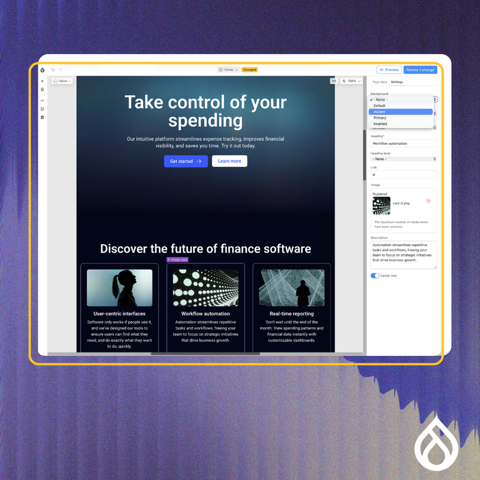
Drupal CMS 2.0 features visual building tools. Source: Drupal
Adding to the speed and simplicity are pre-configured Site Templates, offering feature-complete starting points for specific use cases. It includes themes, content, layouts, and design systems – allowing you to install a complete professional site in under three minutes. Drupal CMS 2.0 also ships with Byte, a marketing site for a SaaS-based product, with more templates to follow.
“The last mile, if you will, becomes a lot easier because you don't have to build it all from a blank canvas,” Dries explained.
One area where developers have long held domain is in enabling third-party integrations. Drupal CMS 2.0 tackles that with the presence of recipe-based automation for Mailchimp, Google Analytics, Google Tag Manager and AI – all the difficult but essential minutiae that marketers typically can’t handle. Now, with one-click integrations, you can add complex configurations with simple prompts for credentials.
In all, Drupal CMS 2.0 really delivers on the platform’s mission to democratize enterprise-grade web publishing, giving non-developers the ability to launch fully branded, professional websites in days instead of weeks, link up key integrations, and significantly accelerate site build times – all without the need for technical know-how.
An ‘AI evolution’
As I’ve already mentioned, AI has been a key focus for Dries and the Drupal Association for quite a while. The synergy and momentum were formalized last June with the Drupal AI Initiative, a community-led, strategically funded effort to integrate powerful, open-source artificial intelligence capabilities directly within the Drupal content management system.
Its vision: to democratize AI-powered digital experiences, allowing organizations of all sizes to create intelligent, adaptive websites while maintaining human oversight and control.
“If you go to the AI channel on the Drupal Slack, there are almost 2,000 people,” Dries reinforced. “And then there's a core team, maybe 30 full‑time people, that are just working every day on adding AI capabilities.”
As he explained, this isn’t just about evolving Drupal’s technology. It’s about expanding the human component – about breaking down barriers so more people can use the Drupal CMS to bring their projects to life and achieve their digital goals.
“AI is basically changing who can build websites,” he said. “It's changing who can build with Drupal, and it's making it easier and more accessible to millions of people.”
Drupal CMS 2.0 reflects this drift towards the AI experience, where users can generate pages from simple text prompts. They also have access to an admin chatbot – an intelligent assistant that can support an array of site-building tasks.
“If you think about building a landing page, it might be 100 clicks,” Dries explained. “Now, with our AI, you can basically prompt a page. It will look at your design system. It will use existing components in your CMS – content types and everything – and it does it with just that prompting, and you hit enter.”
Of course, no matter what kinds of guardrails you have in place, mistakes happen. Or AI produces less than satisfactory results. That’s where the safety valves of Drupal’s configuration management and versioning can help maintain control and keep things rolling.
“Most CMSs that I know don't have that,” Dries said. “It's a very powerful feature in the age of AI, because when AI assembles a page, it's basically doing configuration. When it makes a mistake, you can actually say, ‘hey, go back to three versions ago of this page, not just the content on the page, but actually how the page was structured, to the two-column version versus the current three-column version.’”
Elevating accessibility and governance
This crop of new AI features – which are fully optional in Drupal CMS 2.0 – certainly have the potential to streamline day-to-day work for experience building and content operations. But these advancements also stand to impact accessibility and governance on a large scale. This is particularly valuable to the many large, distributed organizations that use Drupal to power a broad ecosystem of websites.
Dries gave me the example of a large U.S. state that’s running lots of Drupal workloads – and why granular permissions and deep governance are such critical needs.
“They have hundreds of Drupal sites for everything, basically,” he said. “They have hundreds of thousands of people creating content on their Drupal sites, and for that reason, we have all these capabilities.”
Always a forward-thinking steward on the topic of accessibility, Drupal CMS 2.0 is further enhancing its native structural features with AI-powered automation – providing alt text generation that’s easily missed by editors as part of their publishing workflow. This has been a persistent problem, and one that AI has the potential to solve.
“A lot of content creators are not accessibility experts,” Dries said. “If you're a more simplistic CMS, you're at a disadvantage because you're missing some of these building blocks. You're missing these governance-related capabilities.”
The AI storm – and the clear skies of digital sovereignty
At our recent CMS Kickoff 26, there was a palpable shift in the perception of AI from 2025.
While we’ve moved past much of the hype, the pressure to deliver high utility results – and real ROI – has become paramount. Buyers aren’t intoxicated by AI washing or flash-in-the-pan generative features, and vendors are doubling down on how agentic systems can truly impact commerce and the overall content supply chain.
Despite this momentum, the atmosphere is still unsettled and uncertain. Even as we face down continued economic disruptions and the specter of political unrest, people and organizations are wondering just how AI will further transform their business models – and their lives.
Dries sees this moment with AI as a sort of crucible.
“AI is the storm,” he said, “but it's also the way through the storm.”
It certainly feels that way. I asked him to elaborate, and he had an interesting example that illustrates the choice we face at this great moment of change. And it wasn’t about technology. Or strategy. Or even people.
It was about bison.
“When there’s a storm coming, what do they do?” he said. “They don't run away from it. They actually run into it. And if you do, it’s the fastest way to get through it.”
The metaphor feels apropos. Drupal is running head-on into the AI storm, but they’re still navigating the challenging conditions. What does it mean for Drupal as a product? For digital agencies and their business models? Or the innovation model in an open source community?
“Governments are waking up. They've lost their autonomy and their digital sovereignty. And I think open source is the best path, the most direct path to digital sovereignty around the world.”
For Drupal, which has carved out a trusted niche with federated and democratically-centric organizations like governments, this is also a tipping point – particularly around the topics of data privacy and digital sovereignty. As Dries said, open source presents a path towards greater transparency and independence.
“Governments are waking up,” he told me. “They've lost their autonomy and their digital sovereignty. And I think open source is the best path, the most direct path to digital sovereignty around the world.”
Over the last few years, we’ve seen some of the challenges that open source has faced. At its lowest, a broken trust within the inner halls of WordPress led to significant community fallout and serious questions about securing the software supply chain.
At its best, the formation of the Open Website Alliance – and the decision by countries like Switzerland to embrace open source as a core digital foundation – elevated the movement to new heights. As Dries reinforced, it’s all about putting control back in the hands of people.
“Only with open source can you look at the code, make changes to the code, host the code yourself – you're not dependent on anyone,” Dries said. “What I hope will happen is that governments are going to take open source more seriously and actually fund it, more like public infrastructure.”
The next chapter for Drupal
2025 saw a lot of headlines and bellicose rhetoric about the demise of CMS. And it’s not the first time. We’ve seen cycles, ebbs and flows, where the “elder statesman of the stack” has been counted down. But clearly, never out.
And even in this age of AI – when companies like Cursor are dumping their headless CMS to vibe code their way to a functional flow using markdown files – content management systems are proving their value as platforms for managing the chaos at scale.
Organizations need more than features from their software. They need trust. And a solid CMS is an absolute requirement for facilitating content transformation, maintaining users and teams, and ensuring provenance amidst the AI slop and exponential variants being produced.
As an open source project, Drupal maintains a strong foothold in the digital zeitgeist. Today, more than 500,000 websites run on the platform, including digital experiences for the BBC, UNICEF, Tesla, various government agencies, and leading universities around the world.
This diversity of industries and use cases is a lightning rod for Drupal's versatility and enterprise-grade capabilities. Gone are the days when organizations questioned the security, scalability, and general fortitude of the open source project – and that trust is putting it firmly alongside leading commercial solutions.
With an estimated $3.5 billion in Drupal-based projects generated annually through the global ecosystem of Drupal Certified Partners (including development and hosting), Drupal’s economic impact is significant. Now, as it rolls out its evolutionary release of CMS 2.0, the last 25 years feel a bit like the starting block – with huge potential ahead.
“It's a pretty exciting time to be in the Drupal ecosystem,” Dries told me, “but it's also a bit of a scary time because we also don't quite know what this all means.”
The unknown is like that. Exhilarating. Intimidating. But that’s the nature of a storm, where you feel the electric charge of possibilities swirling around you. And Dries is running into it with 25 years of wisdom, a loyal community – and a full heart.
Drupal CMS 2.0 is available starting January 28, 2026. For more information about Drupal CMS and to get started, visit drupal.org/drupal-cms
Upcoming Events

JoomlaDay USA 2026
April 29 - May 2, 2026 – Delray Beach, Florida
Be part of the Joomla community in one of the most iconic cities in the world! JoomlaDay USA 2026 is coming to Delray Beach, and you can join us for a dynamic event packed with insights, workshops, and networking opportunities. Learn from top Joomla experts and developers offering valuable insights and real-world solutions. Participate in interactive workshops and sessions and enhance your skills in Joomla management, development, design, and more. And connect with fellow Joomla enthusiasts, developers, and professionals from across the world. Book your seats today.
CMS Summit 26
May 12-13, 2026 – Frankfurt, Germany
The best conferences create space for honest, experience-based conversations. Not sales pitches. Not hype. Just thoughtful exchanges between people who spend their days designing, building, running, and evolving digital experiences. CMS Summit brings together people who share real stories from their work and platforms and who are interested in learning from each other on how to make things better. Over two days in Frankfurt, you can expect practitioner-led talks grounded in experience, conversations about trade-offs, constraints, and decisions, and time to compare notes with peers facing similar challenges. Space is limited for this exclusive event, so book your seats today.
Umbraco Codegarden 2026
June 10–11, 2026 – Copenhagen, DK
Join us in Copenhagen (or online) for the biggest Umbraco conference in the world – two full days of learning, genuine conversations, and the kind of inspiration that brings business leaders, developers, and digital creators together. Codegarden 2026 is packed with both business and tech content, from deep-dive workshops and advanced sessions to real-world case studies and strategy talks. You’ll leave with ideas, strategies, and knowledge you can put into practice immediately. Book your tickets today.
Open Source CMS 26
October 20–21, 2026 – Utrecht, Netherlands
Join us for the first annual edition of our prestigious international conference dedicated to making open source CMS better. This event is already being called the “missing gathering place” for the open source CMS community – an international conference with confirmed participants from Europe and North America. Be part of a friendly mix of digital leaders from notable open source CMS projects, agencies, even a few industry analysts who get together to learn, network, and talk about what really matters when it comes to creating better open source CMS projects right now and for the foreseeable future. Book your tickets today.