Progress Powers Its Vision for ‘Generative CMS’ with Agentic RAG and a Legacy of Innovation

The enterprise software leader is accelerating AI readiness and delivering transformational use cases with its Agentic RAG-as-a-Service platform. But this new wave of intelligence is also powering its plan for the next evolution of content management. Interview with Sara Faatz, Senior Director of Community and Awareness.
Sara Faatz has marketing in her blood – and a mastery of building relationships.
Her resume reads like a hit list of content-focused communications roles with a tacit focus on partnerships and community. Along the way, she’s nurtured alliances and cultivated cohorts of developers and channels, giving her a keen sense of the “human side" of the digital frontier.
Maybe that’s what makes her the perfect ambassador for Progress Software as it progresses into the next chapter of its storied history – helping marketers and developers to build, deploy, and manage AI-powered apps and digital experiences at the cutting edge of the agentic frontier.
I caught up with Sara just after Forrester had published its 2025 Wave Report for DXPs. The timing was serendipitous, as Progress had the distinction of being one of just nine platforms included in this year’s research, notching a spot as a Contender.
To some, that position on the Forrester Wave might seem less enviable when compared to Leaders like Adobe or Optimizely. But as Mark Demeny observed in our analysis of this year’s report, this is a “rarified group,” and any vendor on this year’s map is demonstrating real innovation and potential in the evolving race to agentic transformation.
Maybe this news isn't such a surprise – especially when you consider that Progress is a company that's been around the block and amassed a substantial footprint across the globe. It has certainly earned its place as a leader, boasting over 4 million developers and technologists at hundreds of thousands of enterprises that rely on the company’s broad range of products across data, digital experience, development and infrastructure ops, UI/UX tools, and secure file transfer.
But we're in a new phase of the digital experience game, and agentic AI is presenting both opportunities and challenges, even for legacy vendors. For Sara, this sea change with AI is igniting a cultural shift within the company. As she told me during our conversation, it’s creating new opportunities to drive value for customers. And based on her passion and zeal, this new landscape is lighting her up.
“For a company that has been around for 40 plus years and is a billion-dollar enterprise, this is the most startup feeling we've had in a very long time,” she said. “And I’m here for it. It’s so much fun.”
We don’t often hear the word “fun” associated with the arduous pace and acceleration of the AI boom. But Progress has taken a mindful strategy with its foray into the hyperbolic realm of GenAI, building on its decades-long legacy of investing mindfully in what’s next.
On the artificial intelligence horizon, the company has been consistently innovating in areas like semantic AI, extruding greater value from enterprise knowledge with metadata management via its Progress Semaphore. Meanwhile, Progress Corticon provides a critical layer of deterministic rules to AI-generated insights, acting as a decisioning filter that minifies errors and hallucinations from models.
Now, as agents take the spotlight, Progress’s AI vision is coming into sharp relief. As I said in my Forrester analysis, the market is moving past hype and into a more challenging yet opportunity-rich phase of the cycle. The big question for 2026 is shifting from foundational model capability to application performance, with success driven by which companies deliver tangible economic results through integrated platforms – including DXPs.
Completing the picture is the new Progress Agentic RAG platform, a SaaS solution that automatically scans and indexes proprietary business information (think scattered caches of documents, video, and other files within your organization) to retrieve accurate, high-quality, and verifiable answers. This new product is one of the key reasons why Progress was included in this year’s Forrester report, as it lays the bedrock for the company’s agentic foundation.
It also provides the superstructure for what Sara calls “Generative CMS,” the synthesis of Progress’s signature Sitefinity CMS with its new Agentic RAG engine. She detailed how this vision incorporates the legacy of the company’s secure, scalable, and well-adopted footprint in content management with bleeding-edge AI that will enrich a host of capabilities.
Progress also has a proven track record of helping customers navigate the challenges of a constantly evolving regulatory landscape. This penchant for addressing key business considerations is another advantage it brings as a reliable and established vendor – one that is forging a new path in an evolving DXP landscape.
Building on a legacy of AI innovation
Progress is one of the few companies in the pantheon of enterprise software to have seen the evolution from floppy disks to teraflops. Founded in 1981 under the original mantle of Data Language Corporation, the name “Progress” was officially adopted by the end of the same decade as the company expanded on its original Unix-based application development system. It went public in 1991, hitting $100 million in revenue a year later.
Following a steady stretch of growth ignited by the dawn of the internet age, Progress acquired Telerik in 2014, a platform of developer tools focused on .NET and JavaScript frameworks. Along with Telerik came Sitefinity, which Progress used as the foundation for its current, fully-featured DXP.
The new Progress Agentic RAG platform is just the latest chapter in a legacy of boldly strategic moves by the company to catapult its business forward. As I mentioned, AI has long been a fixture within its products, well before the recent GenAI boom.
Compared to its peers, Progress might have seemed less ambitious during the most recent runup of ChatGPT-infused content generation. But even hyperscalers like AWS were methodically patient during the irrational exuberance of this “AI Wild West,” and I asked Sara how this played into their strategy.
“AI has been around for a very long time,” she said. “We’ve had AI features and functionality in a lot of our products. We’ve stepped up in a very, very big way in the last couple of years, and it’s within every part and every facet of our organization.”
Like Sitefinity, Progress Agentic RAG was born from a smart acquisition. In June, the company purchased Nuclia, a Spanish-based innovator in agentic Retrieval-Augmented Generation (that’s the RAG acronym) AI solutions. Nuclia’s novel RAG-as-a-Service enabled organizations to automatically leverage their proprietary business information.
You’ve probably heard of RAG, but just in case you haven’t, it’s a technical strategy that enhances the performance of large language models (LLMs) by allowing them to access and use information from external sources to generate more accurate and relevant responses.
It works by first retrieving relevant data from a knowledge base or database. As I already mentioned, this can be your company’s files, documents, technical briefs, whatever you to point it at. Then, it feeds that information to the LLM to "augment" its response, enabling it to go beyond its original training data and use that specific information. Think of it as a laser-focused version of AI that gives you total control over the target and produces more reliable answers.
How Progress Agentic RAG works
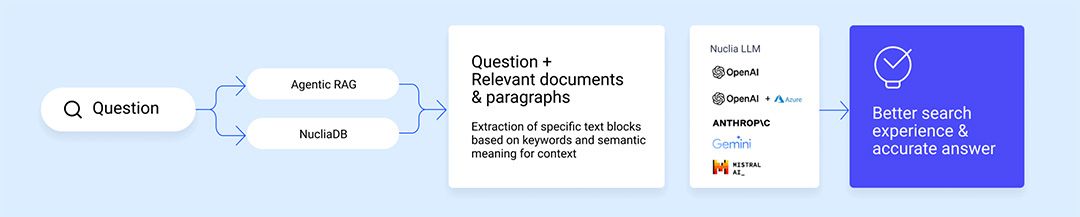
At the core of Agentic RAG are its retrieval agents – what effectively renders the service as “agentic.” Imbued with dynamic memory to drive context, retrieval agents harness reasoning engines to determine how and where to retrieve information.
Once a question has been prompted, there's a dance between the Agentic RAG and NucliaDB database, and the magic begins around extracting text, keywords, and other semantics. Those results are passed to the LLM of choice, and answers are surfaced in a custom user experience (this could be a search field, window, or console).
Source: Progress website
RAG has been around for a while now, and has been successful in practice across a myriad of use cases. But Nuclia’s modular approach enabled both SaaSification and broader deployment across almost any application, making it much more extensible with custom AI classification, personalized document summarization, and access to a range of LLMs.
Progress Agentic RAG also allows you to surface results from highly complex queries – the kind that require heavier data indexing and search with a large package of context. The solution’s API makes it easy to integrate into almost any enterprise stack, and it comes with a comprehensive SDK to help grease the wheels where needed. Having used Progress products in the past, I can vouch for the robustness of the documentation.
Source: Progress website
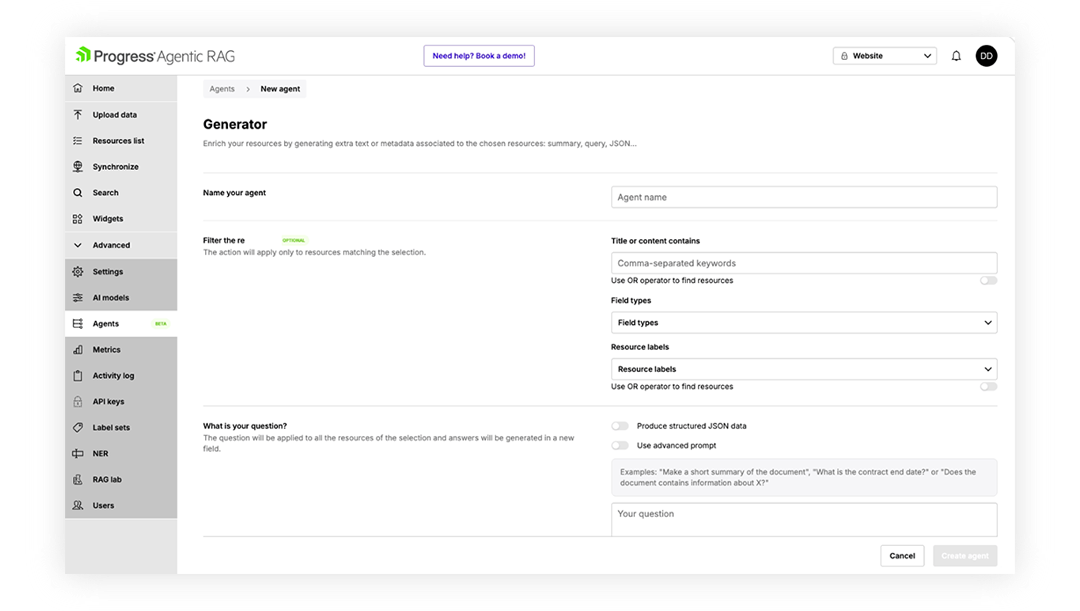
You also have a lot of control over the UX when using Agentic RAG, which is buoyed by natural language queries. There are adaptable chat interfaces, real-time prompt engineering, and other features to help enhance the user’s dialogue. This includes support for diverse data types and linguistics.
There are some huge benefits to this RAG-as-a-Service model. First, it eliminates the need to build and maintain your own RAG stack, which in turn accelerates your time to ship an AI-powered application or service. With the market moving at a hyperbolic pace, this could be a critical factor for organizations. Compound that with the price tag for doing it yourself, and Progress Agentic RAG could save your organization up to 80% of the cost.
Finally – and perhaps most importantly – Progress Agentic RAG is designed with privacy and security in mind. Enterprises have been wrestling with this issue as they explore and adopt third-party AI chatbots and other services, many of which lack transparency around data governance. Where is your data stored? How is it protected? Will it stand up to regulatory scrutiny?
Progress has made these conditions a priority, meeting some of the highest industry standards and certifications, including SSL, 256-bit AES, SOC 2 TYPE 2, and ISO 27001. With a global footprint, it offers both EU and US-based data center options to help address data residency requirements – all of which puts Progress Agentic RAG in the EU AI Act’s low to minimal AI risk category.
Source: Progress Agentic RAG
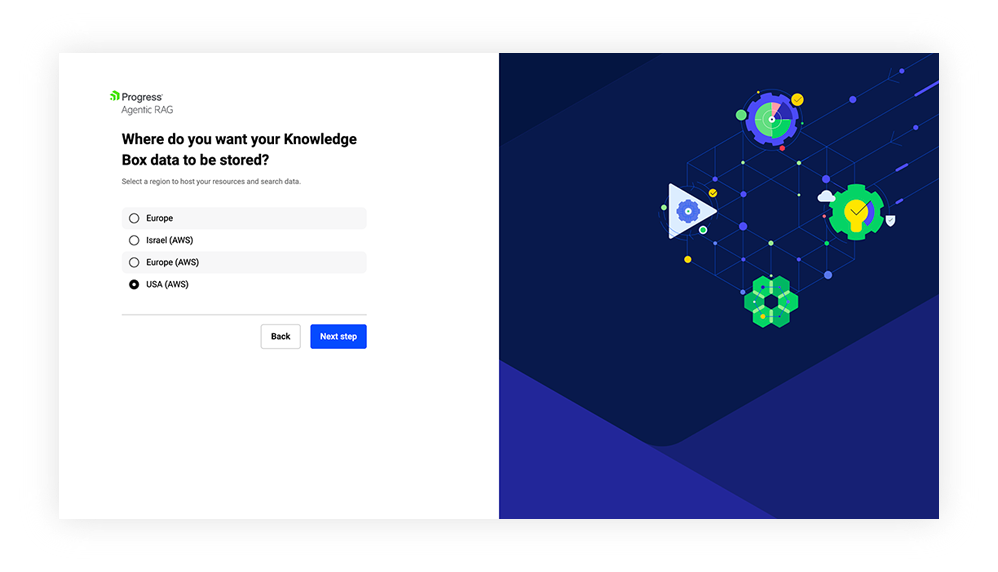
The Nuclia acquisition closed just a few months back, but Progress is already full steam ahead with Agentic RAG. I set up a free trial account in less than five minutes and was able to add my “Knowledge Box” in my local region (you can also choose Europe, as well as AWS-hosted regions within Israel, Europe, and the US). I started uploading documents and adding links almost instantly. The whole experience feels simple, intuitive, and relatively easy to master.
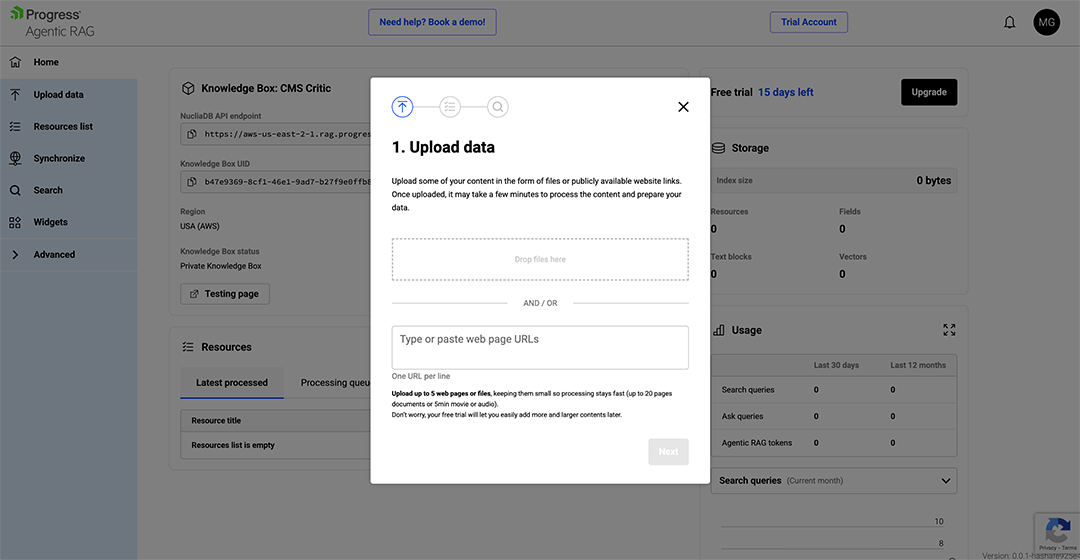
Source: Progress Agentic RAG
As Sara told me, reducing the friction was a key part of accelerating the value to the market.
“Right now, we have an early adopter program where people can come in and try it,” she said. “It allows you to have the brand guard rails in place, lining with your legal, your regulatory standards, and more.”
Welcome to the ‘Generative CMS’
With Agentic RAG firmly in its portfolio, Sara shared Progress’s vision for what it calls the “Generative CMS,” which, as she described, builds off its Sitefinity heritage. This comes at a time when content management has been transforming rapidly as agentic AI capabilities become native tooling.
But as I’ve frequently stated in presentations and analyses, enterprises aren’t just buying software, they’re buying trust – and in the AI space, that word is paramount. This is where legacy CMS and DXP platforms have a critical advantage as systems of authority that meet rigid and often expensive benchmarks for compliance.
Bottom line: these attributes have been hard-fought to develop and expensive to invest in, and have become the domain of legacy enterprise players that can meet the needs of highly regulated industries like healthcare, finance, and the public sector. This also extends to responsible and ethical AI, ensuring that those core principles are built into all of its products – not just Agentic RAG.
“With CMS as a commoditized space, I think we’re being disruptive right now,” Sara said. “But being able to say you have an organization behind you that’s been around for decades and has the largest defense organizations and companies in the world, that means that our security and compliance has to be top-notch for everything we’re doing and implementing.”
So what is a Generative CMS? And how is it creating differentiated value in a noisy, AI-washed marketplace? As I relayed to Sara during our conversation, many vendors in the content management category have adopted new monikers that align their CMS capabilities with next-gen AI features. It’s more than marketing; these edge vendors are having to telegraph entirely new capabilities like agent orchestration while satisfying the central role of content management in the mix.
It would be reductive to say that Progress’s vision for a Generative CMS is simply “Sitefinity plus Agentic RAG.” As Sara said, that’s coming – and there’s sure to be more native integration with Nuclia at an architectural level that will enable real advantages with a complete Progress Sitefinity deployment. As Sara described, the whole concept is greater than the sum of its parts, and Progress sees Generative CMS as fundamentally different from a traditional content management system in significant ways.
First, and perhaps most obvious, it’s generative. That means it’s designed to power dynamic, real-time adaptation of layouts, components, and narratives on the fly.
“We’ve been talking about personalization for how many years, right? And personalization isn’t just my name on an email. With RAG technology, you can absolutely start to show real ways to achieve hyper-personalization.”
Unlike traditional CMS platforms that serve fixed or template-driven content, Generative CMS uses AI and rules-based logic to instantly deliver more relevant and meaningful experiences. Imbued with AI, it harnesses real-time, data-driven responses and content assembly, while traditional CMS platforms lack this level of automated intelligence.
“Instead of just providing a one-size-fits-all digital experience, you’re leveraging the RAG engine to truly identify who this person is and what experience they’re expecting to be delivered, or what they’re looking for,” Sara said.
This dynamic adaptability also unlocks the “Holy Grail” of deep personalization, once again powered by Agentic RAG. As Sara explained, this enables hyper-personalization beyond the usual static or simple personalized fields seen in most legacy systems.
“People want their experiences to be more conversational,” she elaborated. “We’ve been talking about personalization for how many years, right? And personalization isn’t just my name on an email. With RAG technology, you can absolutely start to show real ways to achieve hyper-personalization.”
Flexibility and composability are also key pillars of a Generative CMS. Sara emphasized how LLM choice is just one aspect of that promise. She went on to explain how their solution isn’t limited to their own Sitefinity CMS, but can also be integrated with other platforms, enabling true composability beyond traditional closed systems.
“I talked to somebody last week at a conference, and he said, ‘Hey, I'm using Adobe Experience Manager, can I use this with it?’ Absolutely,” she exclaimed. “What's beautiful [about Sitefinity and Agentic RAG] is that they're both products at Progress, and we can combine them into one.”
Generative CMS is also designed with built-in regulatory, legal, and brand guardrails, all critical tenets for enterprise and regulated industries. We’re seeing more of these on-board attributes across the CMS category, negating the manual configuration required to enable these features in the past. This is one area where enterprises are seeking more AI-enriched solutions that offer full or adjacent integrations while still maintaining composable structures.
Finally, there’s the central AI capacity for learning and continuous improvement. As Sara said, this is about the future, and enabling trustworthy AI that truly empowers users while evolving the overall value of your CMS.
“It's collecting and analyzing and learning from the queries that are happening, the responses that it's getting,” she said. “And you can leverage any LLM in the background in the back end that you want. It’s performing all of the source traceability. It's maintaining transparency and governance.”
Why it matters
Back in my agency days, I led a team through a Progress Sitefinity migration for a very large government agency. It was one of those intimidating lift-and-shift époques that required a delicate hand surrounding public-facing data, secure forms, and all the other scary stuff that keeps you up at night.
One of the best things about working with Progress was the depth and completeness of its documentation and developer resources, which made the journey much easier. These kinds of intangibles reinforce that trust factor I spoke of – and help differentiate commoditized platforms by enabling the humans behind the projects to be successful.
I think that’s a key point in Progress’s favor as they look to challenge (or, as Forrester said, be a Contender) in the agentic race. It speaks to the wisdom the company has accrued over its long and storied history, especially as it relates to the business optics of delivery.
Nowadays, with the advent of AI, we often say that we need to “keep the human in the loop.” But Progress has always done that. Now, they’re leveraging that heritage to cultivate an internal beachhead of startup innovation that’s propelling the company forward and empowering its users and customers.
Case in point: the Nuclia acquisition was a genius move. Not only is it acting as a catalyst for its own aspirations by enriching Sitefinity, but it also expands the end-to-end value of the Progress Data Platform – creating opportunities to reach a broader market of organizations looking to easily leverage the modular value of its Agentic RAG-as-a-Service.
There’s certainly more nuance to the roadmap, but Sara sees Progress as ushering in a new era with its vision of a Generative CMS – powering adaptive, AI-driven, hyper-personalized, and compliant digital experiences. It’s breaking the rigid, manual, and static paradigm of traditional enterprise CMS and providing a composable solution that frees up the extensibility. Best of all, it’s built with a legacy commitment to choice and trust, both pillars of the Progress brand.
While classified as a DXP in the Forrester Wave, Progress is also a pastiche of developer-centric tools and an ecosystem for powering software development with artificial intelligence. As I said, this is a focus area for Sara, who still devotes time to nurturing developer communities as a relationship manager and evangelist at live events and forums.
“So many organizations, even on the Developer Relations side, they think it's just about showing up and wearing your logo swag,” she said adamantly. “But that never works unless you actually make yourself a member of the community in a genuine and authentic way. And you have to have something to add, and I'm not talking just about the product, but adding value, whether it's thought leadership or content or introductions, especially in this era of AI. I think the human side of what we do is that much more important when it’s done personally.”
Agentic RAG builds on this legacy of best-of-breed developer resources, which has the potential for an echo effect across multiple layers of application architecture. By fortifying developers with AI-enriched tools and platforms to build better, faster, smarter applications, Progress is turning developers into “superdevelopers” by improving productivity, reducing bugs, and enhancing security.
And that evolution within the developer community is something Progress is committed to guiding. Ed Keisling, the company’s Chief AI Officer, said there’s going to be a transformational shift over the next few years in how engineers need to approach their work. This will include non-negotiable AI tools like GitHub Copilot that will need to ride along with traditional development frameworks.
This is where Progress Agentic RAG can also play a role as an activator for accelerating app development and AI adoption, helping businesses deliver responsible AI experiences by partnering with customers to solve their problems.
Finally, for the vast community of marketing and technical creators, Generative CMS could be the pathway to enhancing the next wave of digital experiences with impactful personalization, more accurate search, and AI-powered applications that help enhance CX – all while meeting the challenges of a regulated digital frontier.
We'll see how it all unfolds. But one thing is certain: Progress is still making progress. In a big way.
Looking for more guidance on Progress? Talk to an expert.
Upcoming Events

CMS Kickoff 2026
January 13-14, 2026 – St. Petersburg, FL
Meet Sara Faatz and other industry leaders at our fourth annual CMS Kickoff – the industry's premier global CMS event. Similar to a traditional kickoff, we reflect on recent trends and share stories from the frontlines. Additionally, we will delve into the current happenings and shed light on the future. Prepare for an unparalleled in-person CMS conference experience that will equip you to move things forward. This is an exclusive event – space is limited, so secure your tickets today.