Sanity’s AI Content Operating System Powers Intelligence with Structure and Agents with Context


The platform is evolving its popular Content Operating System for the AI era, giving teams the structured foundation, automation layer, and agentic context to run AI in production at scale – and meet the agentic future. Interview with CEO Magnus Hillestad.
“The hottest new programming language is English.”
That’s what AI luminary Andrej Karpathy tweeted back in 2023, well before the modern permutation of vibe coding existed.
As he noted at the time, a GPT-3 paper showed how LLMs were performing in-context learning, and could be "programmed" via natural language prompts to perform a diverse set of tasks. This could lead to more complex multi-step reasoning.
My, oh my. What a few years will do in the rapid and raucous realm of AI.
In a recent blog post by Sanity co-founder and CEO Magnus Hillestad, he conjured this same incantation about English supplanting the complex layers of code – something I’ve spoken about frequently with Netlify’s Matt Biilman. The notion of what a developer is (or more appropriately, who) is changing before our eyes as AI softens the skills aperture.

Sanity co-founder and CEO Magnus Hillestad. Source: LinkedIn
But Magnus was zeroing in on something below the surface, where content becomes context, and context becomes the essential infrastructure that powers the performance of agents. It happens when they utilize logic to process a task or engage with a customer about a critical policy.
Agents, as he said, are hungry for context.
When I spoke to Magnus last May about Sanity’s complete vision for a “Content Operating System” – a salve for what ailed modern CMSes, which he contended were “broken” – it was already a maturing moniker. As he told me then, his company didn’t fit squarely into an industry category, and this felt more reflective of its true value.
“I think we're not a headless CMS,” he said emphatically. “Of course, we have an API, but we’ve never kind of been that, right? We started calling ourselves a ‘Content Operating System’ in the fall. This is all part of this process.”
And that process continues to prove its value, particularly as enterprises struggle to adopt AI at scale. As I’ve seen firsthand, many teams are running into whitewater – not because of AI itself, but because the content foundation of legacy systems wasn’t designed for this new reality.
Bottom line: AI thrives on structure, relationships, governance, and real-time data. It needs it all to do its thing. That’s why Sanity is launching (or relaunching) its platform as the AI Content Operating System, promising an intelligent backend for companies to build AI content ops at scale.
I talked to Magnus about the news this week. While the infusion of the AI narrative feels fresh, Sanity’s core philosophy really hasn’t changed. If anything, they’re doubling down and sharpening the focus.
“I think the most important thing about this launch for us is that we’re making our positioning much clearer as an AI native product,” he said. “The content operating system, it's a continuation of what we have always been about. This is content as data, and we're really reinforcing that.”
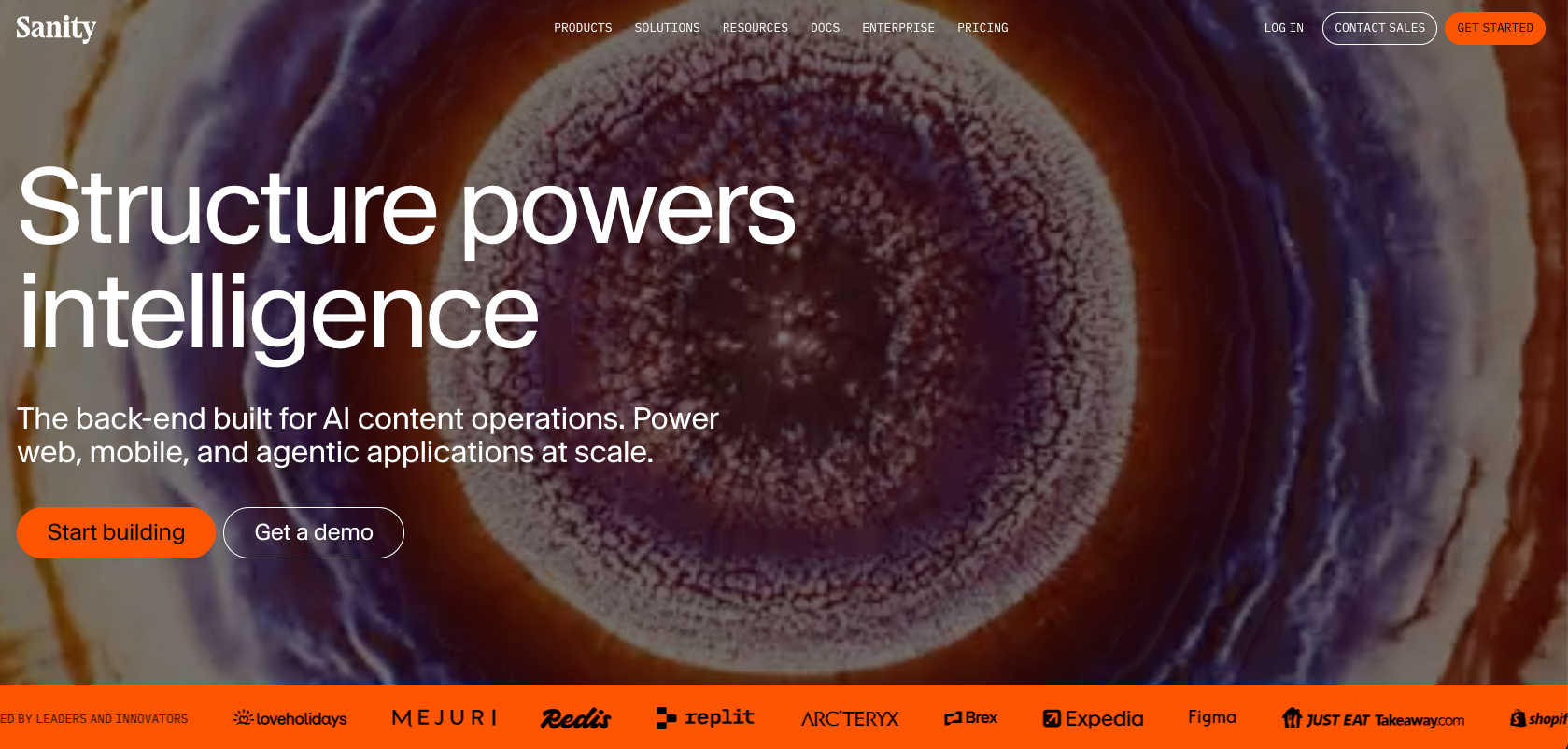
Source: Sanity website
Along with this launch, Sanity has been juicing up its website and building on the momentum of its visual gestalt, which crystallizes and articulates its AI-native ethos. It’s a sophisticated, eye-popping accelerant, reflecting the hyperbolic pace of a synthetic world where control is the operative goal.
“We launched our new brand last year, so it's the same logo, the same identity,” he explained, “We’re continuing to iterate on it, but the whole point is that it's still the same message it has been, and it continues to be, from the day we started. We use different words, and we got better at it, but it’s really the same logic.”
The homepage hero video is intense. It feels atomic, explosive, and fraught with a tension that is crying out for structure. In every way, it positions Sanity as a pioneering signal that cuts through the AI cacophony.
Be sure to scroll to the bottom, where they have some stunning video snippets from customers like Lady Gaga’s team (yes, that Lady Gaga). They had never used a CMS before, but are now regularly logging into Sanity and making updates via Sanity Studio, the platform's open source editor. As testimonials go, it totally rocks.
This also captures the Sanity brand vibe in less than two minutes:
Unlocking the potential of AI content operations
According to Sanity, its AI-imbued content ops platform is built around three core concepts: modeling your business, automating everything, and powering anything. They’re intentionally broad ideas, but that’s the idea: you can build in any direction, but Sanity provides the structured foundation, automation layer, and agentic context to run AI in production.
The word context kept coming up, and rightly so. As Magnus explained, you need to structure and operationalize content so AI can do something meaningful with it. Again, this feels more like a continuation of its mission in the AI era.
“Even pre‑AI, Sanity was all about modeling your business the way you want it, automating it, and distributing it anywhere,” he said. “We believe that the context layer for the Internet, or the content system of record for the AI era, is what we're building, and that's ultimately what you really need.”
Sanity has been active over the past few months, rolling out several native AI features. This includes Sanity's Content Agent, the first AI agent built to run complex content operation at scale. It allows you to audit thousands of pages, surface strategy gaps, stage content for publishing – and do it all directly in the editorial workflow.
Sanity Functions, a fully managed serverless environment, also provides compute for servicing the full content lifecycle, enabling the creation of custom workflows without the headache of managing infrastructure. Agent Actions API also lets you programmatically run schema-aware AI instructions to create and modify documents from anywhere you can execute code, so you can extend automation to tasks like translations.
From MCP to a backend for agents
I first covered the launch of Sanity’s Model Content Protocol (MCP) server last year, which enabled AI agents to interact with content using powerful tools for document management, GROQ queries, and more.
Sanity’s MCP is giving external AI agents direct, governed access to structured content, eliminating duplicate data stores and custom integration work. It enables AI agents in tools like Cursor, Claude Code, and v0 to have full access to your Sanity workspace to query content, manage releases, deploy schemas, and more.
As Magnus said, it’s been catching on like wildfire across Sanity’s 1 million-plus users and 6,000 teams that are utilizing MCP as a connective tissue for expanding their agentic horizons with environments, toolsets, and choices.
“We have the best MCP on the market,” he exclaimed. “We're seeing hockey stick adoption of our MCP server, because it really simplifies the way you're building and operating the developer side of our platform.”
Driving all of this is the agent frontier, and that’s where Sanity is instrumenting for the future with structured content as a long-term AI advantage. AI breaks without structured content operations, but Sanity is eliminating many of the barriers and complexities, giving organizations a more powerful foundation for AI agents, content operations, and personalization. As Magnus explained, their approach addresses several key performance problems.
“What we're doing is also launching Sanity as a complex backend for agents, which is basically launching a native vector database together with our structured database, which really gives you more power out of the content platform,” he said. “If you only have unstructured data, and you're doing embeddings on top of that, you don't get good enough content.”
Welcome to Agent Context
Again, context is the keyword – and Sanity’s latest native AI feature, Agent Context, is accelerating the pathway towards the company’s broader vision.
Agent Context is RAG, but the retrieval is both smarter and nimbler. It’s designed for production agents that truly serve your users, providing read-only, scoped access to a single dataset that’s controlled by an Agent Context document that can be configured in Sanity Studio.
What’s cool is that the Agent Context MCP gives your agent two capabilities instead of one: Semantic search and structured content retrieval, built on top of out-of-the-box features combined with Sanity Content Lake.
With Agent Context, you can power search, support bots, and deploy other content-driven features in your app. And by compressing your Sanity schema, agents don't just retrieve your content – they understand it, translating natural language questions into precise queries against your actual data model. Here’s an example leveraging Sanity’s AI shopping assistant starter, which offers some useful patterns for getting your setup off the ground:

Source: Sanity website
The benefit is that there’s no vector morass to weed through, or flattened embeddings that abstract the relationships that make your content meaningful. You’re also able to pipe Agent Context to your Sanity project and easily prompt it to set up the integration and connect to your dataset with schema-aware tools that are ready to use.
“When content is modeled intentionally – with relationships, validation rules, governance, and real-time APIs – AI systems stop guessing and start reasoning,” said Magnus. “That’s the foundation companies need to compete.”
When it comes to retail and commerce, this is especially critical. Agents can hallucinate on factors like price, but that’s not the model’s fault. It’s typically the content backend. This is a common failure point for agents, and Sanity is trying to bring order to the chaos.
In terms of real-world use cases, Complex, a pop-culture multimedia company with its hands in everything from entertainment news to style and streetwear, harnessed Sanity to automate its e-commerce editorial operations – freeing up team members to work on other creative endeavors. You can check out more in this e-commerce agent use case.
Getting abstract: The ‘build versus buy’ conundrum
I started with vibe coding and citing English as the hot new programming language. Perhaps it was apropos to end my conversation with Magnus in the same territory.
These days, it seems all roads lead to the inevitable question about the future of software. In the recent SaaS meltdown, which I believe was vastly overblown, AI was the central instigator – or maybe even the convenient scapegoat. It all depends on your perspective.
I’ve talked to many SIs and enterprises as of late, and there’s a clear sense that AI will enable more building versus buying. No one wants expensive license fees; that’s a no-brainer. But at the same time, there’s too much riding on performance, and too much dependent on governance and compliance.
There’s also this often-referenced but poignant reality check: the vast majority of AI projects fail before they even reach production. This is driving brands back to the safety of proven software. Not to mention the billion-dollar questions of scalability, security, reliability, and continued innovation.
As Magnus said, everything in software is a level of abstraction. The question is what level you want to be at. In other words, what’s good for the goose might not be good for the gander.
“We believe there's immense value in building on top of our abstraction level for the problem of content operations,” he said. “But there will always be people who don't want to do that, and that’s totally fine.”
Still, he’s skeptical that large organizations will be able to sustain purely homegrown, bottom-up stacks – even in an age of agents and AI-assisted development.
“If you look at the tens of thousands of people working in large enterprises, they need certain systems and standards for how they're building things,” he explained. “Providing an operating system really takes care of a lot of that, and it can be extremely valuable.”
It’s impossible to predict the future, other than to say that change is inevitable. Still, as AI lowers the cost of building software, Sanity has an advantage as the demand for stable, scalable content infrastructure – the kind that can act as a system of record and a vital context layer – will likely continue to increase.
Why it matters
Sanity’s packaging of its Content Operating System for the age AI is a logical step in its evolution. The company has long been at the forefront of AI transformation, particularly from the developer’s repo – and that’s given way to some spectacular innovation from its expansive community of users.
Along with its steady roll-out of new features, including its Content Agent, Functions, and Actions, the introduction of Agent Context shows real promise. The company has also seen demand rise for its Sanity Media Library, a “DAM lite” product that treats assets like structured content (as you might guess). Launched last year, it’s getting rave reviews, and Sanity is continuing to invest in it as part of its content operating system roadmap.
As Sanity looks ahead, clarity seems to be one of its strongest muscles, and it's focusing that strength on context as the fulcrum for making agents more valuable in our content ecosystems.
“Here’s what keeps getting missed,” Magnus said. “Agents don't just need access to information. They need precise context they can act on.”
Having this clarity is an important attribute at a time when being a headless CMS – but also being more than a headless CMS – is forcing vendors to reframe their stories to the market.
My recommendation: From complex data modeling to advanced AI capabilities, Sanity still earns top billing as a headless CMS for developers, so more technical users are certainly in its sweet spot. That said, Sanity Studio offers an open source, React-based option for customizing workflows and giving content editors a luxe UI for real-time editing and real-time review – without merging conflicts. I really dig it.
If you’re ready to evolve beyond the confines of a purely headless CMS into more of a holistic content operating system mindset, there’s a lot to offer under the hood with the potential to power enterprise concerns. From a pricing perspective, there’s a free tier if you want to kick the tires, but even their Growth plan is reasonable at $15/seat. They also offer a number of add-ons like SSO, support, and more, so you have a lot of control over what you need.
Upcoming Events

JoomlaDay USA 2026
April 29 - May 2, 2026 – Delray Beach, Florida
Be part of the Joomla community in one of the most iconic cities in the world! JoomlaDay USA 2026 is coming to Delray Beach, and you can join us for a dynamic event packed with insights, workshops, and networking opportunities. Learn from top Joomla experts and developers offering valuable insights and real-world solutions. Participate in interactive workshops and sessions and enhance your skills in Joomla management, development, design, and more. And connect with fellow Joomla enthusiasts, developers, and professionals from across the world. Book your seats today.
CMS Summit 26
May 12-13, 2026 – Frankfurt, Germany
The best conferences create space for honest, experience-based conversations. Not sales pitches. Not hype. Just thoughtful exchanges between people who spend their days designing, building, running, and evolving digital experiences. CMS Summit brings together people who share real stories from their work and platforms and who are interested in learning from each other on how to make things better. Over two days in Frankfurt, you can expect practitioner-led talks grounded in experience, conversations about trade-offs, constraints, and decisions, and time to compare notes with peers facing similar challenges. Space is limited for this exclusive event, so book your seats today.

Umbraco Codegarden 2026
June 10–11, 2026 – Copenhagen, DK
Join us in Copenhagen (or online) for the biggest Umbraco conference in the world – two full days of learning, genuine conversations, and the kind of inspiration that brings business leaders, developers, and digital creators together. Codegarden 2026 is packed with both business and tech content, from deep-dive workshops and advanced sessions to real-world case studies and strategy talks. You’ll leave with ideas, strategies, and knowledge you can put into practice immediately. Book your tickets today.
Open Source CMS 26
October 20–21, 2026 – Utrecht, Netherlands
Join us for the first annual edition of our prestigious international conference dedicated to making open source CMS better. This event is already being called the “missing gathering place” for the open source CMS community – an international conference with confirmed participants from Europe and North America. Be part of a friendly mix of digital leaders from notable open source CMS projects, agencies, even a few industry analysts who get together to learn, network, and talk about what really matters when it comes to creating better open source CMS projects right now and for the foreseeable future. Book your tickets today.