Storyblok JoyConf ’26: ‘Content Confidence’ Stole the Show, but Human Connection was the Real Magic

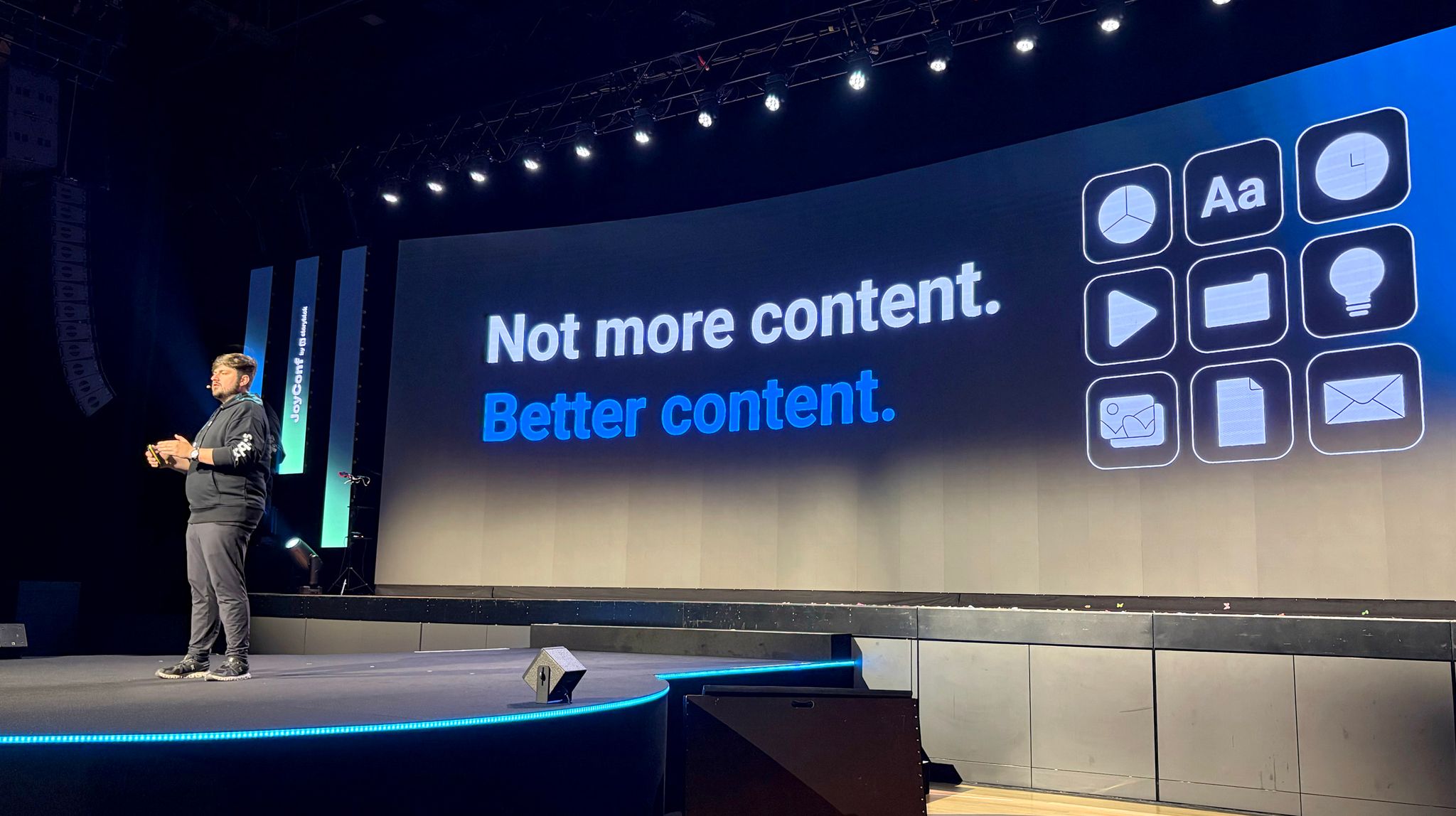
At the headless CMS vendor’s second annual community event, the message was clear: AI is exposing the severity of the “Content Debt” crisis, and brands need help to break the spell. From bold customer use cases leveraging FlowMotion, to the promise of semantic search with Strata, Storyblok is positioning itself as the system of record built for content – and proving how a human-focused, deeply beloved culture is the strongest kind of magic.
Highlights
- Storyblok held its JoyConf ’26 conference in Mainz, Germany, on October 28-29
- This year’s event drew a global audience of customers, partners, and practitioners
- “Content confidence” and being “the system of record built for content” were key messages
- The event showcased recent product updates, namely Storyblok Strata
- Keynote from Hannah Freegard of FT Longitude focused on the “Content Debt” crisis
- Sessions included powerful use cases from brands like Porsche and TomTom
- Partners including Lokalise, MSQ DX, RDA, and synaigy shared composable success stories
When it came to planning JoyConf’s second act, Storyblok CEO Dominik Angerer had a few tricks up his sleeve. And like a masterful illusionist, he played his cards close to his chest – right up until showtime.
As a speaker at this year's conference, I've paid close attention to the agenda as it came together. I knew Keelan Leyser was booked to emcee the gig, and if you do a quick search, you’ll see that he’s billed as a “tech and AI magician” with millions of followers and a popular Las Vegas show called Hacked.
I’ve seen my share of skilled mages performing their wizardry at conferences, mostly on the sponsor floor or at after-parties. I didn’t know what to expect, but I wasn’t prepared for the digital sorcery that commenced.
Throughout the event, Leyser wowed us with feats that defied logic, mystifying the audience at the intersection of the physical and the virtual. One minute, he was prompting ChatGPT. The next, he was pulling a physical card out of an iPad’s screen.
It was mind-blowing. And a perfect way to capture the imagination of an audience.
“Magic is about making people feel a sense of wonder that the impossible can somehow be achieved,” Leyser said during his opening act. He framed it as a dance between deception and creation, one that leaves you questioning what's possible.
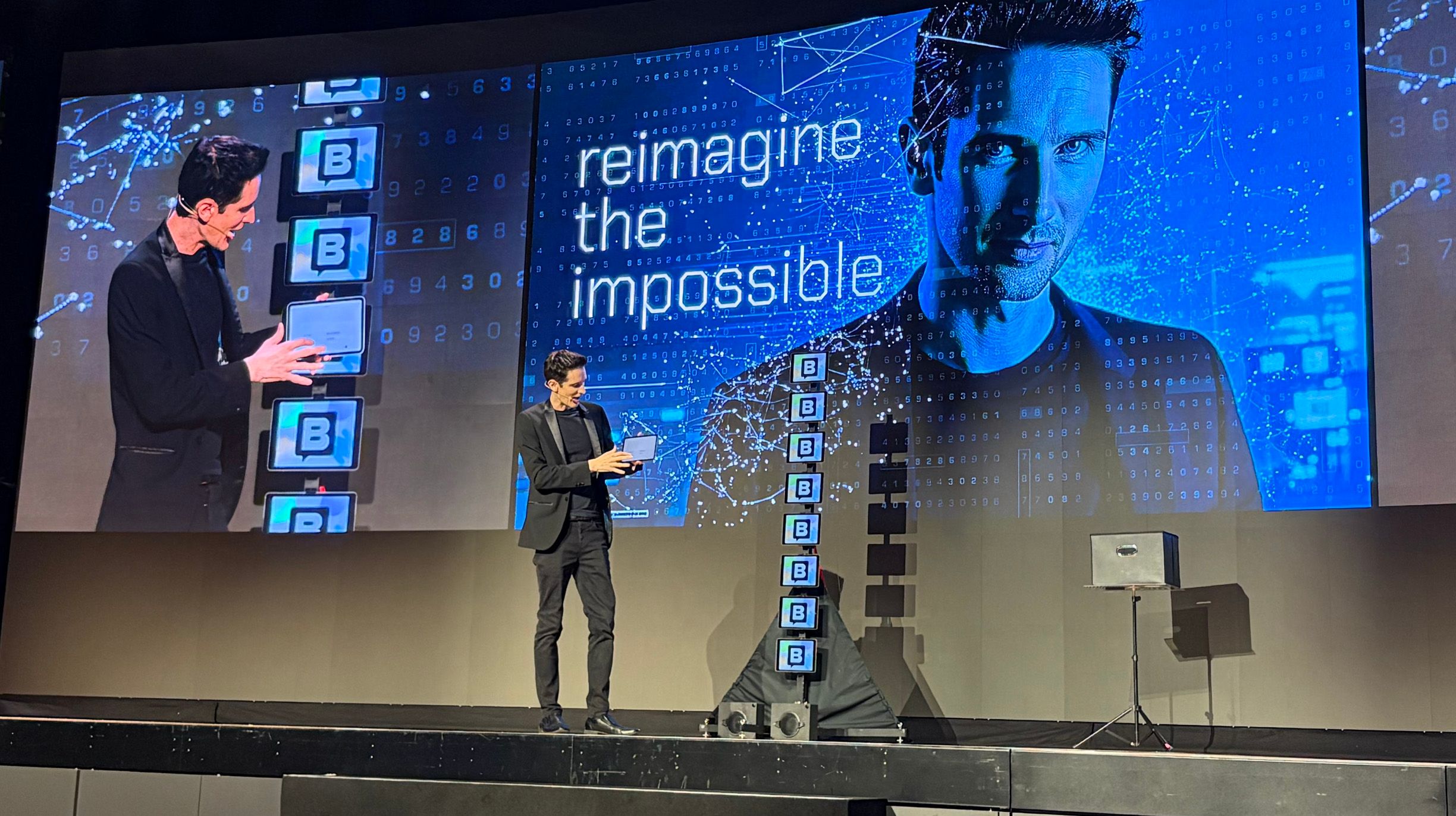
Tech and AI magician Keelan Leyser performing on stage at Storyblok JoyConf '26.
Everyone loves a good magic trick. But Leyser’s real triumph was comparing his reality-bending feats to the curiosity marketers and developers feel when they practice their own wizardry. When they have the right tools, they can bring experiences to life – and turn the ordinary into extraordinary.
At JoyConf ’26, this kind of magic was everywhere. Yes, it was on stage in the literal spotlight, but it also echoed in the quiet hallways of conversation, where new connections blossomed into fast friendships, hugs outnumbered handshakes, and partners spoke about their Storyblok account reps like family. It all felt enchanting.
The host city of Mainz also felt magical, if not a bit more subdued than the touristy bustle of Amsterdam (where last year's event was held). But this was, after all, the birthplace of the Gutenberg letterpress, and the hallowed ground where content was forever transformed. Could there be a more historically apt backdrop for publishing the future of CMS?

Photos from the Gutenberg Museum and around the city of Mainz
In so many ways, JoyConf ’26 crystallized Storyblok’s magical momentum. As Dominik told the audience in his opening salvo, the company had an amazing year, with each quarter topping the previous. But as he admitted, this keynote would be markedly different, with no blockbuster product announcements.
As conference-goers, we expect big reveals. It's part of the allure. But given the velocity that Storyblok is shipping at – including the recent launches of Strata and its native Agents – it wasn’t shocking. In fact, I think we’ll see more of this trend across all vendor ecosystems as AI accelerates development.
That didn't mean JoyConf was short on impact. In fact, quite the opposite. Storyblok focused its powers on the existential crisis of “Content Debt,” and why fixing what we have today is more important than what we publish tomorrow. Technology can help, but this isn’t a tech problem. It’s a process problem – and that requires more than shiny dashboards and slick features to fix.
As Benedikt Grimm of Storyblok Platinum Partner synaigy told me during an interview at JoyConf, the comparative race between platforms isn’t just about the product. The entire field is commoditizing, and AI is making parity less of an obstacle. What people need now is a vision they can believe in, and solutions that reinforce it.
It's one reason why he described Storyblok as “The first CMS that felt right to me.” Put that on a t-shirt.
JoyConf ’26 was also a signal of a brand scaling up, and not scaling back. It traded last year’s trifecta of European and US events for a single international consortium, which allowed for a more concentrated agenda. The Rheingoldhalle conference venue – nestled along the banks of the Rhine – was an illuminating upgrade, offering a modern space for sponsors to engage with attendees, and ample room for breakout sessions and meetings.
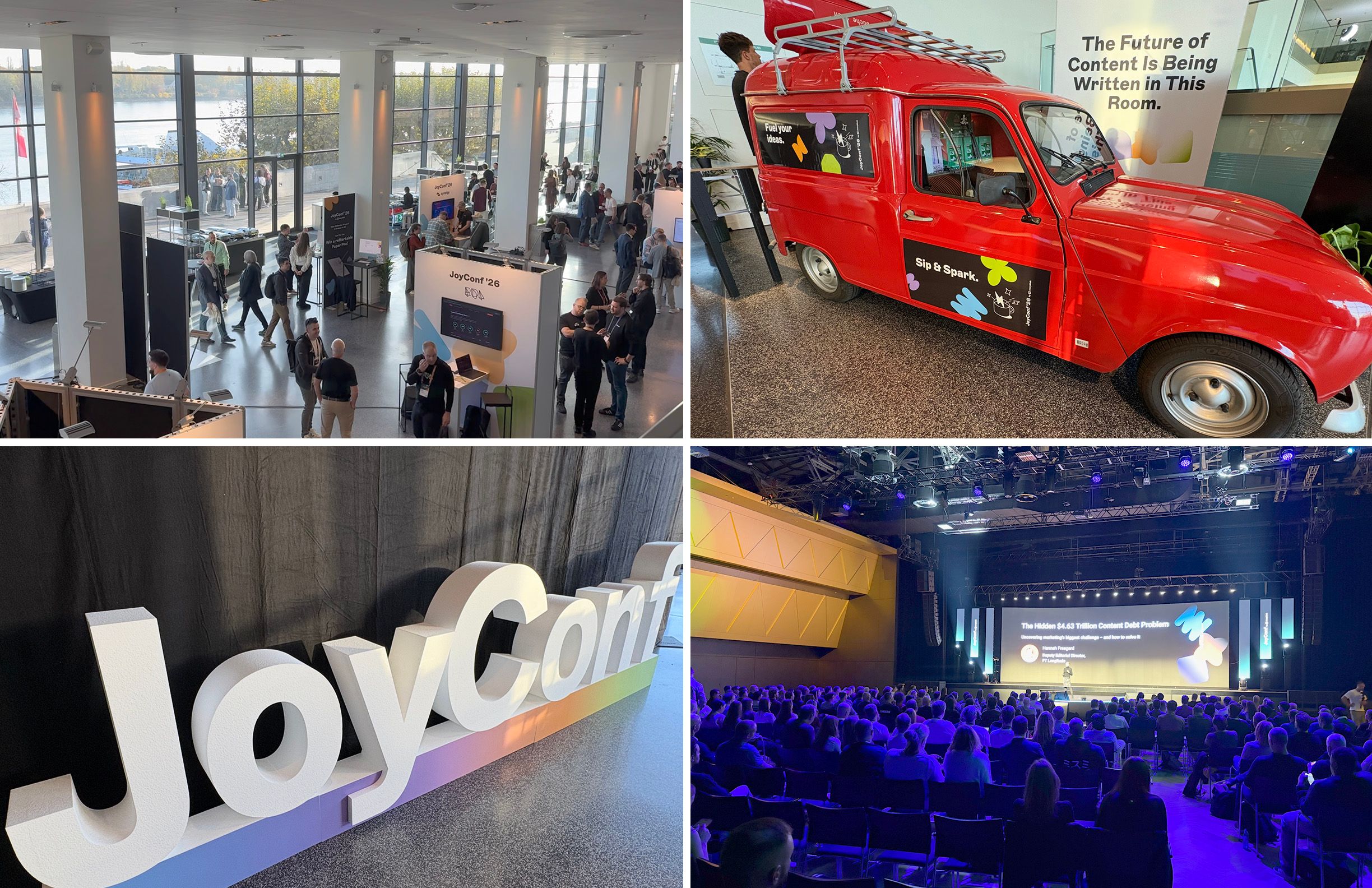
Scenes from Storyblok JoyConf '26 at the Reingoldhalle in Mainz
Attendees also provided a lot of palpable feedback after last year’s inaugural event, but above all, there was a resounding call for more customer examples and use cases. JoyConf ’26 stepped that up in a big way, showcasing how global brands like Porsche have successfully migrated to Storyblok’s headless-first architecture and accelerated performance.
As both an analyst covering the event and facilitating a main stage fireside chat, I couldn’t be everywhere at once (I’ll leave that kind of wizardry to Keelan Leyser). But I squeezed a lot out of my time in Germany, crisscrossing through immersive talks, focused sessions, and in-depth conversations. Here’s a bit more of what made it all magical.
‘Content confidence’ requires content ownership
“Last year, the clicks disappeared. This year, the answer is the decision.”
When Dominik Angerer flashed those words on a slide during his opening keynote, it was a stark reminder that traffic died on the vine in 2025, dropping by as much as 90% for certain publishers. A year later, the prognosis is even worse: AI summaries are becoming the default, and only 22% of people research beyond the answers they’re served.
The answer has indeed become the decision – and the content behind it is often old or outdated. Add to that a mountain of AI-generated garbage, and it’s a crisis of epic proportions.
A big part of the issue is a pre-programmed tendency to create mass quantities of content. For years, we’ve operated under the premise that more was always better. Now, we can’t even see our corpus of content, let alone fix any of the low-quality articles or posts living in our systems. Meanwhile, AI is accelerating the “hype slop” machine.
The problem is hidden deeper than we realize, and that’s a key liability. AI bots are finding content in places we’ve either forgotten about or neglected, and that means a brand could be misrepresented in AI summaries. It's a pressing trend that we discussed when Dominik joined me for a “Couch Conversation” during the JoyConf event (you can watch the episode below):
“It’s not about more content, it’s about better content,” Dominik emphasized. And to get to “better,” we need to fix the content we already have. To help guide that process, Storyblok is rethinking the concept of the Content Lifecycle, one that positions its CMS as the system of record for built content.
It’s not an earth-shattering idea, but that’s the point: we need sound, logical, adoptable processes to help ground us, and a reliable place to store it all. That’s what the Content Lifecycle proposes: a system of Structure, Collaboration, Delivery, and Optimization that all reinforce ownership.
“Cleaning your content house,” as Dominik quipped, could have profound impacts on your content performance. This is especially true when it comes to AI visibility, a topic we discussed during my JoyConf ’26 fireside chat with Dominik and Stefan Baumgartner, Storyblok’s VP of Product.
It’s true that AEO and GEO tools have cracked open the “black box” surrounding AI viability. Tools like Otterly.ai are providing visibility into how citations and recommendations are being surfaced in ChatGPT and Claude. But influencing those channels starts under your own roof, and humans need to drive it. As Dominik told me, this is the most pressing issue they hear from almost every new prospect.
“No one has clarity over who owns which part of the content,” he said. “I don’t even mean what technology they use. The problem happens before this, inside organizations where they define who owns the content from publish to offline. Someone needs to take ownership.”
Being AI native and ‘headless to the core’
We throw around the moniker of “AI native” so casually, it’s hard to assign universal meaning. As Dominik told me, he and his team thought long and hard about how to frame it through the Storyblok lens.
For him, the answer lies in the platform’s open nature, and being able to connect your own AI model and harness it via Storyblok's MCP, which was launched in March. Vercel’s Julian Eckerle called the new server a “beast” on stage at JoyConf, noting how it’s optimized to avoid tool bloat and deliver more efficient and economical performance.
MCP is a big part of Storyblok’s agentic readiness, but the platform also provides its own native functions. Storyblok Agents, which were introduced in September, provide built-in capabilities that are tailored to your workflows. I demoed Agents when they were announced, and they offer slick automations like content auditing, translation checks, and pre-publish reviews – all through a familiar prompt field with zero friction.
FlowMotion is also a big part of the AI native promise. Introduced at last year’s JoyConf, it provides a vital automation layer that can trigger actions across hundreds of tools via n8n (an enterprise AI tool for managing workflows and agents). It also supports MCP, allowing you to directly manage tasks with Claude, Codex, or via Storyblok Agents. The successful use cases are compelling.
When I sat down with Stefan Baumgartner to discuss Storyblok’s product positioning, the focus was on their architectural heritage and remaining “headless to the core.” I asked him why that distinction mattered in a field where every vendor calls themselves an AI or agentic tool of some kind.
“It’s important to understand what headless is really about,” he explained. “It’s having a contract that humans can understand, and machines can read. That contract is in writing. It’s machine-readable. It’s parsable. You can derive types and payloads from it. As developers, we love this. It’s clear to us how we could operate with the system.”
Agents are a new audience – and one that’s constantly changing. They’re communicating with our interfaces, and MCP and APIs are becoming more important for facilitating those connections. For Storyblok, the answer to meeting this audience rests with the nimble flexibility of being headless, and that supports its AI nativeness.
While other vendors are repositioning as “agentic experience platforms” and adopting similar monikers, Storyblok is embracing its roots. And even as AI is creating a groundswell of uncertainty, Stefan sees more opportunity for Storyblok given its strong legacy as a headless system.
“No one knows 100% what’s happening next,” he explained, “but we know we will play a role because we are suited for this.”
Strata and feature upgrades are elevating the product magic
“Content confidence” was the theme at JoyConf, and a consistent thread across the product ecosystem. During Stefan’s tag-team keynote with Director of Product, Derk Majoewskij, the graph of key product improvements – which accompanied the bigger AI announcements prior to the event – became a centerpiece.
As Derk pointed out in our one-on-one interview, Storyblok is hyper-focused on shipping smaller but meaningful features alongside its bigger projects. And thanks to the advent of AI across its developer teams, they’re delivering with greater velocity and consistency.
It’s no secret that Storyblok’s visual editor is one of the best on the market. I’ve previously highlighted its elegant, intuitive functionality, and the company’s cache of G2 Reviews codifies this. According to Derk, they continue to improve upon it, and recently introduced inline editing to the experience. It’s a simple add-on, but a powerful one that really means something to users.
“Our UI and editor is kind of what Storyblok was founded on,” he said. “Personally, I’m a big fan of this, as I came out of the marketing department. It’s a key differentiator for us, and one example of building up on a core feature.”
Storyblok Environments are also progressing in their first release. Introduced last year, these are isolated spaces within your production setup for testing changes, running automations, and validating components without risking live data. Semantic dependencies and other AI-focused features are also on the near-term roadmap.
While Agents and MCP were hot topics, Strata was the star. Officially unveiled at last year’s JoyConf, it brings native vector-powered semantic search to the Storyblok CMS. I had a chance to demo the product, and saw just how easy it is to implement.
Here’s the pitch: Strata understands your search queries at a deeper level, going beyond keywords to surface relevant content. For example, a visitor who searches “Can I send my order back?” finds a page that says “Return Policy”, even though the two phrases share no words. In this sense, it works more like your human contextual brain. It can also juice website search and deliver more granular results across languages.
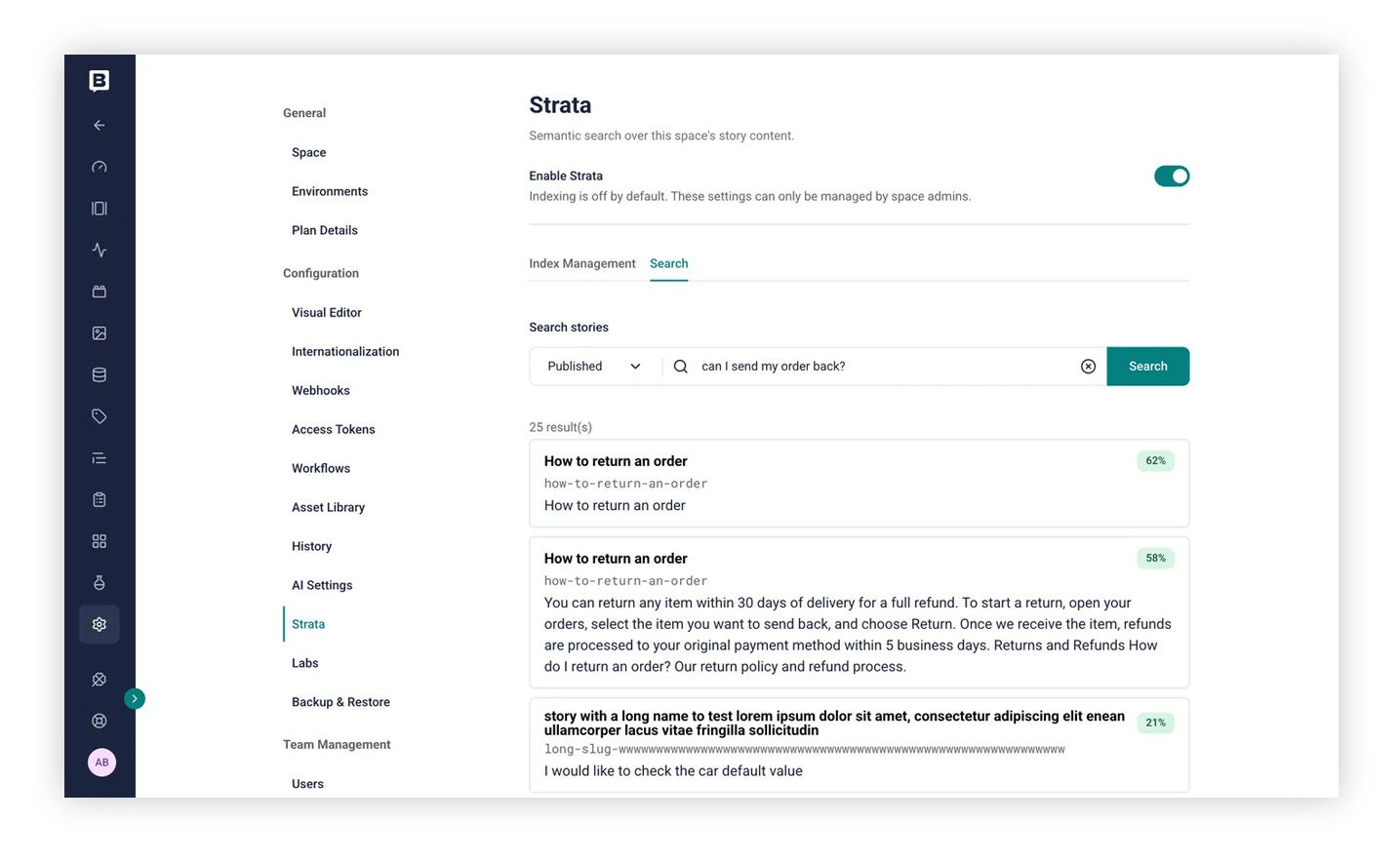
Semantic search results can be accessed in the Strata Search tab in Storyblok
In my demo of the Strata Playground, I saw how the tool’s vectorized intelligence, metadata focus, and reciprocal rank fusion (RRF) are powering hybrid search functions, along with an intuitive scoring system for weighting search results. Some of the new features include draft and published content, multilingual and context-based queries, and MCP support.
With Strata, brands have more control and visibility when it comes to their content. They can move past static recommendations and personalize experiences using relevant content that reflects a visitor’s preferences. It’s also ideal for audits, enabling lean teams to find duplicate content, broken links, and reusable assets – all with simple prompts. It's making content useful in new ways and unlocking opportunities to build more engaging and personalized digital experiences.
As Derk pointed out, Strata’s connection with FlowMotion and Storyblok Agents provides a recipe for ensuring you have the highest quality content to enhance your AI visibility.
“All these AI tools are reading your content and using it in the answer engines,” he said. “With Strata, it’s about understanding what content you have out there.”
If you're interested in giving it a spin, Strata is in public preview for Elite, Plus, and Ultimate Storyblok customers at no additional cost through March 31, 2027. This includes one Strata-enabled space per organization. You can get started here.
The $4.63 trillion “Content Debt” crisis: can we break the spell?
One of the most insightful conversations I had at JoyConf ’26 was with Hannah Freegard, Deputy Editorial Director at FT Longitude – the market research arm of The Financial Times. She was the chief architect behind Storyblok’s research into the “Content Debt” crisis, and we sat down to discuss not just her data, but what brands and enterprises can do to pay down this eye-popping metric.
I won’t go into all of the details from the report (you can read my analysis here). For context, it was based on a deep survey of 550 senior marketers and tech CEOs in Germany, Australia, the UK, the Netherlands, and the US. In our conversation, we revisited the scope of the problem, and how it focuses on content that’s outdated, poorly structured, and not optimized for search or AI discovery.
As Hannah told me, “Content Debt” is both a business and trust problem. It has persisted for a long time, but we ignored it – simply because we could. Now, AI is acting like a truth serum, exposing our outdated content in answers that can misinform customers, weaken a brand’s consistency, and damage customer relationships.
So what can we do to stop this trillion-dollar trick? Hannah broke it down into three core remedies: see, govern, and automate.
“The first thing is to conduct a content audit,” she said. And while that might sound like a no-brainer, Hannah explained that most organizations can’t see or manage their content properly, making a complete audit something of a pipe dream. This is why having the right tech in place – like a headless CMS – gives you the best shot at a full and auditable view of your content.
The second piece is all about enabling the right structure and guardrails for your content, and that comes down to ownership and governance. “Every piece of content you have as an org needs to be owned and checked, and you need to keep tabs on who is publishing,” Hannah reinforced.
Not an easy feat, but an essential one. For CMS practitioners, this is similar to roles, permissions, and histories within content operations. These fixtures have been around for years, but clearly haven't governed everything. Hannah added that organizations will need to shift their mindsets on how to approach this in a process-driven way.
Finally, there’s automation – and this is where AI can make an impact. It’s one thing to have governance, but workflows and systems can help enforce governance while AI agents handle more of the auditing and automated validation.
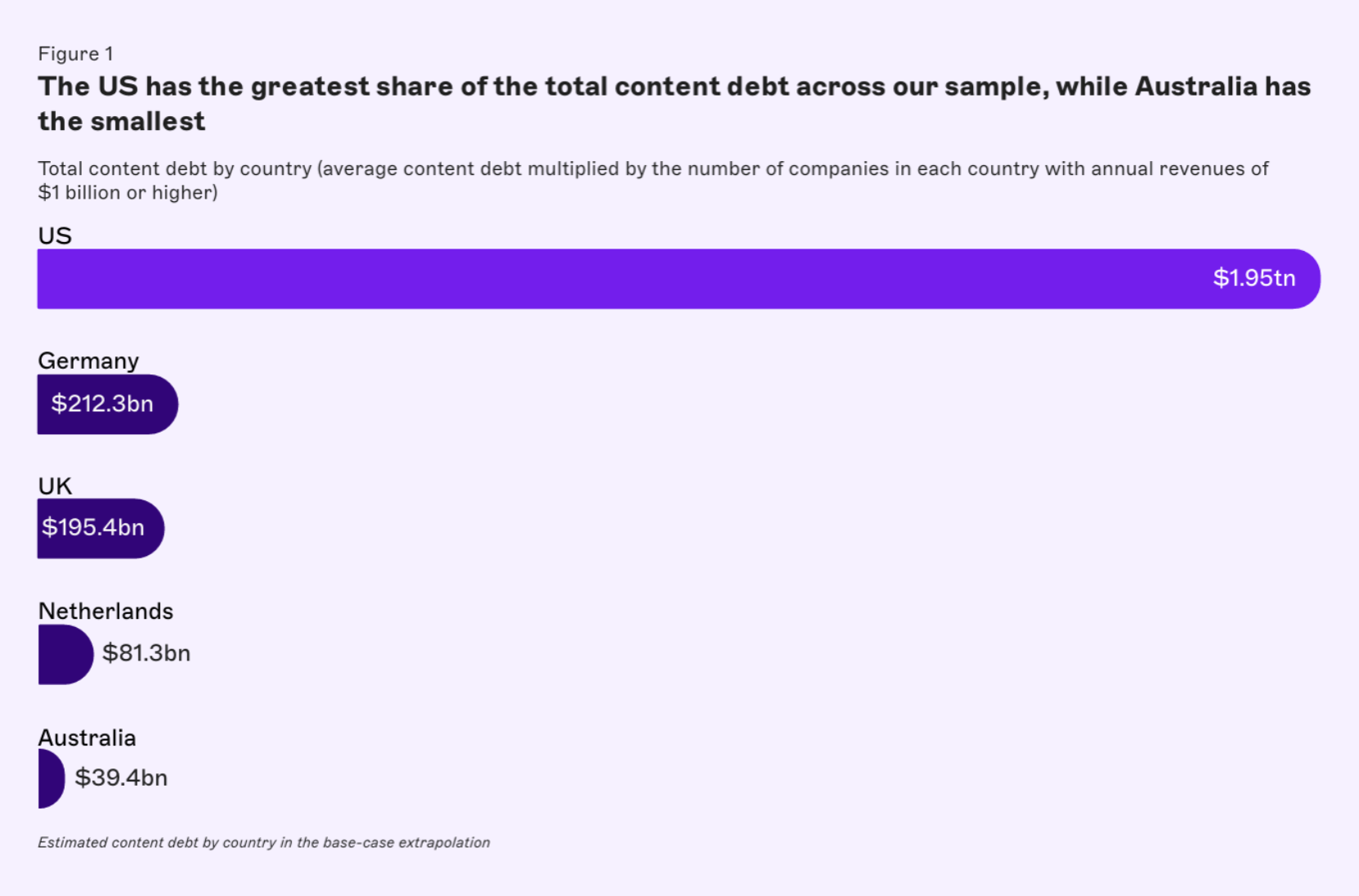
Source: “Content Debt: A $4.63 Trillion Business Liability” report
While the content debt crisis feels dire, Hannah is optimistic about our prospects. “AI is going to force positive change,” she said. “It will elevate brands to produce better quality content. It’s what we always should have been doing.”
One of the most telling data points to come out of FT Longitude’s research was around a single question posed to the survey participants: if you had an extra million dollars to spend on content, what would you spend it on? As Hannah noted, brands with the right structures in place answered with more visionary goals like personalization.
During JoyConf, Storyblok also provided remedies as part of a Content Debt Recovery Plan. These strategies were outlined during targeted sessions for developers and marketers, focusing on relevant tactics for maintaining a healthy, sustainable content system.
The “Content Debt” crisis won’t be solved quickly, but there are navigable pathways – and Storyblok is clearly positioned as a foundational answer. But as Hannah alluded, there’s more at stake than just AI visibility or potential brand damage.
“Content Debt is a blocker to creativity,” she added. I can't think of a more compelling reason to fix this.
Partner and customer sessions put the spotlight on success
JoyConf ’26 offered a rich agenda, flush with more of the agency and customer use cases that attendees were asking for. From global brands like Airstream and TomTom to reputable agencies, SIs, and consultancies, there were compelling tales of transformation and revelation – all built on the Storyblok foundation. Many of the use cases featured composable execution throughout the journey, with FlowMotion orchestrating more of the program.
At JoyConf '26, Storyblok also showcased another class of its MVP Program, celebrating the Builders, Changemakers, Collaborators, and Advisors who are shaping the future of the platform.
“It’s really, really cool what our partners are doing,” Stefan said. “They have, with pride and joy, shown me amazing demos of how to integrate agents into Storyblok in ways we wouldn’t have thought about."
Here are just a few that stood out for me:
synaigy
I loved the hands-on delivery of “Fit for Years: A Storyblok Space Health Playbook,” featuring Benedikt Grimm, Head of Technology at Storyblok partner synaigy. As a Storyblok space grows, its structure can drift, and editors can find themselves working around awkward models, losing intent, and keeping things they should let go of. The answer isn’t a one-time cleanup or explicit limitations, but a new practice of ownership and maintenance. It's also about being ready for whatever changes next, like an AI agent joining, a redesign, new people, or a new integration.
Benedikt’s advice was sage: plan for an exit, record the “why,” and look for those pesky workarounds. “The best way to prevent workarounds is basically to understand why they are needed in the first place,” he said. It was practical yet powerful advice for getting your spaces in shape.
RDA
Chad Solomonson and John Sedlak of Storyblok partner RDA combined personal reflection with AI-powered scale, framing digital growth as both a business and architectural challenge. Chad opened the session with the idea that technology alone is not enough – and how German agencies were inspiring him with their commitment to craftsmanship, pride, curiosity, and human connection.
John bookended the talk with RDA’s approach to reusable design systems, component libraries, and agentic orchestration for maintaining brand control while experimenting faster. They even introduced a Content Confidence Report as a way to assess site and surface improvements. The human piece really resonated with me.
“AI cannot make you feel pride for what you build,” Chad said, “or really understand what it means to have passion about the output.”
Kingspan Light, Air + Water
Lukasz Masbach of Kingspan Light, Air + Water – a global lighting manufacturer – illuminated the challenges of moving 50 websites to Storyblok in 50 days (the numbers actually grew to 51 sites in 74 days on stage; I'd call it “real-time scope creep”).
What I loved was the mockup that his team used like a vision board to align on their goals, like choosing a platform, building a reusable design system, and achieving AI readiness. There were lots of practical lessons for launching a CMS, and I appreciated the frankness regarding the failures they experienced. I also loved the idea of writing your FAQs on day one (or at least a skeletal framework). It all felt creatively motivated.
“Human connection was the hardest part,” he admitted. “People want authentic experiences.”
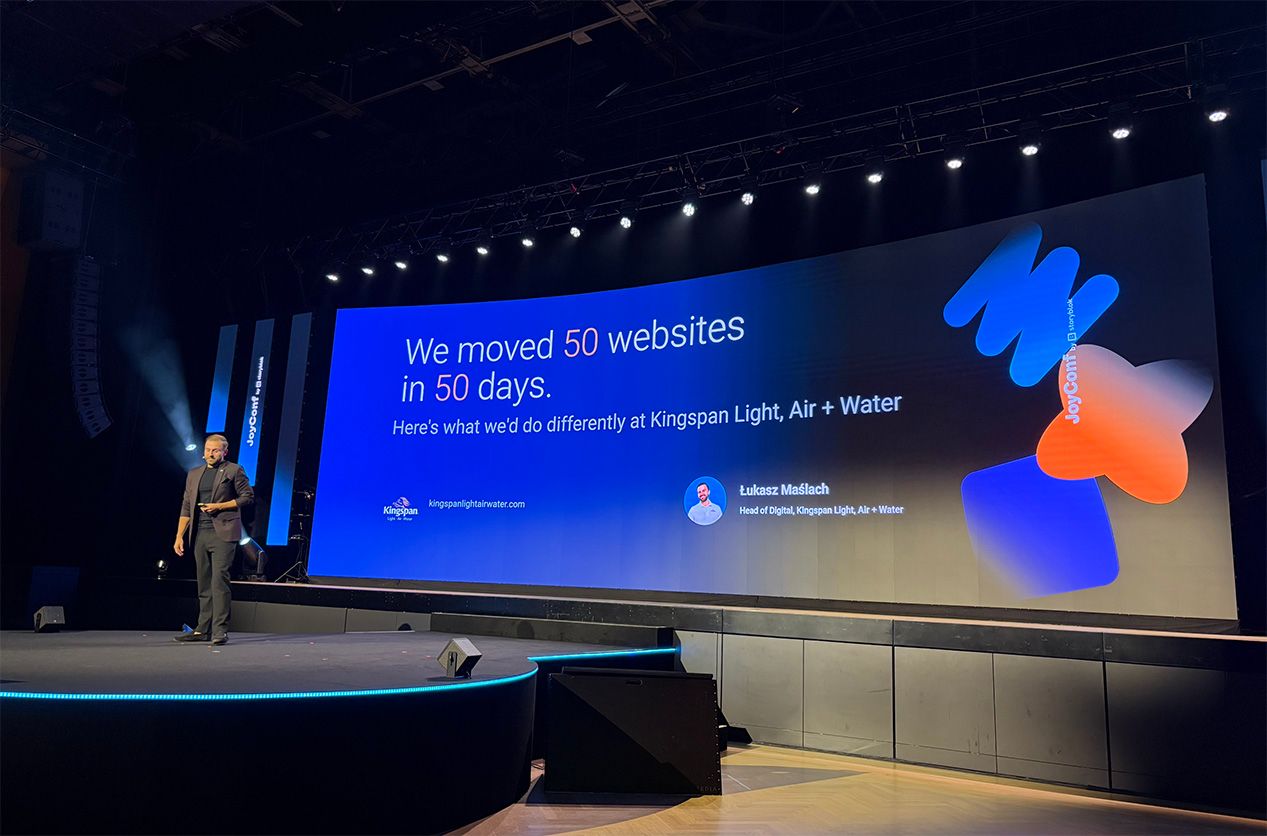
Lukasz Masbach of Kingspan Light, Air + Water
MSQ DX
Christoph Bordeck, Lead AI Architect at MSQ DX – a global digital transformation agency – brought a creative spin to AI orchestration through the lens of the customer journey. Citing an average of 63 touchpoints when buying a new car, he distilled that complexity into five stages spanning the website, email, social, showroom, and handover.
His use case illustrated how Storyblok provides the structured content backbone and FlowMotion connects the data and actions, keeping the experience connected and on-brand. What I loved was how he kept bringing the technology back to the human taking that journey. Producing more content means little if it doesn’t help the customer move forward.
“One source makes it manageable, and orchestration makes it relevant,” he said. “The user is what really matters.”
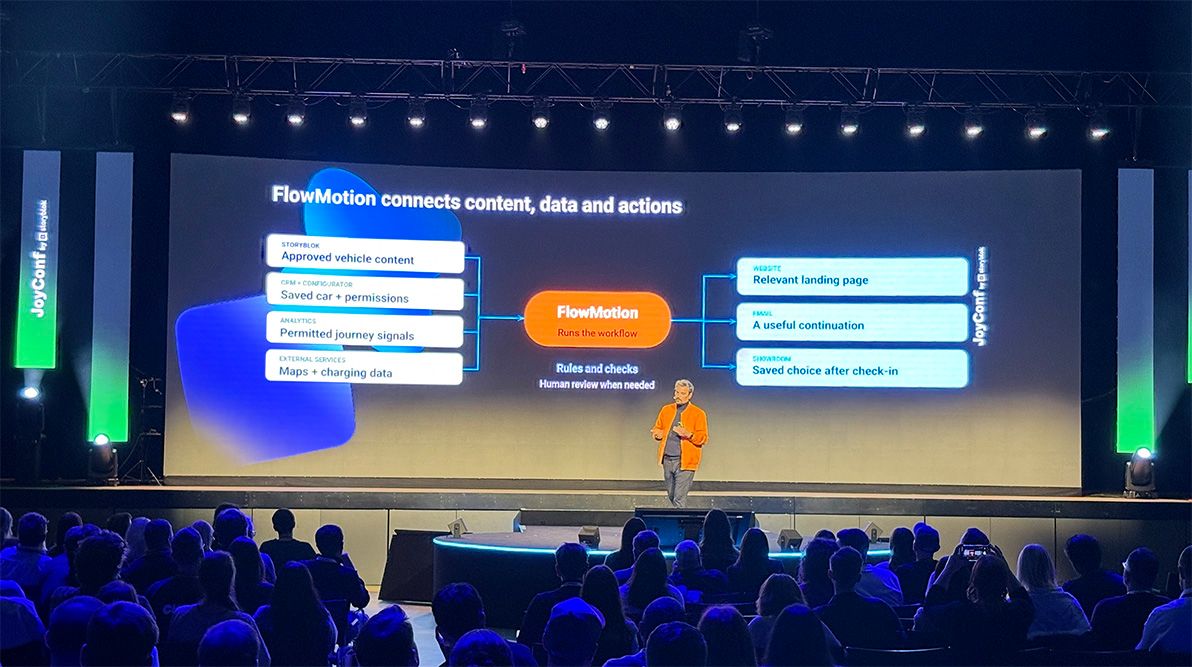
Christoph Bordeck of MSQ DX
Lokalise
Sahil Gamhbir of Lokalise, a language localization partner, argued that brands need more than translated content to serve local and global audiences. He demonstrated this by asking an AI search engine the same question in different languages, resulting in different recommendations. His central thesis: the development of a Language Market Fit where content reflects local cultural context while staying true to a brand.
“Language shapes what AI retrieves,” Sahil said. To that end, he also framed an approach for using shared language assets to help AI surface the right content. He also framed how AEO is rapidly evolving the digital discovery landscape, making it one of the noisiest top-of-funnel opportunities.
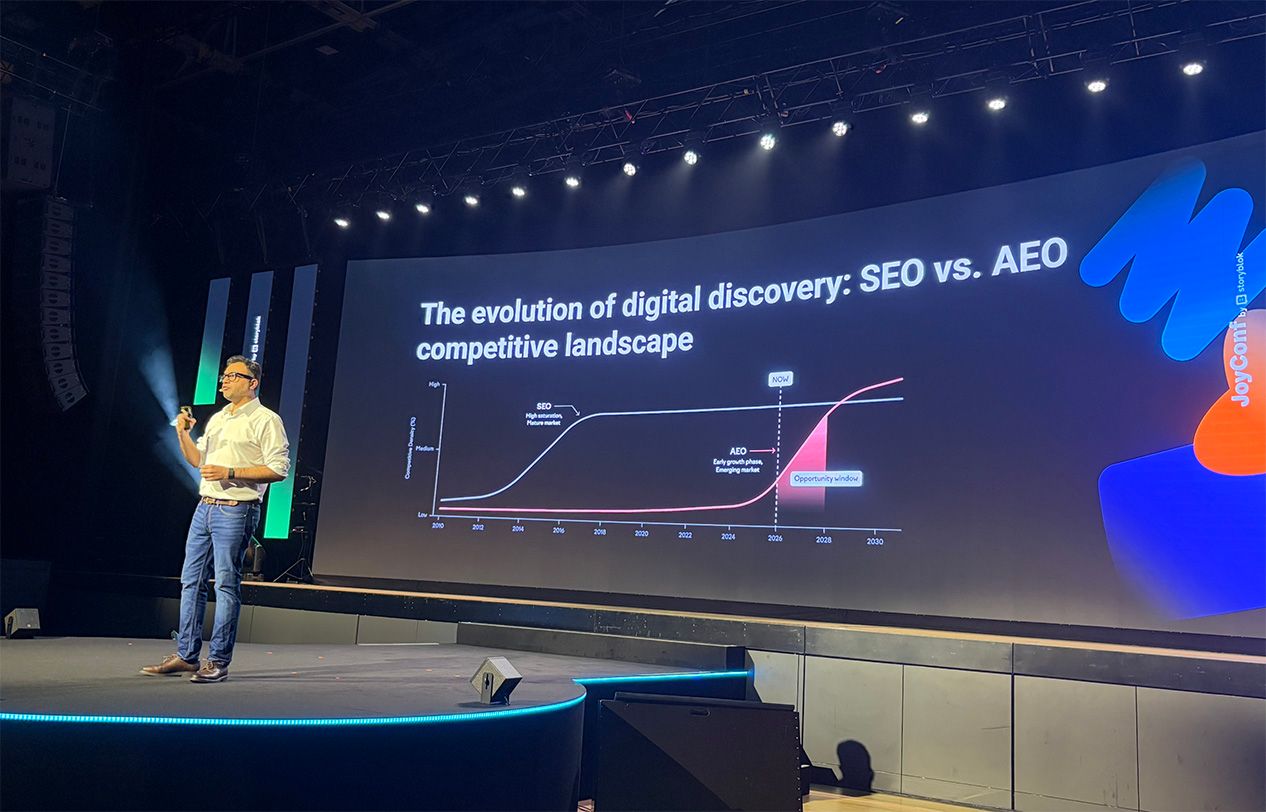
Sahil Gambhir of Lokalise
Porsche Digital
Kilian Gödderz of Porsche Digital made acceleration the centerpiece during the conference’s closing session, outlining the famed automaker’s drive to a sleek, modern, composable web architecture for porsche.com. Joined by Leif Marcus of MHP (a Porsche company), they discussed the business and technical decisions – and the trust needed to make a bold change.
“Transformation and delivery don’t have to compete,” he said. No doubt that mindset helped them win the race.
The final trick: moving from content confidence to ‘joyful confidence’
In my second year covering the only CMS event with “joy” in its name, I’m once again drawn to the human side of the story.
Yes, I’ve tracked the product advancements. Seen the demos. There are always sparks of innovation, but it’s not just about the flash. The real impact often lives in ordinary, day-to-day upgrades that can put a smile on a user’s face. And Storyblok is shipping that promise faster and more consistently than ever.
From what I’ve seen, collaboration is shaping more of the potential. Every agency I spoke to is building to solve real customer problems and leveraging Storyblok at the core. Together, they’re producing some magical outcomes, and the MVP pool is growing. All signs that people are powering the real roadmap for growth.
And they’re coming not just because of the tech. They’re betting on Storyblok because of how it makes them feel. That it’s obsessed with trust amidst the uncertainty of AI and takes pride in the quality of its experience. Time and again, I spoke to people at JoyConf who described the vibe – the human connection – as the reason for being here.
The “Content Debt” crisis is worse than any of us realized. This past week, I was speaking at the Boye 26 Conference in Aarhus, Denmark, where I caught a great presentation from Strawberry's Kira Olesen. She chronicled the multi-year process of cleaning her company's content house, and as we discussed in the session, AI amplified the good and the bad. In their analysis, brands will have to think hard about what to keep and what to let go.
AI is rife with questions surrounding its security and value – even as data from the MACH Alliance suggests companies that have embraced composable architectures are seeing ROI from their AI investments. Balancing the risk and reward is proving to be a challenge for every vendor, and Storyblok will need to translate this in a meaningful way for analysts and buyers.
Despite its strategic momentum, Storyblok is also facing competitive headwinds. Teams are achieving feature parity by shipping faster than ever, making it difficult to sell only on bells and whistles.
As Vercel's Malte Ubl said at the recent MACH X Conference, this shift toward the agentic web is undeniable, and even his own company is now relying on AI for 100% of its code. But as that code becomes cheaper to produce, trust becomes the most valuable commodity. And that trust is hard-earned.
You can't build confidence on nothing. It needs a foundation. This is where entities like a proven system of record are essential, and why a headless CMS like Storyblok is providing the critical bedrock within a composable stack. That foundation is also reinforced by customer intimacy, where adding something simple like inline editing provides more “joyful confidence” in a partnership.
AI is forcing change on a daily basis. But even as it disrupts, it creates. Across the many rooms and conversations at JoyConf, I felt the boldness of looking ahead with hope, not fear. Several agencies I spoke to were finding opportunities to leverage their use cases into business conversations with enterprise attendees. Why? Because the hunger for answers is overwhelming. And consultants have an opportunity to align their value around the complexity of AI transformation.
At JoyConf, Dame Dr. Maggie Aderin gave one of the main stage keynotes. As a space scientist who has worked on the James Webb Space Telescope, she embodies the intelligence, curiosity, and fiery ambition to explore the unknown. But getting anywhere takes grit and confidence – not just in the tools we use, but in the joyful human connections we make.
A tech magician in her own right, I think she summed up JoyConf in one line:
“Together, we can achieve the seemingly impossible.”