What’s the ROI of an Agentic CMS? Kontent.ai ran the numbers. Here’s what they found


First to market with the mantle of an “Agentic CMS,” the headless pioneer is building an evidence-based business case for the value of its AI-powered capabilities and helping enterprises calculate their own potential. What kind of return on investment can you expect? The numbers will surprise you.
Last November, I wrote an analysis of the Forrester Wave for Digital Experience Platforms called Welcome to the “Agent Hunger Games.” Are the odds in your favor?
In it, I predicted exactly what we’re seeing now: a market where the AI rhetoric is reaching peak volume, and every software tool is touting its agentic virtues. The “tributes” have entered the arena, and the battle for dominance is playing out across Panem.
The rise of the agent economy can't be understated. By year’s end, 40% of enterprise apps will feature task-specific AI agents. And by 2028, the average global Fortune 500 enterprise is projected to have as many as 150,000 agents punching the clock. The sprawl is real, and it’s already underway.
Like the rest of the technology pantheon, content management systems have raced to adapt, adopt, and inject their products with AI agents. Now, the market is being flooded with agentically-imbued conventions faster than buyers can unpack, translate, and ultimately evaluate solutions.
But one new mantle that's found its footing is the Agentic CMS, which was first pioneered by Kontent.ai back in 2025. After seeing a real-time demo of their agents in action – performing a “demilitarization” of website content – I did a deep dive into their platform. What I discovered was a simple, clear, and elegant application of agentic AI that was delivering results.
In May, Irina Guseva and Mike Lowndes of Gartner published a report that codified Agentic CMS as an “emerging category.” As they surmised, a true Agentic CMS lives at the intersection of automation, decisioning, and orchestration. They’re no longer repositories of static content, but response engines for LLM prompts to create, build structures, run audits, and update content at scale.
This is where Kontent.ai has been directing its agentic innovation. In April, I spoke to the company’s Chief Product and Technology Officer, Martin Michalik, about the launch of its Expert Agents. With zero code or complexity, content strategists and editors can configure everything using natural language – and it all keeps working, like the CMS is running itself. On top of it all are clear layers of governance that put humans in control.
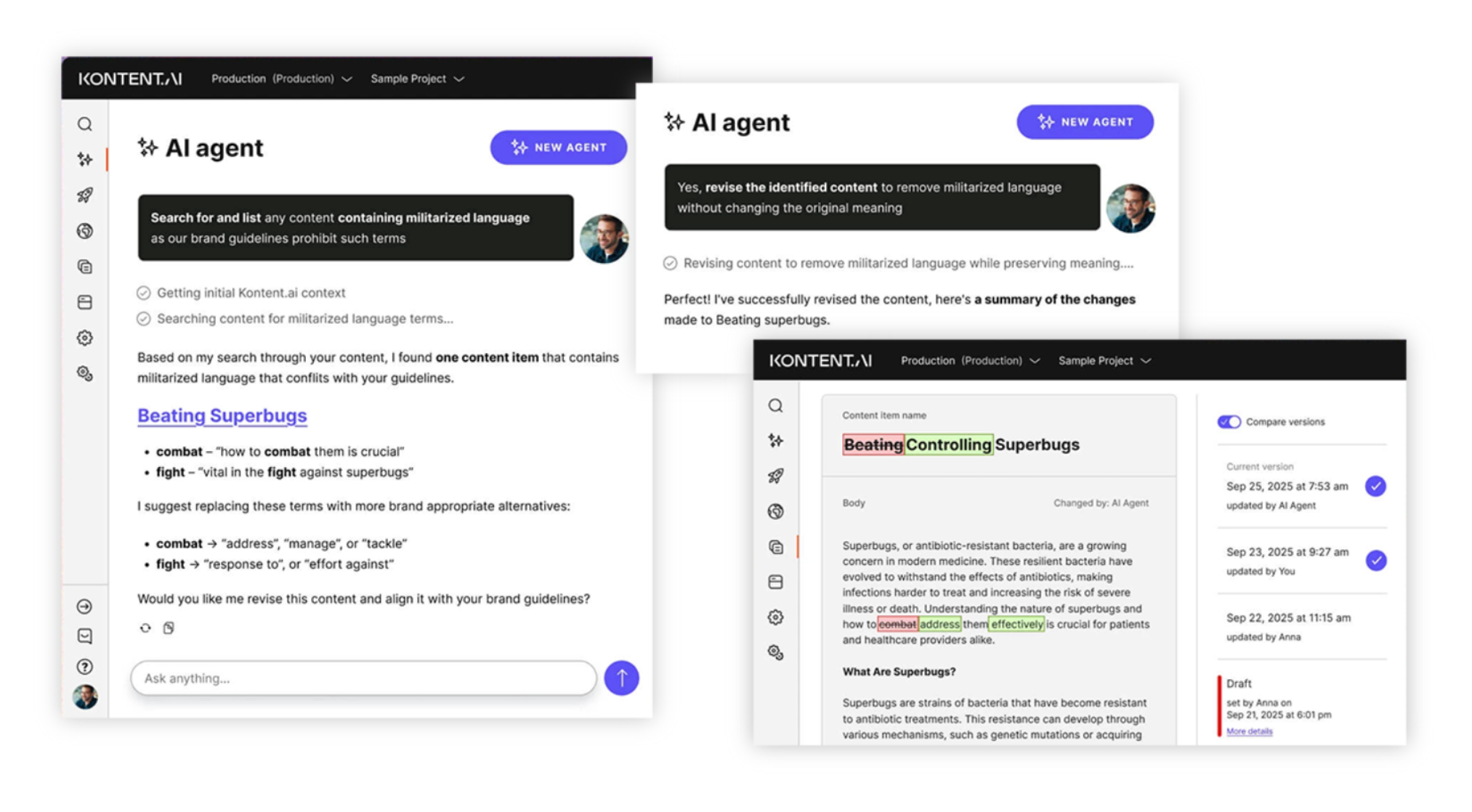
Kontent.ai’s Agents can be directed at a wide range of tasks. Source: Kontent.ai website
If you read CMS Critic regularly (it should be bookmarked), you know I’ve been analyzing this agentic shift across the toolscape. For an Agentic CMS, a big part of my focus has been on the ability for content and marketing teams to accomplish repetitive and mundane tasks.
But what's the actual value?
In other words, what is an Agentic CMS worth to an enterprise, particularly when it comes to the kind of work that teams perform over and over? Given this is a nascent category, comparatively calculating that ROI has been a black box – at least until now.

Kontent.ai Director of Product Marketing, Nikolay Georgiev. Source: LinkedIn.
When I recently connected with Kontent’s Director of Product Marketing, Nikolay Georgiev, he pulled back the curtains on this quandary, sharing an evidence-based methodology that unlocks the value equation for its Agentic CMS. He explained exactly how they measured it, and even how you can calculate your own ROI.
This revelation resonates. As you’ll see, the cost savings are profound. But for me, the bigger story is the scalability and business acceleration – outcomes that Nikolay shared through a real customer use case.
The “Agent Hunger Games” are upon us. But Kontent.ai is playing it smart by leading the way with value. And that’s putting the odds firmly in their favor.
How Kontent.ai calculated the ROI for Agentic CMS
Let’s start with the methodology, because it matters. First and foremost, the research Kontent conducted isn’t a business case for moving from a traditional CMS to headless. It focuses solely on the incremental value that agents create with a headless foundation.
“This doesn't include the broader value an organization could realize by moving from a traditional or monolithic CMS to a modern headless foundation in the first place,” Nikolay said. “We deliberately keep those two value calculations separate.”
As Nikolay relayed to me, the biggest value of Agentic CMS is also the hardest to measure. As part of the analysis, they didn’t monetize benefits like accelerated time to market, improved content quality, reduced compliance and brand risk, or the additional strategic capacity created for teams. As he said, this is where a significant part of the broader business value actually sits.
Now, for the nuts and bolts: Kontent analyzed actual content-volume data across 298 of their customers to establish representative operations. Within that corpus, they identified seven recurring use cases across content operations. This included:
- Draft Creation
- Translation & Localization
- Legal & Regulatory Compliance
- SEO/GEO Optimization
- Brand & Tone-of-Voice
- Metadata Management
- Asset Management & Alt Text
From here, Kontent’s team estimated the manual effort required for each of these operations, applying documented labor and/or market rates. They cross-referenced that with industry benchmarks like translation costs, labor rates, and other relevant data. What this led to was a simple set of what I’m calling “value equations” for each use case (e.g. Net value = Manual cost – Agentic cost).
Kontent applied this math to its own data, and most of the seven use cases followed this logic. The same variables are applied in the Agentic CMS ROI Calculator, which provides you with a personalized value profile.
“We modeled the human effort required across these use cases and then ran actual experiments with our agents to measure the AI credit consumption required to execute the same work. This wasn't based on asking customers to estimate hypothetical savings.”
This might seem like a lot of trouble to go through for a slice of the overall pie, but measuring the potential impact of an Agentic CMS is still amorphous – and this is a grounded approach. We assume that automating tasks will free people up to focus on higher-value work, but divining a precise financial impact is a stretch. This is why Kontent elected to benchmark its research against real customer data in places where work is being impacted.
“The possibilities and value of Agentic CMS are really limitless,” Nikolay added, “just as are limitless the opportunities to use agents for all kinds of use cases.”
From prompts to payoff
Let’s run the numbers for a representative Kontent.ai customer: by moving these seven recurring use cases to its Agentic CMS, an enterprise team could achieve almost $657,000 in annual net value. They could also reclaim nearly 15,000 hours of capacity each year, and free up as many as 7 full-time employees (FTEs).
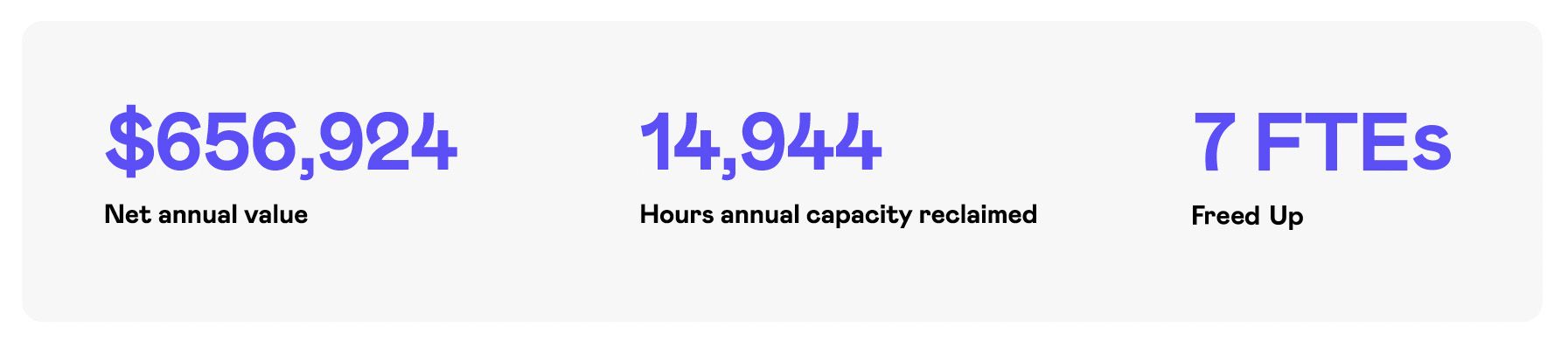
Source: Kontent.ai
These are astounding metrics. And even if they don’t tell the entirety of the value story, they offer a strong foundation for how an Agentic CMS can profoundly impact your content operations.
To be clear, this is a representative outcome based on Kontent’s customer data, industry benchmarks, and a few validated assumptions. Obviously, your own brand’s content volumes, languages, labor costs, and other parameters will influence these figures in either direction.
Here’s a closer look at the breakdown by each use case:
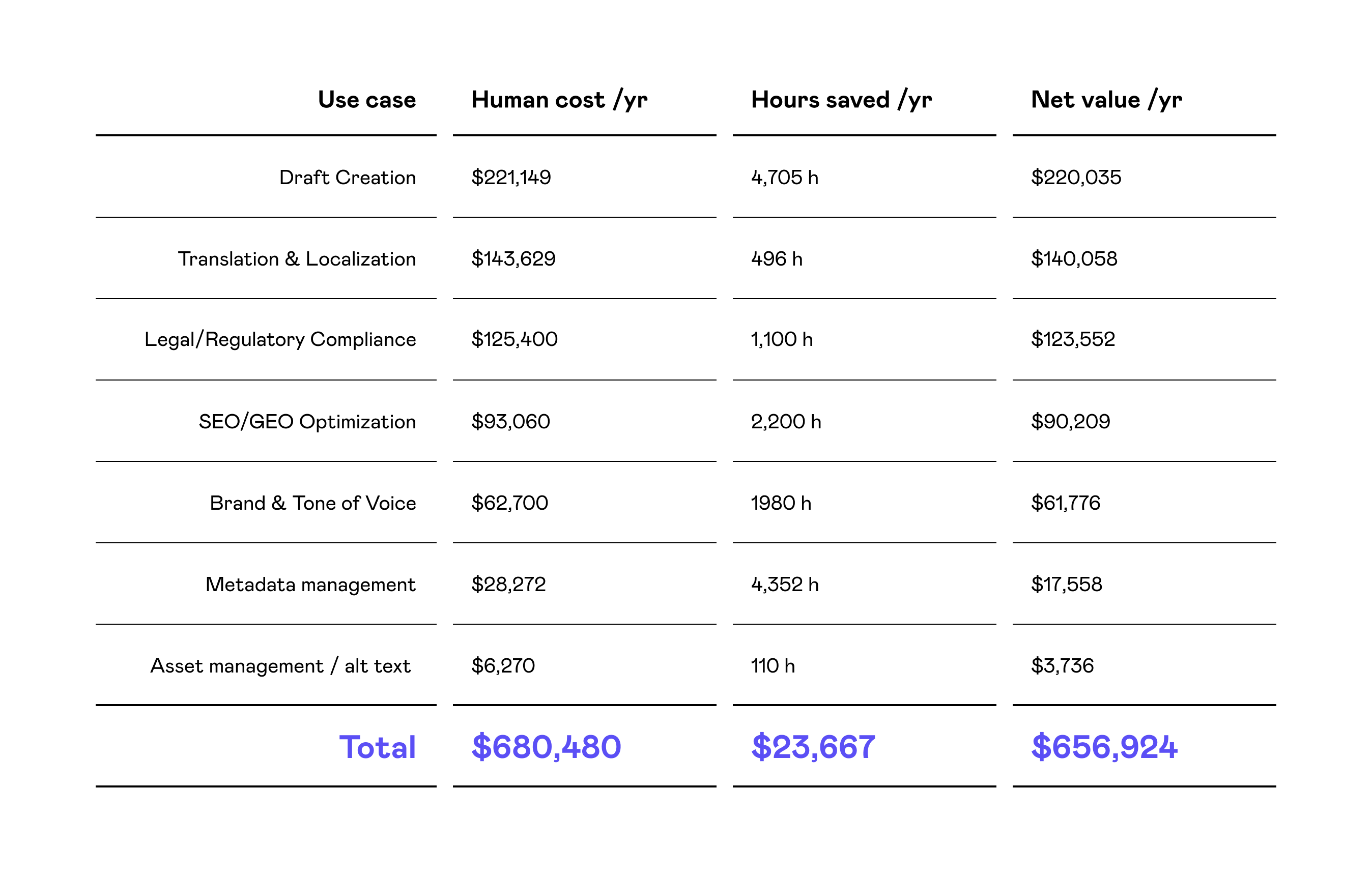
Source: Kontent.ai
“If you have these seven use cases, and you're the average-size customer for Kontent.ai, having around 30,000 content items in your CMS and around 1,200 new items added every year, you actually will be able to save around $657,000 a year,” Nikolay said. “The annual value we calculated is intentionally a conservative floor, not the total value of Agentic CMS. Compared to what we ask you to pay, this is a huge return.”
Evolving the content operating model
Kontent.ai has gathered multiple success stories with its Agentic CMS over the past year. But one recent example illustrates how value was realized not just through cost savings or increased productivity, but through the transformation of the customer’s content operating model.
Thomas, a leader in global talent assessments, has been working with Kontent.ai as it expands into new markets. The company – which focuses on delivering precise psychometric testing, psychology, and data – helps companies evaluate candidates and employees with its powerful Thomas Connection Intelligence (CXI) platform.
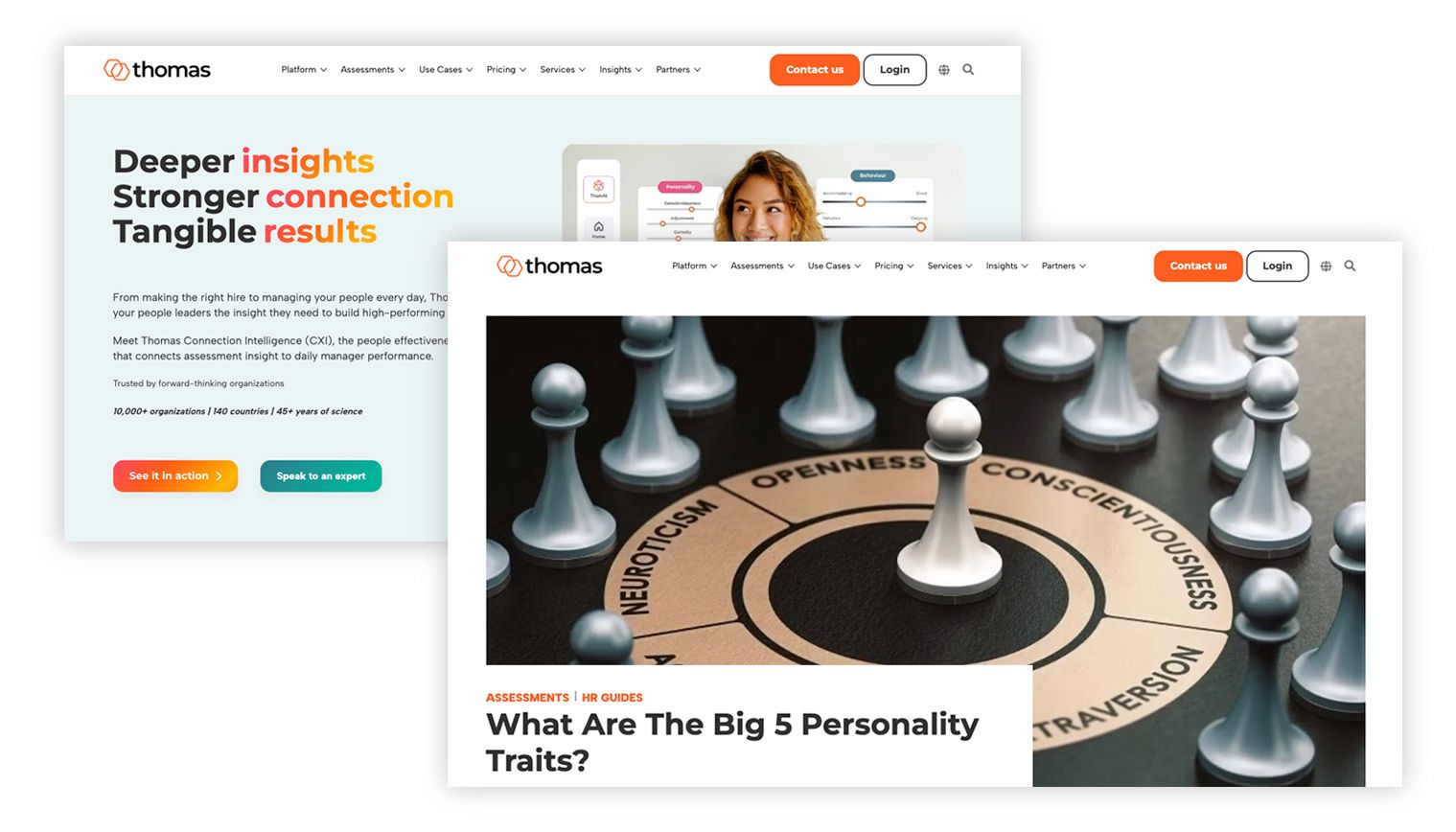
Source: www.thomas.co
Thomas runs a big content machine, managing over 60,000 items across 14 languages. But the team managing that content is comprised of highly skilled psychologists and psychometrists. With Kontent’s Agentic CMS, the goal was to remove repetitive operational work from these specialized practitioners, empowering them to focus more of their expertise on tasks where human judgement is essential.
“We’re talking about highly specialized content,” Nikolay explained. “Thomas hires educated psychologists to write psychological assessment, platform, and UI content, which is then translated into multiple languages to support their global customer base."
Prior to Kontent, Thomas’s team was experiencing substantial release delays across its different language channels. They were also mired in manual copy/paste functions when emailing drafts. Thomas’ Director of Content, Caitlin Meyer, harnessed Kontent’s Expert Agents to handle each of these language versions at scale and reduce the friction of adding new languages without adding headcount.
“Once a product is released in English, an Expert Agent creates the first draft in the respective language,” Nikolay explained. "Then, depending on the risk level of the content, either a native-speaking linguist with a background in psychological application reviews and approves the final copy, or, for lower-risk content, an Expert Review Agent handles that final linguistic fine-tuning itself."
According to Thomas, these benefits have eliminated the release lags to reach regional markets – and achieve regional revenue – by six months. New language product feature activation has been reduced to a matter of days. Kontent’s agents are also automating more of the routine draft volume, so those skilled psychometrists can focus on producing high-value content.
Overall, Thomas has realized a 70% reduction in manual effort while creating 5,000 draft-language variants a month at peak volume. And while those numbers are impressive, the more profound impact is around business acceleration and scalability. Case in point: the savings have enabled an investment in human specialists with Mandarin Chinese expertise, allowing the creation of more strategic content in new markets.
“They completely transformed their business and team,” Nikolay said. “The Thomas content team no longer spends its time on repetitive translation workflows. Instead, they're writing scientifically accurate content, building the glossaries and guides that make our Expert Agents smarter, and reviewing what comes back. That's the real transformation: their time now goes toward the work only they can do.”
Where recurring content work creates recurring value
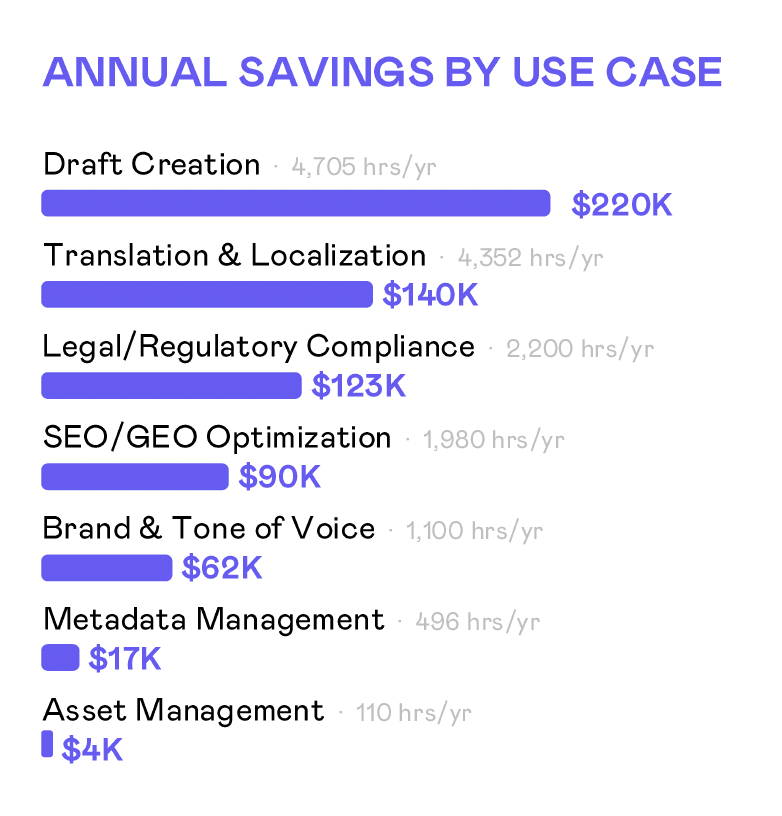
For customers like Thomas, the outcomes speak for themselves – clearly demonstrating where Kontent is delivering ROI in a meaningful way. But let's take a closer look at the annual savings per use case. The following table is a snapshot, and I’ll drill into a couple of them below.
Source: Kontent.ai
Brand & Tone of Voice
Content and assets are scaling at an exponential rate, and maintaining brand consistency is getting harder by the minute. Reviewing against brand guidelines across existing libraries can create repetitive bottlenecks, but it’s vital: based on data from Forbes, maintaining brand standards across all platforms can increase revenues by up to 23%.
Kontent’s Expert Agent for Brand Voice reduces the lift by reviewing content for tone, style, and messaging. At this scale, automating the workflow could reclaim up to $61,776 in annual labor value while freeing teams from repetitive brand and tone-of-voice reviews.
SEO/GEO Optimization
One of the hottest trends in martech is the rise of GEO (Generative Engine Optimization). While Google still considers it a subset of good old SEO (Search Engine Optimization), it has established its value as a key strategy for influencing AI search and visibility across answer engines like ChatGPT. While many tools exist in this burgeoning space, there's no silver bullet. Content teams are in a continuous cycle of reviewing and optimizing pages across an expanding inventory.
Kontent’s Expert SEO/GEO agent can automate reviews and propose updates to improve content discoverability and accelerate remediation. In this instance, automating SEO and GEO optimization could reclaim around $90,000 in annual labor value while enabling teams to optimize content much more consistently and at scale.
What can 200 credits actually do for you?
We should all be fans of ROI, and that’s what I like about this research. But Kontent.ai takes it a few steps further, turning it into something actionable. As Nikolay shared with me, presenting value through this ROI lens has successfully converted customers.
Kontent’s metrics are, in its own words, defensible benchmarks. But the proof is in the pudding, and that’s where the Agentic CMS ROI Calculator provides an easy button for personalized insight. You can enter your brand’s content volumes, map to the use cases that matter most to your organization, and calculate a savings and AI-cost estimate based on your own numbers.
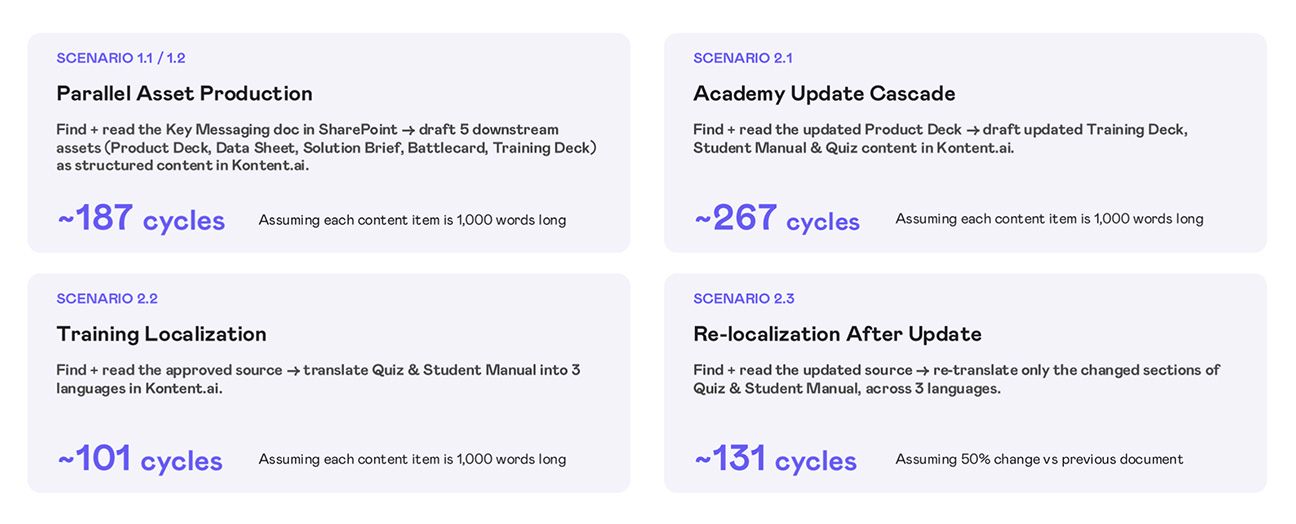
Of course, the real litmus test lives inside the credit burn. As Nikolay shared with me, an enterprise prospect asked them what they could actually accomplish with 200 AI credits across several specific workflows.
“Because we had measured AI consumption experimentally, we could translate that into concrete operating capacity,” he reflected. “For example, taking an approved messaging framework and creating five downstream sales and enablement assets could be executed approximately 187 times under the modeled assumptions.”
Source: Kontent.ai
The diagram above showcases a customer with multiple content assets across different scenarios. In the second example, an “Academy Update Cascade” – where an agent finds an updated product deck and uses it to draft updates to a training deck, student manual, and quiz – could be completed approximately 267 times with the same 200 credits. That's a powerful testament to what's possible.
“This has been a useful way of moving the AI-cost conversation from an abstract number to ‘What business work can I actually get done with this?’” Nikolay added.
The verdict
The Hunger Games is dystopian fiction at its best – and with a new film coming this year, it’s a timely trope. In the agentic game, the stakes feel a lot more realistic as platforms vie for attention in a market of choices and confusion.
I’ve been following Kontent.ai since it first launched in 2022, and it continues to earn that “.ai” append in its name. I’ve seen the trajectory from generative to agentic, and they continue to lean forward as a pioneering force. Along the way, they’ve made smart, incremental moves that prioritize practicality and reinforce the pillars of content modeling, structure, and best practices for modern digital experiences.
In my previous conversations with founder Petr Palas, a visionary in the content management echelon, the mission has always been focused on customers. Kontent has been a vehicle for exploring how AI can reinforce that customer centricity with meaningful applications that can make a real difference in content operations.
What I like about this ROI research is that it endeavors to make the Agentic CMS economically understandable and even testable. It supplies a useful benchmark that is grounded in real data but also transparent about its assumptions. Further, the Thomas case study highlights the real value beyond cost savings, illustrating how agentic operations can transform an organization and deliver significant business impact.
Kontent.ai may have been the first to market with an Agentic CMS, but what really matters is how they continue to move ahead. They’ve spent years building AI value into their platform, and this research helps enterprises assess the value coming out of it.
They’re putting a price on the promise – and that’s how leaders win the game.
My Recommendation: If you’re evaluating CMS and its agentic capabilities, Kontent.ai should be on your short list. The Agentic CMS ROI Calculator is a good starting point, and you can identify key use cases for a personalized demo. Pricing is based on a combination of user seats, content types, and content items, and you can get a precise estimate here.