Agent Evolution: Kontent.ai Brings Intelligent ‘Expert Agents’ to its Agentic CMS

The headless, high-powered content management system just released a slate of specialized AI agents that move beyond simple AI-assisted tasks to automate complex, multi-step content operations. Interview with CPTO Martin Michalik.
“Robby the Robot” made his debut in the 1956 film Forbidden Planet. If you’re a sci-fi nut like me, this lovable automaton has a special place in your heart. He was the OG, the template for so many of the androids on film and television that inspired our imaginations.
Spoiler alert (although this one is so ancient, I’m skipping the mea culpa): This movie is about a group of space explorers from Earth who land on a distant planet, only to encounter – you guessed it – an alien that wants to kill them.
There’s a scene where Cookie, the human chef from the spaceship’s crew who doubles as the comic relief, asks Robby if he can replicate the last of his “Rocket Bourbon.”
The robot proceeds to drink it, an essential input for his synthesizing process. Cookie is distraught by the loss of his remaining elixir, but when Robby returns with 60 gallons of 120-proof brown drink, his demeanor shifts. A smooth bourbon will do that to you – especially on an alien planet.
In many ways, Robby is like an AI agent on fire. Throughout the film, he executes a multitude of complex tasks for his human companions, automating day-to-day operations. And yes, to Cookie’s delight, breaking down complex recipes to whip up 480 bottles of liquid lightning.
It’s not your typical automation. It’s expert-level.
Since 2023, there’s been a hyperbolic race to bolt AI into the CMS. I’ve covered this hustle at length and watched many hours of demos along the way. After a while, much of the generative functionality started to feel commoditized and – dare I say – predictable.
There were useful features. But the barrier was never about generating descriptions or captions on the fly. That’s table stakes. The real friction that teams face is with their content operations, where tasks like content audits, translations, and vital governance checks get passed over while juggling multiple brands or enterprise workloads.
Agentic AI promised a path out of this morass. To be clear, agents have long been a fixture in software, automating a host of functions and workflows. But AI has revolutionized the scalability and potential of what agents can do – and made it possible for anyone to use them with a few simple prompts.
When I first covered Kontent.ai’s bold vision for the industry's first Agentic CMS, I was more curious than skeptical. The headless platform had adopted the “.ai” extension at the dawn of the recent generative bonanza, and they’ve been fervent about their AI-centricity – something I discussed with their VP of Marketing back at 2023’s MACH TWO Conference.
Fast forward to 2025, and agents were suddenly all the rage as businesses struggled to translate AI into real value. Kontent’s Agentic CMS, which came to life last summer, was hitting at a time when most CMS vendors were branding around an AI-first position and introducing some manner of agentic capabilities. Translation: it was getting noisy.
But Kontent rolled up its sleeves and architected AI at a core level, embedding agents directly into the operational layer of content management. This was crystallized in Kontent’s Main Agent, which allows teams to operate the entire platform using natural language to create structures, run audits, and update content at scale. That decision has unlocked clear advantages.
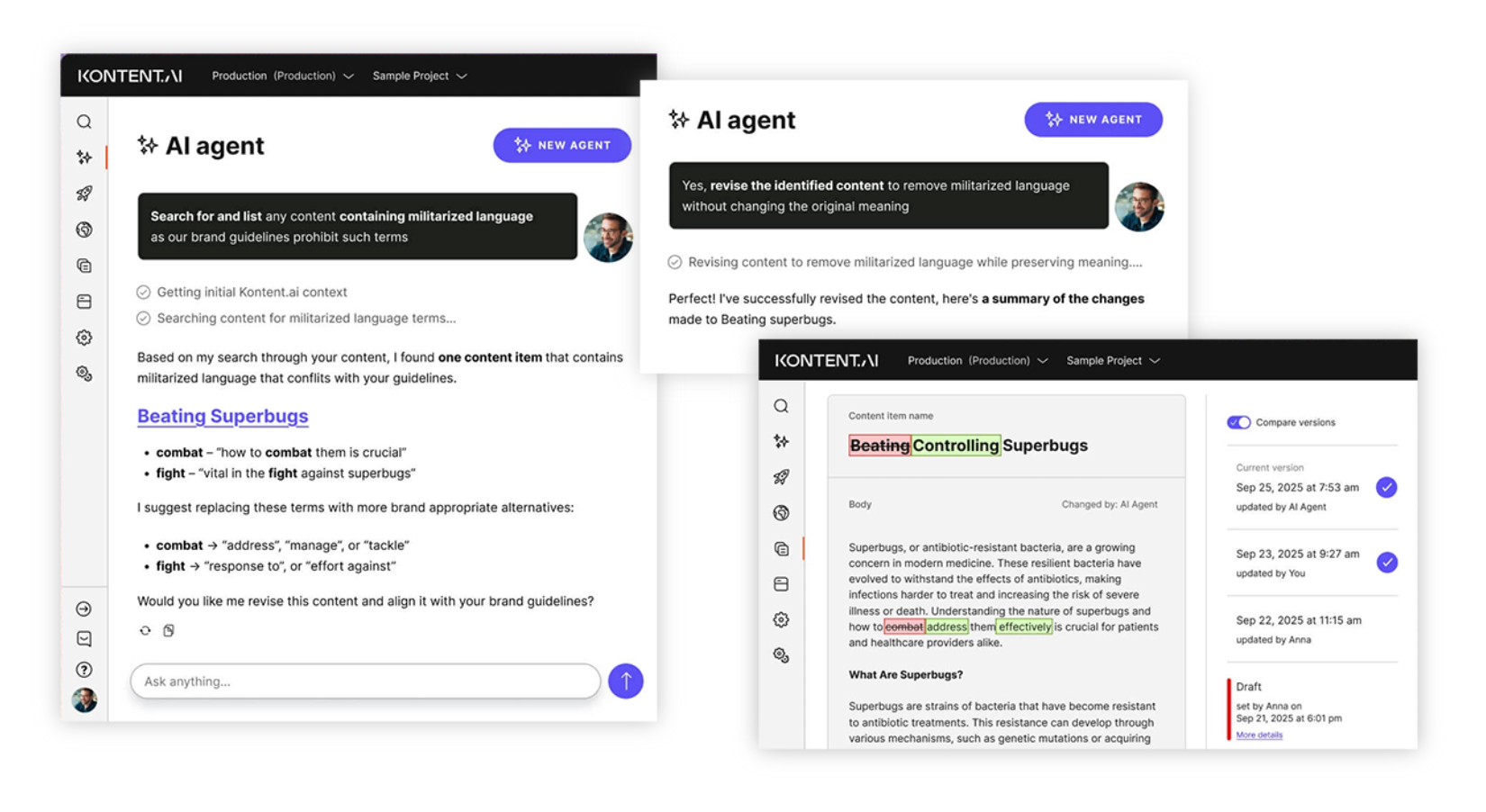
AI Agents can automate content governance at scale with accelerated ease. Source: Kontent.ai website
Now, Kontent.ai is fueling the next evolutionary step with the launch of Expert Agents – and it’s worth paying attention to. Balancing out the general capabilities of its Main Agent, Expert Agents bring a targeted layer of intelligence that is purpose-built for specific, high-value content operations that really matter for organizations.
When I recently caught up with Kontent.ai’s CPTO Martin Michalik, he told me how much work had gone into this vision since we saw each other last August at CMS Connect 25. At the time, he shared a working concept of Agentic CMS in action, which showcased how simple prompts could automate the removal of militarized language from a website’s content.
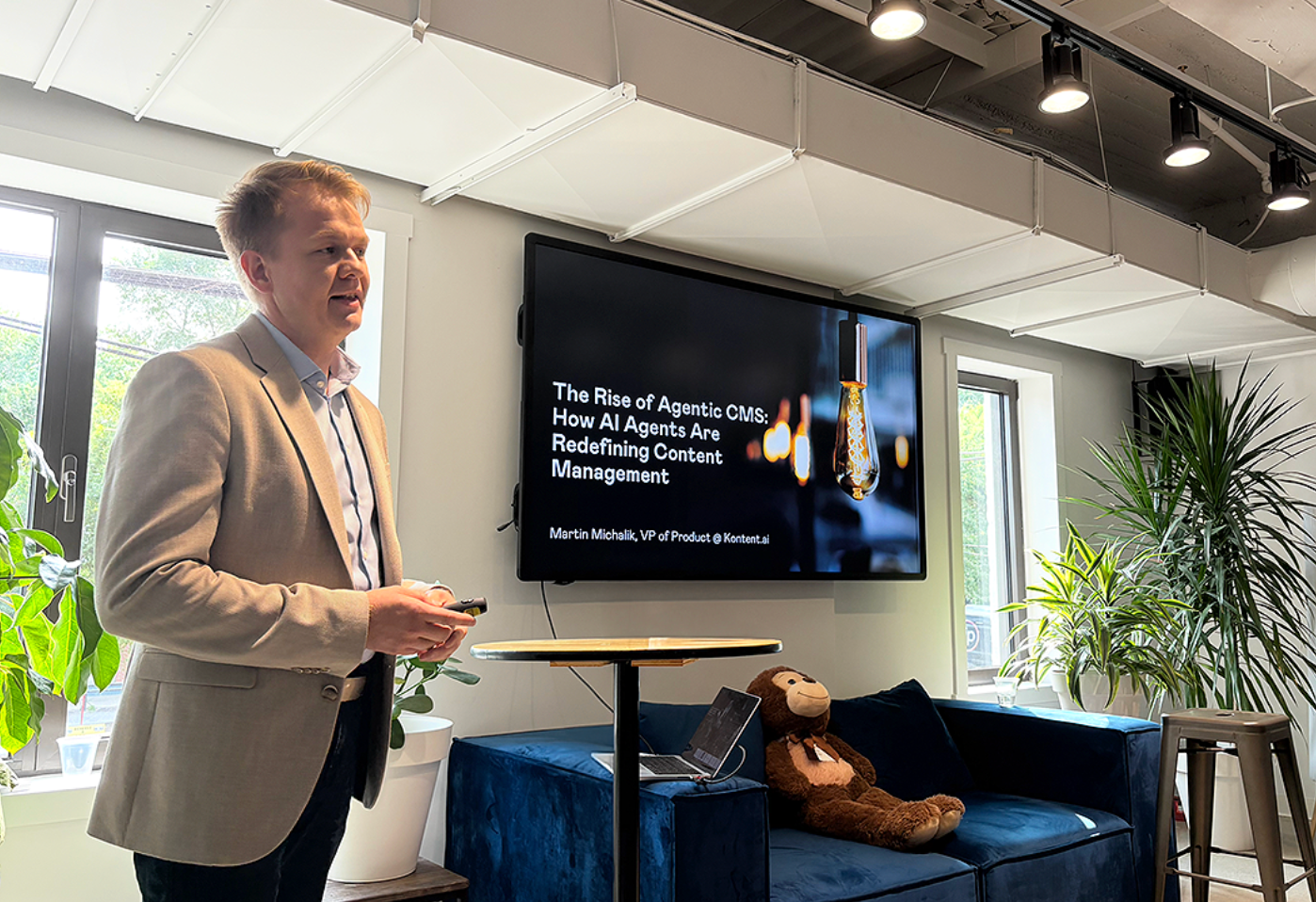
Kontent.ai’s CPTO Martin Michalik at CMS Connect 25 in Montreal.
“We then took it and went to customers and said, ‘Hey, look what our CMS can do,’” he said. “The reaction was, ‘We didn’t really know this was possible, and we’d love to try it in production.’”
That curiosity turned into a free alpha program that ran through the end of the year, putting agentic workflows under real load. As part of the alpha, customers provided feedback, and it helped optimize and ultimately unlock the potential for the platform. According to Kontent, 60 organizations are actively using its Agentic CMS – and seeing real results.
What are Expert Agents?
Like Robby the Robot, Expert Agents take agentic AI to another planet. They’re evolved, moving beyond simple digital assistants to purpose-built teammates with deep, specialized intelligence – and they’re capable of handling content operations tasks that teams cope with every day.
What makes Expert Agents powerful is that they’re proactive. They don’t sit idly in a sidebar waiting to be prompted. They’re wired directly into workflows, activated automatically by the states and signals that already govern your content lifecycle.
To understand why Expert Agents matter, you have to look at where content teams actually spend their time – and where they lose it. Because the real operational pain hasn’t budged. Teams are still coordinating manually across regions and brands. Governance still relies on people using Post-it notes as reminders to run checks. Regulated organizations live in fear that something might slip by them and create liability.
With Expert Agents, this gets flipped on its head. SEO teams that once had to manually audit individual pages can “Leave it to an Expert” and optimize more fluently for GEO (Generative Engine Optimization). It makes everything faster, lightens the load, and provides governance. And while the agent takes care of the heavy lifting, the human is still firmly in the loop and able to approve everything.
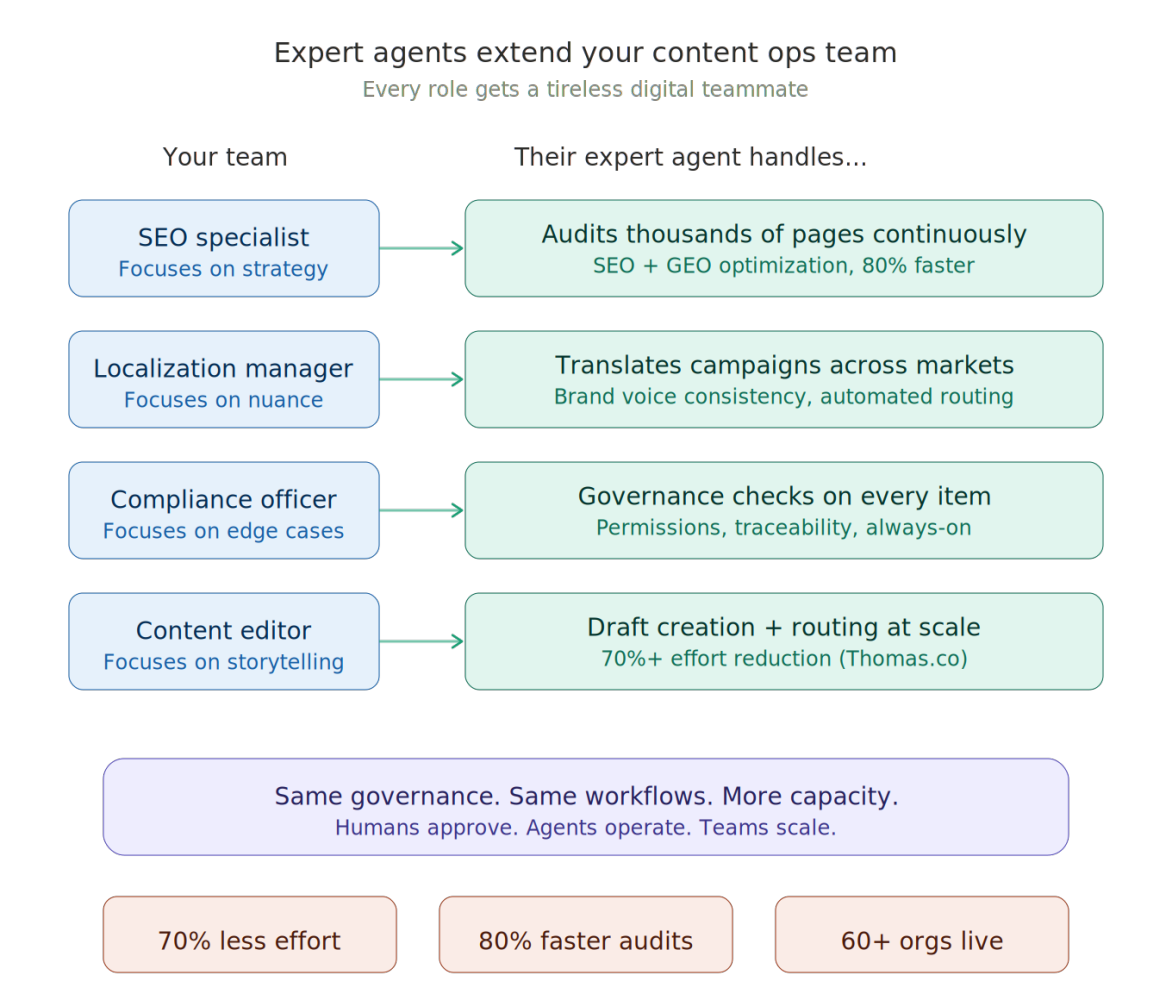
Source: LinkedIn
“These are agents that you don’t trigger manually as a user, but are triggered by your content workflow,” Martin explained. “Every time you reach a specific step, or whatever signal you fire, the agent executes. Because of the capabilities and tools it has available, it can progress a portion of the workflow, or even the rest of the workflow, and then pass it back to the users.”
Built for performance – with no code or complexity
Under the hood, Expert Agents required a different kind of engine – one that respects LLM constraints while operating at enterprise scale. Kontent took an innovative approach to solving this bulk challenge, building something that’s native, secure, and contextual.
“We started to think about an architecture that would allow us to break these large bulk activities into something smaller and quickly executable,” Martin said. “Instead of running a large operation, you run thousands of them. You break it down and combine it together at the end. It allowed us to run everything at scale. Now, apart from time and cost, there’s literally no limitation on how much you can process.”
The effect is that Expert Agents can run continuously across content workflows, handling everything that doesn’t require human judgment, configured by the people closest to the work using natural language. You describe what the agent should do – which content it should watch, which signals should trigger it, what standards it should enforce – and it gets to work.
And it keeps working. Like the CMS is running itself.
The beauty of Expert Agents is that they abstract complexity, allowing content teams with a wide range of skills to experiment without the cumbersome bottlenecks of R&D or IT. There’s no code required. Content strategists and editors can configure them using natural language, and that opens up the possibilities.
“With the agentic layer, you can say, ‘Hey, I have an idea for a new landing page or microsite for this position,’ and the agent can say, ‘We have similar positions, can we reuse this? Do you want it to look different or similar?’ It doesn’t just speed up the process. It enables users who weren’t primary CMS users before to work with it.”
Governance and control at the center
In the gap between AI and trust, anxiety thrives. That’s not hyperbole. According to the Harvard Business Review, 88% of organizations use AI in at least one business function, but only 6% trust AI agents to autonomously run core business processes.
“We live in technology, and we’re in it every day and night,” Martin told me with a certain modicum of frankness. “But for many companies, this is the first exposure to AI that runs on its own somewhere in the background.”
This is why Kontent.ai has made control a central feature of its Expert Agents. And when you start delegating parts of your workflow to autonomous agents, you need a much stronger story around control to satisfy key questions: What exactly did an agent do, when, and under whose authority? Is it auditable? Can you roll back if something goes wrong?
“Human in the loop” has become a bit of a trope IMO. It’s one of those phrases that everyone uses, but few define with any teeth. In many AI applications, it amounts to little more than “the user clicks approve at the end.” For enterprise content operations, that’s nowhere near enough, and Martin and his team approached this as a non-negotiable attribute.
“I don’t think CMS is going to be obsolete. It’s still going to be a system of record for your content and the way your organization’s brand and knowledge is represented. What’s going to change is how much content you have and how abstracted the data structure becomes underneath it.”
“We had to solve two things,” he said. “First, how can we make it persistent so it runs even when a user isn’t at their computer, because some of these operations take a while. But second, how we keep the control and guardrails in place.”
To solve this, Kontent built a comprehensive auditing and traceability layer directly into the agentic stack that tracks every change and its attribution. The system allows you to see whether changes were committed by humans or agents, who triggered it, and if it was scheduled. The level of granularity goes beyond a simple “AI made this change” tag.
“You can examine the log and see that someone triggered a change that was run at this time, and what the scope of the change was,” Martin said. “That was very important for us to get into production, because it was essential for customers.”
This is where the CMS is being galvanized as a foundation for agentic applications, providing a reliable, authoritative source of truth – and playing a critical role in maintaining governance.
“I don’t think CMS is going to be obsolete,” he said. “It’s still going to be a system of record for your content and the way your organization’s brand and knowledge is represented. What’s going to change is how much content you have and how abstracted the data structure becomes underneath it.”
Expert Agents, with their embedded governance and audit trails, are part of that evolution.
Empowering non‑technical teams without losing the plot
I’ve been in tech almost my entire career, and as someone who started in the corridors of code, I can attest to seeing how innovation often focuses on developers before business users. The rise of headless CMS is a testament to this.
But agentic AI is one of the first turns that truly has the potential to unlock both in parallel. Martin has a front-row seat to that.
“Every single technology shift or change was technical, and it was primarily unlocking technical teams and, later, business teams,” he confirmed. “I feel like this is, for the very first time, unlocking both. In the end, it’s providing more options and more control to non-technical users.”
Part of that comes down to interaction patterns. When the primary interface to complex operations is a simple prompt, you change who can effectively drive the system. It’s why Andrej Karpathy called English the “hottest new programming language.”
And this value is manifesting beyond the four walls of the office. Martin shared a personal example from outside his CMS world, using an AI coding tool to assemble a financial dashboard for his family.
“I rambled for five minutes about what I needed and what my goals were,” he said. “Then I hit enter, and it literally created a plan, how it was going to build it, and what it meant for the data. In 15 minutes, it was ready. I could never have done this before. It spun up my GitHub and pushed the data there for me. The level of proficiency it gives me to build something is incredible.”
"Right now, we need to focus on breaking down the barriers. Vendors have a responsibility to educate and to build systems that are resilient but safe to use.”
That same pattern – compressing the distance between intent and outcome – is what Expert Agents aim to bring to content operations. Content strategists, editors, and operations leaders don’t need to write code or craft complex scripts to automate their workflows. They simply outline the tasks, feed it the guardrails and goals, and the agent handles the mechanics.
At the same time, Martin was quick to point out that Kontent.ai is consciously aligning itself with its customer arc, so they’re working in tandem to address real-world needs with practical and impactful outcomes. This is what I saw in January’s “CMS Idol” competition at CMS Kickoff 26 – and the chief reason why Lukas Martinak and Kontent walked away with the win.
“We had some really crazy ideas,” Martin admitted, smiling wryly. “But we said, let’s slow down here, because our audience isn’t ready for that yet. This will come. Right now, we need to focus on breaking down the barriers. Vendors have a responsibility to educate and to build systems that are resilient but safe to use.”
Solvent points, to be sure – and a clear demonstration of how Kontent.ai is balancing ambitious capability with conservative control. It’s another example of how responsibility and ethical practices are key to charting the AI frontier, and driving a top-down vision for this will guide the next phase of AI in content management.
The verdict
Boards and leadership teams are done treating AI like a science project. In fact, dumping innovation into skunkworks without a clear ROI endgame feels like the sequel to Forbidden Planet.
The expectation is clear: AI has to be valuable. It has to deliver on one or multiple fronts, like enhancing productivity, reducing operational cost, accelerating time to market, or eliminating manual coordination across growing, global content portfolios.
The timing is apropos. Content inventories are exploding. Markets are multiplying. Governance and compliance demands are only getting stricter. Agentic AI is being positioned as a tangible solution for these challenges, but trust remains the question. And with agentic systems facing operational headwinds – something I spoke to Curtis Northcutt of Cleanlab about – human control is an absolute essential.
When it comes to content supply chains, the organizations pulling ahead aren’t the ones with the longest list of nifty AI features. They’re the ones using AI to fundamentally re‑architect how their content operations run – where audits, translations, SEO updates, and policy checks are executed continuously by reliable systems, not sporadically by overextended humans.
As Martin put it, the biggest epiphany wasn’t what the technology could theoretically do. It was about what happens when you put it in front of real customers.
“The biggest moment was getting the technology in front of people and seeing what they’re thinking, what their experience was,” he said. “It’s been a lot of learning, a lot of reality checks and shaping the roadmap. But it’s been really interesting to see what we can build now.”
In a market saturated with AI‑washed feature releases and low-brow wrappers, Expert Agents feel like the right vector: using AI not just to move faster, but to operate smarter.
I think Robby the Robot would concur. And you can drink to that. “Rocket Bourbon,” if it's available.
My recommendation: Kontent.ai’s Expert Agents are a clear evolution of its Agentic CMS capabilities. There are solid advantages from an architectural standpoint, as it's not just another bolt‑on chatbot or a novelty sidebar – it's embedded directly into the operational layer of the CMS, enabling more performant workflow capabilities while ensuring better speed and security. The control piece is critical, and when demoing, pay close attention to where your checkpoints are relative to your use case. The auditability and traceability make this a win, and if you’re evaluating headless CMS platforms, Kontent.ai’s Agentic CMS should be in your mix.
Upcoming Events

JoomlaDay USA 2026
April 29 - May 2, 2026 – Delray Beach, Florida
Be part of the Joomla community in one of the most iconic cities in the world! JoomlaDay USA 2026 is coming to Delray Beach, and you can join us for a dynamic event packed with insights, workshops, and networking opportunities. Learn from top Joomla experts and developers offering valuable insights and real-world solutions. Participate in interactive workshops and sessions and enhance your skills in Joomla management, development, design, and more. And connect with fellow Joomla enthusiasts, developers, and professionals from across the world. Book your seats today.

CMS Summit 26
May 12-13, 2026 – Frankfurt, Germany
The best conferences create space for honest, experience-based conversations. Not sales pitches. Not hype. Just thoughtful exchanges between people who spend their days designing, building, running, and evolving digital experiences. CMS Summit brings together people who share real stories from their work and platforms and who are interested in learning from each other on how to make things better. Over two days in Frankfurt, you can expect practitioner-led talks grounded in experience, conversations about trade-offs, constraints, and decisions, and time to compare notes with peers facing similar challenges. Space is limited for this exclusive event, so book your seats today.

RAISE Amsterdam
May 20, 2026 – Amsterdam, Netherlands
Sponsored by Kontent.ai, RAISE Amsterdam brings together bold marketing and technology leaders to explore how agentic AI is reshaping the way ambitious brands create and deliver content and what it takes to use it safely, responsibly, and with proper governance. Experience the ideas that are shaping the future and dive into big thinking, innovative strategies, and expert insights. Held at the Klein Canvas, Volkshotel, you'll hear from world-class speakers in dynamic sessions that will reveal how AI-powered content operations are accelerating production, improving governance, and driving creative impact. Limited spots are available, so book yours today.

Umbraco Codegarden 2026
June 10–11, 2026 – Copenhagen, DK
Join us in Copenhagen (or online) for the biggest Umbraco conference in the world – two full days of learning, genuine conversations, and the kind of inspiration that brings business leaders, developers, and digital creators together. Codegarden 2026 is packed with both business and tech content, from deep-dive workshops and advanced sessions to real-world case studies and strategy talks. You’ll leave with ideas, strategies, and knowledge you can put into practice immediately. Book your tickets today.
Open Source CMS 26
October 20–21, 2026 – Utrecht, Netherlands
Join us for the first annual edition of our prestigious international conference dedicated to making open source CMS better. This event is already being called the “missing gathering place” for the open source CMS community – an international conference with confirmed participants from Europe and North America. Be part of a friendly mix of digital leaders from notable open source CMS projects, agencies, even a few industry analysts who get together to learn, network, and talk about what really matters when it comes to creating better open source CMS projects right now and for the foreseeable future. Book your tickets today.