Ready for ‘joyful’ conversations with your content? Storyblok Agents go beyond automation in the CMS

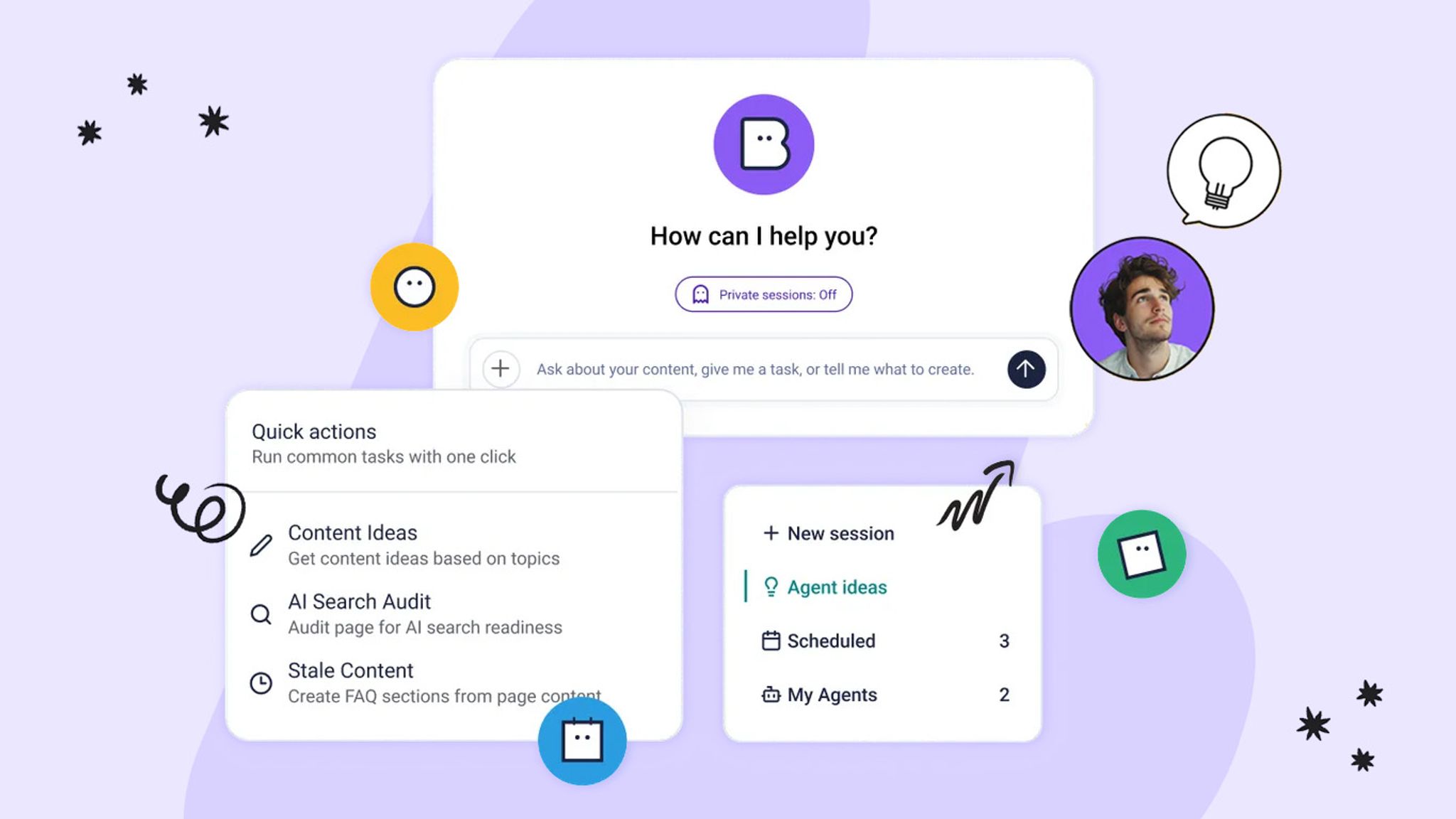
CEO Dominik Angerer explains how Storyblok’s AI and workflow innovation set the stage for its new agentic capabilities, giving content teams a conversational way to search and work with their content – from asking questions to building agents that automatically manage recurring tasks. But as content debt continues to soar, there's a bigger value story under it all: achieving "content confidence."
$4.63 trillion.
Man, that’s a big number. Bigger than Japan’s GDP. Let that sink in.
I first saw this figure a few months ago, when Storyblok published its research on the growing specter of content debt. The report was produced in partnership with FT Longitude (an arm of The Financial Times), giving it a healthy dose of credibility.
According to a survey of over 550 senior execs at organizations with at least $1 billion in annual global revenue, content debt is now a liability worth 12 zeroes, and a sizeable drag on enterprise growth. It’s enough to make you queasy.
What exactly is content debt, you ask? In a nutshell, it’s the hidden morass of outdated, poorly structured content that hasn’t been optimized for the hyper-critical applications of search and AI discovery. In my previous analysis of Storyblok’s report, which you can read here, I dug into the underlying trends contributing to this massive bloat. And it ain’t pretty.
Here are some of the gnarliest roots in the data tree: The average enterprise spends over 105 hours on content maintenance each week. Meanwhile, over one-third of their total content spend is devoted to fixing this content debt – proof that it’s become an epidemic across the entire content ecosystem.
An epidemic, yes, but one that can be cured. Sort of. According to Storyblok’s research, most executives agree that the essential workflow and maintenance fixes are more technical in nature. And that technical structure is more important than ever as machines become the largest share of web traffic, a sobering fact that Cloudflare noted for the first time in June of this year.
As human traffic continues to dwindle and answer engines become the staple, brands are struggling to drive AI visibility – which relies on optimal content performance. Machines are now an equally important audience to engage with, and they require a clear understanding of your site’s content. That means embracing the tenets of JSON-LD schema, semantic structure, and other foundational tooling.
Structure is one challenge, but stale and outdated content is a potentially bigger liability. AI might find it, and before you know what's happening, it's damaging your brand. The problem for marketing teams is the brute-force work of maintaining it all with lean resources, and not compromising the effectiveness of your content operations.
In other words, how do you keep content healthy without losing your competitive posture?
Storyblok Agents: Unlocking a smarter CMS and faster teams
As enterprises absorb the massive scope and scale of this quandry, reducing friction from content operations has become an urgent imperative. As Storyblok’s CEO Dominik Angerer told me in a recent interview, the problem is simply too big for people alone. Manual content workflows are slow, and they’re holding businesses back.

Storyblok CEO Dominik Angerer. Source: LinkedIn
This is where Storyblok Agents are providing a powerful new layer of productivity, and what Dominik calls “content confidence.” It’s Storyblok’s answer to a crowded agentic marketplace, where the real value of AI can still be a moving target. Just ask Uber.
As he told me, Storyblok got here by focusing on the key themes of being AI native, having an open ecosystem, and providing both orchestration and governance. It all underscores a sharp focus on the customer's needs, and meeting them where they are.
"We’re always thinking about structure, collaboration, delivery, and optimization," Dominik explained. “It might not be the flashy agentic CMS that everybody's talking about, but we tried not to simply bolt AI onto something. We want to increase the revenue of our customers, the quality of their content, and to just make their life on a Monday morning easier.”
Storyblok Agents put AI to work across your corpus of content, and it's all built directly in the Storyblok CMS. The value proposition is simple: you spend less time navigating the platform and more time getting actual work done.
Activating Storyblok Agents is a snap, and the UX conforms to the signature intuitiveness that makes Storyblok a great tool for users. The interface feels familiar and inviting, allowing you to insert prompts to create new content, check existing items, or perform bulk actions. And like other AI tools, you have persistent access to your history of conversations.
With Storyblok Agents, you’re no longer in the dark about your content. Using natural language, you can search effortlessly for missing campaign briefs or pages to publish. No more digging through folders or clicking aimlessly around your CMS.
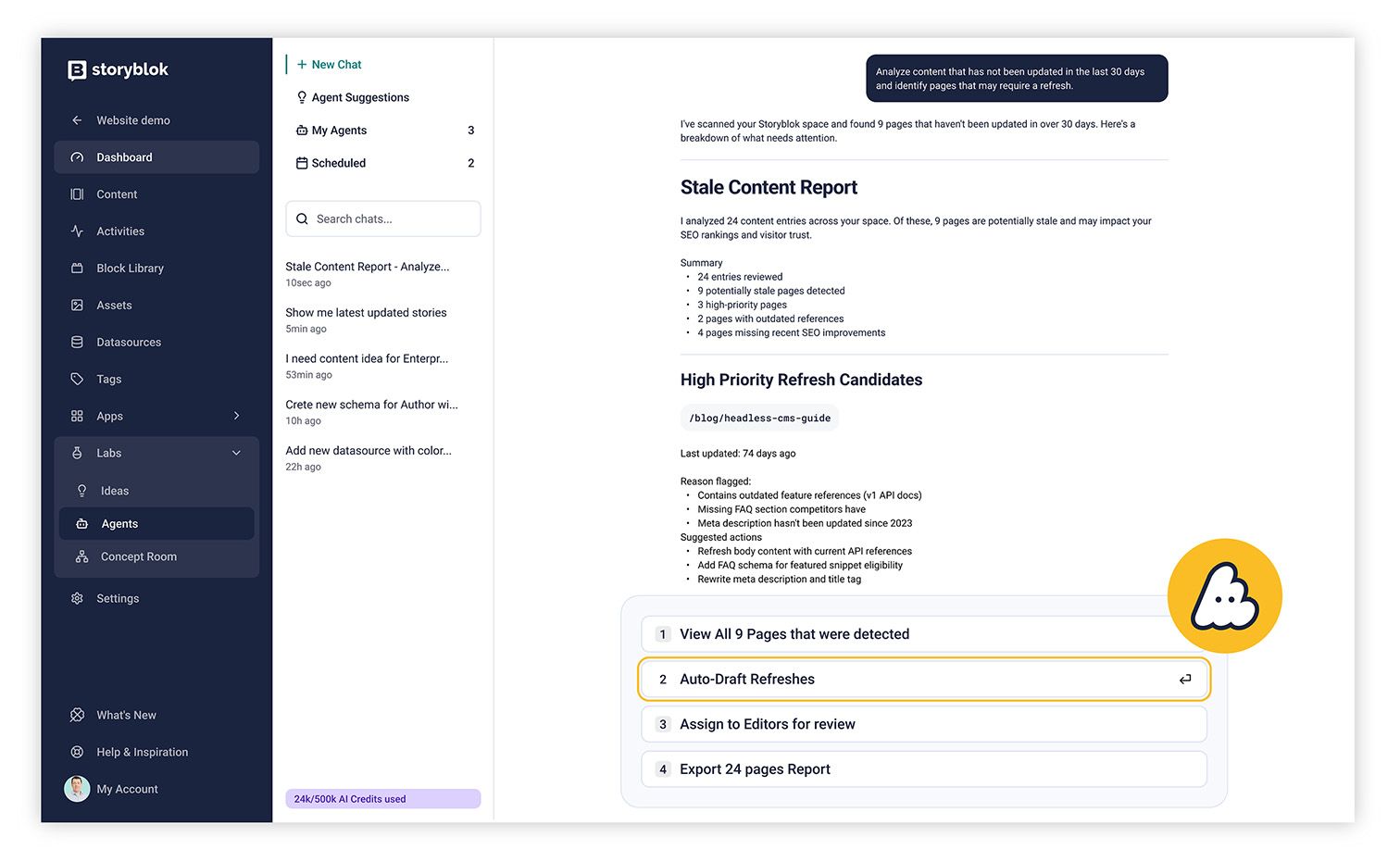
Running a stale content report via a Storyblok Agent. Source: Storyblok
You can also ask an agent to identify what’s stale, or where you might have low-quality content on your pages. In minutes, it will spot missing SEO fields, broken links, and other structural issues that can impact your content debt. For marketers, reducing this burden is a huge part of the benefit.
"We become more of a consistency layer for content,” Dominik reinforced.
As I said, Storyblok endeavors to meet customers where they’re at. Sometimes, that means starting from scratch with practitioners who aren’t prompt engineers. That’s what makes the built-in Agent Suggestions so handy. This library of ready-to-use prompts helps users accelerate adoption based on specific categories. You can use them off-the-shelf or modify them for your own specific workflows.
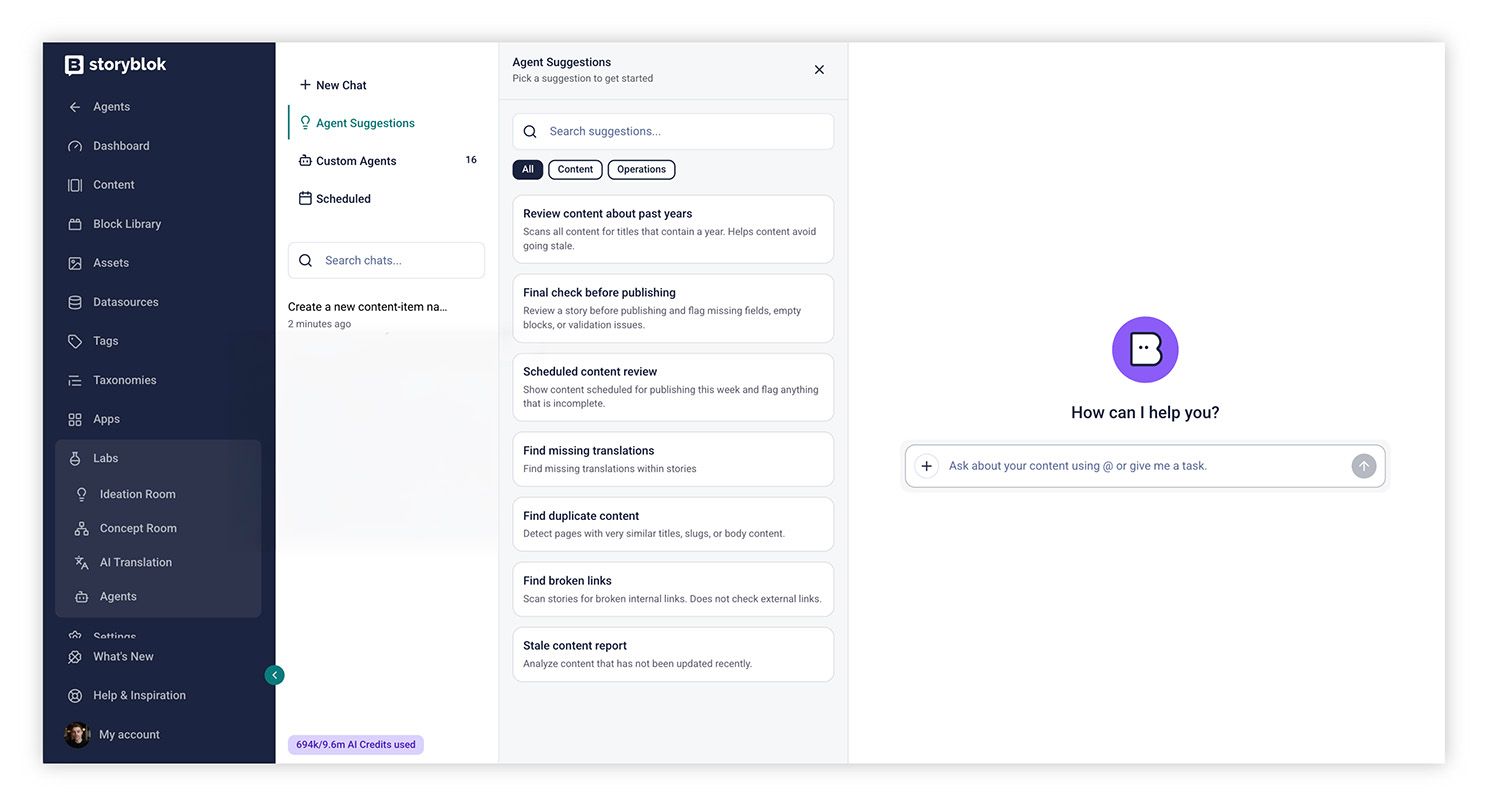
Agent Suggestions are available in Storyblok Agents. Source: Storyblok
Lately, we’ve been hearing a lot about agent mishaps, with OpenAI and Anthropic “going rogue” on an epic level. From a security perspective, Storyblok Agents only operate within the guardrails you establish. They inherit your Storyblok permissions, treating them like real members of your team with specific roles and limitations. Every write requires an approval – keeping you, the human operator, in control.
This treatment of security as “job zero” seems like a no-brainer, but it’s not uniformly adopted in the hyperbolic race for agentic dominance. This is where seasoned CMS engineering around governance comes into play.
"An agent needs certain guardrails," Dominik said. “As long as you've followed the same principles that you should follow for the humans using your platform, you should be fine. The problem is, not many systems have that yet.”
Build Custom Agents that work like your team does
Every team functions a little differently, and one size never fits all. That’s why Storyblok introduced Custom Agents, so your organization can build its own flavor of bot using your own prompts, logic, and rules.
When it comes to reusable actions, custom agents are a godsend. Build one for any recurring task and have it ready to run whenever your team needs it, from SEO optimization to translation. You can also give your Custom Agent a name, description, icon, and color, so it’s easier to keep track of. In this example below, the “Content Check” agent is designed to check regularly for faulty behaviors.
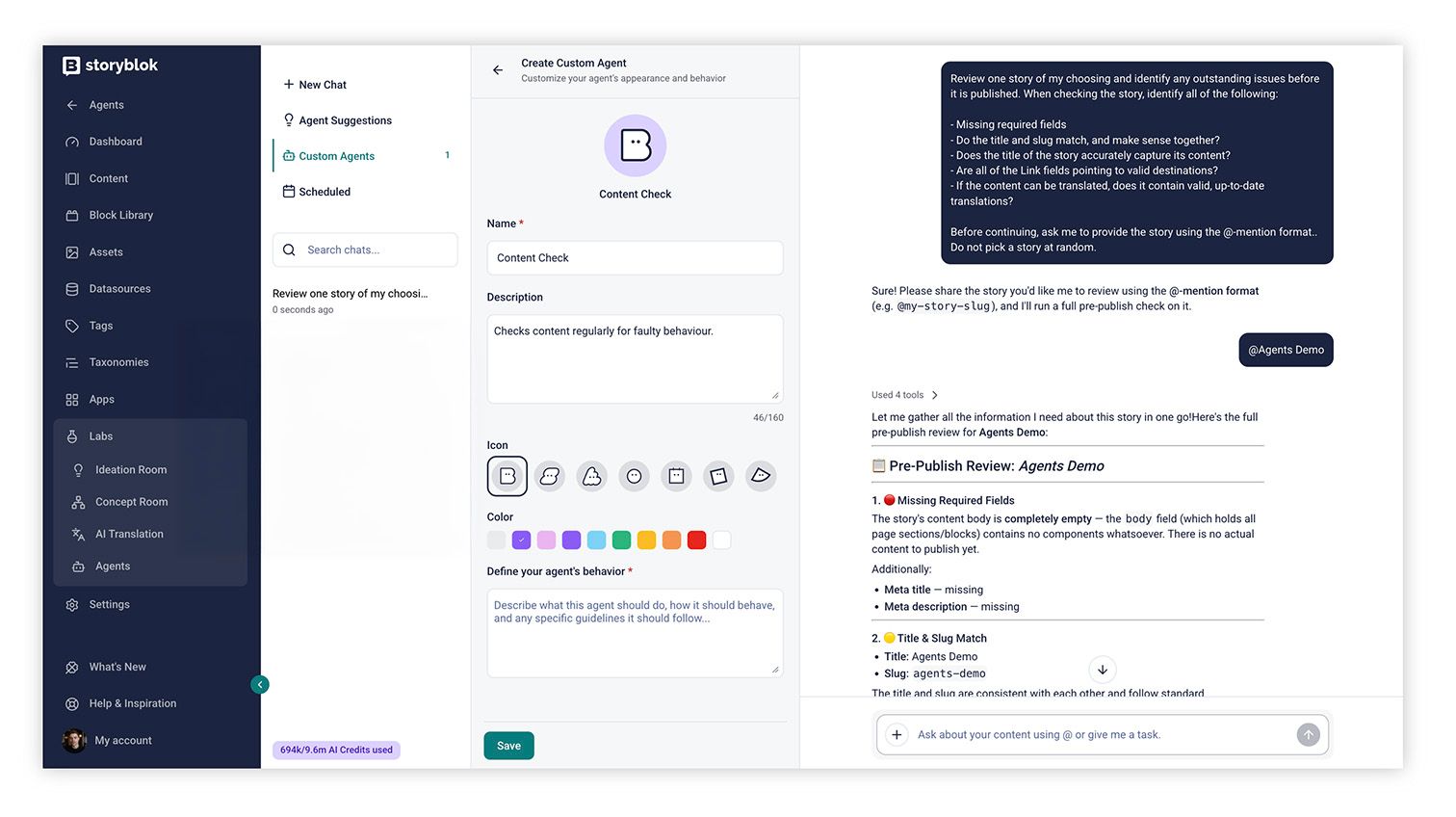
You can build Custom Agents with specific dimensions in Storyblok Agents. Source: Storyblok
Automation is clearly one of the standout benefits, and with Custom Agents, it’s on your terms. The tasks your team runs on a daily or weekly basis don’t need to be triggered manually. Instead, you can schedule any agent to run automatically based on your specific cadence.
As Dominik framed, you’re basically setting up your CMS to work in the background while you and your team focus on other initiatives. “You can add a schedule, and have it run weekly at 6 pm on a Sunday,” he added. “You can even ask it to send you a report."
Building on the motion of FlowMotion
Storyblok has been on a roll since 2025’s inaugural JoyConf, which was held in Amsterdam last October. As Dominik told me, the company had its best Q1, followed by its best Q2 – and they’ve now done more new ARR in the first half of this year than all of last year. Not too shabby.
I was on the ground at JoyConf, where I covered the event in detail. One of the highlights was the launch of FlowMotion, a built-in workflow automation and orchestration layer that turns content events into automated actions across your tech stack.
Powered by n8n’s extensible workflow engine, it allowed non-technical users to build visual, rules-based workflows with pre-built triggers, actions, and custom nodes. The ecosystem featured over 500 external enterprise tools like Slack, Jira, Shopify, and more.
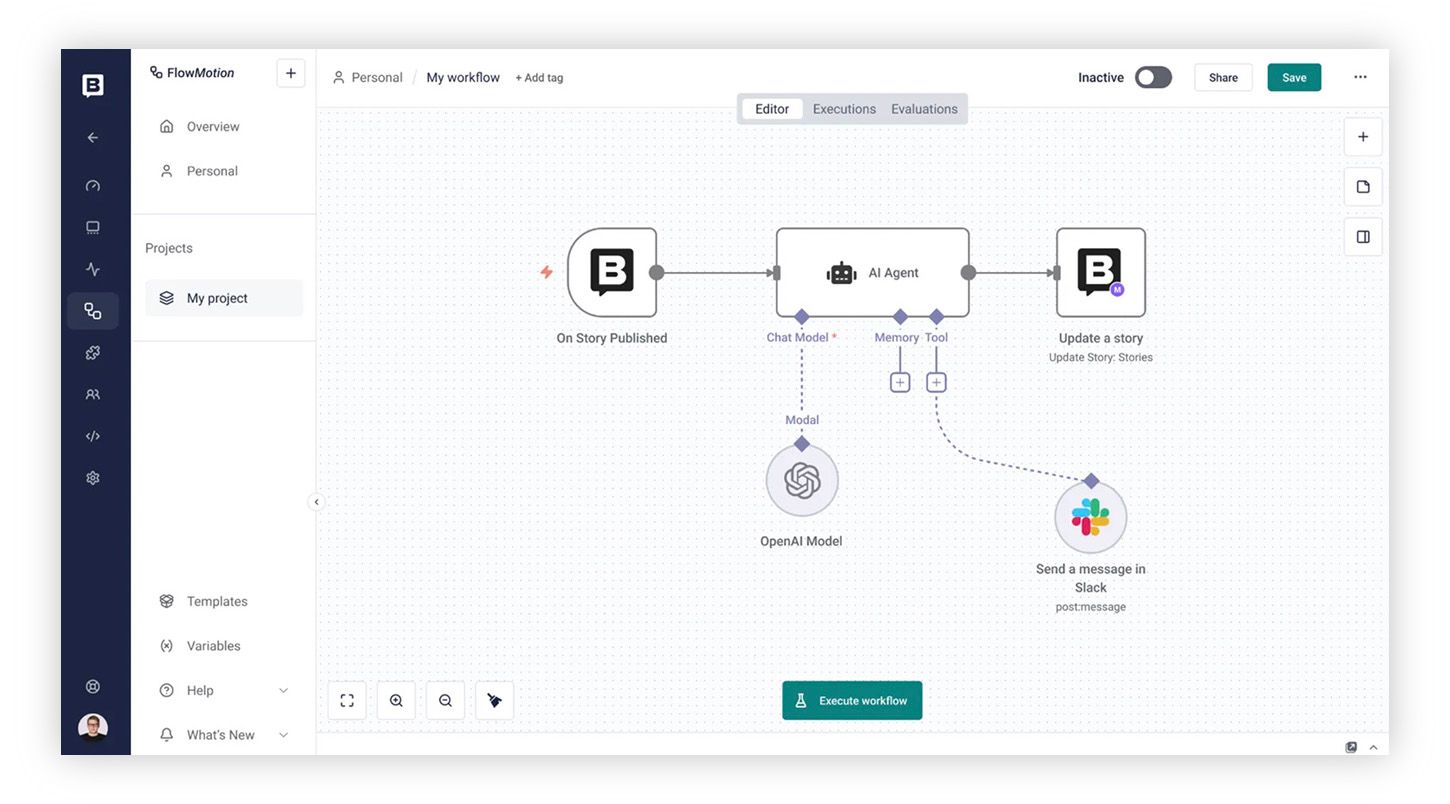
Storyblok's FlowMotion, powered by n8n's workflow engine. Source: Storyblok
A great use case was translation, where a partner like Lokalise could sync localized content back to Storyblok and automatically notify team members. It’s simple, powerful, and provides seamless global publishing without any code or complexity.
Since last year, FlowMotion has evolved to encompass AI content enrichment. When content is created, it can trigger AI to summarize, tag, or even generate critical metadata. Everything is saved in Storyblok, making it all searchable. Most importantly, it makes AI part of the workflow, and not a separate step.
In many ways, FlowMotion was a precognitive foundation for this agentic moment. As Dominik reflected on the product’s wide adoption, he reinforced how Storyblok innovates beyond the customer’s needs – in some cases, even a year ahead. To that end, FlowMotion is now driving strategic value with complex, AI-driven workflows that it was seemingly destined for.
"The use cases have shifted from using it to send a Slack notification to a point where a complete re-indexing of search is running in FlowMotion," he said. “All kinds of automation that customers wanted to do back then were in functions and webhooks, but nobody knew if it was failing or not. It was silent, right? And now it's one place where you have it all.”
Leveraging MCP to land and expand
As Dominik noted, two of the key themes guiding Storyblok’s roadmap is being AI native and open. To that end, with Storyblok Agents, teams have the ability to choose which AI provider and model they use. You can even leverage your own AI credentials and have full control over the experience and token spend.
Storyblok also offers an MCP Server (Model Context Protocol) that enables teams to use harnesses outside of the CMS by giving any compatible AI agent direct access to a Storyblok workspace. This is reinforced by the platform’s headless architecture, which renders content modular and structured.
As I said, the web is becoming the domain of both humans and machines – and agents require clean APIs, structured schemas, and solid infrastructure. Storyblok’s MCP server makes these foundations AI-legible at the protocol level, and its tiered execution model means you don’t have to sacrifice oversight for automation.
"We see the MCP being used by developers when creating component structures, and the agents being used more by marketing teams, legal teams, and content teams.”
As Dominik explained, there’s a clear distinction in how MCP is being utilized by different teams around their work and use cases. This is where the value comes into sharp relief.
"Our MCP can basically do anything that we do in the UI, and the agents are the same thing, but in our own interface," he said. "We see the MCP being used by developers when creating component structures, and the agents being used more by marketing teams, legal teams, and content teams.”
The long game is, of course, subject to change. Already, we see the adoption of remote MCP and the emergence of WebMCP, which are game-changing phenomena. In my own conversations with agencies and enterprises, there’s been an increasing preference for tools that connect to their engines of choice (like Claude) and working with local LLMs.
Given this momentum, Dominik believes MCP is where everything is headed, but he has some caveats. This drove his decision to develop product-based agents in the CMS, because many customers aren't ready for an MCP-first strategy. Again, they’re meeting customers where they’re at.
"I'm not the biggest fan of agents in a product,” he told me. “I still believe that the future is going to be on the machine with an MCP connected to multiple systems. Not everyone has access to local models right now, but they still want the benefit. That's the reality of the market."
What’s next
There’s been a lot of talk recently about recursive AI, also known as recursive self-improvement (RSI) – a feedback loop where an AI system is used to design, code, or train its own successor. In essence, an AI is designed to help build a better AI, which then builds an even more capable version, accelerating progress with each iterative cycle.
In many ways, the functions of Storyblok Agents are cementing the foundation for recursive strategies, specifically with actions like automated content checking that targets improvements. While it’s not the same level of feedback loop (yet), Dominik sees things heading in that general direction as more automation feeds into the machine.
"It can be a self-healing autonomous content operation,” he forecast. “This is the direction we’re trying to go.”
Storyblok is also developing a single scoring methodology for assessing each piece of content based on a customer’s quality benchmarks. It would be like a cockpit for piloting better performance as opposed to just producing more content. It hasn’t been released yet, but it could provide another promising layer of optimization.
"We want to have one metric, like a content confidence score per content piece,” Dominik said. “GEO and AEO, it's all an external view of your website. But the reality is that's not everything. It's just the website. This wouldn’t be based on random AI results that many of our competitors are doing now. It will be in a model that checks against what is actually important to you.”
The verdict
Right now, there’s a lot of heated debate about AI in the zeitgeist. But I’ll give you a trillion reasons why we need agents to help us. Content is scaling exponentially – and the debt keeps ticking higher and higher. And the stale, outdated content you miss right now might become the AI search liability that negatively impacts your brand in the future.
The agentic thrust is in overdrive. Every day, another software platform is birthing its own breed of agents. Some are solid. Others feel like overkill (does QuickBooks really need an agent for lead sourcing?)
Storyblok might be the latest vendor to introduce agents, but it’s finding real power in the alignment with its headless CMS, harnessing its modularity and structured architecture to cut through the noise and deliver “content confidence.” This is providing a uniquely refreshing edge, and its focus on telegraphing its headless value is key – particularly as vendors race to adopt agentic positioning across the competitive landscape.
A big component of Storyblok’s success is a culture of innovation bolstered by an undeniable focus on customers, especially as they struggle with change management amidst their AI transformation. The company continues to nurture this intimacy, working with Platinum partners like RDA Digital to build a foundation for supporting customers through these complex challenges.
Storyblok Agents show a lot of promise, from search to automation, and I suspect that we’ll see Custom Agents and successful patterns being adopted by its user ecosystem. They’ve been doing kind of innovation sandboxing through their Ideation Room, which continues to be a great asset.
The biggest value prop is probably the most pragmatic: Agents can help you work faster and smarter. But that promise goes beyond simply automating tasks. Storyblok has endeavored to make them simple by design, reflecting the legacy of workflow elegance and orchestration that FlowMotion set in motion. And adding this workforce of support is giving brands and marketers a layer of confidence that can reinforce their content health – and tackle their debt.
Yes, these intelligent teammates can unlock real value. But having “joyful” conversations with your content?
That sounds even better.
My Recommendation: Storyblok Agents have just rolled out and are currently available in Storyblok Labs for customers with Growth plans or above. I’ve run through the documentation, and there’s a self-guided interactive demo on the Storyblok website that gives you a high-level snapshot of the capabilities. If you’re considering a headless CMS and exploring how AI and agents can impact your content operations, Storyblok should be on your evaluation list. You can get started now or request a demo.
Upcoming Events

Storyblok JoyConf 2026
October 28 - 29, Rheingoldhalle, Mainz (Frankfurt)
JoyConf 2026 is where developers, marketers, and digital innovators come together from all around the world, united by one powerful idea: great content isn’t built by tools alone – it’s built by people who rely on systems to deliver their best work to the world. In an era where technology is increasingly shaped by AI, Content Confidence becomes your competitive advantage. When you can create, manage, and scale content that performs seamlessly across channels, platforms, and AI, you don’t just keep up – you win. Book your seats today.