Agentic AI for Agencies in 2026


Agentic AI is here to stay. But success in this new era will not come from simply adding AI to existing processes – it requires rethinking, and the right tools to build on. Here's how agencies can harness the agentic future using platforms like Kentico, and why it's all exciting.
Brian McKeiver is Co-Owner of BizStream, a digital agency in Grand Rapids, MI, USA. He’s been in the CMS space for over 18 years and is recognized as a Microsoft Azure MVP in AI and Cloud, Kentico MVP, Kontent.ai MVP, and a CMS Critic contributor.
Over the past few decades, I’ve seen firsthand how the CMS world has changed rapidly to meet the evolving needs of organizations and digital marketing teams. From the beginning, when teams were creating their own CMS from scratch, to the move to proprietary platforms, to World Wide Web Consortium (W3C) standards, to handling localization, mobile responsiveness, SEO, personalization, GDPR, WCAG accessibility, and a chatbot and cookie banner on every site, change has been constant.
However, that pace of change is almost nothing compared to how much and how fast Artificial Intelligence (AI) is taking the world by storm. Platform vendors, agencies, consultants, analysts, and customers are all scrambling to try and stay on top of the AI arms race that we are all in now. As we start 2026, everyone is in the same boat of, “How can I figure this out?”, “What do I do next?”, and “How can I stay ahead?”
Trends for Platforms, Agencies, and Customers in 2026
Trends that I see all include the letters “A” and “I”. You cannot look anywhere in the CMS, development technology, or digital marketing worlds without seeing or hearing about AI. It dominates the headlines, and end customers, agencies, and platform vendors alike are craving it.
My point was actually proven on stage at the recent Boye & Company annual CMS Kickoff conference in St. Petersburg, Florida. Just about every session and every CMS platform demo at the conference was all about AI. Agentic AI and the idea of AI agents taking over content operations was a huge topic; Generative Engine Optimization (GEO) was the second-largest topic discussed; MCP Servers (a way for LLMs to communicate with outside systems, third-party APIs, and external tools) came in third. Digital sovereignty was also brought up a few times because having control over your data is crucial to getting the most value out of AI and having an AI advantage.
It wasn’t just the CMS Kickoff conference, though. I’ve had similar experiences at other large national technology conferences, where every session and every demo was on AI. I’ve kept track of very recent insights from Satya Nadella, CEO of Microsoft, on how AI must evolve from standalone models to real systems with real effects. Frankly, I’ve been totally blown away by Vercel’s latest open source agent skill ecosystem growth (over 10,000 new AI agent skills added in the first 72 hours on skills.sh).
This doesn’t even take into account this past January’s announcement of Claude Cowork being created fully by AI and launched within 1 week by the team at Anthropic. Cowork allows non-technical people to dive into the work of having AI agents complete everyday tasks for them with almost zero effort. AI truly is in every facet of what we do now.
To bring it back to the CMS space, though, a consistent arms race has really been going on for about the last 18 months or so, and will continue into 2026 and beyond. Optimizely has Opal, an AI agent orchestration platform. Sitecore has rebranded to Sitecore.ai and now bills itself as the next-generation DXP for the AI era.
Kentico has ARIA and KentiCopilot initiatives (more about this further below). Storyblok has Strata and FlowMotion for vectorization of content and native AI automations. Kontent.ai is moving forward quickly with its built-in AI Agent to be a leader in Agentic CMS. Umbraco has a pretty robust MCP Server for content creation and migrations.
Adobe's new suite of AI tools launched for agent orchestration, and it has out-of-the-box agents like the Audience Agent, Journey Agent, and Experimentation Agent. Shopify and Salesforce Commerce have gone all in on Agentic Commerce and the new Universal Commerce Protocol (UCP). I could keep going too, but I think that’s enough.
The goal of all of this is to drastically increase the efficiency and speed at which digital marketing teams can operate at. AI will supercharge marketers to do more at scale. That’s why all of this is such an exciting trend.

The Effect on Agencies
Overall, it is a tumultuous world for digital agencies in 2026. Most agencies, including my own at BizStream, are watching all of this very carefully. While I used the word “exciting” previously, when you shift the perspective to look at it from our standpoint, to be honest, the word that comes to mind is “terrifying”. I say that because the world of Agentic CMS and AI agents has the very real potential to completely upend the way we have done business for the last many years.
As agents get more sophisticated and can do more of what marketers want, that could mean that marketers might not need to rely on agency support as much. Marketers can just vibe market and vibe code up that next campaign landing page with personalized variants, that next brand refresh and UX update, or email campaign now, right? In my opinion, some of that might be true, but not all. There will still need to be a human in the loop.
We’ve seen this idea happen in the development space for some time now. When ChatGPT and GitHub Copilot came out in roughly 2023/24, every headline was that software developers and software engineers everywhere would become obsolete. That has not been the case. We need skilled developers to call out AI where AI is wrong, and it is wrong often.
However, in the last three months, with the release of the latest models like Opus 4.6, developers are more and more becoming orchestrators of coding agents and less and less writers of syntax. It is a change that some developers welcome, and at the same time makes some developers very nervous. Agencies cannot ignore the fact that the way technical teams build software is completely changing.
It’s not just software developers and technical users that this trend is massive on. This week, I had a chance to participate in a mastermind session of local technology leaders in West Michigan. I happen to sit at the same table as the director of digital marketing at a very large local organization. We spent over 30 minutes talking about where he is at with his digital strategy, his main branded site, and all the native apps that connect to it. They had just chosen a new CMS to replatform to, and to my surprise, they are all-in on agentic development, including him directly.
To prove how much he believes in the future of agentic development and how it is the only way forward, over a weekend, he personally built a component using Claude Code, matching the requirements and design system. He also did his first-ever pull request into the source code repository for the team’s main project. The team was shocked. His work proved a point: that agentic development to create real-world components was possible. The next day, they had a few more components built using AI by a few software engineers on the project. A little while later, they had many components developed using Claude code and are now moving on to the next phase of the project.
This director is not a professional coder; he is a director who wants to show his people that this is the future. In my opinion, those actions are quite impressive for a non-software developer.
Here’s the most interesting part of this story. He told me it took over 3 years to build the last iteration of their full digital experience platform and all the commerce and native apps it required with a full team of engineers. This month, he has given that team a deadline of completing the full migration to the new CMS, including a rebuild in a new stack, within the next 8 months. Yes, he expects, and is pushing to, turn what used to take over 3 years of effort into 8 months of effort (without any agency help, by the way).
This drastic level of change for Agentic CMS and agentic development, or evolution as I like to think about it, requires agencies to rethink how they deliver value, how they charge for services, how they go to market, and how they keep up with the competition. I’m shocked that in 2026, some agencies are still ignoring this massive trend and continuing to do business as if it were 2020. Frankly, this is what is keeping me up at night: how can we re-tool our whole organization in such a short time?
Luckily, I’m surrounded by a brilliant team and have some key partnerships with platform vendors. We are pushing forward and figuring it out. We have our own code to design workflow now that lets us take the user stories and requirements for our client’s projects, marry that with design systems in Figma, and let agents create code, components, and widgets inside of the chosen CMS platform. It’s pretty remarkable to see it all work. It’s also nice to be able to participate in the CMS Experts group and see what others are doing in this space as well.
Why BizStream as an Agency Still Chooses Kentico
I am most likely slightly biased, and I think it is fair to acknowledge that, but my agency really likes where Kentico is at in 2026.
At BizStream, we have partnered with many CMS, DXP, and E-commerce platforms over the years, but throughout all of that, we've been working with Kentico the whole time, over 17 years straight, in fact. The technology has always been solid and in our wheelhouse in terms of being based on the Microsoft Azure and .NET stacks.
Kentico’s main flagship hybrid headless DXP, Xperience by Kentico, is performing incredibly well for us, and our customers love it. The people behind the product are quite dedicated and care about it passionately. The commercial and partner teams support our agency when we need it very well, especially with transparent pricing and effective partner communication. Customer support and service have always been top-notch; in fact, they went above and beyond yet again a few weeks ago when helping me troubleshoot a live production issue in the middle of the night.
From a product standpoint, and what matters highly to BizStream, is that Kentico has always been at the forefront of modernization. Kentico CMS was the first .NET CMS to be certified in the Azure cloud back in 2011. The CMS was one of the first .NET platforms to embrace the MVC development style when it first became a part of the .NET framework, and the CMS/DXP has led the way in terms of supporting the modern ASP.NET Core story and .NET 10. Even though modernization is not always where marketing teams want to spend their budgets, we think this is key to being able to be innovative in a very crowded space.
Other than those factors, Kentico has embraced the idea of agentic development and AI agents for quite some time now. As an MVP, my team and I have had early access to Kentico’s AI strategy and tools. We’ve been able to combine that with our Web Accelerator for Kentico starter template and are seeing some impressive results. Let’s dive into that strategy a bit more.
Kentico’s AI Vision
I've had long conversations with the team at Kentico, including the head of product, Debbie Tucek, and CEO Dominik Pinter, about where Kentico sees the future of CMS over the past 24 months. I appreciate the prudent path that they have taken and the vision that they have for the future.
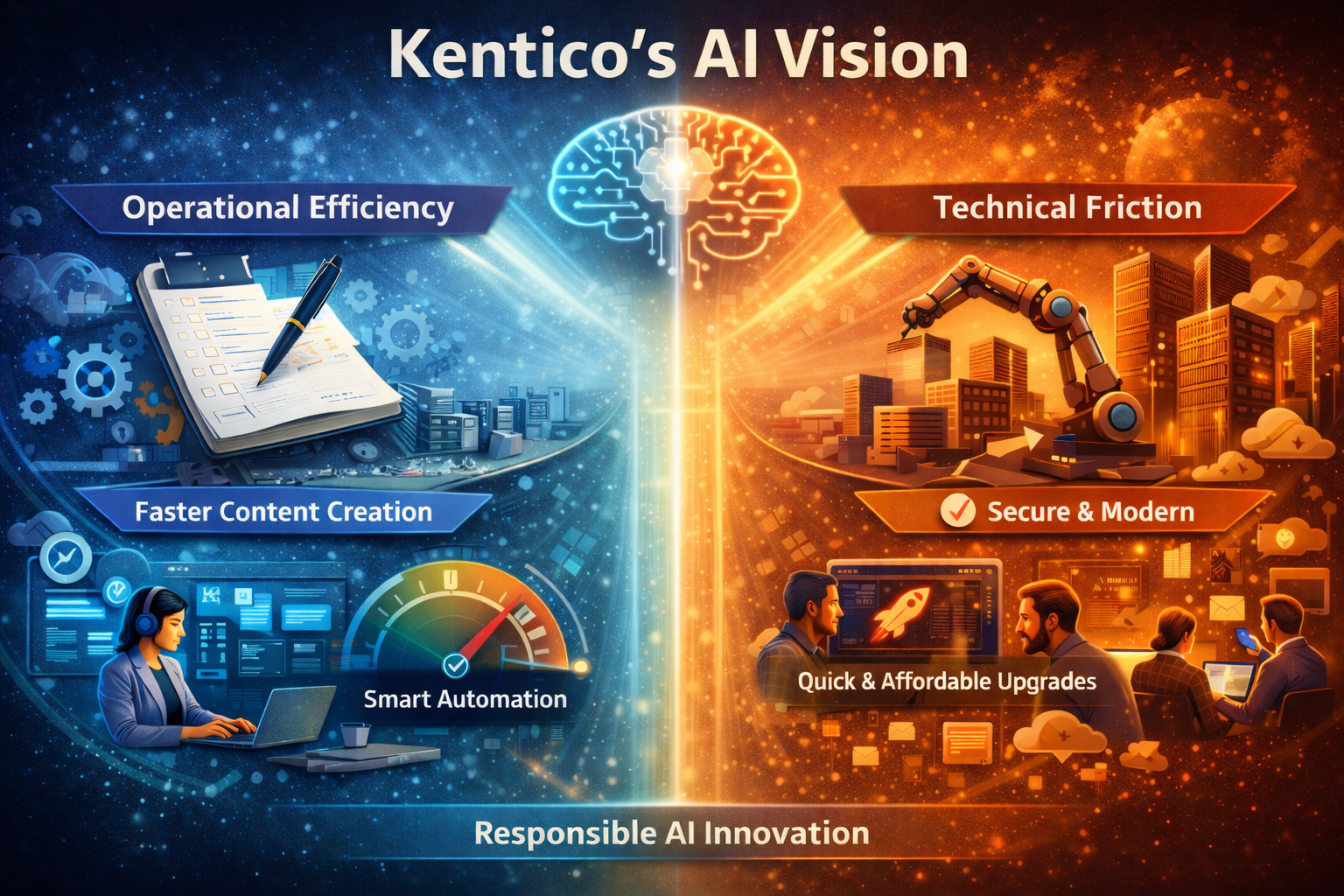
While some platforms bolted AI right onto an existing aging stack, Kentico took a different approach. They didn’t just add a chatbot interface on a new screen with text generation and summary; they ignored that step. Kentico wants to use AI to fundamentally attack the two hardest challenges in digital agencies and customers: operational efficiency (making the process of content management go faster) and technical friction (quicker builds, cheaper upgrades, and continuous modernization). Responsible use of AI was also talked about at every turn in these discussions as well.
Inside the Xperience by Kentico ecosystem, there are two large new umbrellas of functionality to tackle the two challenges.
AIRA for Marketers & the AIRA Agentic Marketing Suite
The first large umbrella of features is AIRA, short for Artificial Intelligence Recommendations and Assistance. AIRA originally appeared in the early fall of 2025. It was introduced as a helper utility within the CMS admin tool. It has matured since then, and today AIRA is Xperience by Kentico's native AI toolset built to help content admins automate creation and deployment of content. It’s now been branded as the AIRA Agentic Marketing Suite.
The AIRA Agentic Marketing Suite is still directly inside of the CMS admin tool, right at the fingertips of admin users. It is a reference to a set of out of the box Ai agents. The vision is that AIRA's AI teammates will be able to support digital marketing planning, content creation, content testing, and content optimization so ideas turn into measurable results, faster, and convert more.
AIRA Smart Assistant & AI Agent
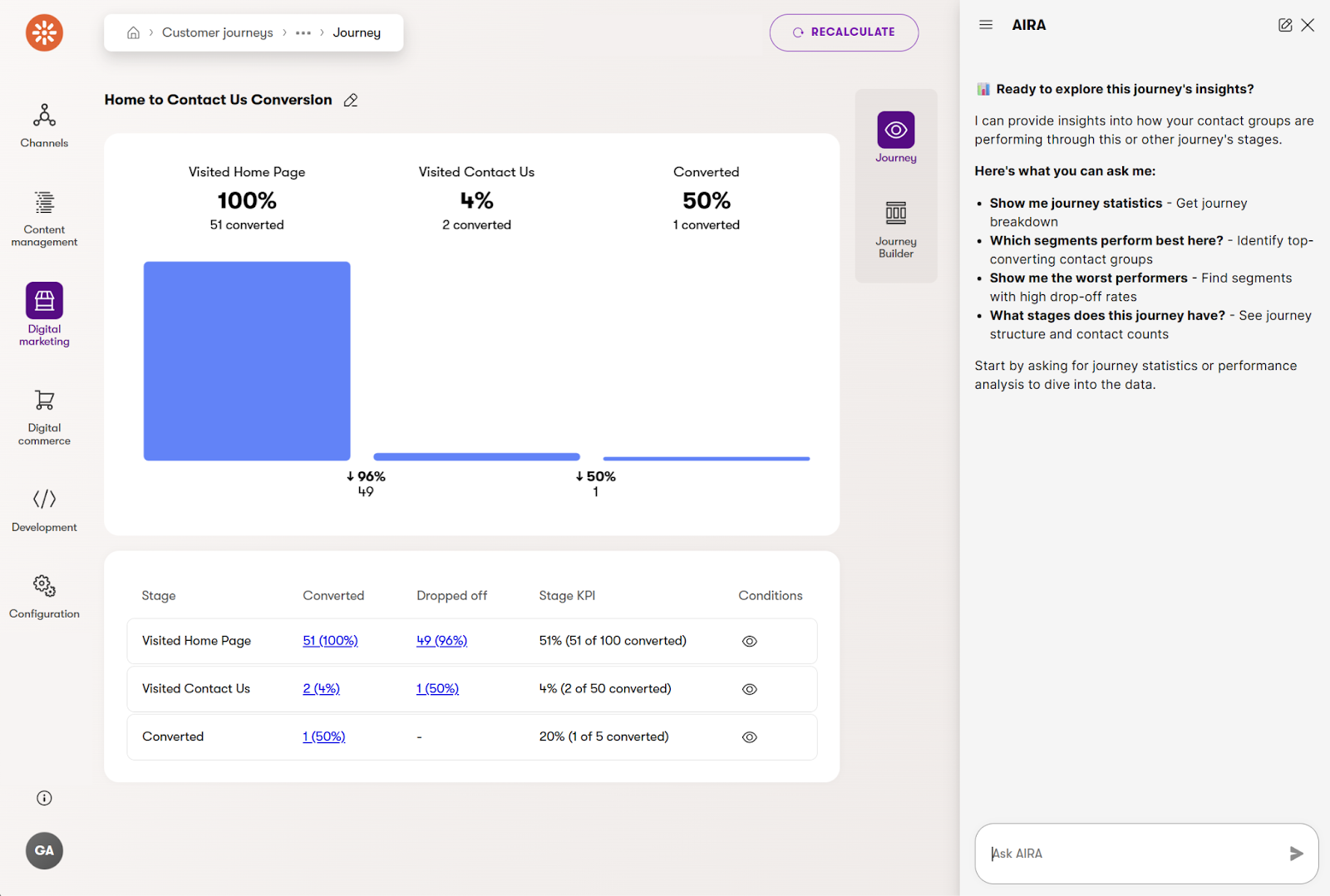
AIRA acts as a helpful assistant and is represented by AI agents. It can answer questions about Kentico and lead a content editor to the right place within the system to get up to speed faster. It also gives insights on the performance of content in the system. AIRA can even help out with content creation and automated management of content.
Source: Brian McKeiver via Kentico
There is also a set of governance and control for how it is implemented. If an organization wants to use AIRA, they can enable it with one simple check box to turn it on. If an organization doesn’t want to step into the AI-powered world, AIRA is just as easily disabled with a simple uncheck of a checkbox. There are also further roles and permissions that can be applied to what administrative users can and cannot do. I think that this is a responsible approach and speaks to the Kentico leadership team’s approach to AI enablement.
AIRA Specific Features
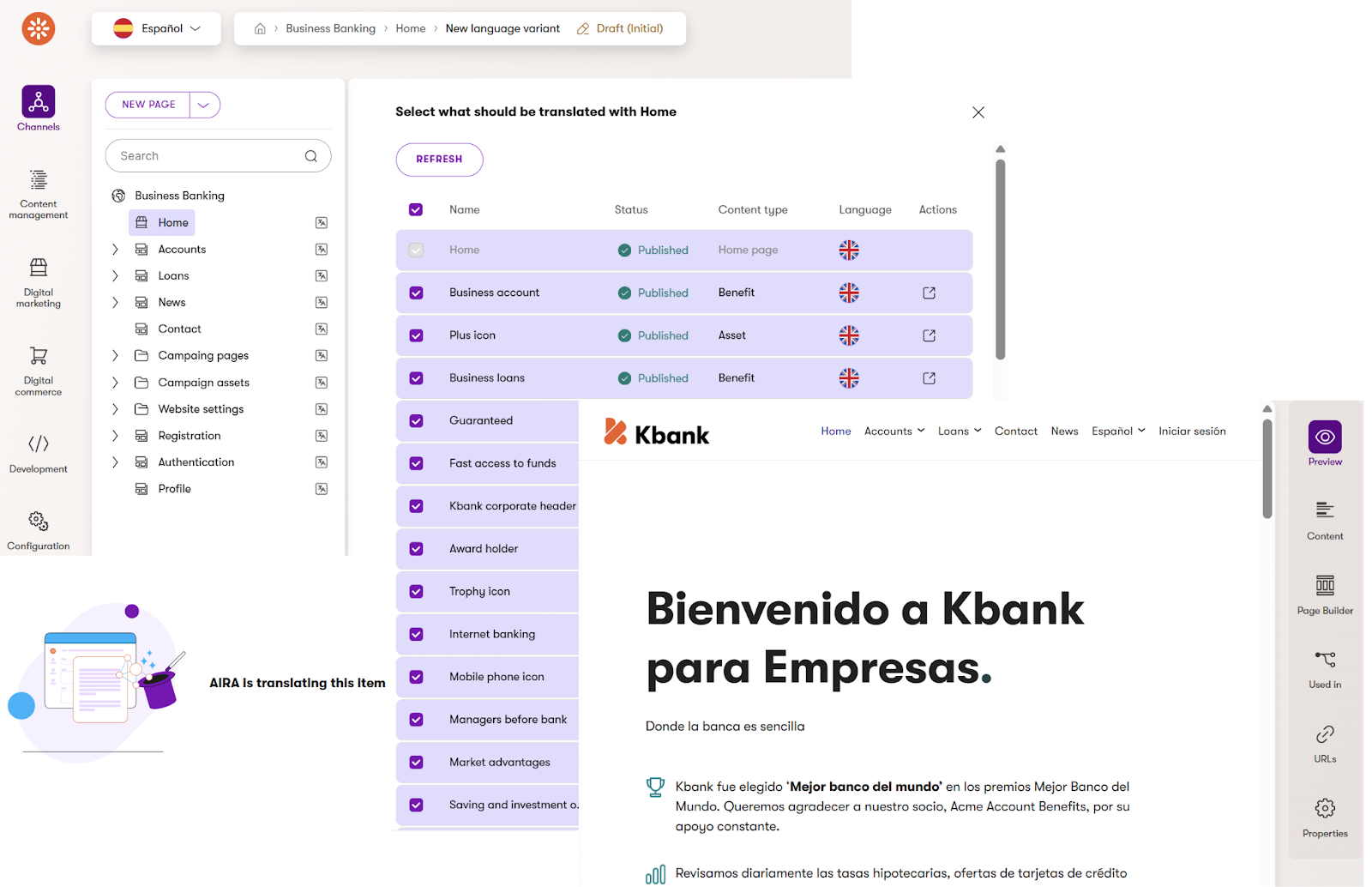
My favorite feature of AIRA is the ability to translate pages, emails, and content items with an LLM. You can also maintain the same tone and terminology of the translated content with configurable translation rules. One key aspect of this new feature is that it can automatically detect all the dependent or child components that make up a page and ensure those are translated too. That prevents the editor from accidentally missing a child component or random asset that makes up the entire full page.
AI translation alone is a highly sought-after feature by many of my customers. It also tends to be an expensive feature. AIRA does make this much easier. AIRA credits are consumed by this and other specific AI features to be transparent, though.
Source: Brian McKeiver via Kentico
Other specific features of AIRA include automatic image focal points, auto tagging of assets to a taxonomy, and smart asset alt text generation. These are small things, but add up to all be quite helpful.
Lastly, text fields can be configured to allow generative text capabilities like rewrites from brand tone, shorten to be more concise, and other ChatGPT-like writing features.
The specific features that are AI-enabled are nice, but the real unlock of AIRA is the AI agents that it ships with.
AIRA as an Agent(s)
The AIRA Agentic Marketing Suite includes a Content Strategist Agent and Customer Journey Optimization Specialist in preview. The first production release of the Agents will be available in the upcoming February update to the platform. More agents and ways to even look at your entire agent ecosystem are planned.
The Content Strategist Agent thinks about your content ecosystem as a whole and not just independent paragraphs where you have to explain the full context. It can analyze your existing content to identify gaps and provide recommendations on what to create next. It acts as a protector of your organization’s brand tone, maintaining editorial guidelines to ensure every piece is coherent and strategic.
The Customer Journey Optimization Specialist Agent shows where Customer Journeys in Kentico are working and not working. It can clearly highlight where users drop off, but offer support in explaining why the drop off happens and/or how to improve the performance of the journey. Marketers will receive contextual, actionable recommendations directly within the Customer Journeys application inside the CMS.
Around Q1 and into Q2 of this year, another agent – the Campaign Manager agent – is coming. Instead of starting every campaign from scratch, it will recall historical campaigns and know performance results. It turns campaign management into a continuous learning system, ensuring you don't repeat past mistakes. It can help build on what has succeeded before.
Through a conversational interface, marketers will be able to collaborate with AIRA to create a campaign brief, turn it directly into an executable campaign, and continuously validate progress. AIRA will check whether assets are prepared as planned and whether customer journey results align with the goals defined in the brief. The result is enhanced and easier campaign orchestration.
I’ve used these tools and seen them since the beginning. I think our customers are very much going to appreciate the time saved by leveraging these AI features and agents.
KentiCopilot for Developers
Closer to my heart, as I have a highly technical background, is the second main umbrella of Kentico’s AI strategy: KentiCopilot. KentiCopilot is not a single feature but a suite of tools designed for developers and implementation partners to enable agentic development. There are multiple parts to it.
Source: Brian McKeiver
Kentico MCP Server(s)
Kentico's first MCP server was announced, under the KentiCopilot umbrella, and made live after last fall's annual Kentico Connection event. The documentation MCP Server was all about knowing up-to-date Kentico knowledge and being grounded to the new Xperience by Kentico platform documentation. This ensured no legacy documentation, research, forums, blogs, etc. etc. about the legacy versions of Kentico would cause hallucinations. Accurate information helps new and seasoned Kentico developers get the right information faster.
A newer MCP Server, launched in December 2025 is the Content types MCP Server for Kentico. It enables developers to work with content types in Kentico using LLMs. It supports operations such as creating content types, creating reusable field schemas, as well as editing, reading, and deleting them. You can change the entire shape of your content model easily with this tool. The MCP Server is also useful for data migrations and initial imports of content from CSV files, JSON files, or other CMSs.
Custom Widget Builder Agent
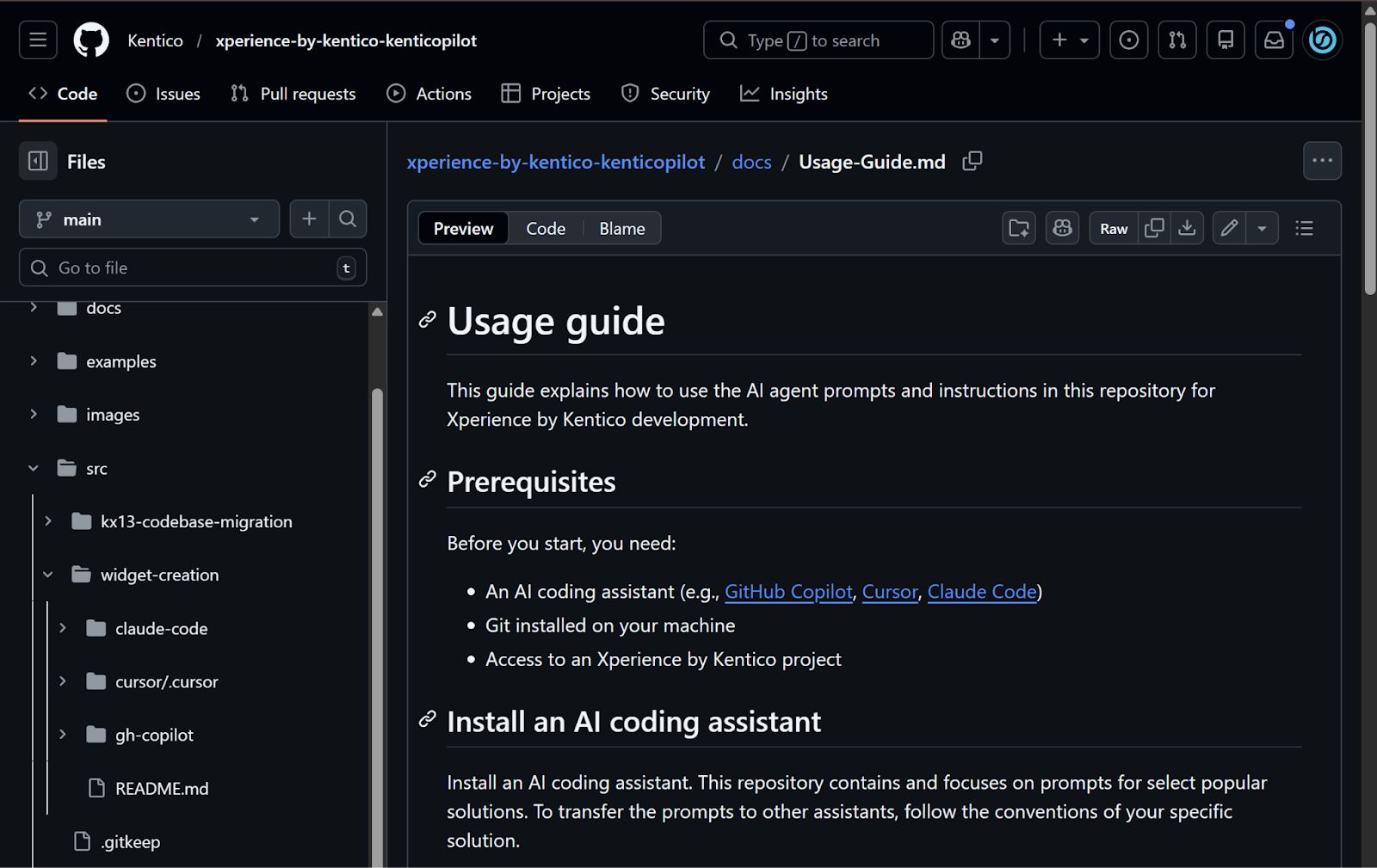
Now available at GitHub, Kentico has also released a set of custom instructions for how you can use Claude, Cursor, VS Code, or other code editors to use agents to write front-end code for you. Being able to go from a prompt to having finished Razor views that are registered as Xperience by Kentico Page Builder widgets is incredibly powerful. This has long been possible in the JavaScript framework world, but in .NET this is a bit harder to get correct.
This aspect of KentiCopilot is the most exciting aspect to me. Kentico partners and customers have longed for the ability to generate the front end of the solution much faster than writing it custom. Enabling a custom widget builder agent on a project is game-changing. We have been using a version of this and seen it completely accelerate our development workflow. I cannot recommend enough that Kentico developers immerse themselves in this repository, especially if they are new to agentic development.
Kentico Migration Toolkit Enhancements
One of the biggest headaches in the DXP world is the upgrade cycle. Moving from legacy versions (like Kentico 13) to a modern stack has historically been complex. It requires a large amount of effort and time. It slows down marketing teams.
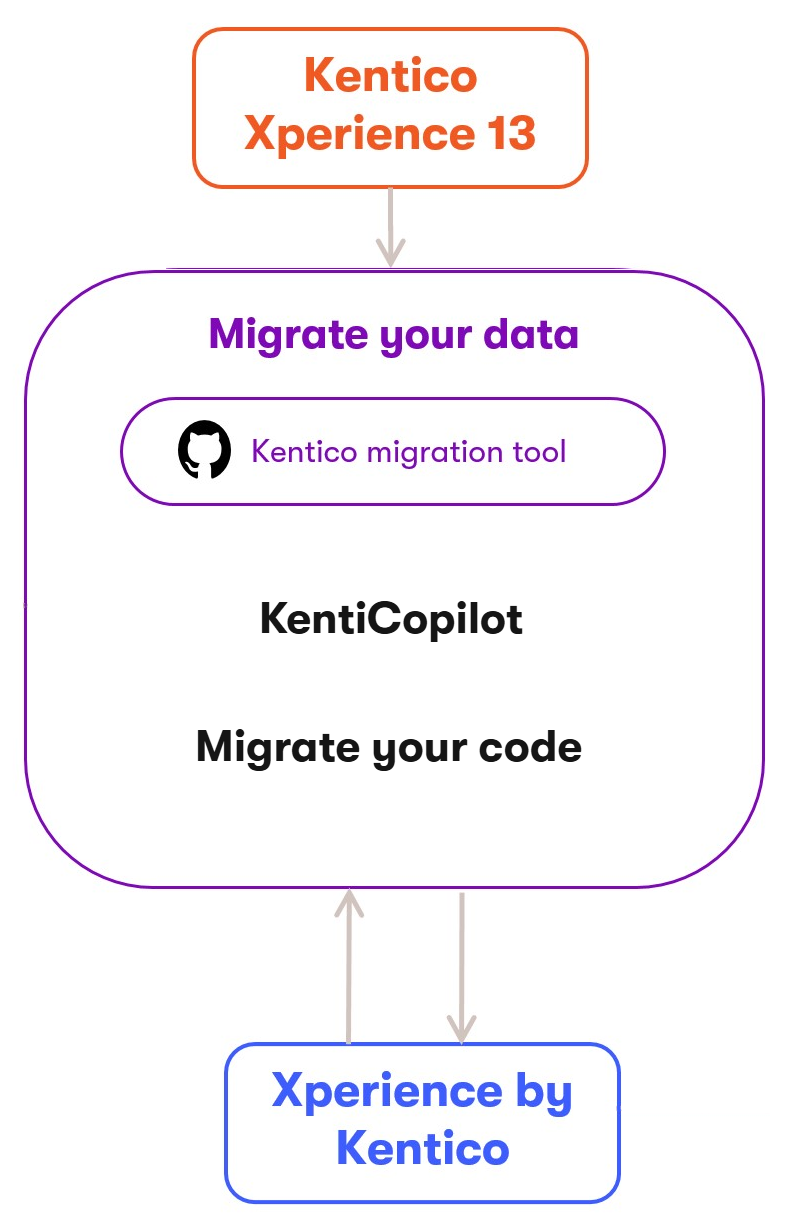
The latest updates to KentiCopilot specifically target this friction point with AI-assisted code upgrades. These tools assist developers in migrating code and content models from older versions to Xperience by Kentico. It lowers the cost of an upgrade, turning what used to be a daunting migration into a manageable evolution. As of January 2025, there are even some supported code migration capabilities. This takes the form of more custom instructions inside of the GitHub repository for how AI coding assistants can migrate some of the live site presentation logic.
Source: Kentico
Now, I’ve been a part of the Kentico Migration Toolkit offering since the beginning of it and was one of the first people to use it live in production. It has always been about migrating the data of legacy versions of the CMS to the Xperience by Kentico. Now with KentiCopilot, the story is different. Using the newest agentic techniques, Kentico is attempting to assist as much as possible with migrating your code as well.
The tool is good, and I do recommend it, but it does still have a few gaps in the total service it offers. Don’t get me wrong, though; it does deliver the savings that it promised when compared to having no tooling to start with. Depending on the scenario, it can still be better to write custom migration tooling to support what the Kentico Migration Toolkit does.
Where Kentico Differentiates
Kentico is dogfooding AIRA and KentiCopilot as much as they can. They use KentiCopilot internally to build their own digital properties, such as their demo sites and the new Community Portal. This means they feel the friction of development and pass this information on to us agencies to hopefully improve the process, and stop any AI hallucinations that may occur.
This approach can be invisible to an end client, but it directly impacts project costs and timelines. If AI can reduce the "grunt work" of development by 33% or more, that translates directly to faster launch times and more budget available for more high-value strategic tasks rather than just getting the basics right.
However, there are challenges with this strategy. For instance, the pricing model of how AI features in AIRA will be metered and is not yet publicly released. Pricing has caused pain for Kentico (and many other vendors in the space) for over 6 months now. Because it is all so new, almost all platform vendors are trying to figure out what kind of cost they will have, and how to fairly charge customers. This reminds me of how Microsoft first released Copilot to only a select number of enterprise clients, and did not really reveal its pricing to the rest of the world.
Another challenge is how Kentico will differentiate itself against the competition. As I mentioned above, almost every CMS/DXP/Headless platform is rushing to add these types of features. For me, the differentiator for Kentico is the order in which they are tackling the AI problem. As I said, many platforms are leading with flashy AI features aimed purely at marketers. The underlying developer experience remains archaic and manual. Kentico has taken a foundational approach by reducing technical friction. That decision matters because the speed of delivery still dictates whether AI-powered features can actually reach production and deliver value.
By focusing on autonomous marketing agentics, agentic development, modernization, and tooling for customers, Kentico is effectively multiplying the impact of AI. Agencies can deliver more reliably, customers can iterate more frequently, and AI features stop being experimental add-ons and instead become part of standard operations.
Kentico’s differentiation is also cultural as much as it is technical. Their product leadership has been transparent about what is ready, what is still evolving, and where customers should be cautious. In an era where AI hype is everywhere, that honesty builds long-term trust with agencies and enterprise customers alike.
Impact at BizStream
We've seen real-world impact on efficiency at BizStream. Implementation tasks that used to take 16 hours are now taking 30 minutes when orchestrated correctly. I’m not going to lie; to set up all this has taken a few months. The context you provide is super important to agents. You should give it very specific instructions, including good examples and patterns to match and examples to NOT follow. You should feed it exactly how your team works, handles code conventions, and tests for quality. If the result is not working the way you expect it, give that back to the AI and explain why it’s wrong.
This is a repetitive pattern, but worth getting the details correct. Utilizing AI agents has also opened up our technical team to move more into the strategic work and work less on the syntax work. Our engineers are becoming orchestrators. AI is supercharging them to do more than they could before.
All of these changes have also opened up new challenges for us. The market is expecting to see some of the efficiencies passed on to the customer. We are having to rethink how we price our services to meet that new demand. We are also having to create new materials for how we sell services, and update our marketing to acknowledge the new way that we are delivering. All of this is not quite public yet, but I am excited to see the results and can’t wait to launch it all. We are truly orchestrating the next generation of our agency.
Conclusion
In my opinion and prediction, agentic AI, AI agents, agentic CMS, agentic marketing practices, and agentic development practices are all here to stay. No matter whether you are a platform vendor, agency, end customer, consultant, or analyst, you need to be exploring and experimenting with how AI can help you go faster and deliver more.
What is becoming increasingly clear is that success in this new era will not come from simply bolting AI onto existing processes. It requires rethinking workflows, investing in the right foundations, and keeping humans firmly in the loop. Organizations that treat AI as a power tool rather than a rusty old hammer will be the ones to succeed in this new world.
For me, as an agency owner, it truly is the most exciting and most terrifying thing to ever happen all at once.
Upcoming Events

JoomlaDay USA 2026
April 29 - May 2, 2026 – Delray Beach, Florida
Be part of the Joomla community in one of the most iconic cities in the world! JoomlaDay USA 2026 is coming to Delray Beach, and you can join us for a dynamic event packed with insights, workshops, and networking opportunities. Learn from top Joomla experts and developers offering valuable insights and real-world solutions. Participate in interactive workshops and sessions and enhance your skills in Joomla management, development, design, and more. And connect with fellow Joomla enthusiasts, developers, and professionals from across the world. Book your seats today.
CMS Summit 26
May 12-13, 2026 – Frankfurt, Germany
The best conferences create space for honest, experience-based conversations. Not sales pitches. Not hype. Just thoughtful exchanges between people who spend their days designing, building, running, and evolving digital experiences. CMS Summit brings together people who share real stories from their work and platforms and who are interested in learning from each other on how to make things better. Over two days in Frankfurt, you can expect practitioner-led talks grounded in experience, conversations about trade-offs, constraints, and decisions, and time to compare notes with peers facing similar challenges. Space is limited for this exclusive event, so book your seats today.

Umbraco Codegarden 2026
June 10–11, 2026 – Copenhagen, DK
Join us in Copenhagen (or online) for the biggest Umbraco conference in the world – two full days of learning, genuine conversations, and the kind of inspiration that brings business leaders, developers, and digital creators together. Codegarden 2026 is packed with both business and tech content, from deep-dive workshops and advanced sessions to real-world case studies and strategy talks. You’ll leave with ideas, strategies, and knowledge you can put into practice immediately. Book your tickets today.
Open Source CMS 26
October 20–21, 2026 – Utrecht, Netherlands
Join us for the first annual edition of our prestigious international conference dedicated to making open source CMS better. This event is already being called the “missing gathering place” for the open source CMS community – an international conference with confirmed participants from Europe and North America. Be part of a friendly mix of digital leaders from notable open source CMS projects, agencies, even a few industry analysts who get together to learn, network, and talk about what really matters when it comes to creating better open source CMS projects right now and for the foreseeable future. Book your tickets today.