Are your AI projects stalling? Acquia Source is priming an agentic engine for marketers


Acquia’s VP of Platform and Solutions Marketing, Maggie Schroeder, unpacked how most AI pilots hit a wall due to workflows, knowledge, approvals, and governance. In our interview, we also discussed what it takes to turn AI from a basic chatbot into a digital coworker, and how Acquia Source is providing a unified command center for orchestrating an agentic foundation.
I went to college in a coastal city, one where a summer-afternoon deluge could, at times, transform a cobblestone street into an oily pool of unknown depths.
On one such day, there was a particularly heavy downfall, and I was driving my Chevy beater through it. I came upon one of these instant lakes and attempted to drive – er, surf – my way through it. The 19-year-old brain works in mysterious ways.
I made it almost halfway, but it was much deeper than my initial calculations. So, logically, I sped up, hoping to reach the other side faster. That’s when I felt the engine start to cough.
I tried to back up. Said a prayer. Even made a pact with the devil, but to no avail. The wake had breached the bottom of the door, and I stalled. Trust me: you haven't lived until you've climbed out of your car window to reach higher ground.
Marketers are in a similar kind of storm right now, trudging through the murky waters of AI. It’s not all bad, mind you. On one hand, it’s force-multiplying productivity. But with every inch, CEOs are demanding more miles – and faster. Meanwhile, costs are increasing, and traffic is still plummeting as the answer engines drive more search and discovery.
If you’re like most companies, AI is now driving a large part of your strategy, with an emphasis on agents. As I’ve been stating in my recent keynotes, the market is driving towards this vision of the “Agentic Enterprise” and the promise of AI’s scalable benefits.
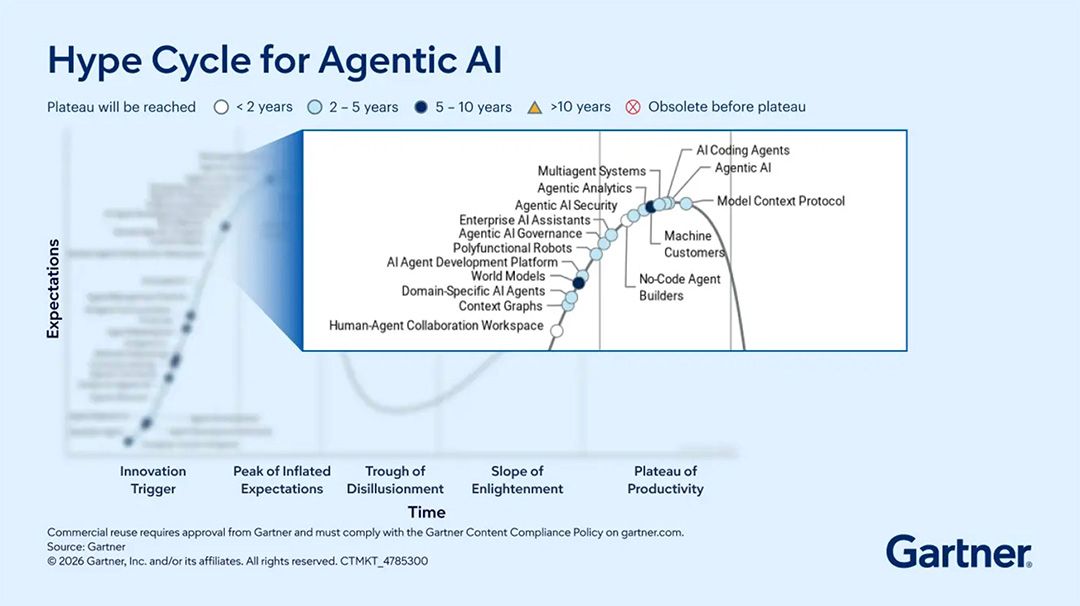
Source: Gartner
For more evidence, simply consult Gartner’s recent Hype Cycle for Agentic AI. The category is cresting at the peak of inflated expectations, and we're expecting a lot. Agents are now being harnessed across the full marketing lifecycle from planning to execution – leveraging your brand, ICP, and full stack of tools.
OK, so basic chatbots are so 2025. The CMS and DXP platforms I’m talking to have already moved on. The real potential is with intelligent agents that possess the knowledge, skills, and tooling to become a true “digital teammate.”
Still, even with all this AI magic, it’s not unusual to see AI projects and campaigns washing out. Stalling in the high waters of disconnected tools and lost velocity.
But why? Isn't AI supposed to be speeding things up?

Acquia's VP of Platform and Solutions Marketing Maggie Schroeder. Source: LinkedIn
It’s a question that Acquia’s Maggie Schroeder asked during her main stage talk at the recent Gartner Marketing Symposium. With a gaggle of CMOs in the room, she waded through the muck to explain what’s really happening and how it’s solvable with the right structure – and the right agentic mindset.
Maggie, the DXP’s VP of Platform and Solutions Marketing, recently sat down with me to dig deeper into the challenges that marketers face as they struggle to coordinate their stack, and how Acquia Source is priming a new agentic marketing engine that won’t stall in the shifting tides of AI.
CMOs need to ‘gear up’ the governance
When it comes to AI, there are several factors contributing to the friction for marketing teams. First and foremost, they often buy tools first, then look for a nail to use their shiny new hammer. The problem? Few solutions connect to existing systems in the right ways, and workflows aren’t codified properly. Add in a lack of vital knowledge like brand voice, and AI has no idea who you are. As such, gears grind, and things get stuck.
One of the biggest drags is a lack of governance. We live in a compliance-first, highly regulated world of content ops, where teams “overgate” reviews and “undergate” the output. Drafts are being produced faster than ever, but campaigns are increasingly tied up in QA queues and legal inboxes because core workflows for approvals haven’t kept pace with AI.
Across the marketing organization, this quagmire is resulting in a lack of clarity. Maggie saw this disconnect firsthand in the lead‑up to the Gartner event. In her conversations with CMOs, she heard a consistent pattern of executive pressure to adopt AI without any clear guidance on what for – let alone how agents should be harnessed. This lack of policy is also creating tension.
“While marketers want AI, there's not necessarily anyone out there saying this is exactly how you should embrace it, and how you become an agentic marketing team,” Maggie explained. “So CMOs and every C‑suite member might say ‘use more AI,’ but then you're asking, 'For what?’”
“I think seeing is believing in the era of AI. I don't trust any content that's put in front of me unless there's a demo. Show me the product, walk me through it, or I'm out.’”
The pressure to become an “Agentic Enterprise” is compounding, and the resulting sprawl is starting to look like a tidal wave. The Wall Street Journal highlighted market research that predicts the average Fortune 500 enterprise will be running over 150,000 agents in the coming years. The previous forecast was just 15.
Yes, observability will be a challenge. Cost will be another dimension. But how effective will these agents be without rethinking the workflows, approvals, and system access that make it capable of being a true digital coworker? And when agents gain more autonomy, how will organizations ensure governance becomes non‑negotiable, especially with evolving regulations in industries like finance, healthcare, and the public sector?
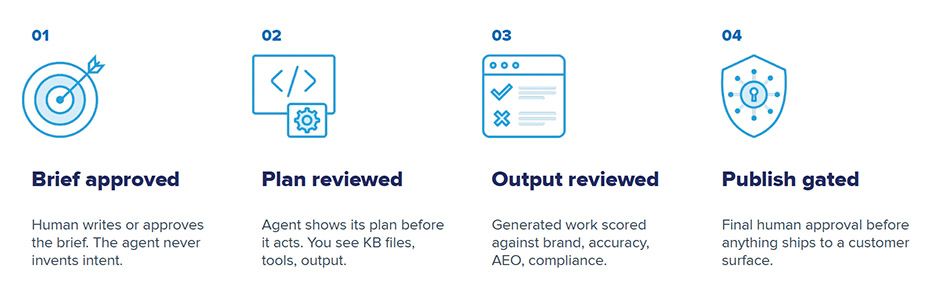
Maggie and I discussed what a meaningful governance layer looks like in practice. It runs wide and deep, impacting what tools and data sources agents can touch, as well as the permissions for what they can create, update, or publish.
It also addresses the vital points where humans can review and maintain accountability for agent actions and outputs. As she sees it, brand safety isn’t a “bolt-on”; instead, it’s wired into the workflow at precisely the right steps. As such, having a platform that helps you maintain that is more important than ever.
Source: Acquia
Governance isn't a luxury add-on. Vendors need to make it demonstrable for stakeholders, and I love Maggie’s personal mantra of “Trust the demos, not the decks.” It’s sage wisdom, especially for CMOs. If a vendor can’t show you a working agent that reflects your use case or goals – and what governance looks like – they’re probably not ready for production.
“I think seeing is believing in the era of AI,” she proclaimed. “I don't trust any content that's put in front of me unless there's a demo. Show me the product, walk me through it, or I'm out.’”
The three layers of Agentic Marketing
Maggie’s perspective on AI is shaped by a career that spans cloud infrastructure, payments, and enterprise CMS – all through a product and go‑to‑market lens.
Before Acquia, she was at Turbonomic (acquired by IBM), an application resource management platform, where she worked on cloud and on‑prem optimization. She also had a stint at Mastercard, where she focused on payment verification. It’s a diverse background that makes her hyper-sensitive to security, scale, and workflows – some of the biggest concerns in today’s AI marketing experiments.
In that spirit of experimentation, Maggie is passionate about helping customers evolve beyond the glorified chatbot. As she told me, the roadmap to Agentic Marketing needs more than a large language model.
“There are three pieces to it,” she explained. “The first is making sure that you have an established knowledge base, and not just one that’s accessible by humans, but accessible by AI as well. It’s thinking about all the internal positioning, the definition of the personas that you're targeting internally, and your strategies per go‑to‑market region.”
Having the right order and structure here is key, as well as abstracting any internal tribal knowledge from the equation. AI can't understand what's going on in our heads, and it doesn't understand what your CMO thinks. Your knowledge base has to be your source of truth.
Second, you need a skills library that expresses the baseline for different outputs. This includes the substance of a campaign – things like ad copy, landing pages, sales decks, webinars, and more.
“You have to look at what’s downstream, what it’s used for, and what marketing tactics you have,” Maggie said. “Are you creating ad messaging or slide decks for your sales teams? Are you creating webinar or video content? Then, it’s defining what ‘good’ looks like and structuring a skill. Because if you don't tell AI how to do it, it's just going to do whatever it thinks is good, not what you have defined as good.”
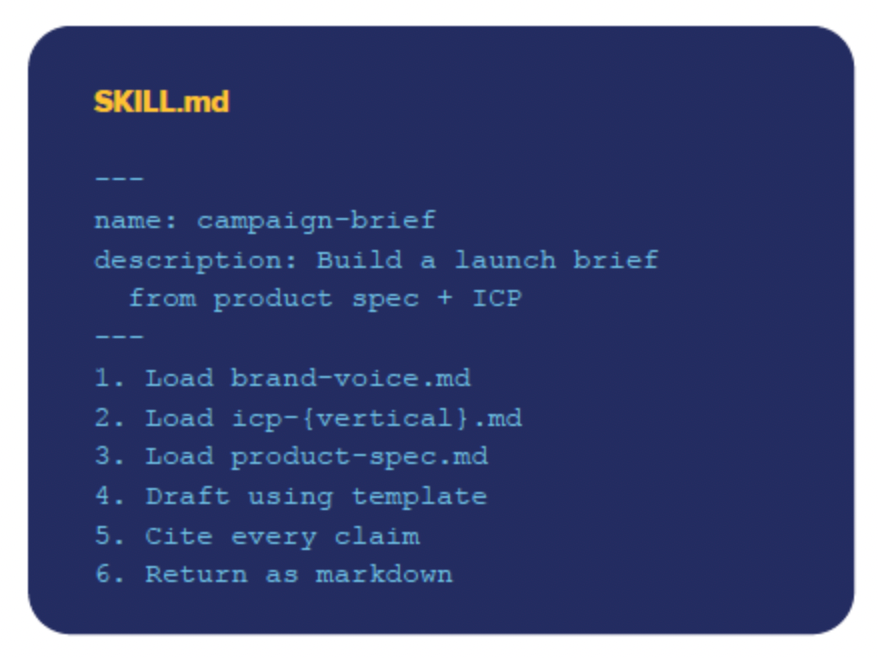
An example of a standard SKILL.md markdown structure. Source: Acquia
To be more specific, we’re talking about an agent skill as a repeatable workflow with both instructions and guardrails. It can be a set of instructions in natural language, or tool calls for specific connectors. This can be contained in a SKILL.md file – a standardized markdown file used to teach AI coding agents new capabilities, domain knowledge, and specialized step-by-step workflows.
Finally (and this is a hard one), you have to connect all your tools. AI that can’t reach into your stack is still just a chatbot. This is where MCP (Model Context Protocol) is closing the loop and encompassing the broader ecosystem, from CMS content to DAM assets to analytics.
When those three pieces are in place, AI can begin to function like a true digital teammate. It can decipher your brand, products, personas, and GTM strategy. It knows how to execute specific tasks and what quality bar to hit. And it fits into real workflows, not hypothetical ones.
Acquia Source: A command center for orchestration
There’s a new marketing engine revving up to help reinforce these layers – as well as the vital governance needed to maintain it all. It’s called Acquia Source, an AI-powered platform launched at the end of 2025 as a SaaS CMS. It has since evolved to encompass Acquia AI’s specialized agents as those “digital teammates” I've been referring to.
As the umbrella, Acquia Source orchestrates the stack, from content to DAM to web governance. It’s the control panel for your GTM strategy, and it also allows teams to harness the agentic capabilities of Claude while tapping a shared knowledge base for brand, data analysis, and more.
One of the big payoffs Maggie pointed to with Source was the speed to ship. By overcoming the “Complexity Tax” of disparate tools, marketers can go from a brief to a live campaign in a single afternoon. And with a knowledge base that’s brand-ready – and content that’s AI-readable, accessible, and compliant – teams can avoid stalling out when it comes to governance.
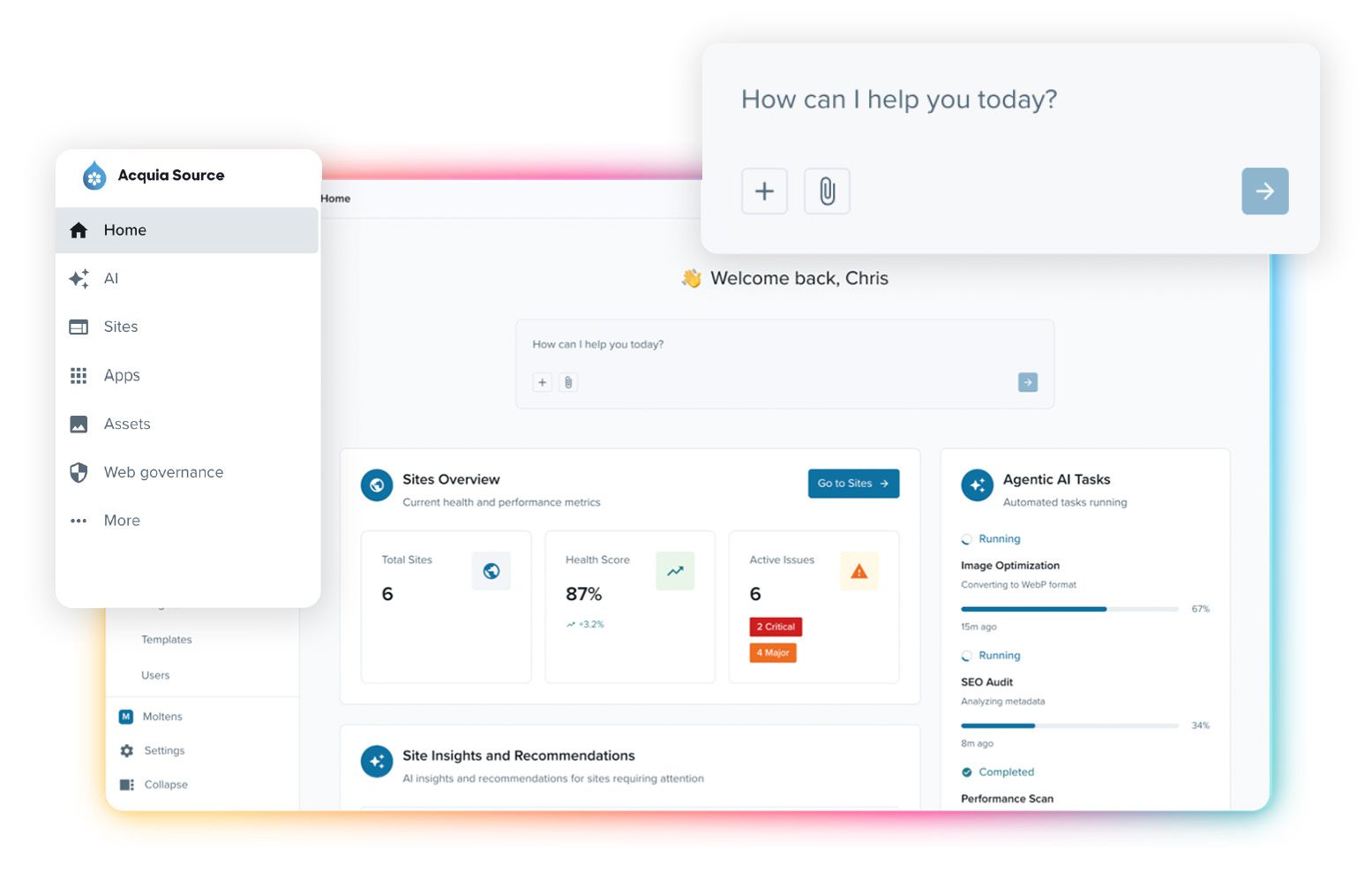
What I like about Acquia Source is that it provides a unified view across your ecosystem, with access to AI agents in a cohesive workspace. It helps mitigate all the siloed fragmentation of data and painful context-switching between tools, and you can easily toggle to your CMS, DAM, and AI apps using elegant navigation.
Source: Acquia website
Acquia Source brings agentic streamlining to the forefront. Case in point, its AI Site Builder Agent is a standout feature, promising that users can go from a creative brief to a robust, multi-page site in just a few hours – with no delays from development. Users just prompt their way to a live campaign site and even tap a drag-and-drop visual builder to add off-the-shelf library components.
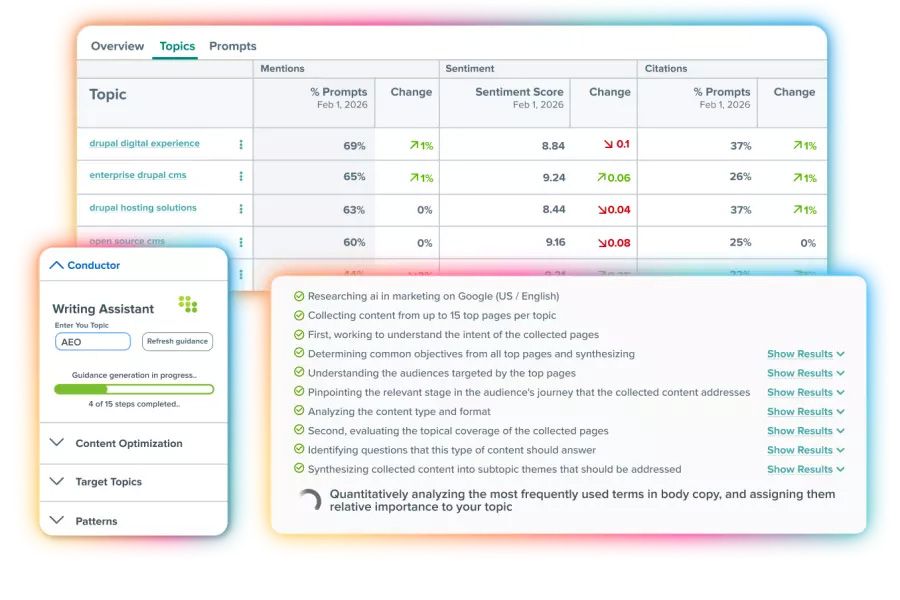
Within Acquia AI, marketers can also harness an AI Writing Assistant Agent that goes beyond simple text generation to deliver optimal content for both SEO and AEO, so your experiences are readable by both humans and machines. This is achieved at an architectural level, so your content is truly structured for AI discoverability.
Let’s drill into this AEO piece. Acquia Source, like most of its DXP brethren, provides a native solution. Rather than build or buy, it’s powered by an OEM with Conductor – a leading intelligence platform that I’ve written about extensively. Conductor enriches Acquia’s Content Optimization features with critical functionality like keyword analysis, while supporting content structure that can help influence citations and visibility across leading answer engines like ChatGPT.
Within Acquia Source, you have a slick visual dashboard that tracks your brand citations across AI engines. But it’s the synthesis of Acquia’s AEO and SEO features – from an AI topic map to holistic content ROI – that makes the solution robust, meaningful, and actionable for marketers, so they can optimize their content performance.
Source: Acquia website
And of course, there’s governance. Acquia’s Supervisor Agent and an AI Web Governance Agent provide critical insights to support your digital strategy and enforce compliance across marketing operations around accessibility, data privacy, and more.
Within Acquia Source, Acquia AI is acting as the action layer for the holistic skills that Maggie alluded to. As she told me, this is what Acquia’s CPTO, Ryan Studer, refers to as “building from the inside out.” Marketing teams can leverage all the insights from external martech platforms, but also the resources that exist within the Acquia Source command center.
They’re also betting on an “outside‑in” model, where marketers continue to work in assistants like Claude, and Acquia acts as the secure execution backend via MCP. This is a trend I’ve been seeing within more marketing ops.
“Our AI has pre‑baked skills based on our own best practices,” she said. “But you can also build through Claude and integrate that kind of build process or that automation into your workflow. All of that I could just do right from within Claude.”
What CMOs can do now to avoid the stall
“More tools” is seldom the answer to any problem in our modern tech stack. For marketing teams struggling with stalled AI projects or stymied campaigns – particularly CMOs that are leading the charge towards growth – Maggie’s prescription is to focus on structure and readiness, and understand problems before making purchases.
Here’s what I distilled from the conversation that can be made actionable:
- First, marketing teams need to codify their knowledge base for AI. That means inventorying and centralizing their brand voice, product positioning, personas, GTM strategies, regional nuances, and messaging frameworks, then making them AI‑readable.
- Second, they should document workflows from intake to legal approval to launch, specifying quality standards for every step – so agents have a clear process to follow. Often, this kind of workflow is trapped in the human tribal domain. Without a clearly documented source, AI has no map to follow.
- Third, leaders should provide a top-down governance model and agent access. Deciding up front which systems agents can touch, what they’re allowed to do, and where human review is mandatory is essential to deploying AI with confidence. That requires systems with rich control over roles and permissions.
As Maggie told me, there’s a clear reliance on both people and technology to pull all of this off. This is an area where Acquia’s partners could be a decisive factor. The company’s global network includes digital agencies, systems integrators, and technology providers that specialize in everything from Drupal development to the wider Acquia DXP.
“There's a full upfront piece of work that a marketing team has to do to get to the place where they can harness the technology that Acquia is coming out with,” she expanded. “This is really an area that we're going to start leaning into with a lot of our partners to help bridge that gap for marketing teams.”
Why it matters
Humans have an evolving episodic memory. It thrives because we have native context and universal access. That’s what keeps my stalled-out Chevy top of mind whenever there’s a slightly flooded street in my path.
AI is transformative. But it’s limited by many of the human systems we’ve relied on for years. These tribal entities (like a brand voice that’s locked up in a creative director’s head) haven’t made their way into a machine-readable realm. And when a meaningful governance loop is absent, friction builds – but trust doesn’t.
Solving these problems is what Acquia Source was built for, delivering a comprehensive command center that puts human marketers in control. It’s an orchestration dynamo, unifying CMS, DAM, governance, and workflows while reducing the complexity of managing everything. And with Acquia AI under the hood, co-pilots graduate to reliable “digital teammates” that really deliver.
While Acquia’s customers are already seeing the benefits, Maggie shared that her own internal team has been dogfooding Source to add custom Acquia AI skills and run AEO and SEO experiments on a daily basis. The net result has been an 8x increase in campaign velocity. In other words, no puddles to stall in.
When I spoke to Drupal founder Dries Buytaert earlier this year about Drupal CMS 2.0, it was evident that AI was becoming a core concern. During our conversation, I recalled how the Drupal Community was an early wellspring of innovation for generative connectors.
That’s been paid forward in spades as Acquia Source evolves beyond a CMS to help brands win in AI discovery and make teams more productive through automation. This open source posture is a key advantage for accelerating ideation at a time when tech platforms need to move faster.
As Maggie said, seeing is believing in the era of AI. Acquia Source brings some solid capabilities to the table, but don’t take my word for it. Follow hers: “Show me the product, walk me through it, or I'm out.”
My Recommendation: Acquia Source is promising. It brings all the right features under one roof and it's focused on acceleration and measurable outcomes. As with any platform evaluation, do your homework: you can peruse Acquia's use cases, but I would schedule a demo and define your specific goals to explore a custom fit (I saw a recent first-hand deployment for a public sector customer that was really successful). Acquia's pricing isn't super transparent – although they do provide a cost savings calculator for Drupal Cloud – so you'll want to inquire about your enterprise scope and scale relative to the solution set.
Upcoming Events
CMS Connect 26
August 5-6, 2026 – Montreal, Canada
The best conferences create space for honest, experience-based conversations. Not sales pitches. Not hype. Just thoughtful exchanges between people who spend their days designing, building, running, and evolving digital experiences. CMS Connect brings together people who share real stories from their work and platforms and who are interested in learning from each other on how to make things better. Over two days in Montreal, you can expect practitioner-led talks grounded in experience, conversations about trade-offs, constraints, and decisions, and time to compare notes with peers facing similar challenges. Space is limited for this exclusive event, so book your seats today.
Open Source CMS 26
October 20–21, 2026 – Utrecht, Netherlands
Join us for the first annual edition of our prestigious international conference dedicated to making open source CMS better. This event is already being called the “missing gathering place” for the open source CMS community – an international conference with confirmed participants from Europe and North America. Be part of a friendly mix of digital leaders from notable open source CMS projects, agencies, even a few industry analysts who get together to learn, network, and talk about what really matters when it comes to creating better open source CMS projects right now and for the foreseeable future. Book your tickets today.

Storyblok JoyConf 2026
October 28 - 29, Rheingoldhalle, Mainz (Frankfurt)
JoyConf 2026 is where developers, marketers, and digital innovators come together from all around the world, united by one powerful idea: great content isn’t built by tools alone – it’s built by people who rely on systems to deliver their best work to the world. In an era where technology is increasingly shaped by AI, Content Confidence becomes your competitive advantage. When you can create, manage, and scale content that performs seamlessly across channels, platforms, and AI, you don’t just keep up – you win. Book your seats today.