Flying the Agentic Skies: easyJet’s Paul Curtis on Taking Off with Agents and Soaring with MACH


The CTO of one of Europe’s leading airlines is packing for an agentic future. In our exclusive interview, he gets real about the impacts of AI, the importance of human readiness, and how the MACH Alliance can elevate success in the agent-to-agent ecosystem.
There’s a moment in the 2009 film Up in the Air when George Clooney’s character, Ryan Bingham – a lonely corporate gunslinger who spends more time on planes than in his apartment – tells a colleague that life is better with company.
“Everybody needs a co-pilot,” he says.
I couldn’t agree more.
Bingham has many candid revelations throughout this charming romcom, softening his professional gait as a “hatchet man.” That’s colloquial slang for someone who fires people for a living. Yuck.
On the upside: During the second act, Bingham surpasses 10 million frequent flyer miles, and the pilot (played by the intrepidly mustached Sam Elliott) delivers the news at 37,000 feet.
Down on the ground, along the evolving runway of AI agents, the word “co-pilot” is apropos. Maybe these handy tools can’t plug a sad hole in our hearts, but they’re right by our side, lightening the load and making life better. They've become nearly ubiquitous in our apps, with every tool sporting a prompt-based experience for chatting, searching, or executing tasks.
It's worth noting that an agent isn't a new concept. We've had them bouncing around the stack for years, handing off jobs from one place to another and automating workflows. Even the idea of engaging with a conversational bot was pioneered by MIT's Joseph Weizenbaum, who built the ELIZA interface back in the late 1960s.
Nowadays, you can spot them everywhere in the wild. In the DXP jungle, leading vendors like Sitecore and Optimizely have introduced not only omnipresent AI assistants, but also agentic features that work both on-demand and ambiently, with the ability to customize agents for automating an array of duties.
But the potential of agents is evolving – and in quite personal ways, beyond the confines of software ecosystems and into the public atmosphere. Case in point: your mom might not know what an “agent” is, but she’s probably using ChatGPT to plot her parking job at Trader Joe’s.
Agents are becoming more like us. They’re getting human names. Email addresses. Organizational titles. Even music legend Will.I.Am has become an agentic ambassador, unleashing AI’s creative potential across his music. In a recent interview, he suggested that students might graduate from school with their own agent, trained on their collective knowledge and capable of unlocking their “human awesomeness.”
Sounds like an exciting future.
But right now, the vision of an agent-to-agent ecosystem – one where agents can move beyond proprietary constraints and connect with websites, applications, and other agents to transact on our behalf – is still trying to get off the ground. According to research from Cleanlab, only 5% of enterprises have agentic systems in production, and many are having to refactor key components on a regular basis.
Nowhere was the agent maturity race more evident than at last month’s National Retail Federation (NRF) conference in New York. Commerce has long been the canary in the digital coalmine when it comes to change, and AI was front and center.
From accelerating checkout experiences to personalizing shopping, the agent momentum was furious. There’s long been talk of monetizing the answer engines via agentic services, and we’re seeing that come to fruition with Google’s Universal Commerce Protocol (UCP), an open standard for agents and systems to work together. With UCP, customers can buy from retailers directly through Google’s AI Mode in the browser, or via the Gemini app.
Given this progress, it’s clear that AI is no longer up in the air. It’s a requirement. The problem rests with execution, and most organizations are struggling to taxi down the agentic runway.

easyJet CTO and e-Commerce Director Paul Curtis. Source: LinkedIn
At the MACH Alliance’s recent MACH X Conference in London, Paul Curtis, the CTO and e-Commerce director for easyJet – one of Europe’s largest airline carriers – made a stark prediction about the future of agents, and the real risk that brands face if they don’t get on board.
"By 2030, we expect 60% of all online transactions to be initiated through agents,” he said. “If you consider how long it takes large enterprises to deliver change, you've got to start now."
Short of pressing the passenger call button, Paul is signaling urgent action, ignited by the real-world experience he’s acquiring at easyJet. The company is well into its own AI transformation, buoyed by MACH and composable thinking. But to his point, change is hard – especially for enterprises.
I recently caught up with Paul to discuss how the AI shift is playing out in the travel industry, why mobile is still the essential bridge to the passenger experience, and how agentic systems are forcing us to rethink trust, standards, and the role of change management.
As a member of the MACH Alliance Ambassador Program, Paul also shared how the Alliance’s success formula for AI is deeply rooted in a cultural mindshift, reflecting its prescription for implementing composable patterns and stacks.
It was a first-class conversation that was as much about the journey as the destination.
A new breed of ‘Travel Agent’
To put the agentic journey in context for this industry, Paul gave me a familiar framework. In his example, he compared AI agents to humans that, once upon a time, understood our personal history and nuances – and used their judgment to facilitate the experience.
“Take yourself back to the mid 1990s, when you would walk into a travel agency,” he described. “You might say, ‘I want to go on an adventure holiday, and I want to go in June. What can you offer me?’ They would have a deep understanding of you as a customer. They would know all the potential options that are suitable, based on numerous data points that were relevant in your interaction.”
That’s the bar he’s setting for AI with easyJet – a frictionless kind of exchange that leverages context and introduces judgment into the equation.
“What we're trying to do is create a mental model around that,” Paul explained, “to effectively put a bunch of agents together that can fulfill those individual requirements, with the inputs being context about who the customer is, what historical engagements we've had, what are the questions they're asking us, and how do we best service them.”
Of course, building AI systems that behave like trusted human specialists – and not opaque black boxes – is a challenging altitude to reach and maintain. This is where Paul is harnessing easyJet’s years of domain expertise to enhance that critical layer of judgment to an agent workforce.
Flight check: Mobile-first and agent-ready
In an omnichannel world, brands need to be everywhere – and on every device. In travel, high-value transactions used to mean one thing: a big screen and a keyboard. Paul noted that for years, serious purchases defaulted to desktops because that’s where the brand experience and consumer confidence lived.
“Historically, there was this notion that every transaction has to be on a desktop above a certain value, because people wanted the confidence of that big screen,” he said. “If I go back four or five years, I would say you're probably looking at around 80% of all transactions being carried out on a desktop when they’re considered high-value transactions.”
Today, that picture has changed dramatically. Airline mobile apps have become digital wallets for every step of the experience – from browsing flights to booking tickets to storing your boarding pass. As Paul said, easyJet has seen a huge shift in usage as the experience has evolved and trust has become foundational.
“We’re looking at numbers of about 40% of all transactions through the mobile app,” he shared. “And if we extrapolate the trends, mobile becomes the prevalent channel of engagement within 12 to 18 months.”
But as AI answer engines enter the equation, the consumer’s search and discovery behavior is shifting. People are planning trips and researching options using ChatGPT and Perplexity – and while transactions aren’t yet possible, Google’s UCP is already lining up with brand partners like Shopify, Etsy, Walmart, and Target.
“We’re making huge investments in our app, because we do see it as the primary tool of engagement, in a way that’s reflective of what we think the direction of travel is.”
Despite the buzz around answer engines and agents, Paul is clear: the airline app isn’t dead. In fact, investment appears to be accelerating. Hopefully that yields better outcomes, because most airline apps are – in a word – terrible.
“If you look at other industries, airline apps aren’t a great user experience,” Paul said. “In the last six to 12 months, what’s interesting is that the level of investment being made in airline apps has dramatically increased. British Airways is investing huge amounts of money in theirs, and they clearly see it as a key part of their strategy going forward.”
Where mobile really becomes indispensable, Paul argued, is at the physical edge: the airport. The app isn’t just a booking frontend, it’s becoming your identity and travel orchestrator.

easyJet mobile app. Source: Google Play Store
“We’re very close to being able to store your passport information securely in your app with biometrics at the airport, so you don't even have to take your passport out of your pocket to travel internationally,” he said. “If we can make your mobile app ubiquitous to every part of the user journey, even through the airport environment, then the value we get from you engaging and transacting with the app versus other channels becomes far more significant.”
From a CX perspective, there’s a key transformation in play that enriches the value of the mobile channel. Paul sees the industry’s app fabric becoming a kind of modular delivery surface, one that’s mobile-first and agent-ready. And when powered by a composable stack, capabilities can be added incrementally via agent protocols without being locked into current patterns.
Interacting with all of these environmental touchpoints – physical and digital – is powerful. But executing tasks and transacting takes everything to the next level. Imagine your app telling you it will take an hour and a half to get through airport security. As Paul said, it could automatically provide an alternative route or even upsell a fast track that saves you time.
Having this flexible mobile strategy sounds like the runway to the next wave of agent-powered services. But with AI, change is the status quo. As the answer engines evolve to encompass transactions, they’re likely to become a more prolific channel in the passenger journey. This is where AEO (Answer Engine Optimization) is becoming a more pronounced part of the digital strategy.
“We’re making huge investments in our app, because we do see it as the primary tool of engagement,” Paul said, “in a way that’s reflective of what we think the direction of travel is.”
Turbulence: Security, compromised agents, and observability
Paul was blunt about the security challenges facing agentic systems. It’s something I also discussed with Curtis Northcutt of Cleanlab late last year. AI agents in production face a multitude of unseen problems, from infrastructure instability to poor performance. Paul is particularly worried about malicious agents quietly embedded in chains.
“The elephant in the room that we're not really talking about is how do we ensure the adoption of these agent ecosystems, but in a secure way?” he said. “I think we’re on the cusp of a bit of an explosion of agents being compromised. If you look at the threat of being able to inject a corrupt agent into a chain of agents that can just sit there silently, collecting data somewhere else. I mean, it's terrifying.”
What makes it worse is how casually users and enterprises are already trusting these systems. As I said in my keynote at the Boye & Company CMS Kickoff last month, we often hook things up without considering the consequences – something that created problems in the early days of APIs with weak authentication, excessive data exposure, and shadow endpoints.
“What's been fascinating for me is the level of trust that consumers have had in a lot of these agentic solutions in terms of the data they're willing to share,” he explained. “The agentic browsers they're willing to install on their desktops that can have access to all of their local credentials. I mean, it's astonishing.”
So what can we do about it? This is an area where the MACH Alliance can bring calm to the storm through greater awareness, training, and education – something they’ve done consistently through the rideMACH program. As Paul said, having the right industry expertise and partnerships is key, as this is still a nascent field. Certification could be an opportunity to shore up skills for individuals and organizations and provide more validation.
Observability is also a critical requirement. Most software tools with agents don’t offer line-of-sight into agent performance and uptime (think container health dashboards in Datadog). This is something that platforms like Rubrik are pioneering, but we can expect more native tooling to emerge.
While the turbulence is real, awareness around these issues is elevating across IT organizations. Achieving a credible operational model for agentic systems will be a key objective, and an area where enterprises will require tangible resilience.
Piloting an agentic AI journey with a MACH mindset
At “The Composable Conference” in Chicago last year, Paul and I had an intersection with CMS strategist and analyst Mark Demeny. We all noted the vibe around agentic commerce and the focus on MCP (Model Context Protocol), but also the elevated drumbeat surrounding the MACH Alliance’s focus on AI.
This isn’t new. I’ve been covering the rise of AI across the Alliance’s messaging for the last few years, reflecting trends across the industry. As Chad Solomonson of digital agency RDA said during a recent presentation, composability has won the battle – and in many ways, it’s offering a flexible flight plan for scaling and experimenting with AI.
The data appears to codify this. According to the MACH Alliance Global Annual Research report, 77% of organizations well into their composable journey are dramatically ahead in their AI adoption. That’s compared to only 36% of those new to MACH. The research suggests that MACH's flexible, connected, and open foundation can translate into faster, more successful AI outcomes that give enterprises an edge in the agentic arms race.
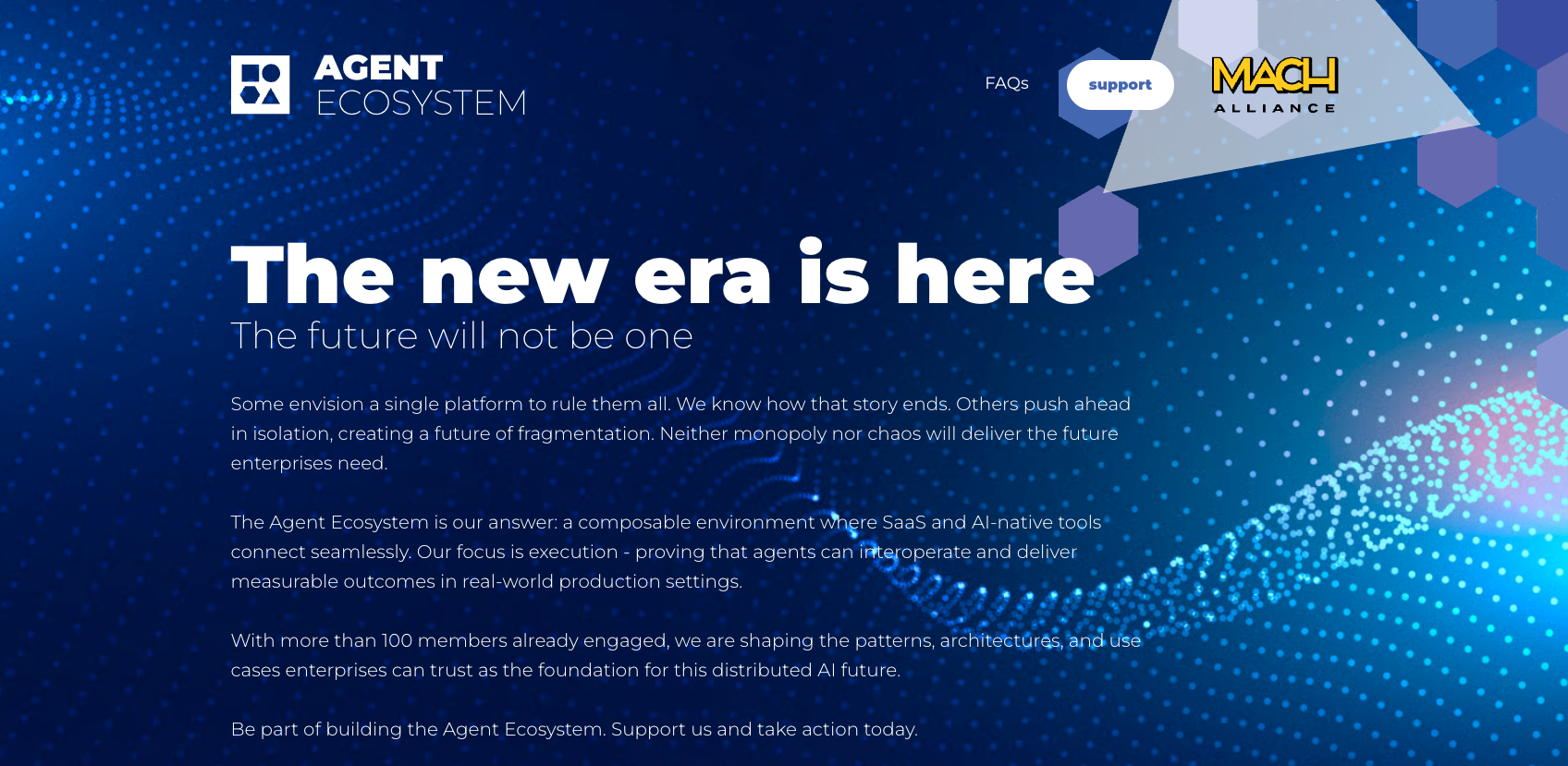
The MACH Alliance Agent Ecosystem website.
In August of 2025, the Alliance made a notable pivot, mapping its vision to unlock trusted, agent-to-agent ecosystems. The organization launched a dedicated website with the stated goal of evolving enterprise AI architectures with a new end-user leadership model. From the top down, the advocacy group would now mine more guidance from experienced industry practitioners.
This included the appointment of Jason Cottrell, CEO of digital agency Orium, as the Alliance’s new president. I spoke to Jason in December about these recent shifts and what he sees ahead for MACH and AI.
If I’ve monitored one glaring gap in this agentic hype, it’s that the Alliance has experienced a bit of an identity crisis. That said, finding your footing in the AI game is a bit like walking a tightrope with an elephant on your back. As an Alliance ambassador, I asked Paul where he sees the value evolving, and he drew a straight line from MACH principles to agent ecosystems.
“This is one of the more fascinating debates that we're having at the moment, particularly at a board level within MACH,” he said. “I think the evolution of agentic plays very well to the strengths of what MACH brings to the table. If you look at the core principles that should be in place to support having a really good agentic ecosystem – principles around composability, interoperability, standard data models – these are all things that are highly relevant to that agent ecosystem.”
It’s a solid point. And last year, the MACH Alliance delivered more actionable resources to maintain these standards, including its Open Data Model. But AI is changing rapidly, and I asked Paul how standardized things should get around agent requirements.
“I think the challenge for us is getting the right balance between defining a core set of principles and standards and being really prescriptive about how those agents are constructed,” he replied. “Do we want to lean more towards the Agile manifesto approach, where it's kind of a tablet of principles? Or prescriptive data models that should be adopted if you're creating a basket agent or whatever it happens to be?”
These are great questions, and we’re still too early to fully answer them. In the meantime, enterprise software vendors are building their own proprietary agent systems that offer both opportunities and dependencies. If true agent-to-agent ecosystems are going to thrive, a standards-driven body like MACH Alliance may be one of the few credible venues to define open agent patterns that avoid vendor lock-in.
Piloting the agentic course with ‘human readiness’
In my recent keynote at CMS Kickoff 26, I mentioned how the phrase “human in the loop” is beginning to feel like a marketing platitude. I’m not disparaging platforms, nor am I suggesting that their tooling doesn’t position humans in some kind of “loop.” But it’s just scratching the surface. Like AI, it needs context – and we need to define just how valuable our human judgment is to an AI-enabled process or workflow.
When I talked to Paul, it was clear just how important this judgment really is. As we discussed, adopting the right tools to enhance human work is key, but adoption is often a source of friction – which can be painful but essential. According to MIT, avoiding this friction is why 95% of GenAI projects fail before they reach production.
But there’s also friction on the people side. Real barriers exist with things like human dynamics, change management, and cultural adaptation. Too often, organizations deploying AI don’t lead with transparency, leaving gaps in knowledge and skill training. In fact, according to PwC, 45% of Canadian CEOs said they haven’t even formalized responsible AI and risk processes.
“AI takes mechanical parts of your job away so you can do more of the human ones. It's not going to replace our human judgment or our creativity.”
In many cases, the greatest challenge isn't choosing platforms or models, it's navigating the complex human landscape of transformation. To help support the human part of the equation, the MACH Alliance has developed programs like its MACH AI Exchange, a hands-on program administered by industry professionals to provide a stronger foundation for streamlining AI adoption.
In lockstep, Paul adamantly agreed that adoption issues surrounding AI are more human than technical – at least at this stage. Most enterprises have over-rotated on infrastructure and under-invested in what he calls “human readiness.”
“There's been this real focus on what I would call ‘technical readiness’ to adopt AI,” he said. “The bit we've really missed is actually the ‘human readiness.’ How do we actually adopt AI in an effective way?”
I’ve written extensively about the critical role of change management in organizations, particularly in this hyperbolic period of AI transformation. As Paul said, the critical foundation of human readiness will be key to making the journey successful.
For enterprises, enrolling people in the vision of a hybrid AI/human workforce is key. As Paul reinforced, it’s not just about declaring how AI will drive efficiency and unlock productivity. Those are vague promises. He’s advocating for a different narrative.
“AI takes mechanical parts of your job away so you can do more of the human ones,” he said. “It's not going to replace our human judgment or our creativity.”
Is the future up in the air?
A lot of it is. That much was evident in the predictions from industry luminaries who mused about 2026 and what lies ahead.
One person who continues to get it right (in my humble opinion) is Netlify’s Matt Biilmann, who first wrote about the rise of “Agent Experience” – known in some parts of Silicon Valley simply as “AX” – back in early 2025.
As Matt recently told me, foundational model providers are enabling companies to apply truly autonomous agents to bigger parts of the work they’re doing, and the landscape is expanding. AX is becoming a key concern not just for dev tools, but for any kind of digital experience.
And as vibe coding becomes the norm (see FIMO’s latest site builder, or DOMO’s latest app builder) and Google’s UCP takes hold, we’re going to see seismic shifts across our tools and businesses.
In all of this, there are risks. Security tops the list. We need more – and better – observability. Ultimately, agent standards could become an essential foundation of an open agent-to-agent ecosystem, but not at the cost of stymying innovation. This is where the MACH Alliance could provide independent guardrails and resources for shaping an agent marketplace that is modular, interoperable, and capable of extending into new frontiers.
Most importantly, we need smart people who can bring judgment and context to help orchestrate all of this. As Paul said, it’s the “human readiness” that we’re lacking, and AI requires a change management strategy that puts people in the pilot's seat.
So buckle up. This is how we fly the agentic skies.
Upcoming Events

JoomlaDay USA 2026
April 29 - May 2, 2026 – Delray Beach, Florida
Be part of the Joomla community in one of the most iconic cities in the world! JoomlaDay USA 2026 is coming to Delray Beach, and you can join us for a dynamic event packed with insights, workshops, and networking opportunities. Learn from top Joomla experts and developers offering valuable insights and real-world solutions. Participate in interactive workshops and sessions and enhance your skills in Joomla management, development, design, and more. And connect with fellow Joomla enthusiasts, developers, and professionals from across the world. Book your seats today.

CMS Summit 26
May 12-13, 2026 – Frankfurt, Germany
The best conferences create space for honest, experience-based conversations. Not sales pitches. Not hype. Just thoughtful exchanges between people who spend their days designing, building, running, and evolving digital experiences. CMS Summit brings together people who share real stories from their work and platforms and who are interested in learning from each other on how to make things better. Over two days in Frankfurt, you can expect practitioner-led talks grounded in experience, conversations about trade-offs, constraints, and decisions, and time to compare notes with peers facing similar challenges. Space is limited for this exclusive event, so book your seats today.

Umbraco Codegarden 2026
June 10–11, 2026 – Copenhagen, DK
Join us in Copenhagen (or online) for the biggest Umbraco conference in the world – two full days of learning, genuine conversations, and the kind of inspiration that brings business leaders, developers, and digital creators together. Codegarden 2026 is packed with both business and tech content, from deep-dive workshops and advanced sessions to real-world case studies and strategy talks. You’ll leave with ideas, strategies, and knowledge you can put into practice immediately. Book your tickets today.

Open Source CMS 26
October 20–21, 2026 – Utrecht, Netherlands
Join us for the first annual edition of our prestigious international conference dedicated to making open source CMS better. This event is already being called the “missing gathering place” for the open source CMS community – an international conference with confirmed participants from Europe and North America. Be part of a friendly mix of digital leaders from notable open source CMS projects, agencies, even a few industry analysts who get together to learn, network, and talk about what really matters when it comes to creating better open source CMS projects right now and for the foreseeable future. Book your tickets today.