Is ‘specialization’ the future of CMS? These 3 vendors are embracing it – and finding success

From CMS platforms coupled with dedicated agency services to industry-focused tools with uniquely engineered experiences, these solutions are proving that domain expertise, human relationships, and trust are providing an edge in a mature and competitive marketplace.
Last year, I talked to Kelly Goestsch of Pipe17 on an episode of The Critic’s Corner podcast. There was frank (perhaps even gloomy) talk about the future of CMS, and his observations have been bouncing around my head for months.
A bit of context: During Kelly’s previous leadership gig at commercetools, we regularly intersected in our roles at the MACH Alliance. Given our composable leanings and shared focus on the evolving tech stack, I invited him on to talk about asteroids, dinosaurs, and the moment in time we’re living in with AI (you can listen to the full episode here).
When I asked him about the value of CMS in a world where vibe coding was replicating software at a breathtaking rate, he was pretty blunt about the prospects, asking if we really need another content management system in an already crowded and mature space.
In his mind, the only real potential for differentiation was with a specific industry use case – like a CMS that’s geared for just the legal or financial vertical.
“Value is not created by that which is different, but that which is unique,” he told me. “That's something that took me a while to fully understand, but it's true. There are a lot of legacy platforms, or even newer versions, but still fundamentally legacy approaches.”
He’s right. CMS is, as I’ve often said, the “elder statesman of the stack.” And yet it persists, even after decades of potential erosion from adjacent tools or disruptive alternatives.
Even in 2026, Scott Brinker’s Martech Supergraphic noted a 21% increase in the total number of CMS and web experience management platforms – up from 504 to 612. This includes EmDash, a new open source CMS project launched by Cloudflare last month.
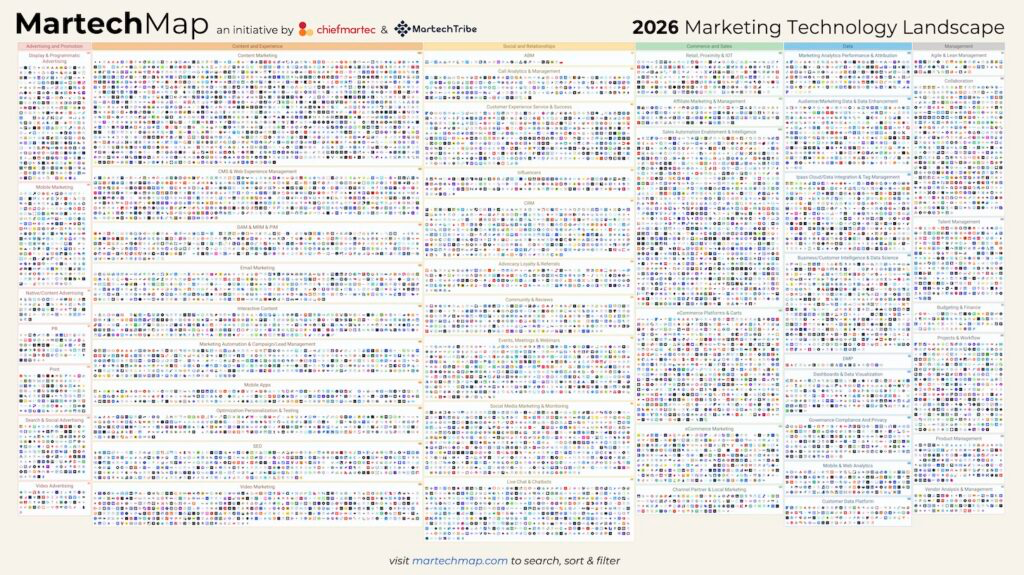
Try identifying any of those logos in the 2026 Martech Supergraphic. Source: Chiefmartec.com
It goes without saying that this increase is a result of vibe coding, which has accelerated the path to production-worthiness. But as I said in a recent MACH Forward Community webinar (hosted by the incomparable Jasmin Guthmann), building a product doesn’t make it ready for the security, scalability, and deep demands of enterprise workloads.
Still, the “Build vs Buy” conundrum is palpable, and both businesses and technical agencies are exploring the horizon of creating solutions where it’s more efficient and financially tenable. As many enterprises approach end-of-life with long-term contracts, more are chasing cheaper alternatives with less lock-in, including open source CMSes that live downstream.
But are they just shopping for a product?
No. They’re buying trust. Software is a promise, and that contract is often supported by intangible value – stuff like help desk services, SLAs, and dedicated TAMs. And of course, the expertise of the people who stand behind the platform when the going gets tough (think DDoS attacks).
While there are enterprise-grade CMS and DXP platforms that compile these dimensions into a marketable offer targeted at both horizontal and vertical use cases, there’s a cohort of tools that offer what Kelly was getting at: specialization.
Specialization is a broad term, but it reflects a business model that augments the transactional sale and support of a product. It doesn’t always mean “niche,” but the descriptors sometimes intersect. It might be a homegrown CMS that’s coupled with a blend of critical agency services, or a product designed to address a specific pain for a vertical industry – one where the platform’s domain expertise has influenced the UX, workflows, and more.
To be fair, all CMSes specialize in their own way, whether that’s around a unique pattern or workflow. Nowadays, much of that emphasis is shifting towards agentic systems and how they’re being utilized to perform tasks at scale. It’s become the central through line, often overshadowing other parameters of consideration.
But each of these three tools focuses on a unique angle that’s worthy of the “specialization spotlight.” They might not be as big – or serve as large a market footprint – but they’re delivering the most important feature of all: happy customers.

RebelMouse
RebelMouse is a rebel with a cause. Founded in 2012 by its pioneering CEO, Andrea Breanna (who once helmed the chief technology duties at the acclaimed Huffington Post), the New York-based firm offers a powerful CMS alongside the full capabilities of a creative and technical agency. Their mission is to help companies like Penske, Vault12, and Brit+Co thrive in the age of AI, where the intelligent web is getting more complex and wirier by the day.
RebelMouse’s enterprise-grade, AI-enabled CMS offers flexible design, workflow management, e-commerce features, and more. But it’s hyper-focused on performance by delivering fast sites, improved Core Web Vitals, and enhanced SEO. Much of that delivery is augmented by the company’s professional services, which help brands with content creation, editorial strategy, and visual design while enhancing user engagement across channels – including social media.

RebelMouse Senior Account Executive Adam Taylor. Source: LinkedIn
I recently caught up with Adam Taylor, the company’s Senior AE, to talk about RebelMouse.AI – a tool that lets you build sites that rank just by chatting. In minutes, you can generate a technically clean, SEO-optimized website that’s structured for speed, UX, and technical SEO out of the box. Unlike AI website builders like Lovable, Framer AI, or Wix, RebelMouse.AI doesn’t just produce pretty pages. It delivers conversion-focused structure.
As Adam explained in the demo, the tool can ingest an existing brand site, automatically extract visual and content patterns, and turn them into a working experience. This includes sample images, color palettes, fonts, and more. From there, users can just prompt their way to new pages or structures (“add an above-the-fold content carousel,” for example) and the system assembles them automatically.
One of the coolest things about RebelMouse.AI is its extensibility. The use case Adam gave was for a brand with a site on another CMS platform.
“You might have a site with 200 pages, but you need to build something awesome for next Tuesday,” Adam explained. “That’s where you can use AI pages off-platform. It matches your site. It’s on your site. It’s just powered by RebelMouse.”
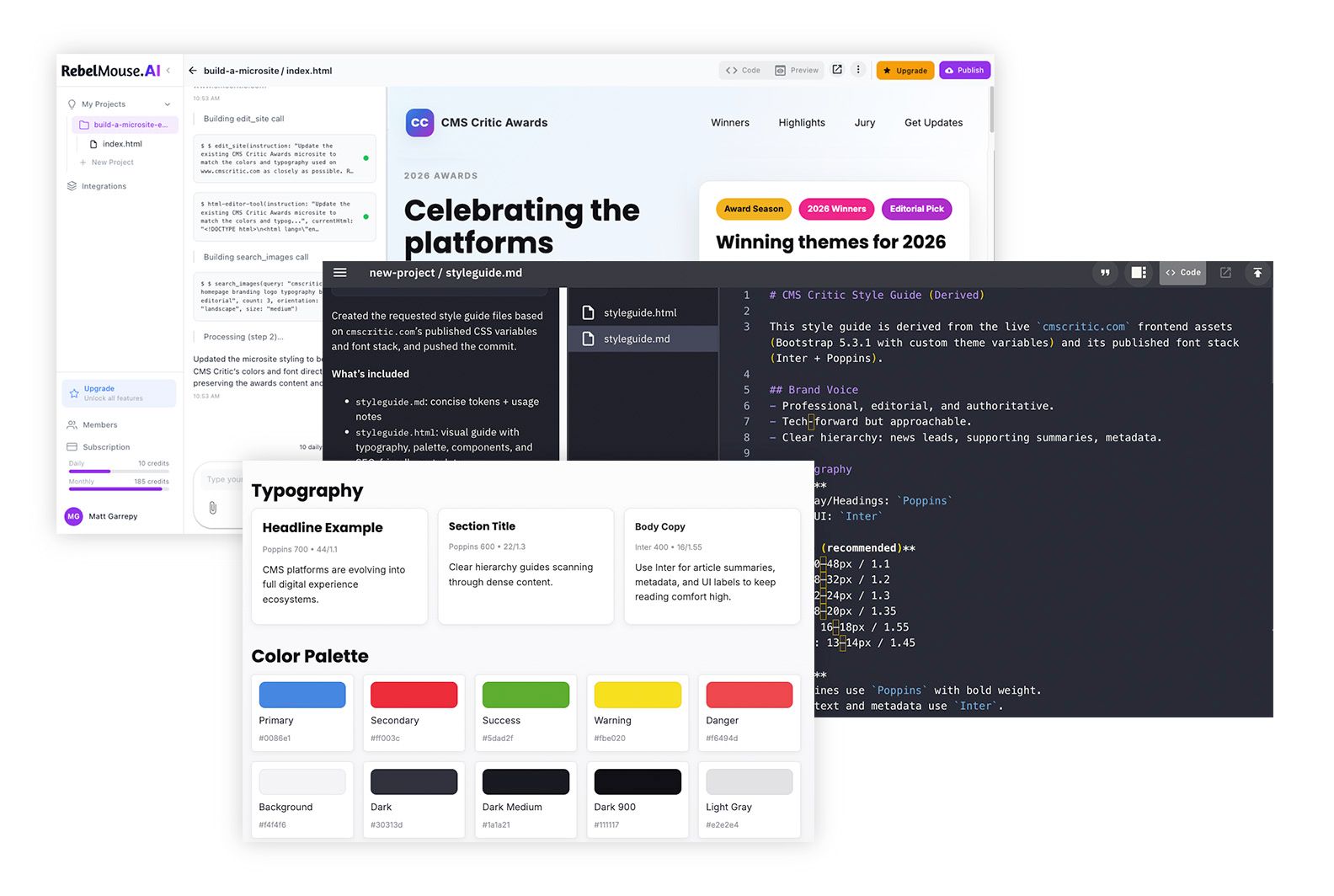
Source: RebelMouse.AI
A critical differentiator in the RebelMouse approach is that the AI doesn’t just generate “good enough” output. It’s trained on 15 years of the platform’s backend, performance, and SEO heritage so that it produces production-grade code – which Adam described as being close to perfection. This includes enforcing technical fundamentals from RebelMouse’s long-standing playbook for Lighthouse scores, speed, and search visibility.
After generating a site, users can customize via prompts or through access to code, giving you maximum control over the output. You can play around with the tool for free – it includes 25 daily credits – and upgrade to unlock the full breadth of features.
Finally, RebelMouse.AI is designed to work both as an enterprise accelerator and as a self-service tool. For large organizations, instead of scoping 35 developer hours and a $10K budget for a new page, the team can now deliver the same quality in a day with RebelMouse experts guiding prompts and validating output. For self-serve, users can start with templates based on industry, use case, or business type – so a media company, manufacturer, or even a plumber in Dubuque can have a tailored site generated in minutes and customize via natural language.
Rebel rebel, look upon this address: www.rebelmouse.com or take RebelMouse.AI for a spin at www.rebelmouse.ai
Crew CMS
Chris Bryce has long been a fixture in our Boye & Company CMS Experts community and a prolific evangelist in the content management pantheon. In addition to his duties as a partner at dotFusion – a Toronto-based agency that, among other things, is a certified B-Corp – he also pilots a podcast called “Beyond the CMS,” where he hosts a gaggle of industry leaders talking about everything from AI-readiness to personalization.

dotFusion partner Chris Bryce. Source: LinkedIn
What makes dotFusion unique is its clear focus as a “headless CMS agency” that powers enterprise content operations across a wide range of CMS platforms (including Contentful, Storyblok, and Agility CMS). They cover everything from e-commerce to AEO to agentic content operations, and they’re known for building complex custom apps to meet specific needs.
The shop’s work is trusted by notable tech brands like Intuit, the artistically avant-garde Cirque du Soleil, and QuadReal Property Group – where dotFusion built a dynamite digital presence for the real estate company’s World Exchange Plaza in Ottawa.
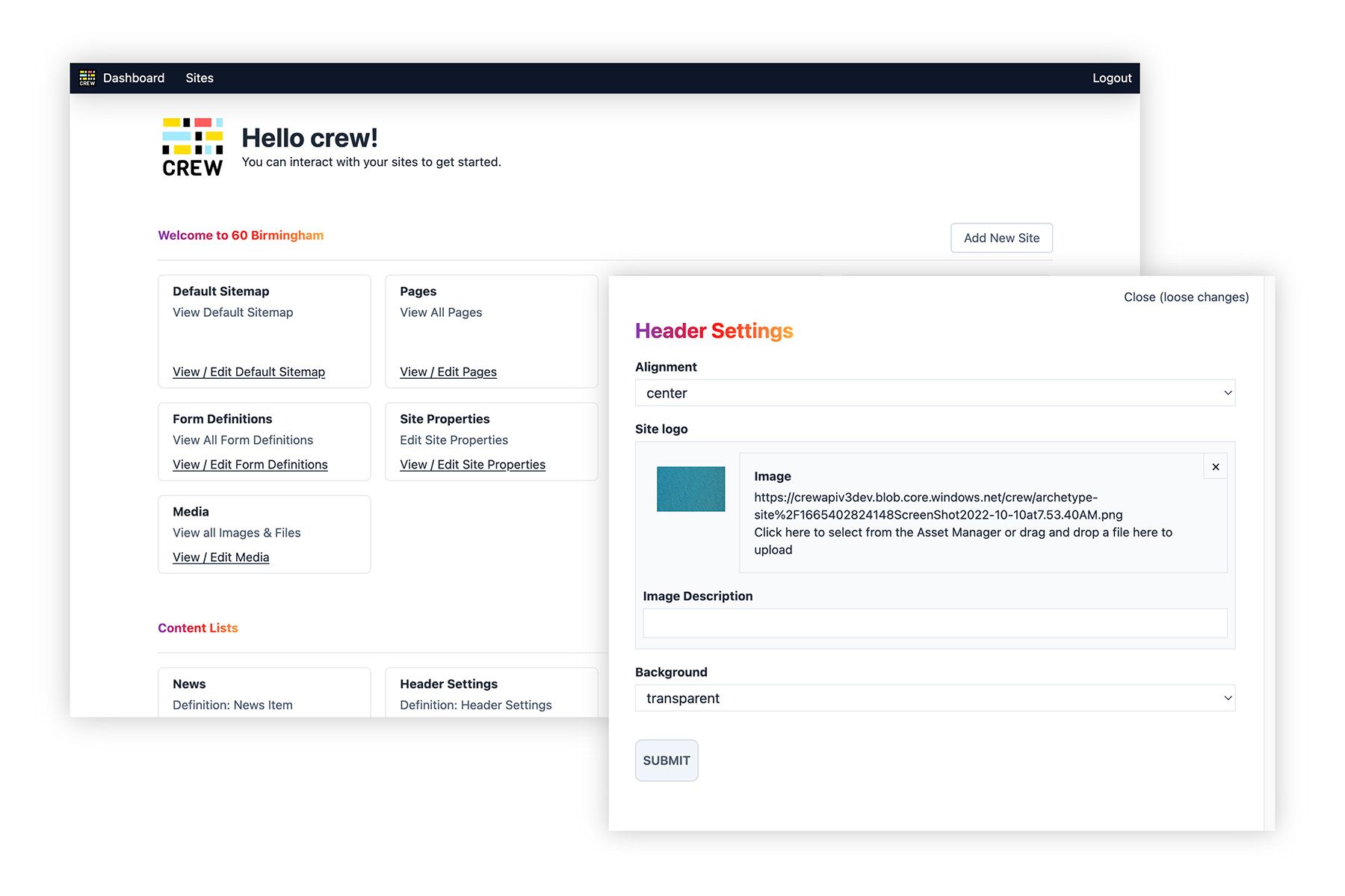
The CMS powering QuadReal’s project is called Crew CMS, an independent SaaS-based content management platform that Chris and his team developed. What makes Crew unique is that it’s the only CMS that’s built exclusively for commercial real estate – particularly mixed-use office towers, shopping centers, and landmark properties.
Crew isn’t designed for every website. It focuses tightly on what buildings actually need from a digital presence: a polished, marketing-forward website that showcases the property, supports leasing activity, and improves the day-to-day experience of tenants and visitors. As Chris explained, it grew directly out of dotFusion’s long history of building sites for major malls and REITs.
“We had been building headless for the last 10 or 11 years, and we were seeing the alternatives that the shopping center and building people were going to go to,” he said. “We started asking, why don’t we just build our own niche CMS, just for buildings, because we know all the features and functions they need. And the reality is, they don’t need much.”
Source: Crew CMS
Functionally, Crew CMS zeroes in on a small but high-impact set of features – things like tenant directories, promotions, wayfinding (including parking and directions), integrations with space inventory systems, and support for things like food court ordering and basic building services.
Crew is architected as a headless platform using React and Next.js, with all the property information exposed via APIs and statically rendered for performance and security. One of the key differentiators is multi-site management from a single login, enabling low-code corporate marketing teams at large real estate groups to manage dozens of buildings at once.
“Out of the box, we can have the corporate director of marketing go and make an update, and it impacts all their properties,” Chris added. “So that’s really attractive to them. It’s super, super basic, but it’s just so easy for these companies to deal with it, they don’t really notice it on their bottom line."
Crew CMS is intentionally lightweight and low-friction. Priced at just a few hundred dollars per month, it’s an easy win for property owners who once spent big bucks per site but are now under intense budget pressure. Because the platform handles only public-facing marketing content (no personal or protected data) and is rendered via modern infrastructure, it naturally sidesteps many of the heavier compliance and security burdens that enterprise platforms carry. At the same time, the stack and component model leave room for owners to apply their own accessibility mandates and tools on top.
What really underpins Crew CMS is dotFusion’s agency DNA and service culture. The product is backed by a team that has spent decades working with some of the largest commercial real estate owners in the world, and that experience is “wholesale exported” into the platform and its onboarding. As Chris told me, relationships are key, and dotFusion will often white-glove migrations, manage content updates, and even operate almost as an extension of a lean property marketing team.
The result is not just a vertically oriented CMS, but a tightly scoped, product-plus-service offering that makes digital operations for buildings simpler, faster, and far less painful for the marketers who own them.
Get the real story on the real estate focus at www.crewcms.com

SimpliCity
I love a good portmanteau. That word, appropriated from French, is apropos in the case of SimpliCity – a Canadian-based CMS that serves a “city” with a “simple” solution.
The brainchild of Briana Sim, who can only be described as a passionate firebrand, SimpliCity is a composable, cloud-based CMS that’s purpose-built for unifying municipal digital services. Unlike traditional CMS platforms oriented around publishing or e‑commerce, SimpliCity was conceived as critical digital infrastructure for cities – supporting everything from property tax payments and recreation sign‑ups to service requests and permitting.

SimpliCity CEO and founder Briana Sim. Source: LinkedIn
As Briana told me, most CMSes are built for publishing or selling. “Municipalities need something for service delivery,” she said. “So we’re like a whole digital infrastructure that supports these complex systems.”
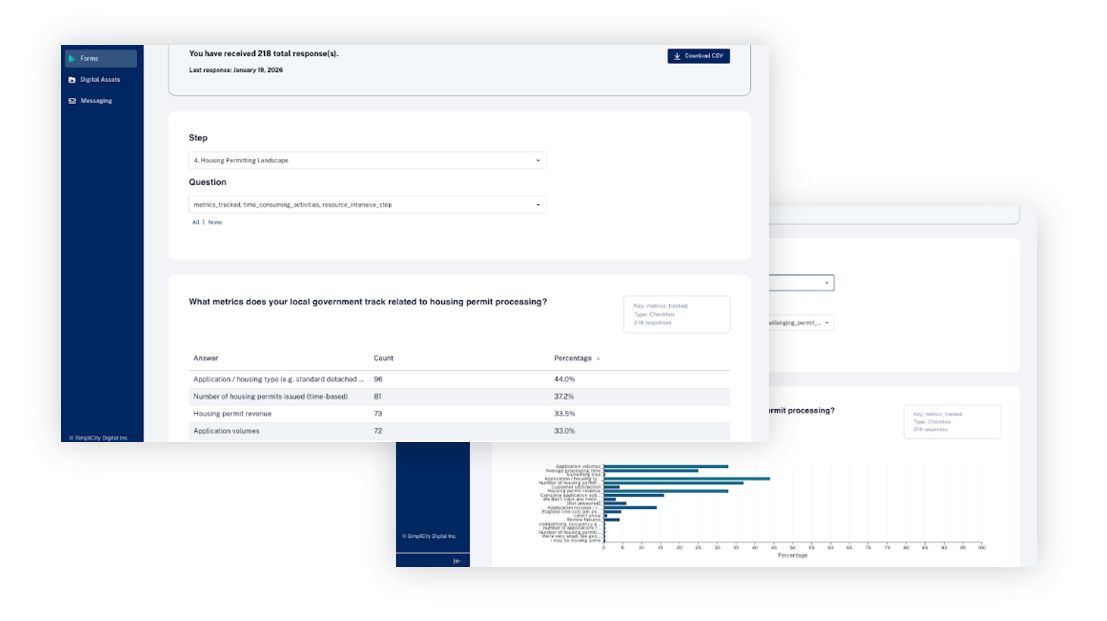
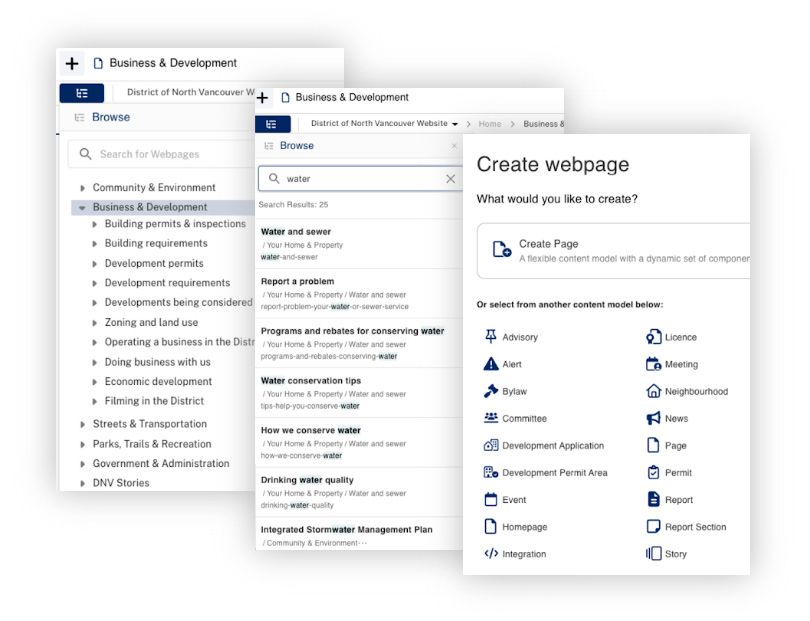
At the product level, SimpliCity combines a staff-friendly console with a headless, API-first backend. Municipal content creators get a familiar administrative environment that’s akin to Drupal or other market products. But that’s where the similarities end: SimpliCity is engineered with out‑of‑the‑box content models for relevant municipal functions like managing a city’s bylaws, news, events, facilities, development applications, contacts, and more.
Within SimpliCity, users can publish alerts for things like snow closures (a common winter event in Canada), as well as manage content and build digital forms – all without developer support. The platform also enables omnichannel delivery to web, mobile apps, chatbots, and even emerging AI interfaces.
Source: SimpliCity CMS
“We built this first to work for the content creators, because those are the major stakeholders that need to use it every day,” Briana said. “Under the hood, everything is structured for composability and reuse. It’s all JSON and structured data, so users understand the context of everything.”
SimpliCity is tightly aligned with the Canadian public sector’s requirements around privacy, data residency, and digital sovereignty. The platform is delivered via SaaS and hosted on Microsoft Azure, with Canadian data centers and per-customer data separation.
“It’s our own infrastructure and our own Azure, but we separate everything behind the scenes by customer,” Briana explained. “It’s designed with British Columbia’s especially strict privacy regime in mind.”
Source: SimpliCity CMS
This managed, multi-tenant architecture removes operational burden from municipal IT teams. Uptime, security, hosting, and scaling are handled by SimpliCity, so staff can free up their time to optimize service delivery or even explore the frontier of AI innovation – instead of just “keeping the lights on.”
SimpliCity’s goal, quite simply, is to be more than a CMS. And that’s exactly what it’s delivering to citizens in the municipalities they serve, like the District of Kitimat. With turnkey engagements like this, SimpliCity works with its sister company, Radical I/O, on both the design transformation and implementation of the CMS.
As Briana told me, her ambition for SimpliCity is to become a sector-wide infrastructure for public services. By enforcing structured, up‑to‑date content (“garbage in is garbage out”), SimpliCity is positioning Canadian municipalities to meet today’s needs and tomorrow’s possibilities. This includes the horizon of AI agents, answer engines, and multi-step, regulation-heavy workflows.
In a rugged, Northern landscape where most cities struggle with siloed systems and fragmented citizen experiences, SimpliCity’s specialized CMS was designed from day one as a unifying force to support the digital frontier for Canadian governments – and to evolve with them into an AI-enhanced, omnichannel future.
Get the simple download at www.simplicitycms.ca
Is specialization the way?
Short of consulting the Mandalorians, it’s not so much “the way” as it is “a way.” But it’s a compelling one that gets back to our roots with blended product and service models.
Specialization isn’t new. Many of the tools in the CMS category began as experiments to reduce the internal baggage associated with content updates to client websites, which often had very discrete, highly customized modules or applications.
Later, when the industry evolved into stand-alone products, some of that heritage was left behind as partner ecosystems – and self-service SaaS – began to scale. Horizontal was the path to growth, but there have always been tools that maintained a clear industry or market focus.
The continued emphasis on specialization is a clear signal that platforms are looking for ways to differentiate. Features alone won’t cut it, and AI is changing the dynamics faster than anyone can keep up. That means a technology-based advantage might be less valuable when your competitor can build parity in record time.
In this ever-expanding morass of complexity, many customers just want a security blanket that wraps snuggly around their digital experience requirements. They might not care about which CMS – they want a partner that can make sage recommendations and handle all the hard stuff. This is more about meeting the customer where they are and listening to their needs.
There are more of these examples out there, and we’ll continue to shine a light on them. Who knows? One of these might be the specialized solution you’re looking for.
Looking for guidance on your next CMS? Talk to us.
Upcoming Events

Umbraco Codegarden 2026
June 10–11, 2026 – Copenhagen, DK
Join us in Copenhagen (or online) for the biggest Umbraco conference in the world – two full days of learning, genuine conversations, and the kind of inspiration that brings business leaders, developers, and digital creators together. Codegarden 2026 is packed with both business and tech content, from deep-dive workshops and advanced sessions to real-world case studies and strategy talks. You’ll leave with ideas, strategies, and knowledge you can put into practice immediately. Book your tickets today.
CMS Connect 26
August 5-6, 2026 – Montreal, Canada
The best conferences create space for honest, experience-based conversations. Not sales pitches. Not hype. Just thoughtful exchanges between people who spend their days designing, building, running, and evolving digital experiences. CMS Connect brings together people who share real stories from their work and platforms and who are interested in learning from each other on how to make things better. Over two days in Montreal, you can expect practitioner-led talks grounded in experience, conversations about trade-offs, constraints, and decisions, and time to compare notes with peers facing similar challenges. Space is limited for this exclusive event, so book your seats today.
Open Source CMS 26
October 20–21, 2026 – Utrecht, Netherlands
Join us for the first annual edition of our prestigious international conference dedicated to making open source CMS better. This event is already being called the “missing gathering place” for the open source CMS community – an international conference with confirmed participants from Europe and North America. Be part of a friendly mix of digital leaders from notable open source CMS projects, agencies, even a few industry analysts who get together to learn, network, and talk about what really matters when it comes to creating better open source CMS projects right now and for the foreseeable future. Book your tickets today.

Contentstack ContentCon 2026
September 30 - October 1, Amsterdam / October 27-28, 2026 – Chicago
Contentstack’s annual customer conference is the premier event for executives, marketing leaders, and developers to redefine their digital experience strategy. This is your opportunity to step out of the "status quo" and into "elite" status, learning exactly how the world’s most successful brands are using the technology you already own to do the impossible. Enjoy a full day of interactive workshops, certifications, and inspirational on-stage sessions designed to help you become an expert on cutting-edge digital strategies and how to turn Contentstack's CMS and adaptive personalization tools into your greatest competitive advantage. Book your seats today.