Life after FAIR? Don’t despair. The pivot to TYPO3 could unlock the future of open source CMS


In my interview with the Crowd Favorite CEO and open source luminary Karim Marucchi, we talk about the fortuitous journey of FAIR in the wake of the WordPress debacle, its second act with TYPO3, and how open source CMS continues to find its way to fertile ground.
As fate would have it, I caught up with Karim Marucchi on the same day that Cloudflare launched the seismic EmDash, its new homegrown open source CMS.
Pitched as a “spiritual successor” to WordPress (although after playing with it for a while, the word Doppelgänger also came to mind), EmDash is a pause – much like its grammatical namesake. I say that because it’s forcing a lot of people to retreat, put on their thinking caps, and unpack what this moment really means.
Look at them side by side, and you can see that spiritual connection:
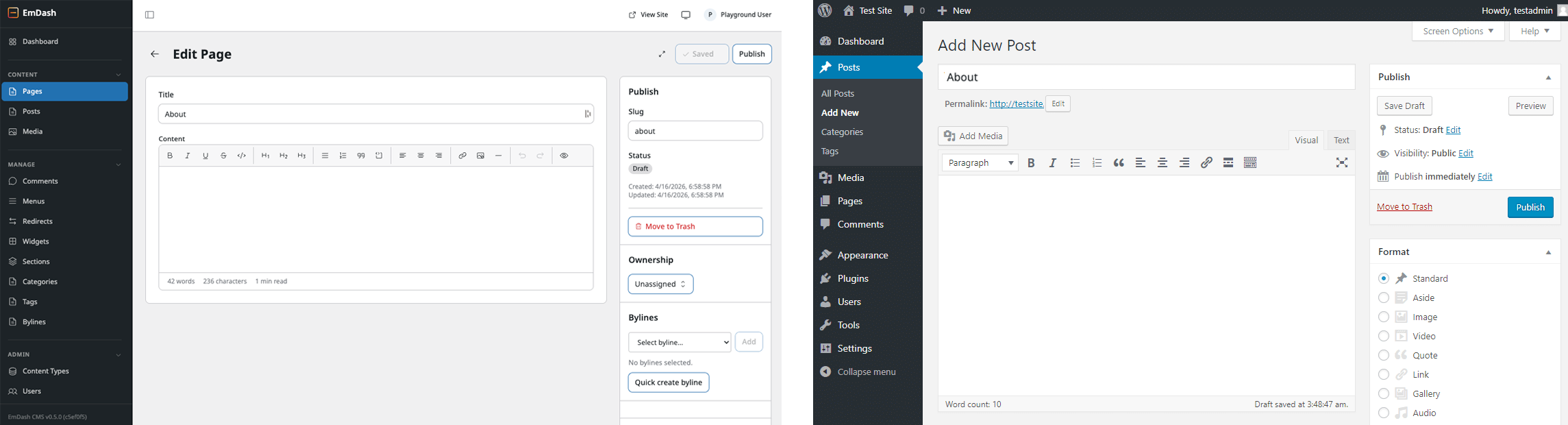
Separated at birth: The EmDash and WordPress editing experiences.
As you enjoy your hiatus (if you need one), ponder this: WordPress still represents over 40% of the CMS market footprint. Among websites with known CMSes, the number is even higher, more than the rest of the market combined. We’re talking over half a billion websites, from skinny landing pages to massive commerce workloads. Arguably, this density of adoption makes WordPress one of the most successful open source projects in history. Full stop.
Or pause, as it were.
But like all things in life, time is the enemy. And to Cloudflare’s point, WordPress is one of the elder statesmen of the CMS guild, sporting a core architecture that goes back two decades and is woefully out of alignment with modern security standards and development patterns.
Of course, this narrative is nothing new. The corpus of the commercial CMS market has always painted WordPress as less secure, slow to adapt, and replete with exploitable widgets and unsupported plugins – relegating it to the domain of less “serious” projects.
Sure, there’s some truth to the perceived WordPress weaknesses. The whole “where there’s smoke, there’s fire” analogy. As someone who has designed and built many a WordPress site, I’ve run into a few potholes with bad plugins and painful updates, and pitched this narrative when selling the benefits of commercial products.
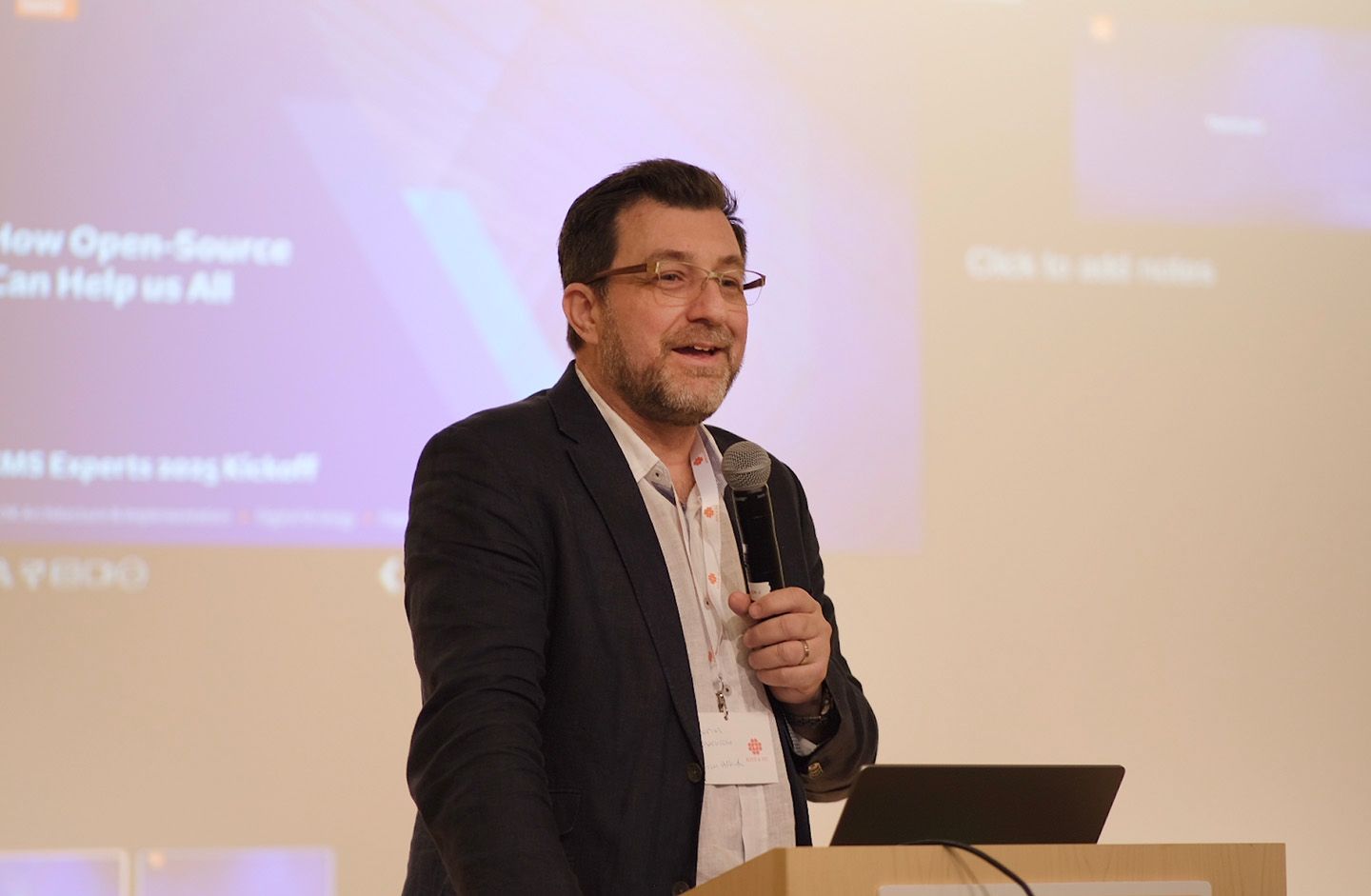
Crowd Favorite CEO Karim Marucchi at the Boye & Company CMS Kickoff 2025.
But Karim has long focused on the upside as CEO at Crowd Favorite, a premier digital consultancy founded in 2007 as the first enterprise WordPress agency. Since then, his team has built complex, secure, and scalable WordPress projects, serving notable Fortune 500 brands like Disney, Nvidia, and Campbell’s.
As he told me in a previous interview, achieving a performant enterprise application of WordPress is all about the implementation.
“In a perfect world, you can use WordPress for a personal site, or Disney’s D23 event,” he said. “If you do it right, you can create software that can be used by anyone globally.”
EmDash is itching a scratch, to be sure. Powered by an Astro and TypeScript foundation with a sleek serverless architecture, it aims to solve the security vulnerabilities of WordPress. For some, that itch is more of a rash, earning it the moniker of the “WordPress killer.”
Opinions on this vary (check out Bastian Sirvend’s early prognosis). When I asked Karim about EmDash, his assessment was blunt.
“I’m not going to say that’s the future,” he said, “but WordPress is more in peril than ever.”
Cloudflare’s danse macabre is merely the latest in a temporal battle over the future of the open web. In late 2024, I chronicled the explosive fallout betwixt the project’s founder, Automattic’s Matt Mullenweg, and WP Engine – a leading managed WordPress hosting provider.
The scorched earth campaign waged on for months. Both sides, armed with legal trebuchets, fired back and forth. In the melee, businesses and agencies relying on WordPress suffered the consequences. You can read the gory details here.
When I first spoke with Karim about the unfolding drama between WP Engine and WordPress, the market was already showing signs of fatigue. The “open sores in open source,” as I framed it then, were starting to fester into something more structural: questions about governance, ownership, and the fragility of an ecosystem dominated by a single personality and a handful of platform players.
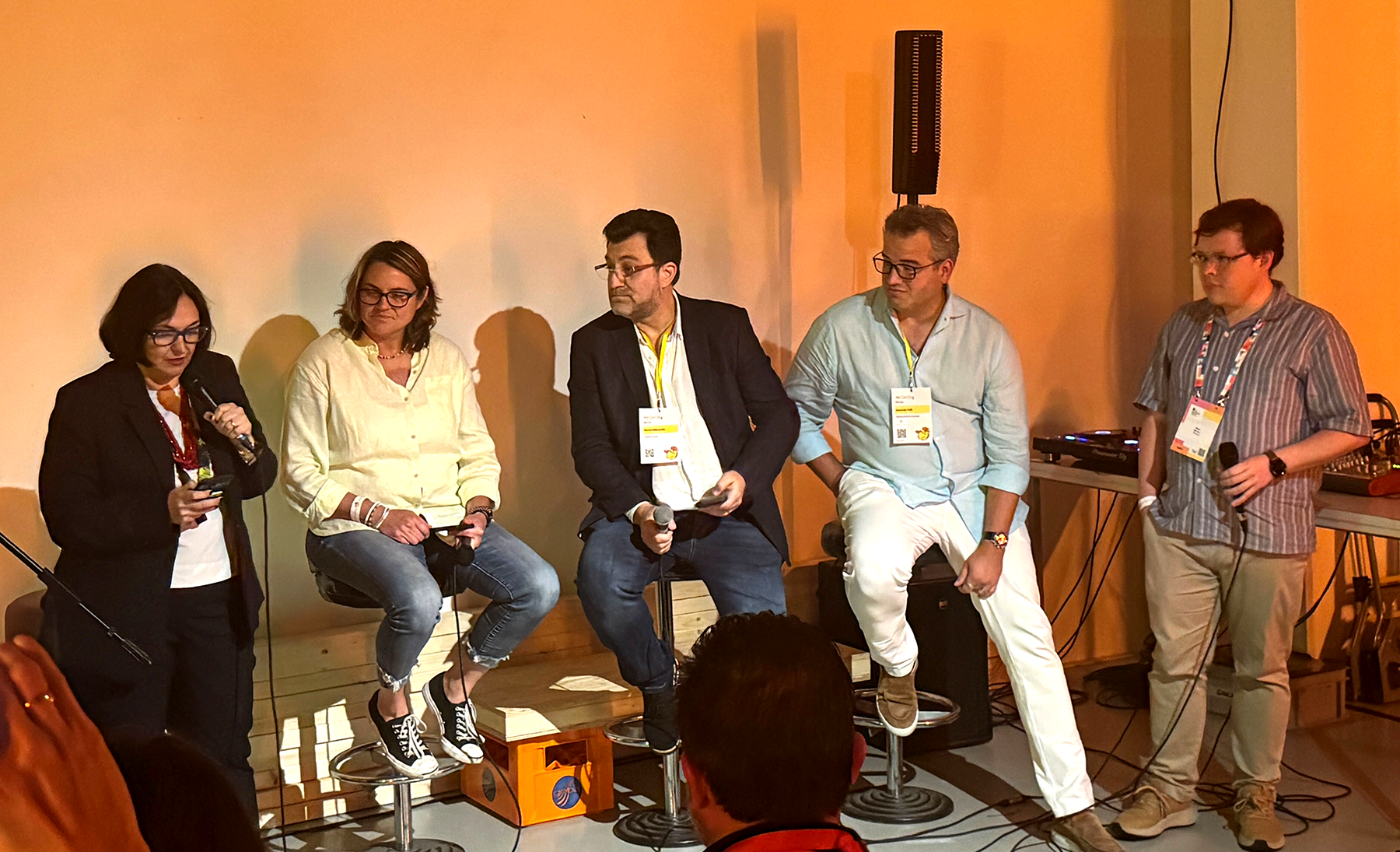
Karim Marucchi and Joost de Valk announcing FAIR at 2025's Alt Ctrl Org in Basel
Last June, I spoke to Karim about FAIR – a kind of grassroots response to the impact of Mullenweg’s heavy-handed blockade. Partnering with Joost de Valk (the namesake behind the ubiquitous Yoast SEO plugin) and a gaggle of committed developers, they engineered a structural intervention that solved a political problem with code.
The FAIR plugin, announced at last year’s WordCamp EU, eliminated the reliance on any single source for core updates, plugins, themes, and more. This independence promised a new era of federation from trusted sources while reinforcing security throughout the software supply chain. It was, in many ways, a prescription for an ailing ecosystem and a vision for sustainability.
But then came the next twist: the large-scale public hosts – an essential layer in the FAIR strategy – were reluctant to embrace it. This forced a reckoning, and ultimately a shelving of the project. As Karim wrote on his blog, goodwill isn’t enough to enable this level of foundational change. It requires adoption, funding, and a shared responsibility.
But wait. Was it a full stop? Or just a pause?
Turns out the FAIR story isn’t over. In my recent conversation with Karim, we discussed how the project has evolved into something much bigger: a multi‑CMS, open source infrastructure play with TYPO3 at the forefront. And along the way, we explored what’s happening to enterprise platforms, SaaS economics, agencies, and the evolution of the content management landscape.
From WordPress cure to multi‑CMS backbone
The roadblock to FAIR wasn’t fair at all. Technically and architecturally, the solution performed exactly as Karim, Joost, and their collaborators intended. The problem was the political economy surrounding WordPress, which stymied its adoption amongst large-scale players like GoDaddy – who hold enormous leverage over what gets deployed at scale in the WordPress ecosystem.
When they didn’t throw their weight behind FAIR, a technically sound project was at risk of becoming strategically sidelined.
“It works 100%, and its scalability and security have been tested for maintaining WordPress sites,” Karim said. “It’s a completely viable product. But what we realized is that without an install base, you’re building something that is more of a perceived vanity project, and there’s no reason to continue going if you’re not getting buy-in.”
At that point, Karim made a calculated pivot, distinguishing FAIR as more than a WordPress.org alternative. This became a sort of inflection point, where he saw it not just as an answer to the WordPress conundrum, but a lever for ensuring the supply chain for other open source ecosystems.
While this thinking applies to large install bases with broad adoption, Karim positioned it as a salve for a major enterprise problem: large organizations needing private ecosystems that don’t depend on the health of a public plugin directory. This idea of pulling, mirroring, and adding internal governance is where FAIR could make an outsized impact.
"Technically, this is why we can declare victory with WordPress, as large organizations now have something they can download and install to solve the supply chain problem.”
“If I’m a Fortune 50 client or a university, I can set up my own infrastructure that grabs certain packages from WordPress.org, copies them, and stores them locally,” he explained. “I can create my own packages and my own rules and everything else. Technically, this is why we can declare victory with WordPress, as large organizations now have something they can download and install to solve the supply chain problem.”
FAIR might have fallen short of its original goal, but it’s now serving as a template for resilience. Given his history with WordPress, I had to ask Karim where he thinks the project is heading now that FAIR is looking elsewhere. As he told me, Gutenberg’s aging database design and the mixing of content, settings, and code in the same field connote heresy.
But the problems aren’t just technical – they’re structural.
“I still think it’s a viable solution if you need to build a complex website,” Karim said. “But the refusal of Matt Mullenweg and Automattic to give up unitary ownership of WordPress, the lawsuit that they’re in with WP Engine, the way that it’s no longer seen as a true open source project? WordPress is being killed from the inside.”
Finding a new home with TYPO3 – and a proving ground
At the Boye & Company CMS Kickoff 26 in January, I caught up with TYPO3 CEO Daniel Fau and the project’s ambassador, Mathias Bolt Lesniak, both of whom I've connected with previously. Daniel helped enroll me as a judge for the 2025 TYPO3 Awards, which offered some truly impressive entries.

Left to right: Daniel Fau and Mathias Bolt Lesniak
On deck was the forthcoming Open Source CMS Conference, which is being held later this year in Utrecht. For the first time, leaders and practitioners from numerous projects will be in one room, discussing the shared intersection around AI, digital sovereignty, and the future of digital experiences.
As the WordPress war raged and FAIR blossomed, Karim was quietly building bridges with Daniel, exploring the possibility of a new venture in North America – where TYPO3 has a small but growing footprint. While it’s a demonstrably strong player in Europe and the DACH region, thousands of sites in the U.S. are leveraging the platform.
“I was very interested in TYPO3 because of its history and the fact that it’s multilingual, and its database structure and other factors,” Karim said. “We ended up signing on to be the first North American agency partner for TYPO3, and I think it’s a great solution for certain types of customers.”
Getting into the ecosystem, Karim immediately saw an opportunity to address a key problem: the need for an ecosystem for extensions. A few weeks ago, they were able to make FAIR fully compatible with TYPO3 v14, so it now functions as the update engine of its content management system.
The role of FAIR and the Crowd Favorite partnership will be a focus at the upcoming TYPO3 Summit North America, which will be held on May 19th in Atlanta. But this is just the beginning. As Karim told me, he’s been having conversations with other open source project stakeholders to explore how FAIR can create what he calls an “open source hub” for organizations.
“Imagine a world where we’ve created an open source support project that could help multiple CMSs and other projects," he said.
The agency reckoning in an AI-first world
One of the more provocative parts of our discussion wasn’t just about CMSs or platforms, but about how agencies themselves are changing under the weight of AI-assisted development. I’ve been talking to a lot of agencies recently – from RDA to Razorfish – and AI is stoking the “build versus buy” conversation in new ways.
As Karim told me, Crowd Favorite isn’t just experimenting on a small scale – they’re moving rapidly into production, leveraging AI-assisted code generation with the necessary patterns and security controls to speed up delivery in entirely new ways.
This is also where the intersection with open source is providing an essential foundation. As Karim reinforced, AI is eroding the advantage of heavily licensed, monolithic enterprise platforms. Agencies know how to wield these tools, but choosing the right open source layer is critical to achieving successful outcomes. He doesn’t see any platform as the answer out of the box, but it provides the canvas – and a cost-effective one.
“Crowd Favorite is writing code six to ten times faster than we did a year ago, and that includes putting all the checks and balances to make sure that it’s not adding in other open source code or other licensed material via IP checks,” he said. “The cost of using an open source CMS as a foundation layer to create a customized experience with completely customized workflows is cheaper than it’s ever been before.”
“The cost of using an open source CMS as a foundation layer to create a customized experience with completely customized workflows is cheaper than it’s ever been before.”
Karim is clear-eyed about the consequences of this shift, both for agencies and vendors. He told me that 2026 is likely to be a challenging year as agencies adapt to this new reality – one where the technical moats dry up. In his mind, they have to prove differentiated value in architecture, governance, and strategy to raise the bar.
So where does this leave products in the stack? As we’ve seen, enterprise buyers are becoming more fluid, less willing to lock in. And at the same time, they’re asking questions that cut to the heart of SaaS economics. Karim validated this.
“I know a lot of my clients who are moving from some very well‑known SaaS products to their up‑and‑coming disruptor alternatives, but none of them are signing long‑term contracts,” he remarked. “I’ve had meetings at Fortune 50 companies where they’ve asked us for estimates to replace the SaaS with an open source solution that’s on‑prem, one‑time capex cost. The cost is less than a quarter.”
There’s no question that we’re seeing a broader rebalancing of value away from locked platforms and toward composable, open, and controllable stacks. But Karim sees an opportunity for open source to play a pivotal role in distributing the weight in the right direction.
To illustrate how agencies can adapt, Karim pointed to Control Center, an ERP-like product that Crowd Favorite built – but not in the traditional “license and bill hourly for customization” way.
“We’re not charging by the hour or for the code,” he said. “The value is in the monthly business consulting on the output of that product. The bad news is that it’s going to be a tenth of the value for me as an agency. But I’ve got a high moat around it. I can provide a lot of value, so you’re going to continue using me for a long time.”
What’s clear is that agencies can’t continue to cling to the old model of high-margin, slow-moving implementation. Those that embrace open code, composable foundations, and AI‑accelerated delivery – and then layer on meaningful human expertise – have the best shot at thriving in this new world.
Open source as a composable foundation
A recurring theme in our conversation was how composable architecture is misunderstood – especially in the way it’s been marketed as a weapon against monolithic platforms. Karim argued that the real decision isn’t within the dichotomy, but the realization that open source platforms are foundational layers that enable composable architectures.
Unfortunately, from his perspective, this concept isn’t well understood.
“Everybody seems to think there’s this hard divide between it’s either a platform or WordPress,” he explained. “We say ‘composable versus monolithic,’ but nobody asks, ‘What does that really mean?’ And I don’t mean composable process plugins. I mean composable as in, there’s a foundation – and there are different pieces to it.”
He went further, framing how commercial services – HubSpot, Salesforce, or other SaaS tools – can be part of a composable stack, as long as your data and business logic live in an open, sovereign core. FAIR, he said, is one of the layers that makes this possible by handling updates, extensions, and security in a composable way.
“On the licensing side, it’s seen as a complete platform, even if they call themselves ‘composable,’” Karim outlined. “I’m constantly trying to educate customers that it’s not WordPress or TYPO3 versus a platform. It’s looking at which open source foundation is the right foundation for a composable ecosystem on top.”
This is where TYPO3 becomes a compelling play, offering the open source sovereignty and well-structured, multilingual, enterprise‑ready foundation. Now, with FAIR under the hood, it can serve as a durable core for composable architectures, giving it an edge as it grows into new markets of adoption.
Life after FAIR: Open fields, not closed doors
Karim and I previously discussed the dilemma facing commercial platforms from an investment trajectory. The piper will come a-callin’ as they say. And in an era where software is getting cheaper and faster to build, the moats are drying up.
This time, we veered into a candid conversation about private equity and how it’s slowing down the very transformation that AI and open source are making inevitable. Karim shared examples of PE‑backed companies that were offered faster, cheaper, revenue‑positive paths – and turned them down because they didn’t fit existing internal narratives about how products “should” be built.
By contrast, FAIR’s trajectory – and Crowd Favorite’s bet on TYPO3 and open-source foundations – represents a different kind of playbook, where leaning into open source can activate and accelerate innovation. And by leveraging composable architectures complemented by FAIR, agencies and enterprises can de-risk complexity.
To be sure, we’re all wrestling with the realization that SaaS and revenue models are facing steep headwinds. How much will they change? Is the SaaSpocalypse real? It’s too early to tell, but the signals are getting stronger. As Karim noted, focusing on long-term value in human expertise rather than extracting rents from static licenses remains the strongest bet.
Maybe FAIR wasn’t the knight in shining armor that saved WordPress. As Karim eluded, you have to know when to put down the sword. But sometimes, the hero rises to fight another day, and TYPO3’s willingness to collaboratively embrace FAIR to underpin its ecosystem is what open source looks like: a community in action.
Is WordPress in peril? Perhaps. It certainly has its share of challenges, from its architectural legacy to its political strife. Those optics seem dire, but they also represent an opportunity for solutions that can position themselves as serious, future‑ready alternatives for enterprises seeking control, sovereignty, and flexibility.
Amidst this chaos, the open web is entering a new phase, one that’s shattering assumptions across the ecosystem – and AI is its seismic center. Heck, Drupal CMS 2.0 has brought AI into its core, and we’re bound to see more of this transformation, even on the open source frontier.
At a time when a war was waging in WordPress, FAIR emerged as more than a plugin. It was a lifeboat. A shared vision that signaled enduring strength in a creative collective. In that sense, it crystallized what open source means as a project about people, not just products.
As FAIR begins its second act, it leaves behind the gravitational pull of a single, embattled ecosystem to roam new fields across the broader landscape of open source content management.
The good news? There’s plenty of fertile ground to cultivate.
Upcoming Events

JoomlaDay USA 2026
April 29 - May 2, 2026 – Delray Beach, Florida
Be part of the Joomla community in one of the most iconic cities in the world! JoomlaDay USA 2026 is coming to Delray Beach, and you can join us for a dynamic event packed with insights, workshops, and networking opportunities. Learn from top Joomla experts and developers offering valuable insights and real-world solutions. Participate in interactive workshops and sessions and enhance your skills in Joomla management, development, design, and more. And connect with fellow Joomla enthusiasts, developers, and professionals from across the world. Book your seats today.
CMS Summit 26
May 12-13, 2026 – Frankfurt, Germany
The best conferences create space for honest, experience-based conversations. Not sales pitches. Not hype. Just thoughtful exchanges between people who spend their days designing, building, running, and evolving digital experiences. CMS Summit brings together people who share real stories from their work and platforms and who are interested in learning from each other on how to make things better. Over two days in Frankfurt, you can expect practitioner-led talks grounded in experience, conversations about trade-offs, constraints, and decisions, and time to compare notes with peers facing similar challenges. Space is limited for this exclusive event, so book your seats today.
RAISE Amsterdam
May 20, 2026 – Amsterdam, Netherlands
Sponsored by Kontent.ai, RAISE Amsterdam brings together bold marketing and technology leaders to explore how agentic AI is reshaping the way ambitious brands create and deliver content and what it takes to use it safely, responsibly, and with proper governance. Experience the ideas that are shaping the future and dive into big thinking, innovative strategies, and expert insights. Held at the Klein Canvas, Volkshotel, you'll hear from world-class speakers in dynamic sessions that will reveal how AI-powered content operations are accelerating production, improving governance, and driving creative impact. Limited spots are available, so book yours today.
Umbraco Codegarden 2026
June 10–11, 2026 – Copenhagen, DK
Join us in Copenhagen (or online) for the biggest Umbraco conference in the world – two full days of learning, genuine conversations, and the kind of inspiration that brings business leaders, developers, and digital creators together. Codegarden 2026 is packed with both business and tech content, from deep-dive workshops and advanced sessions to real-world case studies and strategy talks. You’ll leave with ideas, strategies, and knowledge you can put into practice immediately. Book your tickets today.
Open Source CMS 26
October 20–21, 2026 – Utrecht, Netherlands
Join us for the first annual edition of our prestigious international conference dedicated to making open source CMS better. This event is already being called the “missing gathering place” for the open source CMS community – an international conference with confirmed participants from Europe and North America. Be part of a friendly mix of digital leaders from notable open source CMS projects, agencies, even a few industry analysts who get together to learn, network, and talk about what really matters when it comes to creating better open source CMS projects right now and for the foreseeable future. Book your tickets today.