Diving Deep with Palmata: Contentful Uplevels AEO to Help Brands Understand and Influence AI Discoverability

The content platform just launched a new offering designed to give organizations vital insight into how AI answer engines represent their company – and enable teams to understand, measure, improve, and control their brand’s reputation in AI search and discovery. Interview with CMO Elizabeth Maxson.
If you’ve ever been snorkeling or diving in the Caribbean, you know how intoxicating the ocean is. From the Cayman Islands to Virgin Gorda, the sea shimmers like diamonds in the hot equatorial sun, revealing a crystal-clear aquatic wilderness teeming with life.
Among the schools of tropical fish and marine flora lies the Acropora Palmata, commonly referred to as “Elkhorn” – a hard coral variety known for its thick, robust branches that resemble an elk's antlers.
Over thousands of years, these Palmata have built the Caribbean’s delicate yet resilient reef systems, providing a habitat for countless aquatic species. Swimming around these structures can feel otherworldly, like a submerged jungle from the Avatar films.
What makes the Acropora Palmata’s fluidic ecosystem so divine is the clarity of the surrounding water. Even above it, you can make out the spongy texture of its flat arms, waving up towards the sun. But there’s more to this world that lies below. Much more.
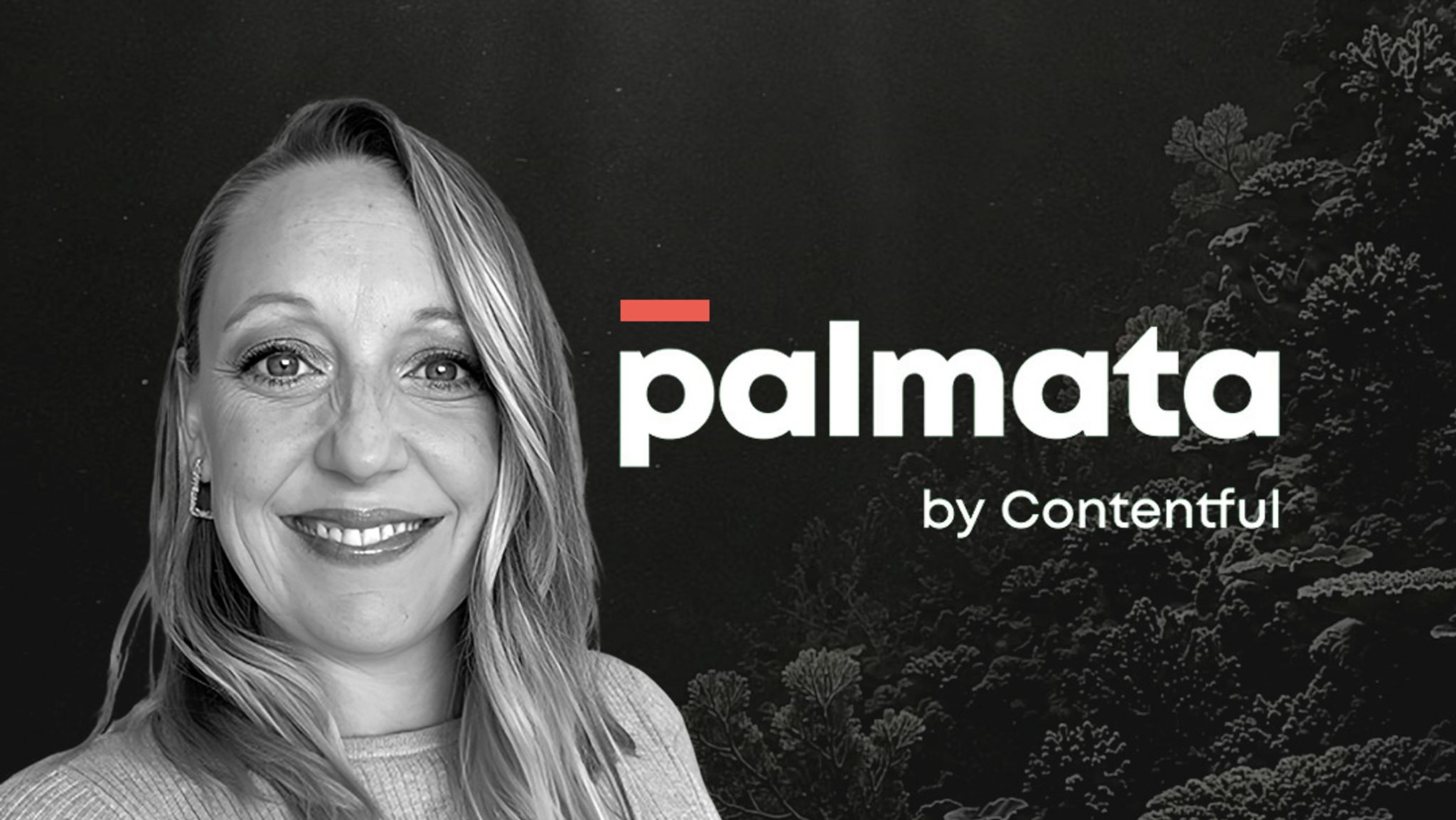
When I recently connected with Elizabeth Maxson about Contentful’s new AI discovery platform – aptly named Palmata – I was intrigued by its unusual name. As the content platform’s CMO, I knew she would have the inside scoop on the new brand. As she explained, this natural phenomenon has become an important metaphor for how they think about AI discovery.
“Coral looks simple from the surface,” she told me. “But below the waterline, it’s part of a living, complex, interconnected system. Its shape is influenced by currents, light, pressure, organisms, and time. You can’t understand the reef by looking at one branch. You have to understand the conditions around it. AI discovery works the same way.”

Contentful CMO Elizabeth Maxson. Source: LinkedIn
A great answer to describe a complex environment of factors – many beyond our control – that contribute to a brand’s visibility in the world of AI search. As Elizabeth pointed out, an AI-generated answer is only the visible surface. Beneath it are source signals, competing claims, category associations, content gaps, language patterns, authority signals, and the broader digital ecosystem shaping how AI systems interpret a business. Contentful built Palmata to help organizations understand this hidden system.
“We reveal the relationships shaping how AI systems describe, compare, and recommend a business,” Elizabeth said, “so teams can see what is influencing AI understanding, where the gaps are, and which content decisions are most likely to matter next.”
What is Palmata?
Palmata is the latest offering from the pantheon of CMS and DXP platforms that aims to capitalize on the burgeoning space of AEO (Answer Engine Optimization). I’ve been writing about it since early last year, when products began to emerge like Otterly.ai, and platforms like Semrush and Conductor started to evolve.
The consumer shift to answer engines like ChatGPT and Google’s AI Overviews has led to a precipitous decline in traffic – something we spoke at length about on the last episode of The Matt & Matt Show. People are turning to these channels to research products, compare brands, and make purchase decisions. Now, AI systems are weighing in before customers ever visit a website.
Meanwhile, the website audience itself has also tilted towards AI. According to recent data from Cloudflare Radar, the CDN’s bot traffic dashboard, humans lost ground to machines for the first time in internet history. That's a sea change (pun intended) that can't be ignored.
The fact is, websites aren’t giving these virtual visitors what they need. Brands spent years optimizing for search engines, but AI systems are different – and marketers need both the tools and knowledge to help understand how they discover, interpret, compare, and represent their companies in these new channels.
During my opening keynote at our CMS Kickoff in January, I pointed to the rise of AEO as a focal point for both agencies and enterprises in 2026. We’re at the halfway point, and this new discipline has become an urgent imperative at the C-Level. Unlike SEO, which was about improving performance in search results, AEO is about preventing invisibility. A more dire threat.
Palmata aspires to be more than the average AEO platform, going beyond just tracking visibility, ranking, and mentions. It was designed to help organizations understand the factors that influence AI-generated answers and provide tangible, prioritized guidance on how to improve them. For marketers like Elizabeth, this is about translating value from the complex waters we’re all treading.
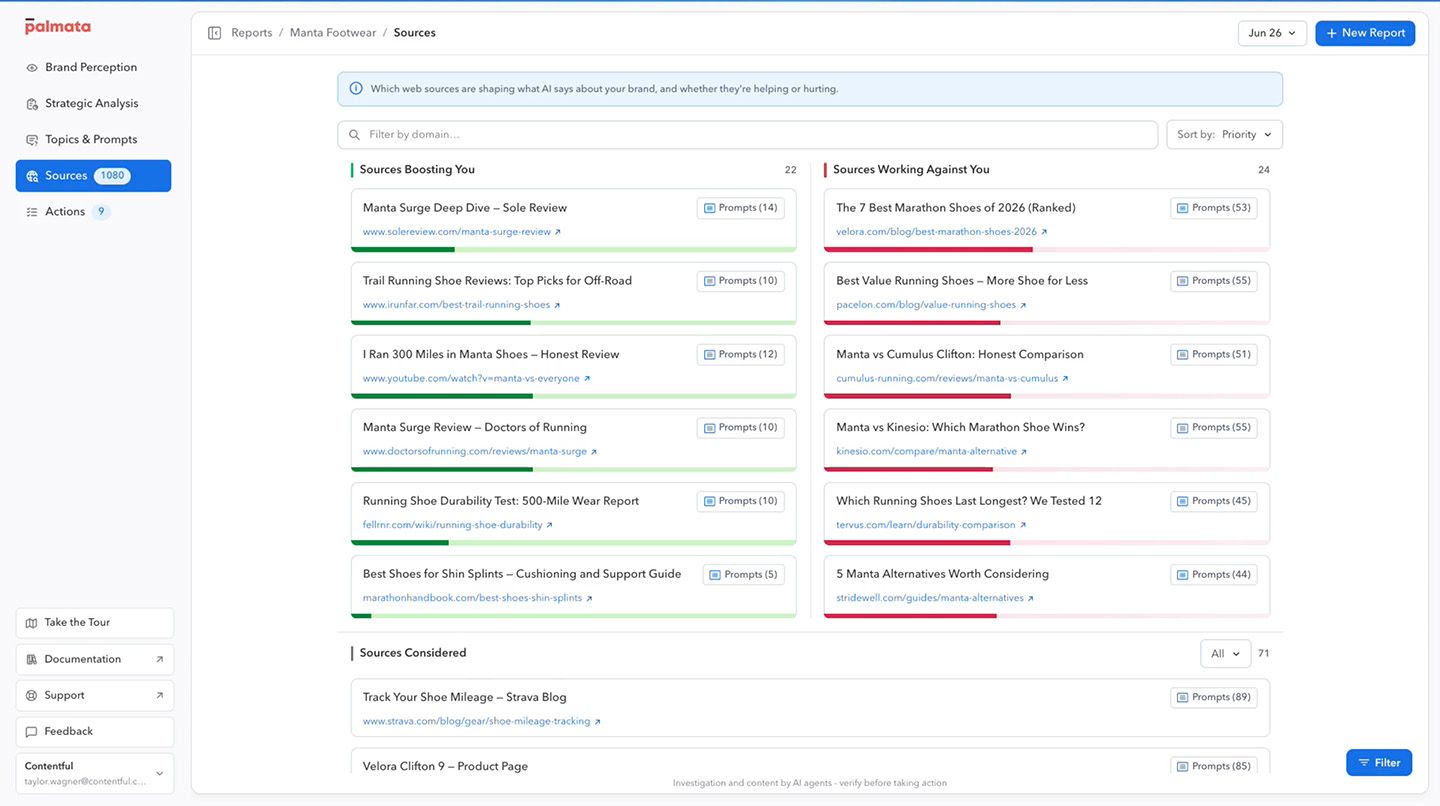
The Sources view in Palmata displays which pieces of content are helping and hurting you. Source: Palmata website
By leveraging its proprietary deep research agent, Palmata helps teams understand which content that the answer engines might be drawing from. But it goes further, identifying the opportunities that really matter and prioritizing the actions most likely to influence visibility across the answer engines.
Insight is great. But in the end, it has to be actionable, enabling teams to confidently control their brand’s reputation. This is where Palmata is aiming to differentiate: by helping marketers go deeper and navigate the sharp but delicate coral below.
Agent-powered intelligence for AEO
Palmata was designed to capture meaningful signals from the surrounding noise that exists in the digital reef. This is key, as AI-generated answers draw on a wide range of these signals – and not just from a single web page, keyword, or prompt.
Perhaps it's fitting that Sounder, Palmata’s proprietary discovery agent, has a “sonar” theme to its branding. Functionally, it's a kind of ambient listening station that observes, learns, and synthesizes the signals that influence AI-generated answers.
How does it work? First, Sounder analyzes publicly available data to build a baseline. But it goes further, researching a company's market, competitors, audiences, content footprint, and digital ecosystem. By harnessing this data, Palmata nurtures a deeper understanding of the factors shaping AI discovery and reputation.
“The Sounder Discovery Agent is what makes Palmata more than a visibility tool,” Elizabeth explained. “It continuously builds context around a business, enriches that context with market and audience intelligence, analyzes the sources and signals shaping AI-generated answers, and translates those findings into recommended actions and modeled impact. That depth of research is what allows Palmata to give marketers a full picture of how AI systems understand and represent their brand along with guidance they can actually act on.”
A flexible, feature-rich toolset for enhancing AI discovery
Palmata puts a lot of control in the hands of users – and they’re already using it. This is codified by several high-profile launch partners that include The Atlantic, Box, Dataiku, Docusign, Marketbridge, and TELUS Digital.
Early input from these brands points to positive results, with Palmata delivering on AI discovery as a credible growth strategy. It also highlights the importance of control and the ability to target Palmata with intentional precision.
“The feedback we're hearing is that marketers don't just want to measure what's happening in AI, they need a way to understand what matters, prioritize where to focus, and confidently steer their strategy in response,” Elizabeth explained. “Teams consistently tell us they value Palmata's ability to steer research toward what matters most to their business, whether that's specific brands, product lines, competitors, audiences, languages, or regions. Rather than receiving generic AI visibility reports, they can focus on the questions that directly influence business outcomes and marketing decisions.”
Palmata didn't fall far from its sophisticated CMS parent. Like Contentful, it has an elegant UX that’s easy to navigate and is focused on clarity. You can see how the company’s proven history of managing content operations at scale has been applied to this new interface, where top-level analytics and resources are within arm’s reach – much like Contentful’s Content Insights app.
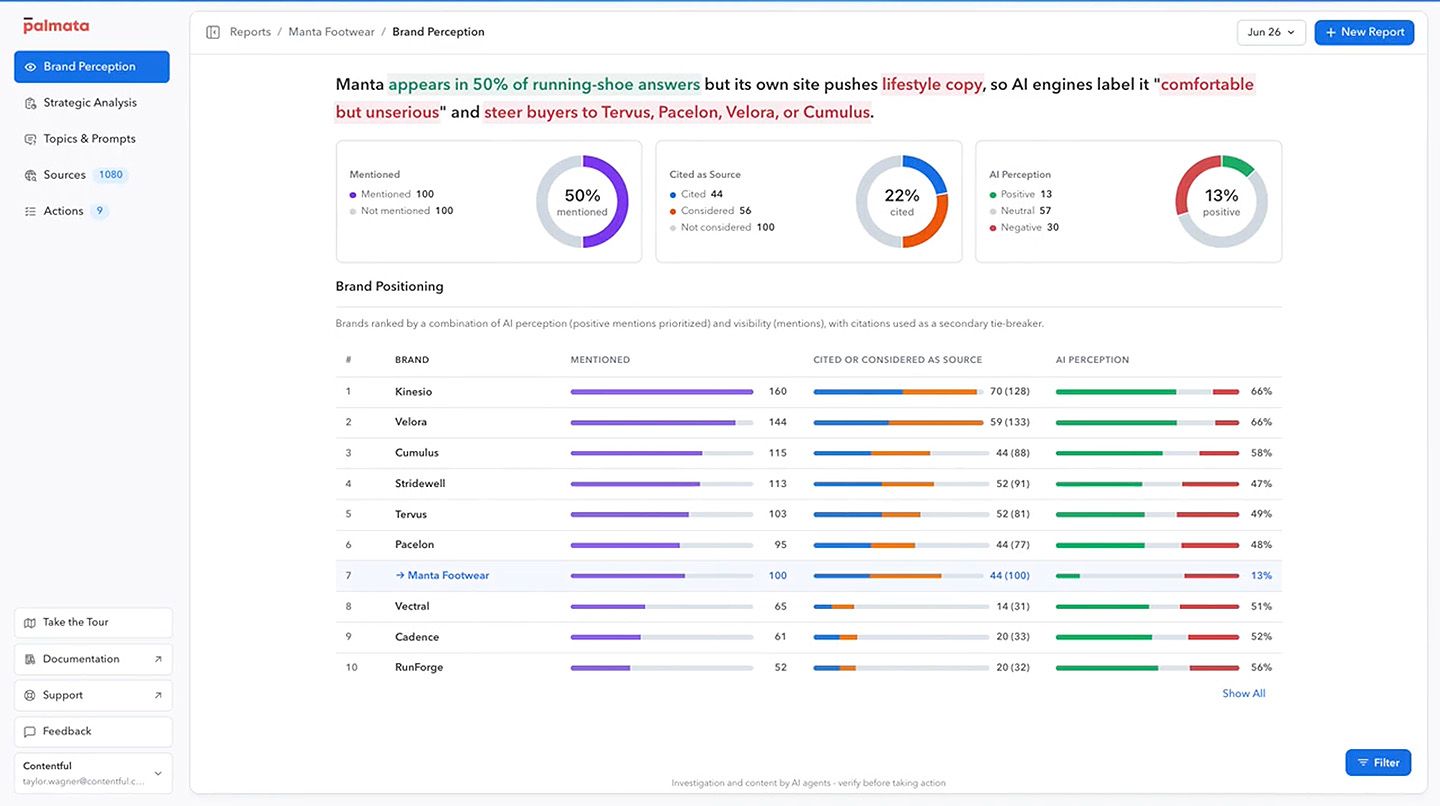
Source: Palmata website
Palmata relies on four core capabilities to turn insights into real action. First, there’s Steering Control, which delivers as advertised. It allows teams to focus their research on specific brands, products, competitors, audiences, segments, and other strategic priorities relevant to their business goals. This is a feature that TELUS Digital is leveraging with specificity to see exactly what AI says they do and where that information originated.
Speaking of steering, I love how easy it is to access reporting and quickly explore topics and prompts. You can peruse coverage maps to compare when and how your brand shows up. Color coding gives you a quick indication of how your brand is performing, and you can drill down into deeper insights to understand how often brands show up in prompts.
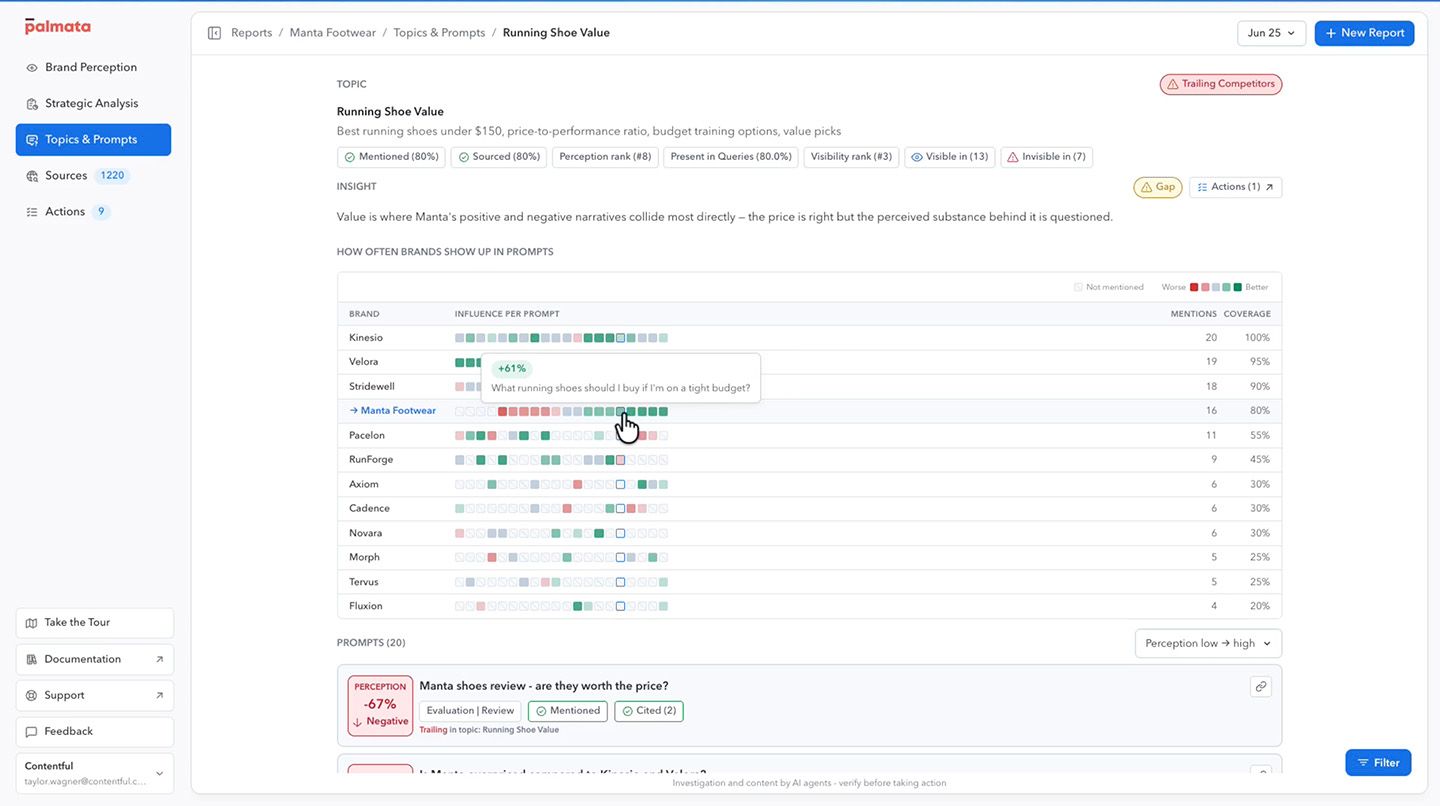
Source: Palmata website
There’s also Adaptive Deep Research, which continuously develops context around facets like competitors, category, audiences, and the broad digital landscape. It’s purpose-built to uncover the factors that shape AI discovery and influence how a brand appears in AI-generated answers.
Source: Palmata website
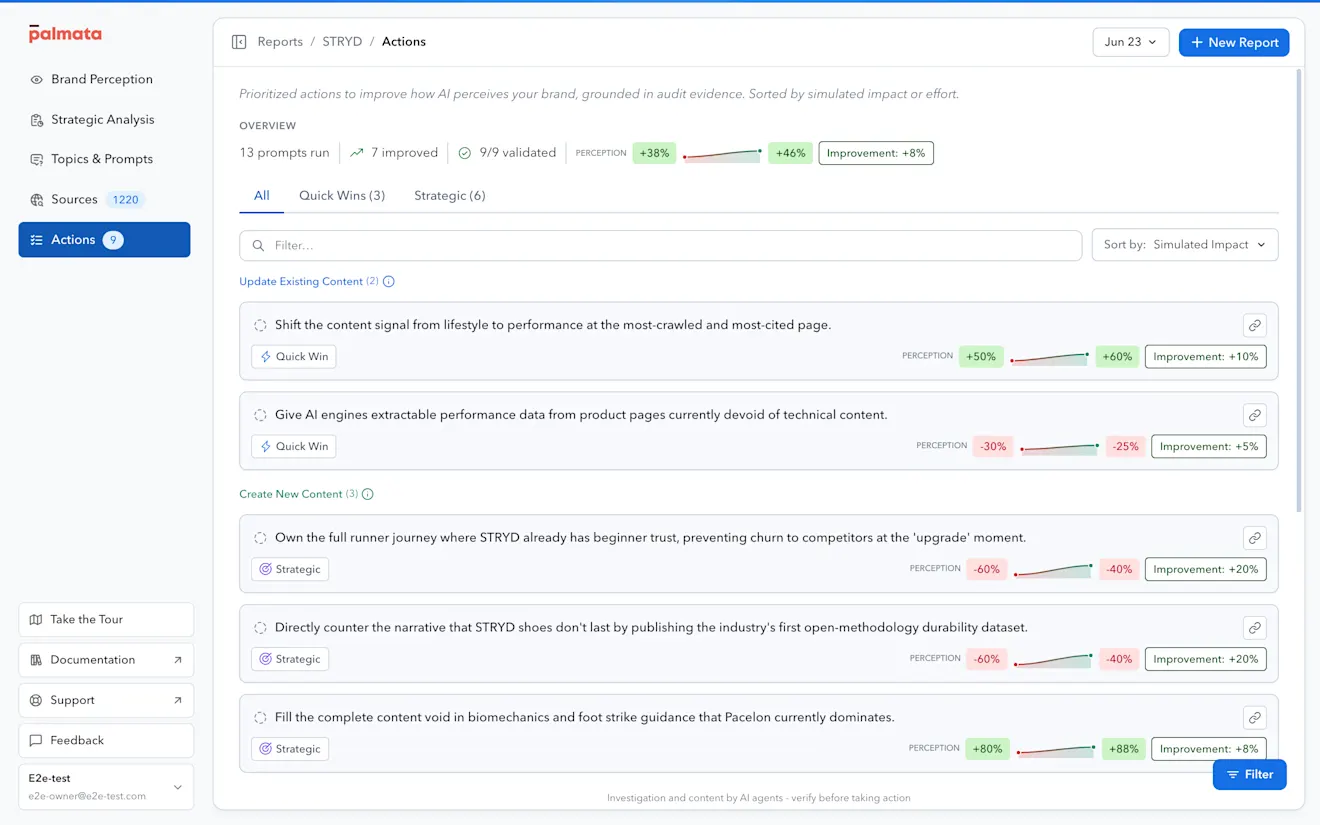
Recommended Actions is, as you might surmise, a kind of “actionable playbook” – ranking a list of tangible moves you can make. Each is tied to a buyer’s question it could impact, like quick wins and strategic opportunities that have the best shot at improving how a brand is represented in AI-generated answers.
Finally, there’s Simulated Impact, which models how recommended actions may influence AI reputation. It’s a proactive planner, allowing teams to compare opportunities, understand tradeoffs, and prioritize investments before committing additional time, budget, and resources.
“As TELUS shared, the Steering Control functionality allows them to direct Palmata toward the products, audiences, and competitors they care about most, creating a much clearer path from insight to action,” Elizabeth said. “We're seeing similar value from larger, more complex organizations. Docusign highlighted how Palmata's Adaptive Deep Research helps them understand how AI systems are representing different parts of their portfolio and identify the most strategic opportunities to improve visibility and influence.”
As an AI tool for the AI era, Palmata is also designed around modern marketing practices, and that includes an MCP server that allows you to read reports and answer questions through your assistant of choice (ChatGPT, Claude, etc.).
Taking a standalone approach – with no CMS required
Contentful isn’t the first platform to add an AEO-focused offering to its ecosystem, but it’s taking a different path by separating the concerns. Elizabeth explained the strategy, which maps to the company’s long-held belief that content is the foundation of digital experiences. Palmata buils on this vision.
“We needed to meet the market where the problem is showing up,” she said. “As AI becomes a primary interface for brand discovery, organizations must optimize their content for AI systems, not just websites and search engines.”
While other platforms have engineered AEO and GEO features into their native CMS and DXP ecosystems, Palmata was envisioned and deployed as a standalone product (it even has its own website at www.palmata.ai). There’s no dependency on Contentful or any CMS for that matter, giving marketing teams a way to focus on AI discovery more directly.
So who’s the target audience? From a practical perspective, it’s marketers. But more broadly, both enterprise and agency stakeholders are hungry for actionable solutions – and Contentful is thinking about both channels as it takes Palmata to market.
“We see a direct opportunity with brands because marketing leaders are feeling pressure to solve for AI-driven discovery right now,” Elizabeth punctuated. “At the same time, agencies can play an important role in helping clients translate those insights into content, digital, and brand strategy. So we see this as a both-and market.”
Standing out in a noisy new category
AEO might not be the newest kid on the block, but it's still young. So, too, is the race to dominate the AI discovery narrative, which really heated up with Adobe’s purchase of Semrush last November. At the time, GEO (Generative Engine Optimization) was the AI acronym du jour, and Semrush – the internet's SEO darling – was making a pivot towards the land of LLMs. That roadmap attracted a sizeable suitor.
Since then, the temperature has been rising steadily. In the last few weeks alone, the DXP category has been a hotbed for AEO transformation: Sitecore announced its acquisition of Scrunch, an AI CX platform, while Optimizely unveiled a full AEO solution in partnership with Conductor – a leading search intelligence platform. Meanwhile, there are dozens of smaller players like SurfaceGX coming online with some interesting downstream solutions and solid features.
The net takeaway? It’s getting noisy. And fast. But for enterprises, key considerations are driving the decision at a higher level, and that could tighten the field at the top.
I asked Elizabeth how Palmata is rising above the static in an increasingly competitive landscape. As she noted, Contentful has spent years helping brands think about content as a strategic system, and Palmata brings that same mindset into the age of AI discovery.
“Much of the noise is still centered on visibility, rankings and mentions, but Palmata is designed to go deeper than that,” she told me. “It helps teams understand what’s actually shaping AI-generated answers, why those perceptions exist, and what to do next. That’s how Palmata cuts through. Not by adding another dashboard, but by moving from measurement to action and giving marketers a clear path to improving AI reputation over time.”
I already mentioned how AEO has become a business imperative and not just a marketing consideration. As such, the volume has increased at the C-Level, where budget is being allocated to these initiatives. That’s creating a groundswell of opportunity, and many enterprises I’ve spoken to are turning to their trusted digital partners – including agencies and vendors – for validated, complementary solutions.
“What stands out most from the feedback loop is how urgently CMOs need answers,” Elizabeth said. “As AI becomes a primary way consumers discover brands, marketing leaders are under increasing pressure to understand how their company is being represented, where they are gaining or losing visibility, and what actions will have the greatest impact on their AI reputation. It's not about getting more data, but also insights that are relevant enough to inform their strategy."
The verdict
Coral is a fascinating natural phenomenon. It’s beautiful. Mysterious. And while it might appear to be a rock or plant formation, it's actually a marine invertebrate – a living animal that forms an intricate underwater network that supports the ocean’s biodiversity.
A coral reef, like AI discovery, might feel like a complex alien landscape. Marketers are being dropped into this environment and asked to improve the conditions for survival. That’s nearly impossible to do without a concrete understanding of this new world – and how to thrive in it.
AEO might seem like the answer, but it’s still a new discipline. Will it stand the test of time, even as Google contends that it’s just a part of SEO? There are numerous unanswered questions, from policies to procedures. Much of it is being engineered on the fly, with emerging tactics like llms.txt and special schema feeling a bit like revolving doors.
Brands are anxious for guidance amidst the uncertainty. And while the new crop of AEO tools looks promising, monitoring and measurement are just the beginning of the journey. We need tangible strategies, and Palmata is delivering a more complete toolbox for enhancing visibility, perception, and reputation across these AI channels.
There’s certainly a lot of intelligence in Palmata. Take the Considered Sources, for example: the referenced links might feel overwhelming, but search marketing pros will probably feel right at home with the density of data (like addressing toxic backlinks in Semrush). Palmata also does a great job of organizing the detritus, allowing you to grab high-level insights, target specific products, and drill down in just the right places.
Is Contentful’s choice to launch Palmata as a standalone product the right move? It could be. There’s certainly sound logic behind it. AI visibility is a problem every brand faces, regardless of its CMS. Abstracting it from any dependency allows for greater flexibility, so I see a check in the win column.
It’s hard to know how – if at all – Salesforce might weigh in, which recently acquired parent Contentful in early June. Perhaps this move influenced the decision to deploy Palmata as its own entity. The ink is still drying on the deal, but I largely saw the acquisition as a positive move for both Contentful and Salesforce. We’ll see how things unfold.
Content operations is evolving, and brands aren’t prepared for what’s ahead. Palmata is Contentful’s answer to this challenge, helping marketers dive deep into the coral – and create scalable, adaptable, and future-ready content strategies with actionable insight.
My Recommendation: Right off the bat, Palmata has a lot to offer. It’s thoughtfully designed and gives users a lot of control over critical business dimensions. I like the standalone nature of the product, which gives it a focused posture as compared to other composed DXP offerings, as well as the availability of an MCP server to access everything through your assistant. I ran my own free report, and found several of the data points and recommended actions to be revealing.
The pricing is relatively clear and ranges from a free tier to a Growth plan for $600, which is limited to 120 credits per month. Large enterprise teams can build custom packages. I would inquire about any additional parameters during an enterprise demo, but you can get a sense of how billing and credits function in the product documentation – which, as a whole, is super intuitive.
Palmata is generally available in select markets, and you can run your first report at no cost. Deploying with launch partners was a smart move for validating performance, so this is definitely worth a test drive if you’re evaluating AEO solutions. Heads up: when you create your account, Palmata reviews each submission, so there could be some delay in activation (at least for now).
Upcoming Events
CMS Connect 26
August 5-6, 2026 – Montreal, Canada
The best conferences create space for honest, experience-based conversations. Not sales pitches. Not hype. Just thoughtful exchanges between people who spend their days designing, building, running, and evolving digital experiences. CMS Connect brings together people who share real stories from their work and platforms and who are interested in learning from each other on how to make things better. Over two days in Montreal, you can expect practitioner-led talks grounded in experience, conversations about trade-offs, constraints, and decisions, and time to compare notes with peers facing similar challenges. Space is limited for this exclusive event, so book your seats today.
Open Source CMS 26
October 20–21, 2026 – Utrecht, Netherlands
Join us for the first annual edition of our prestigious international conference dedicated to making open source CMS better. This event is already being called the “missing gathering place” for the open source CMS community – an international conference with confirmed participants from Europe and North America. Be part of a friendly mix of digital leaders from notable open source CMS projects, agencies, even a few industry analysts who get together to learn, network, and talk about what really matters when it comes to creating better open source CMS projects right now and for the foreseeable future. Book your tickets today.

Contentstack ContentCon 2026
September 30 - October 1, Amsterdam / October 27-28, 2026 – Chicago
Contentstack’s annual customer conference is the premier event for executives, marketing leaders, and developers to redefine their digital experience strategy. This is your opportunity to step out of the "status quo" and into "elite" status, learning exactly how the world’s most successful brands are using the technology you already own to do the impossible. Enjoy a full day of interactive workshops, certifications, and inspirational on-stage sessions designed to help you become an expert on cutting-edge digital strategies and how to turn Contentstack's CMS and adaptive personalization tools into your greatest competitive advantage. Book your seats today.

Storyblok JoyConf 2026
October 28 - 29, Rheingoldhalle, Mainz (Frankfurt)
JoyConf 2026 is where developers, marketers, and digital innovators come together from all around the world, united by one powerful idea: great content isn’t built by tools alone – it’s built by people who rely on systems to deliver their best work to the world. In an era where technology is increasingly shaped by AI, Content Confidence becomes your competitive advantage. When you can create, manage, and scale content that performs seamlessly across channels, platforms, and AI, you don’t just keep up – you win. Book your seats today.