Controlling the Agentic Climb: Contentstack is Elevating Adaptive Experiences with its AXP Vision

During my recent visit to Contentstack in Austin, Rukshana Karunaratne – the company’s intrepid VP of Global Customer Success – gave me an update on its Agentic Experience Platform and how it’s providing an "architecture of action" to help customers and partners reach new heights in the AI era.
The last year in digital experiences has felt a bit like free climbing El Capitan.
Even if you’re not familiar with the name, you'll recognize the rock. It’s a famous towering formation in California’s Yosemite National Park that rises 3,000 feet from base to summit. It's intimidatingly vertical and casts a long shadow. But if the sight of it isn't monstrous enough, a handful of daring people have climbed it – without a rope.
Conquering AI is a similar ascent. Technology is changing so fast that everyone’s on edge, peering into the abyss. Product cycles have been hyper-compressed, and if you’re not shipping every day, you might slip and fall. And yes, we’re all climbing with risk, hoping not to lose our grip as some new AI-powered innovation disrupts everything.
But somehow, humans persevere – especially when facing mountainous terrain. And agentic AI is a landscape where inspiring feats are enabling us to reach new peaks.
When I was in Amsterdam for the MACH TWO Conference in 2023, the Gen AI conversation was still largely theoretical. Every subsequent event I attended promised GPT connectors and whimsical text and image generation. While most CMS and DXP vendors were overzealously experimenting with content creation, there was a “wait and see” mentality shrouding the overall roadmap.
During the event, I had a delightful conversation with Contentstack’s CEO, Neha Sampat, and its Chief Product Officer, Conor Egan. We spoke about the challenges of composable accountability and the impressive MACH-centric projects their platform was being harnessed to build.
But we also talked about AI, and that led to a demo with Contentstack’s Senior Product Manager Christine Masters. That’s when I saw the granular seeds of what was coming: an alignment between Contentstack Automate, a no-code workflow builder, and its new AI Assistant – which was born out of a hackathon intended to push the frontier of AI capabilities.
By June of 2025, the industry narrative had shifted to agents. This was already a through-line at the MACH Alliance’s “The Composable Conference” just a few weeks earlier, where agentic commerce and MCP were all the rage. At ContentCon in June, I spoke to Neha again, and she told me to “stay tuned” for something special that would transform the operational fabric of how digital experiences are created and delivered.
This gradual evolution coalesced, propelling Contentstack beyond the parameters of a composable DXP. They now view themselves as an Agentic Experience Platform (AXP), claiming to be the industry’s first in this new AI-powered category.
A big part of its completeness of vision rests with Agent OS, a unified framework for orchestrated, adaptive, and on-brand agents. We’ll get into more detail, but suffice to say that this “operating system for agents” is giving Contentstack a decisive edge in these raging agentic seas.

Contentstack’s VP of Global Customer Success Rukshana Karunaratne. Source: LinkedIn
As I saw firsthand with last year’s Lytics (CDP) acquisition, data has been a catalyst for Contentstack’s success. But there’s more to it. At a recent Boye & Company Digital Leaders meeting I facilitated in Austin, I sat down with Rukshana Karunaratne, the company’s VP of Global Customer Success, to explore more of the ingredients that make this mixture so rich.
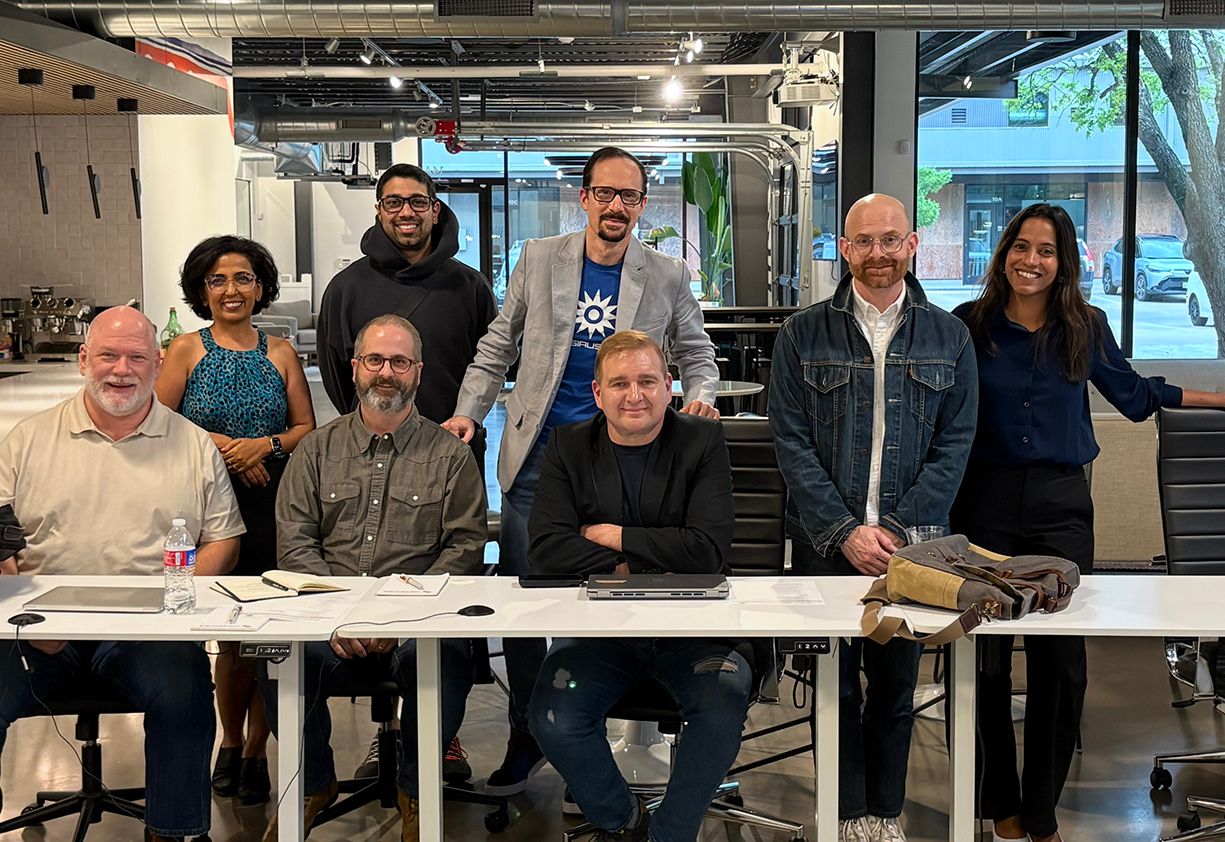
The Boye & Company CMS Experts group meeting at Contentstack’s collaboration space in Austin, April 2026.
As Gartner predicts, 40% of enterprises will have agentic systems in production by the end of 2026. But when it comes to AI, they’re more risk-averse than ever. Too many AI pilots have failed, and according to McKinsey, over 80% of organizations have reported troubling AI agent behavior (like deleting entire databases). There’s never been a more compelling need for secure, scalable, and proven solutions from trusted sources.
During our conversation at Contentstack’s collaboration space (a place that’s as hip as the people weaving in and out of it), Rukshana shared a salient view of how AXP is changing the way her customers think about the intersecting roles of CMS, data, and AI – and how Contentstack is helping them climb to the next peak of AI performance.
Defining an ‘architecture of action’
If the DXP era was about stitching together tools, content, and channels, the AXP era is about something more ambitious: hyper‑relevance at scale, powered by agents that can actually do work. As Rukshana explained, that strategy has crystallized into a powerful concept supported by three key pillars.
“You need some form of an architecture of action,” she explained. And that idea is reinforced by a foundational pillar of automation guardrails, ensuring that AI acts safely and methodically based on the parameters you set. The second pillar is a vital system of context, which is reinforced by its Lytics (CDP).
“Think of that as a memory engine,” Rukshana said, “feeding AI with real-time, up‑to‑date behavioral information so that it can base decisions on facts.”
The third pillar is where the “A” in AXP really comes into focus: Agent OS, the system of orchestration and action. This AI-powered agentic framework transforms Contentstack’s CMS into an autonomous, on-brand Content Cloud that utilizes AI agents and knowledge vaults to provide real-time, 1:1, and adaptive personalization for customers.
“That's the orchestration layer,” she explained. “It's the way that AI starts acting as an autonomous digital workforce and moves from suggesting actions to actually evoking actions.”
Rukshana didn’t hold back when musing about the current state of AI in the enterprise. “Agents today, without content, are just chat overlays,” she said. “That's a saturated market. It's not going to provide an authentic, adaptive experience. And then agents without the context are going to hallucinate.”
Content, context, and orchestration. Or more pointedly: Record, memory, and action. AXP is how Contentstack is codifying everything into a single, coherent platform rather than another AI feature set bolted onto a CMS. As Rukshana said, it has become an architecture of action – one that powers adaptive digital experiences.
“If you don't have all three of these systems, it's incredibly difficult to do this right,” she said.
Agent OS: The automation powerhouse
Last September, when Contentstack first announced Agent OS, it did so under the provocative banner of “Content Management is Dead.” I wrote about it at the time, trying to unpack what this moment meant for the industry – and if the end was truly upon us.
It’s been over six months, and a metric ton has changed. CMS is still around, but is arguably transforming within every vendor’s ecosystem. At the same time, market conditions have shifted. The world feels a little less safe. The economic picture is fuzzy. Tokens are being priced like gold, and the “SaaSpocalypse” has forced serious questions about legacy licensing models.
But these crises are driving a greater urgency for enterprise stability, and Contentstack is stepping up with a clear vision for delivering adaptive experiences. And Agent OS is where the magic happens.
While automation and AI address many challenges for brands, they don’t always operate with full brand and customer context. Agent OS is the unified foundation for AI agents and automations, providing a complete understanding of brand voice coupled with real-time customer insights.
“Automation has been in our DNA for quite some time,” Rukshana noted. “There's deterministic automation that is still going to be incredibly important at enterprise scale, and then the open‑ended generative AI piece of it. We've been working toward this for a while.”
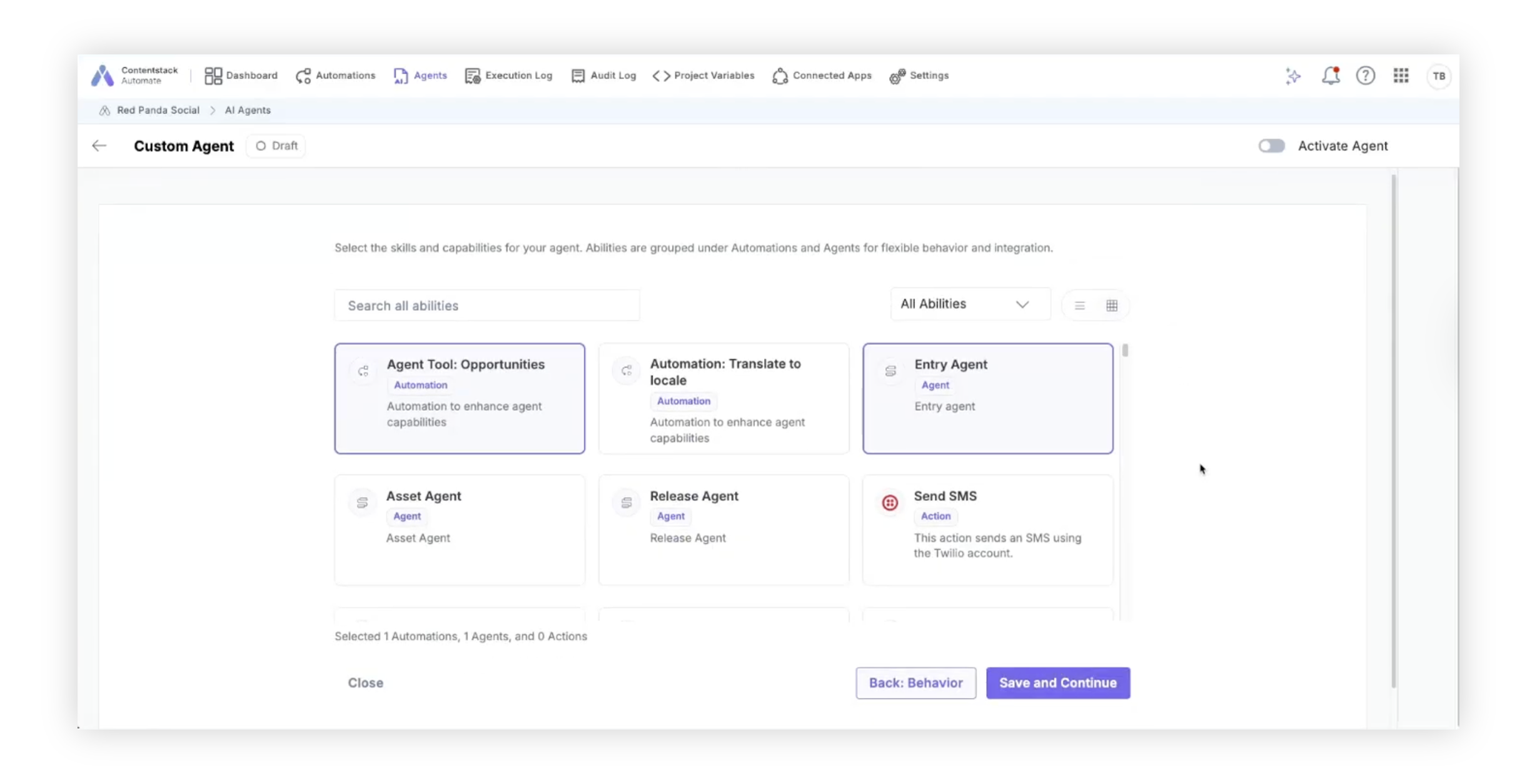
Adding custom agents is a simple, no-code process. Source: Contentstack
She's right – and I've seen the pieces coming together.
Here’s how it works: Agents have access to your content, audience profiling, and other key insights. They can also tap other Contentstack tools to handle predictable tasks and ensure on-brand outputs where it matters. Automations remove the need to switch between tools, set up manual workflows, and configure repetitive, low-value AI prompts. You can also toggle AI models and providers based on specific preferences.
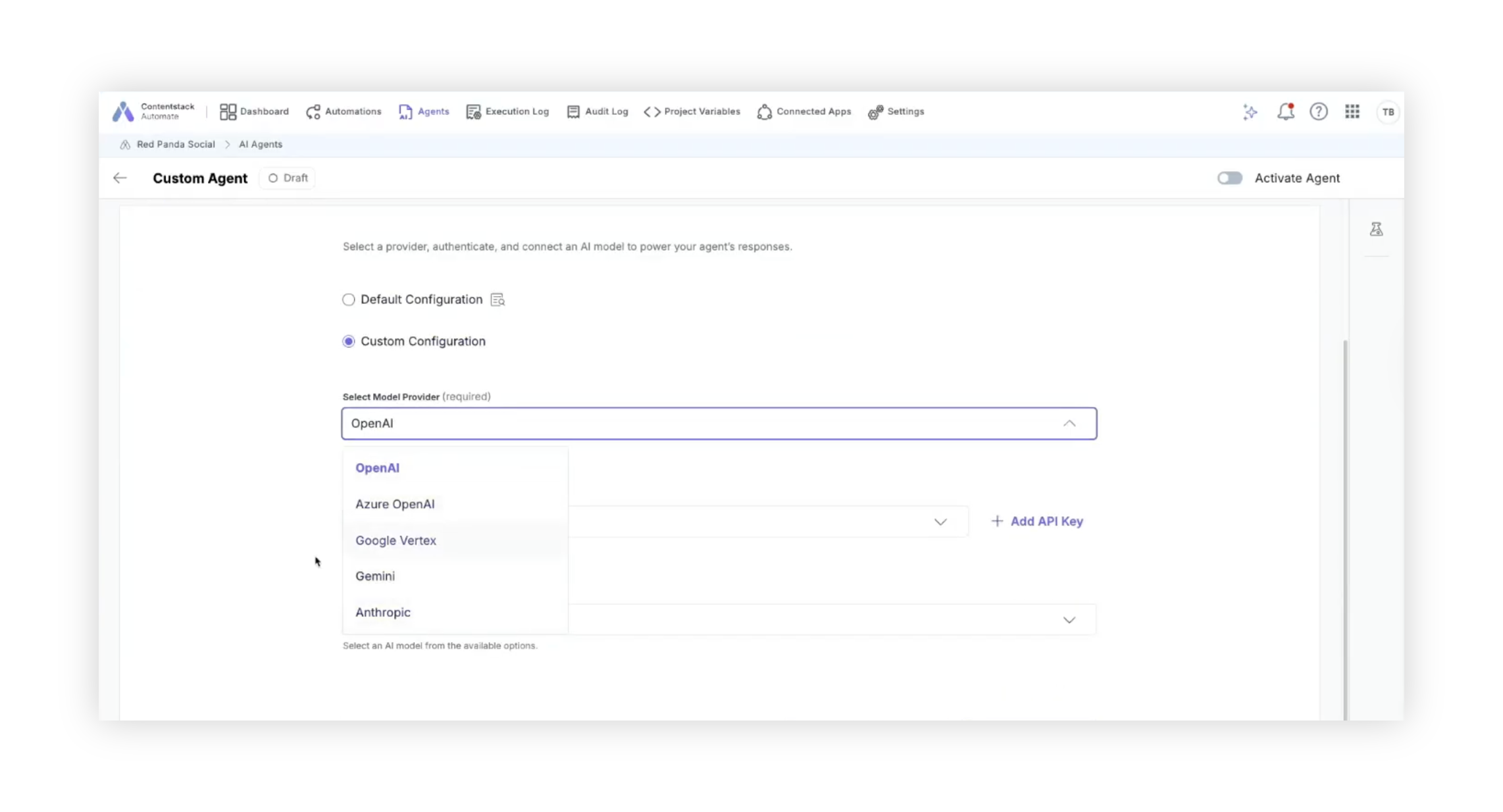
Users can select their provider and model of choice. Source: Contentstack
For enterprises staring down existential questions about brand, compliance, and risk, this is what makes the architecture really valuable. “There are so many AI tools out there that are incredibly agent‑agile,” Rukshana said. “But without the brand guidelines and control, they're going to be context‑blind. They're going to be guessing.”
Also along for the ride is Polaris, Contentstack’s interactive co-pilot. It’s an always-on feature that supercharges productivity and eliminates guesswork for marketing teams.
Agent OS is already proving its value. As Rukshana said, the early use cases might feel more practical, but these no‑code agents are handling mundane tasks for content editors in a matter of seconds, unlocking strategic bandwidth.
Contentstack has been pragmatic about this roll-out, so teams are properly equipped for the journey. “Our plan isn't to drop them on the top of the summit without oxygen,” Rukshana told me. “We want to take them on a controlled climb. Where is the next best opportunity for you to automate? What does that accelerator look like? I don't think the risk is adopting AI too slowly. I think the risk is scaling it without outcomes, control, and context.”
Unifying content, data, and agents for hyper‑relevance
At last year’s ContentCon, there was an image Neha Sampat shared in her opening keynote: two cliffs separated by a chasm, with a luminous skyline of a digital “Nirvana” on the far side.
The point was clear: Brands know where they want to go, but there’s no simple way to cross the expanse. What AXP is attempting to do is build a realistic bridge across that gap with content, data, and intelligent agents.
For Rukshana, Contentstack has the blueprints for building this pathway. “I'm overly simplifying it, but it's ‘Know the customer, know the content, and leverage AI to orchestrate the experience that fits your brand,’” she said.
Of course, the complexity hides in the gaps – and in all the places where those three elements are misaligned. Many of the enterprises she works with are still wrestling with basic activation, and Rukshana said she hears the same feedback over and over from legacy CMS prospects: I have all this data that I collect on my customers, but I can't activate it in real time.
This is where she sees the combined power of Contentstack as a system of record with a system of context as a differentiator. This unification is what promises hyper-relevant experiences, but it requires an agentic system to deliver it.
“So many other vendors are context‑blind,” she said. “So many of them require massive re‑architectures to leverage their platform. In an agentic world, this is a competitive frontline. We used to say that the frontline was digital experiences, but the new frontline is outcome achievement with AI. Are you able to drive the outcomes you need with control and context?”
Speed meets safety with the Contentstack Agent Accelerator
From my vantage point, Contentstack has long differentiated its value through customer service and success – a reflection of its roots as an early headless disruptor with a unique company culture. Its Care Without Compromise program claims a 95% CSR, codifying that support is more than a data point. It's a core value.
On the education front, the company has also produced a lot of resources, including some handy, module-based assets to support the learning journey. AI has been part of the training corpus, going back to the company’s early introduction of an AI Accelerator in its Contentstack Academy, aimed at helping customers discover and integrate generative AI strategically within their workflows.
One of the more interesting things I discussed with Rukshana was the evolution of the Contentstack Agent Accelerator – a new framework for helping customers adopt AXP in methodical stages. She outlined what this might look like at a high level.
“Phase one of an accelerator could be something like solving the digital overwhelm,” she explained. “Just deal with that first. Then work towards phase two, which is automation at scale. Phase three could be integrations like agent‑to‑agent conversations across stacks. And stage four is Nirvana in the form of real‑time agentic digital experiences at scale.”
Crucially, this approach isn’t a rigid path – and that tracks with Contentstack’s track record of meeting customers where they’re at based on maturity. This is where Rukshana’s “controlled climb” comes in, and her team and partners are tuned into this from a people perspective. As such, the accelerator is less about AI literacy and more about business relevance.
“We've anchored everything that we do, especially in post‑sales, to outcome achievement,” she said. “What's keeping your C‑suite up at night? What metric is falling? Let's tie it back to the technology and see where we can infuse AI where it makes the most sense to automate manual requirements and leave more bandwidth to focus on the creative and the strategic.”
There’s also a clear trajectory towards customer self‑sufficiency. The goal, Rukshana explained, is to help customers get to a certain proficiency level using Agent OS, where they're building their no‑code agents without support from Contentstack.
“They're using Polaris within Contentstack to guide them throughout the platform and invoke other agents,” Rukshana said. “But they're doing it in a controlled way because of the foundation they've set.”
Governance, change management, and the enterprise moat
CEO Neha Sampat has long espoused the importance of change management when approaching composable transformation. The MACH Alliance has also evangelized this as a critical topic, reinforcing the need for organizations to embrace the business and philosophical dimensions of digital transformation. The alignment is logical, given Contentstack’s formative role in the Alliance.
Now, in this new age of AI, governance is becoming an essential and foundational covenant. It’s particularly important given the pace of change we’re experiencing – when every morning’s news cycle might include a disruptive “DeepSeek Moment.”
As agentic innovation explodes, many vendors are pushing at the edge. Contentstack hasn’t been slow regarding its agentic ambitions, but it has been methodical and deliberate about meeting the rigors of enterprise workloads. As Rukshana said, the risk isn’t the speed but the lack of control when scaling. That was crystallized at Contentstack’s recent Customer Advisory Board meeting, which is comprised of multi‑billion‑dollar industry brands.
"Customers keep coming back to the intangibles of feeling heard and led. They say, ‘I don't feel lost or scared. I have a partner who's ahead of me, who's thinking ahead of me, and helping me be a change agent within my own organization.’”
“Organizations are aching for a type of phased approach to adoption,” she said, “because the noise in the enterprise is loud. What we will be is the company that recommends the next logical step for you to take. Based on your maturity, based on what we've seen and the research we've done, and the pragmatic use cases other clients have adopted.”
That philosophy extends deep into how Contentstack values people and culture – and that relentless commitment to change management has become a strategic asset. At a customer success level, that means tuning into sentiment and helping clients build confidence as they lead their organizations through massive transformation.
“Our moat is an enterprise seal of approval,” Rukshana said. “The ROI has been clear, and people are out there talking about how significant it has been. Customers keep coming back to the intangibles of feeling heard and led. They say, ‘I don't feel lost or scared. I have a partner who's ahead of me, who's thinking ahead of me, and helping me be a change agent within my own organization.’”
Can we control the climb?
If your palms start to sweat watching Alex Honnold scale El Capitan – or more recently, when he free soloed Taipei 101 – you’re not alone. These are considered some of the greatest and most terrifying athletic feats of all time. Research, careful planning, and intelligence allowed him to map the routes to the top, but it was his human spirit that made the impossible possible.
At the beginning of 2025, only 5% of enterprises had production-worthy agentic systems. It was still largely aspirational. That number is expanding rapidly, but the most secure output is coming from vendors that understand what real automation looks like – and how humans need to be in control.
In Rukshana’s world, Contentstack’s aspirations are turning into reality. She’s candid about the ascent that lies ahead – and what Contentstack faces in the competitive matrix as a challenger in the DXP field. As she told me, the key is educating the market beyond the banner of a being a legacy headless CMS and defining what it means to be an AXP.
“It’s the way we've laid out the AXP as an architecture of action, and how we've simplified the way we're going about it,” she codified. “When I look at our existing install base, the impact we can have if we take them on that controlled climb is going to be massive. Even seeing one or two use cases get unlocked is amazing, because it's the small wins. The minute they get a taste of that, then they get a bit bolder and more confident.”
That’s good. Because it’s going to take bold, confident steps to make this ascent – even if it’s controlled. We can’t see what's around the next corner, so adaptability is one of the most important attributes for anyone exploring the agentic frontier.
Clearly, having an evolved CMS is part of the equipment, but so too is real-time customer data and the essential context that makes AI meaningful. That makes it more than a DXP. And one additional through line from Rukshana was the need for governance, change management, and a phased approach that feels like base stations and camps along the trail.
As other platforms in the CMS and DXP space have recently done, repositioning under an AI-centric banner as an “Agentic Experience Platform” brings both challenges and opportunities. Can it establish clarity as a category? Does it create more or less confusion? Does it dilute the CMS value? There’s an added pressure in this new AI era to explain how tools are delivering not just features, but measurable ROI.
The climb to an agentic future won’t be clean. But if Contentstack’s AXP delivers on its promise, it might offer enterprises the control they need to find the summit – and look towards the next peak with greater clarity.
As Rukshana said, “Pioneers should expect muddy boots.” And Contentstack's are already deep in the dirt.
Get your tickets for Contentstack 2026: September 30-October 1, Amsterdam / October 27-28, Chicago
Upcoming Events

CMS Summit 26
May 12-13, 2026 – Frankfurt, Germany
The best conferences create space for honest, experience-based conversations. Not sales pitches. Not hype. Just thoughtful exchanges between people who spend their days designing, building, running, and evolving digital experiences. CMS Summit brings together people who share real stories from their work and platforms and who are interested in learning from each other on how to make things better. Over two days in Frankfurt, you can expect practitioner-led talks grounded in experience, conversations about trade-offs, constraints, and decisions, and time to compare notes with peers facing similar challenges. Space is limited for this exclusive event, so book your seats today.

RAISE Amsterdam
May 20, 2026 – Amsterdam, Netherlands
Sponsored by Kontent.ai, RAISE Amsterdam brings together bold marketing and technology leaders to explore how agentic AI is reshaping the way ambitious brands create and deliver content and what it takes to use it safely, responsibly, and with proper governance. Experience the ideas that are shaping the future and dive into big thinking, innovative strategies, and expert insights. Held at the Klein Canvas, Volkshotel, you'll hear from world-class speakers in dynamic sessions that will reveal how AI-powered content operations are accelerating production, improving governance, and driving creative impact. Limited spots are available, so book yours today.

Umbraco Codegarden 2026
June 10–11, 2026 – Copenhagen, DK
Join us in Copenhagen (or online) for the biggest Umbraco conference in the world – two full days of learning, genuine conversations, and the kind of inspiration that brings business leaders, developers, and digital creators together. Codegarden 2026 is packed with both business and tech content, from deep-dive workshops and advanced sessions to real-world case studies and strategy talks. You’ll leave with ideas, strategies, and knowledge you can put into practice immediately. Book your tickets today.
Open Source CMS 26
October 20–21, 2026 – Utrecht, Netherlands
Join us for the first annual edition of our prestigious international conference dedicated to making open source CMS better. This event is already being called the “missing gathering place” for the open source CMS community – an international conference with confirmed participants from Europe and North America. Be part of a friendly mix of digital leaders from notable open source CMS projects, agencies, even a few industry analysts who get together to learn, network, and talk about what really matters when it comes to creating better open source CMS projects right now and for the foreseeable future. Book your tickets today.

Contentstack ContentCon 2026
September 30 - October 1, Amsterdam / October 27-28, 2026 – Chicago
Contentstack’s annual customer conference is the premier event for executives, marketing leaders, and developers to redefine their digital experience strategy. This is your opportunity to step out of the "status quo" and into "elite" status, learning exactly how the world’s most successful brands are using the technology you already own to do the impossible. Enjoy a full day of interactive workshops, certifications, and inspirational on-stage sessions designed to help you become an expert on cutting-edge digital strategies and how to turn Contentstack's CMS and adaptive personalization tools into your greatest competitive advantage. Book your seats today.