The AI Sweet Spot: Debbie Tucek on Kentico’s Agentic Marketing Suite and Finding Value Beyond Hype

The DXP’s VP of Product explored the dense jungles of AI as we discussed Kentico’s latest agentic innovation, the focus on impacting marketers, and what’s ahead as orchestration and sovereignty become central topics in the CMS and digital experience conversation.
There’s been an abundance of “wow” moments over the last few years – the kind that leave your jaw on the floor because AI just blew your mind, and everyone starts chanting, “This changes everything.”
Like all tech, these collisions with innovation can feel magical, inspirational, and a bit like being on a tilt-a-whirl at an amusement park. Thankfully, they're generally ephemeral. Things settle down and become, dare I say, a little more predictable. We operationalize, adjust our roadmaps, and normalize our brains and blood pressure to some new reality.
In other words, a shiny new feature becomes mundane.
Are there more “wows” ahead? Absolutely. But they might be a different flavor. Features that eliminate cognitive overload and tool fatigue to give marketers some space to breathe. Less on the order of spellbinding, but still super cool.
When I was listening to Kentico’s Debbie Tucek give her presentation at last year’s Boye & Company CMS Summit in Frankfurt, the weight of context was emerging as a central tenet. CMS was, again, transforming – largely due to AI. But the initial wave of whiz-bang hype had filtered across platforms, and vendors were now focusing on unlocking value beyond the hype.
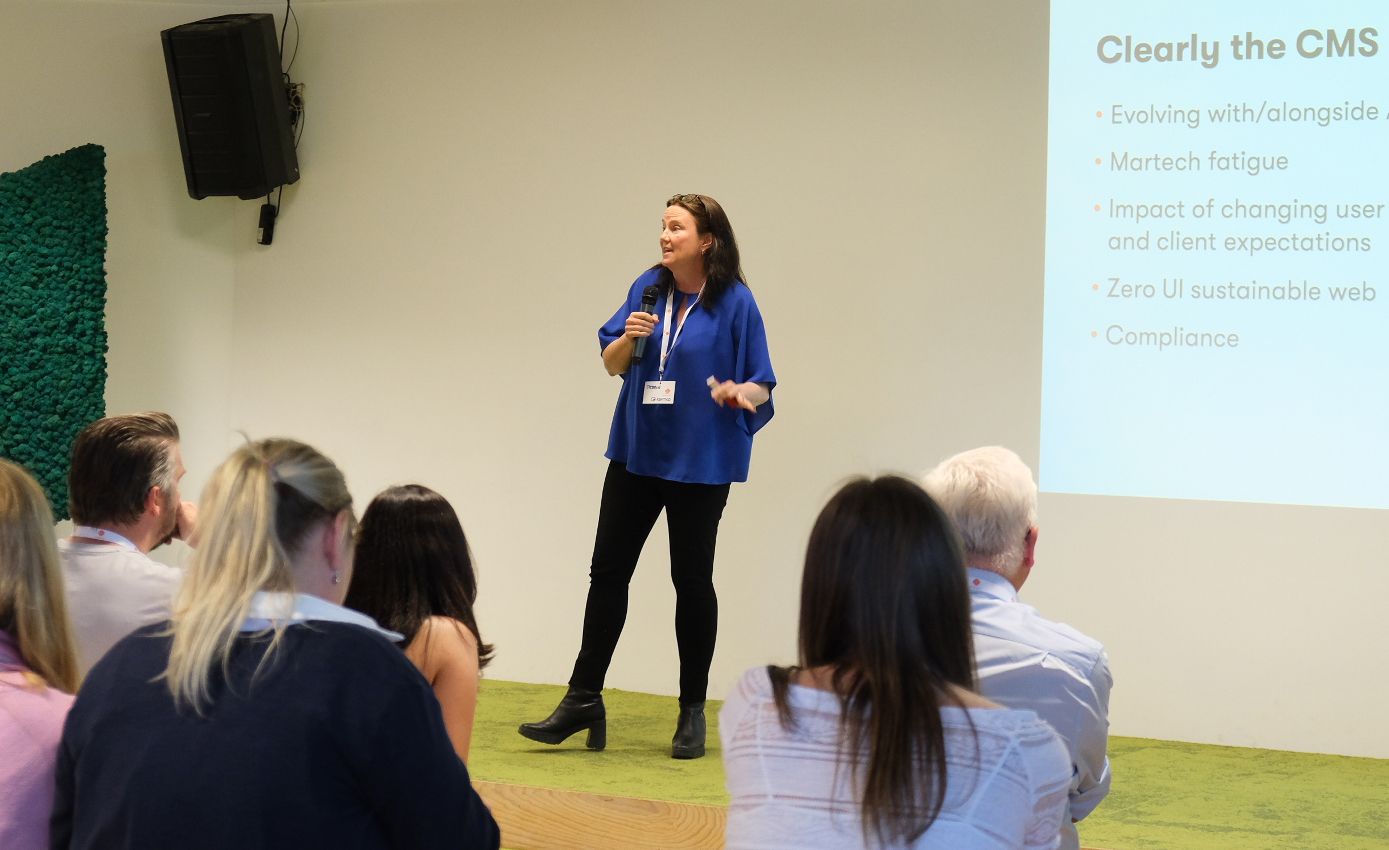
Kentico’s Debbie Tucek at the CMS Summit 25 in Frankfurt. Source: Janus Boye archive
As she observed at the time, the rise of adaptive experiences was forcing vendors, agencies, and customers to reframe their narratives in the marketplace. Almost a year later, with the rapid acceleration of agentic AI, platforms like Kentico are focusing their innovation on empowering marketing teams to turn ideas into measurable results with higher velocity.
At the same time, this question of AI value is coming into sharp relief, particularly surrounding ROI. Durability was front and center during the recent “SaaSpocalypse” (insert whatever name you want here), and the release of Claude Cowork and Tasks for Claude Code – the latter of which is less about AI magic and more about strengthening the principles of software engineering and enabling more persistent memory.
A lot is happening on the AI chessboard, and technology vendors in the CMS and digital experience categories are making bold but necessary moves. Simultaneously, agencies and enterprises are approaching the “build versus buy” equation with renewed gusto as vibe coding becomes commonplace.
Meanwhile (take a deep breath), the need for scalable, reliable, and durable solutions that meet fierce security and governance requirements is more pronounced than ever – and topics like data privacy and digital sovereignty are surfacing in more conversations.
I recently sat down with Debbie to discuss this pileup pastiche, and how Kentico’s agentic tack is keenly focused on reducing confusion and delivering value for customers. As VP of Product, she’s working at the edge to translate the market opportunity and shape the platform’s trajectory.
In our conversation, we talked about the recent launch of Kentico’s new AIRA Agentic Marketing Suite – a AI-powered solution that leverages specialized agents to execute defined marketing and content tasks. Not only is it an agentic leap, but it reinforces Kentico’s vision that AI should be operational, transparent, and embedded directly into how teams work.
Part of the value journey, as Debbie told me, is about helping organizations unpack and understand the impacts of AI. This critical knowledge was gleaned from the hype of the headless movement, and translating the real stakes of why – and how – customers select technologies.
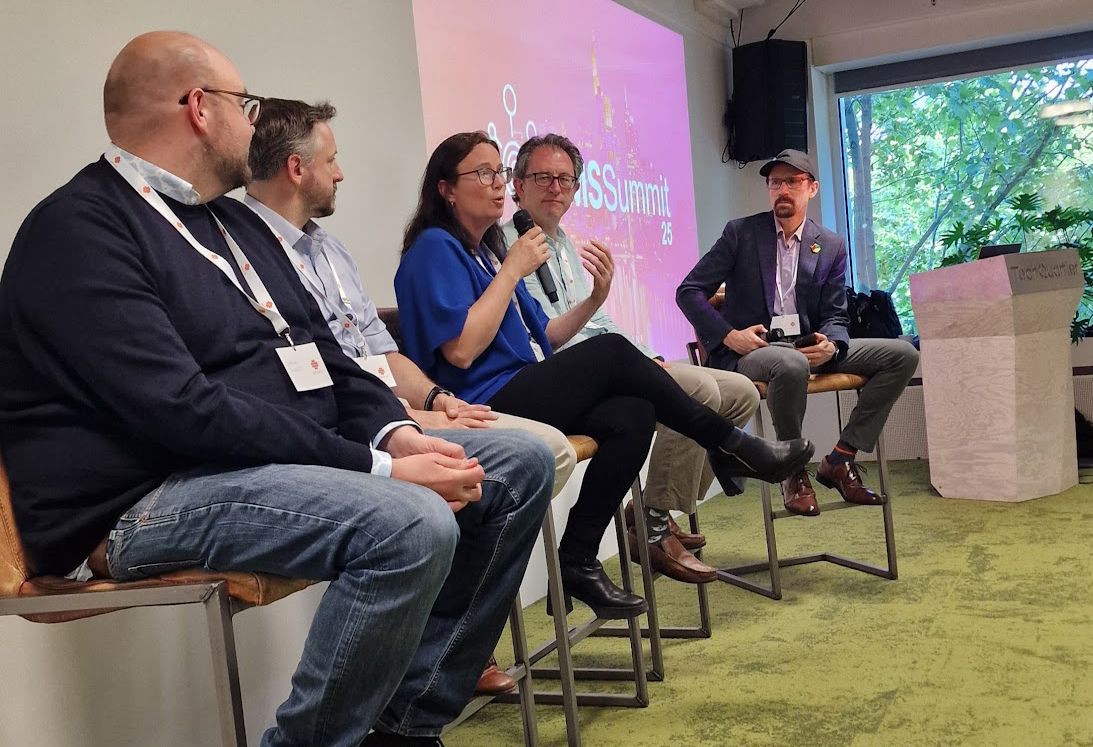
Kentico’s Debbie Tucek participating on a CMS selection panel. Source: Janus Boye archive
“All the marketers were told you've got to go headless,” she reminisced. “And so they all said, ‘OK, well, we've been told we have to do it, but we have absolutely no idea what it is or what it's for, but we'll do it.’ And then they got there, and they just weren't digitally‑mature enough, or really understanding the transformative impact that was going to have on their business.”
My, how we mirror our past behaviors. Thankfully, we have smart people trying to course correct in the explosive AI era.
So what does “wow” look like in this new chapter of the agentic story? Perhaps more like pragmatic, day-to-day impact. As a “zero to one” product practitioner, Debbie has a well-tuned awareness of the incremental components that go into building and shipping a meaningful solution – something she’s done in spades with the company’s signature platform, Xperience by Kentico.
And as evidenced by her PhD in education and 3D immersive learning environments, she’s a teacher working on the evolutionary frontier of experiences. Leading through knowledge is her forte – what one might call her “sweet spot.”
Exactly the kind of person you want in charge of delivering more “wow.”
Sidestepping the ‘SaaSpocalypse’
I recently spoke to world-famous Chief Martec Scott Brinker about the emergence of what he calls CaaS (Context as a Service). This idea surfaced just as the aforementioned “SaaSpocalypse” was melting down the NASDAQ a few weeks back. He postulated that new business models might rise from the ashes as businesses adapt to the impacts of AI on every software ecosystem.
Build or buy? That is the question – and one that’s already being answered in the architectures of CMS products. According the 2025 State of Rich Text Editors report, CMS use cases for pre-fabricated RTEs like TinyMCE are fading. The drop was precipitous: content management systems that utilize RTEs fell from 44% in 2024 to just 31% in 2025.
There is a confluence of factors here, but one obvious trend is that CMS vendors are building more of their own tooling. At the same time, content creation is being “unbundled” and distributed across a host of modular sources.
Enterprises are also weighing the benefits of building custom applications and, where possible, reducing the dependency on third-party software with expensive licensing. At the same time, the need for scalable solutions that meet an uneven topology of global compliance – everything from HIPAA to GDPR to FedRAMP – is a huge consideration. This is giving mature software vendors a critical advantage.
Debbie’s take is that the “build versus buy” debate is a familiar song, but AI has turned the volume up without changing the fundamentals. She pointed to three big blind spots for organizations seduced by the “We’ll just build it” promise.
First, there's the hidden research and design costs that go into developing products and features. Sure, you can now prototype an app with Base44 or Lovable, but just replicating existing processes is missing the forest through the trees – and often results in critical issues. Mature platforms don’t just ship features, they embed years of hard-won lessons and wisdom from customer behavior, edge cases, and even failures.
“At the end of the day, there's a huge amount of work that actually goes into building software. A lot of people don't necessarily take this into account when they first get excited by the idea of building something themselves.”
Then, of course, there’s weighing risk and compliance. Without the right structure in place for security, data handling, and maintenance, you could end up with a data leak or a hack. That’s more than just regulatory risk – it’s potential damage to your brand.
I also mentioned scalability, and Debbie reinforced this. As she said, the reality is that once the business grows or changes, the “quick build” suddenly feels less like sophistication and more like scaffolding.
“At the end of the day, there's a huge amount of work that actually goes into building software,” she said. “A lot of people don't necessarily take this into account when they first get excited by the idea of building something themselves. They have to go through the process to realize where they sit. Are they actually willing to invest in all of this? They have to dip their toes in to get a sense of what it's like, and make better judgments.”
For Kentico, providing enterprise customers and agency partners with control over these choices is part of the product strategy. Having a trusted, unified foundation addresses the risk, while having a flexible ecosystem is the customizable reward.
“We help them to get everything working consistently, effectively, and in the most optimized way, across all of their different channels,” Debbie punctuated, “so they can build the best possible experiences without having to do a lot of the heavy lifting.”
Powering an agentic strategy with AIRA
When I covered the announcement of Kentico’s new AIRA Agentic Marketing Suite in early February, there was a storm of industry activity. The news was hitting at the right time, but a noisy one.
To break through, it was harnessing a solid position with the words agentic, marketing, and suite – a combo that intuitively communicated its AI focus, audience target, and unified attributes.
While this is a new entry in its product toolbox, the Agentic Marketing Suite leverages AIRA (Artificial Intelligence Recommendations & Assistance), Kentico’s native AI agent that streamlines the creation, optimization, and time to deploy for digital experiences. Launched last year, it's the heart of Kentico’s AI strategy, providing marketers with easily accessible tools that cut down on repetitive work and simplify daily tasks.
For Kentico, the Agentic Marketing Suite isn’t just another branding exercise. It’s rooted in a clear product vision that Debbie and her team have been working toward for years.
“The whole concept was really this single pane of glass,” Debbie said, “and being able to facilitate this ability to orchestrate and optimize a multi-channel strategy that marketers are struggling with.”
Kentico is framing its new platform as marketing’s “virtual team,” enabling users to create, test, and optimize without switching tools. It helps you turn your ideas into action, simply by telling it what you want to do with natural language.
In the Agentic Marketing Suite, AI “teammates” support your strategy, content creation, and optimization tasks. With AIRA acting as the orchestrator, these agents function as dedicated virtual collaborators, designed to assist with specific tasks. You'll also be able to add more teammates as your needs evolve, and focus them on specific roles.
Every agent on your team operates with clear, role-based permissions. Admins have total control over defining what actions agents are allowed to take, which content or campaigns they can access, and when human approval is required before executing tasks.
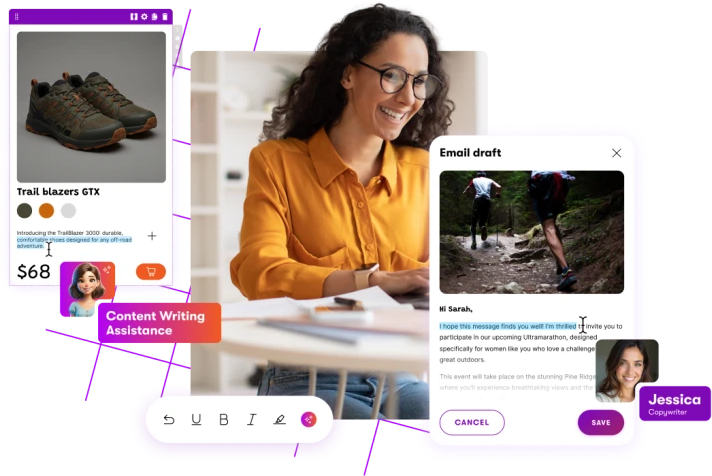
AIRA Agentic Marketing Suite. Source: Kentico website
“We’ve designed it in a specific way where you have an orchestration agent, AIRA, as the interaction point with the user,” Debbie said. “It’s going to take your original problem, look at all of the various agents that you have enabled in your system, and then say, ‘OK, based on what I've been asked to do, I'm going to need these two, three, or four different agents to be able to deliver on a particular plan.’”
The Agentic Marketing Suite’s architectural design is intentionally focused on simplicity. There’s a rich agent anatomy coalescing, and each agent has a carefully mapped set of tasks and tools with access to context. Additionally, with its dynamic orchestration, AIRA decides which agents to involve, builds a plan, and walks the user through it – introducing agents as needed.
Additionally, its semi-autonomous behavior means agents can execute tasks on their own, but still require people to validate key outputs. This is critical when it comes to specific compliance benchmarks, but it will also provide greater control as agents begin to operate across systems.
“The human really needs to be the compliance expert, whether it's organizationally or from a marketing or brand perspective,” Debbie explained. “We don't want it to be completely autonomous in a lot of these areas. We want users to be able to build artifacts, reference them, make sure everything's coherent, and provide as much of a deterministic outcome as possible by providing the right kind of context for each of those agents from the system and beyond.”
A new wave of ‘wow’ moments with pragmatic AI
As I said, the early “wow” moments for AI were largely in the domain of novelty. I should know: Throughout 2023 and 2024, I saw countless demos aiming for the same target, and often missing.
In those days, generative copy and images weren’t fully embraced by creators, and limited tasks didn’t provide significant value. The shine wore off for many practitioners until brand quality and workflows became more robust and reliable.
Like its peers, Kentico is leaning into a different kind of “wow” that’s more operational. That said, it holds the same potential to knock a marketer’s socks off by leveraging AIRA to eliminate time-sucking, multi-step tasks that are universally hated. Debbie gave me a perfect use case of managing bulk assets for a post-conference campaign.
“As a marketer, let's say you’ve completed a big event, and want to use all the assets across your ecosystem," she framed. "You need to go through and work out how many variants for all your various channels, create the different sizes, and even decide what the focal point needs to be for all of them. Maybe you’ve taken 500 photos. Managing all of that takes a massive amount of time, right?”
Instead, the marketer does a bulk upload, and AIRA generates all the required variants and sizes for configured channels, optimizes for specific audiences, applies metadata and taxonomy tags, and maintains a clear map of where assets are used across experiences. Sounds like a “wow” experience if there ever was one.
“You show this to a marketer, and they just go, ‘Oh my God,’” Debbie said excitedly. “And then you say, ‘And by the way, the system will tell you where all of these things are used, so if I replace it here, it's going to update everywhere.’”
As Debbie told me, the same philosophy applies to translations and other repetitive workflows. And the value is ultra-clear: Marketers can eliminate the cognitive weight of these mundane manual tasks, and take back hundreds of hours – allowing them to focus on strategy, creativity, and experimentation.
Opening the door to an agent ecosystem
I’ve been talking a lot to Jason Cottrell, CEO of digital agency Orium and president of the MACH Alliance, about the rise of agent ecosystems and the impending need for industry standards.
It’s death by a thousand cuts right now, because proprietary platforms are introducing their own agent solutions. We’re not even sure what standards would look like, let alone how to regulate them. In the meantime, MCP – Model Context Protocol – is providing some elemental glue to build with.
Still, agent ecosystems are nascent and prone to challenges. This was crystallized by Cleanlab’s research, suggesting that agentic systems are being refactored with a high frequency, and AI luminary Geetha Rajan also dug into why these systems run into problems.
That said, Kentico is building its agents on decades of mindful product development, evolving towards an agent ecosystem for partners and customers. Debbie is already outlining a roadmap for this vision with intentional stages.
“The first step, which we're already doing at the moment, is enabling users to customize things,” she said. “For example, if you're translating, adding in specific kinds of vocabulary for a particular market, or being able to customize agents and how they respond to make sure that they're delivering the right kinds of results.”
The next step, she explained, is allowing customers and partners to add tasks to existing agents. This would finally lead to a kind of “bring your own agent” paradigm, where partners can build custom bots, connect them into the Kentico ecosystem, and have them participate in orchestration alongside native agents.
Kentico is expanding the AI horizon, and its Agentic Marketing Suite is the first example of its investment in the essential scalability and extensibility. It’s also an expression of its confidence in the safety and quality required to deliver reliable outcomes.
Agencies as transformation partners
Digital agencies and system integrators are renegotiating their own business models in this agentic moment. As I’ve covered in multiple interviews with agency principals, code is becoming cheaper to produce. That’s creating pressure on existing time‑and‑materials revenue and legacy business models.
But agents are presenting new opportunities for agency partners to customize, package, and license custom bots – and move beyond traditional “accelerators” into truly differentiated, AI-powered services. The best part? They can monetize their creations.
I asked Debbie how Kentico’s agentic strategy is playing with its partner network, which has grown to include hundreds of digital solution partners around the globe. This includes innovative shops like BizStream, a Kentico Gold Partner with 15 years of proven success across turnkey implementations, migrations, and custom builds for nearly 200 websites on the platform.
“We've been investing a lot in our agency partners,” Debbie remarked. “We have a very strong partner model. A lot of them I would call our friends, because we've known them for so long. It's been kind of a mutually beneficial investment. We can see that their market is definitely evolving, and our job is to support that as much as possible.”
“This is really a value story for agencies. There’s been a lot of concern and panic that the time and materials model is going away for coding. Yes, it is. But all these other opportunities are now available, and here's how you can access them.”
With its agency partners, Debbie explained how Kentico’s vision of an agent ecosystem offers broad possibilities for building vertical-specific agents. This includes applications for regulated industries, niche compliance requirements, or specialized commerce flows.
To help support this transformation, Kentico is providing AI tools that speed up content modeling and implementation work. This includes deep documentation, so both developers and admins can use AIRA to access in‑product guidance and best practices. There’s also an expanded community program to share patterns, learn from other practitioners, and showcase what’s possible.
“We have [our partners] using AIRA, and they've found it super beneficial,” Debbie explained. “For the ones that are doing all of the pre‑launch work, they’re reporting that they're really leveraging AIRA to help them in this process.”
To unlock the full potential of what’s ahead, Debbie is reframing the metric for partners, shifting the focus from “hours sold” to “value delivered.” In this new equation, AI doesn’t eliminate agency value – it amplifies it when partners evolve what and how they sell.
“This is really a value story for agencies,” she said. “There’s been a lot of concern and panic that the time and materials model is going away for coding. Yes, it is. But all these other opportunities are now available, and here's how you can access them.”
Digital sovereignty in a shifting world
Another thread that keeps surfacing in my conversations is digital sovereignty – especially around AI and data gravity. From consumers to enterprises to nations, stakeholders are requiring fierce geographic control and proximity to their data and AI processes, while ensuring that customers and citizens can manage their own data.
This has already manifested in policies like GDPR and the EU AI Act, but is rapidly expanding as countries develop their own sovereign LLMs like CanXP’s Maple PT – a Small Language Model (SLM) trained entirely in Canada, demonstrating how AI innovation can be achieved sustainably and affordably for citizens while reflecting its national values.
Headquartered in Brno – a tech hub in the Czech Republic – Kentico has had to wrestle with EU compliance across its entire lifecycle, navigating its cross-regional and global footprint. Giving customers the necessary amount of control while ensuring secure and performant delivery has always been a guiding principle, and that’s become more urgent as AI demands more access to data.
“Because of the diverse nature of our market and our customer base, we’ve always maintained different deployment models to help customers make good decisions about their specific regulatory compliance, organizational context, and more,” Debbie said. “As different regional and sovereign capabilities grow, we can incrementally bring on these offerings as they pertain to different environments."
Kentico’s flexible architecture already provides a lot of leg room for global use cases. Its hybrid headless composable approach provides a unified solution that can scale in multiple directions, but it’s purpose-built to achieve sovereign deployment requirements. An important distinction Debbie noted was around quality: They’re firm on not deploying in any region if there are challenges with maintaining the ongoing security, privacy, and quality of the output they deliver.
“Customers can leverage our SaaS services, and we’ve specifically designed it to have a single tenant architecture, to be able to at least minimally provide data sovereignty around where those resources are hosted and where that data resides,” Debbie detailed, “and all of the AIRA conversations, all of the artifacts it creates are all completely adhering to those specific kinds of segregations that were put in place.”
Finding the ‘sweet spot’ in an orchestrated future
I hate the term “SaaSpocalypse.” It’s fear-mongering and doom-and-gloom peddling. And frankly, it's hard to type.
But SaaS indeed faces a reckoning. Software revenue models are changing (we’re already seeing it in the CDP space), and tools that lack real business value might wither away from the Martech Supergraphic. But the durable platforms – the ones that provide the security, scalability, and governance that organizations need – will continue to thrive.
Kentico has certainly positioned itself in that latter category, powering enterprise workloads and maintaining compliant postures in a complex global morass of regulations. With decades of wisdom in its collective cache, it offers proven layers of CMS-centric innovation that can’t be replicated with a bit of vibe coding and markdown – even if that’s what Cursor is doing.
When it all shakes out, what matters is whether a tool can deliver more value than hype for its users. To that end, Kentico is driving tangible impact for marketers, targeting the “AI sweet spot” with its Agentic Marketing Suite. To hedge their success, they've cultivated relationships and built a stronger global partner footprint. For Debbie, it's lighting a fire.
“We've been talking about this vision for our product for several years now, and this is a tipping point where we get to explore a whole new vision, right?” she said. “What is the future going to be for us, beyond now? And for me, that's just super exciting. Marketers are feeling like, ‘Wow. What's next? What can we be creative with now?’ And I think that's a beautiful, bright, and very exciting future.”
At last year’s CMS Summit in Frankfurt, I wrote two words on the wipeboard during our closing session: Observability and Orchestration. On the former, we desperately need to see our agents in production, especially in a world where they are destined to move beyond the safe perimeters of our platforms.
For Debbie, orchestration is a lynchpin in the lexicon. Looking forward, she sees it as an ignition switch for the next wave of capabilities. Kentico is already seeding the grains in its Agentic Marketing Suite, giving brands greater agility so they can move beyond the moats of monoliths and harness AI as a force multiplier of marketing potential.
“I'm really excited to see whether our industry achieves that next level of orchestration that everyone has been talking about forever,” she said. “And I think we are so close to this in a way that is exciting for me, to see the level of flexibility in the systems and being able to provide people with ease, comfort, and simplification. There's just so much that we can do now that we could only ever dream of. And for me, it’s incredible to actually see these things being realized.”
In other words, she’s ready for the next “wow.”
Read more
- Websites Still Rock: Kentico’s 2025 ‘Site of the Year’ Winners Push the Boundaries of Digital Experience
- Introducing the Agentic Marketing Suite: Kentico Extends its AI Strategy to Power Marketing Teams
- Agentic AI for Agencies in 2026
Upcoming Events

JoomlaDay USA 2026
April 29 - May 2, 2026 – Delray Beach, Florida
Be part of the Joomla community in one of the most iconic cities in the world! JoomlaDay USA 2026 is coming to Delray Beach, and you can join us for a dynamic event packed with insights, workshops, and networking opportunities. Learn from top Joomla experts and developers offering valuable insights and real-world solutions. Participate in interactive workshops and sessions and enhance your skills in Joomla management, development, design, and more. And connect with fellow Joomla enthusiasts, developers, and professionals from across the world. Book your seats today.
CMS Summit 26
May 12-13, 2026 – Frankfurt, Germany
The best conferences create space for honest, experience-based conversations. Not sales pitches. Not hype. Just thoughtful exchanges between people who spend their days designing, building, running, and evolving digital experiences. CMS Summit brings together people who share real stories from their work and platforms and who are interested in learning from each other on how to make things better. Over two days in Frankfurt, you can expect practitioner-led talks grounded in experience, conversations about trade-offs, constraints, and decisions, and time to compare notes with peers facing similar challenges. Space is limited for this exclusive event, so book your seats today.

Umbraco Codegarden 2026
June 10–11, 2026 – Copenhagen, DK
Join us in Copenhagen (or online) for the biggest Umbraco conference in the world – two full days of learning, genuine conversations, and the kind of inspiration that brings business leaders, developers, and digital creators together. Codegarden 2026 is packed with both business and tech content, from deep-dive workshops and advanced sessions to real-world case studies and strategy talks. You’ll leave with ideas, strategies, and knowledge you can put into practice immediately. Book your tickets today.
Open Source CMS 26
October 20–21, 2026 – Utrecht, Netherlands
Join us for the first annual edition of our prestigious international conference dedicated to making open source CMS better. This event is already being called the “missing gathering place” for the open source CMS community – an international conference with confirmed participants from Europe and North America. Be part of a friendly mix of digital leaders from notable open source CMS projects, agencies, even a few industry analysts who get together to learn, network, and talk about what really matters when it comes to creating better open source CMS projects right now and for the foreseeable future. Book your tickets today.